
Month: February 2010

11 Myths and Facts about Feminism

T. De Rozario and H. Zheng

There are many people who in one breath will say that they believe in gender equality but do not consider themselves feminists. Why the paradox? The definition seems very straightforward.

feminism – n. Belief in the social, political, and economic equality of the sexes.

The truth is that the word comes with a lot of baggage and misconceptions. These fears are so deeply held that many supporters of equality do not want to be associated with the word or the movement. Worse still, for those who do not believe in equality, the myths help instill hatred and fear for the women and men who openly promote the ideals of feminism.

To attack a person based on a misrepresentation of their position is a tactic known commonly as a “straw man argument.” This means creating an easy to destroy caricature of a person by which to discredit them. This tactic is so effective that many women will deny their own support for equality for fear of being associated with the negative stereotypes.

To dispel the myths, we first have to identify them. Let’s take a look…

Myth: Feminism is about fighting men, hating men, and eliminating men.
Fact: Feminism is about challenging systemic inequalities and does not portray men as the enemy.

Myth: “Feminist” is the female equivalent of “chauvinist”.
Fact: Feminism does not support sexism against either gender. Feminism works towards equality, not female superiority.

Myth: Feminism is “un-Asian”.
Fact: Feminism works towards a society based on justice and equality… the very same ideology put forth in Singapore’s national pledge.

Myth: Feminists are opposed to marriage and motherhood.
Fact: Feminists actively fight for the rights of mothers and many feminists are married and are mothers. Feminists recognize that happy families are important and believe that families are strengthened when the wellbeing of all members, male and female, are supported.

Myth: Only women can be feminists.
Fact: Any person who believes in gender equality is a feminist. Many men are feminists and proud to be so.

Myth: To be a real feminist, a woman cannot be feminine or demure.
Fact: Feminism is found in the substance of a person’s opinions and not her form. A woman’s love of nice dresses or high-heeled shoes does not make her less of a feminist.

Myth: If I am a sexually liberal woman, I am a feminist.
Fact: Feminists respect individual, informed choices and believe there should be no double standard in judging a person’s behaviour. Every woman has the right to sexual autonomy including the ability to make decisions about when, how and with whom to conduct her sexual life. However, sexual autonomy alone does not make one a feminist. Neither does the exploitation of one’s own body for favours or advantage.

Myth: Feminists believe that women’s actions are above criticism and can always be excused because of the discrimination they have suffered. Therefore they never have to take responsibility for their behaviour.
Fact: Feminists understand that equal rights translate into equal responsibility. Anyone who seeks rights must be held to the responsibilities that come with these rights. Previous discrimination may explain negative behaviour but does not excuse it.

Myth: Feminism purports that all women are disadvantaged in our society and that all men are privileged by their gender.
Fact: Feminists understand that narrow gender ideals restrict both men and women and thus society as a whole. Feminism seeks to reduce and eliminate these constraining ideals.

Myth: The fact that there are some women who have a higher social and economic status than some men means inequality has been eliminated.
Fact: Systematic inequalities continue to exist at every level of society. There may be female heads of Fortune 500 companies but the fact that they constitute less than 5% of the total means that barriers remain.

Myth: There is no more need for feminism: women have the vote, they have jobs. The goals have been met.
Fact: These achievements are great milestones in the history of feminism, however our aim is nothing less than equal treatment and opportunity for both genders. There are still many inequalities in society’s perception of the roles of men and women. We want to build a world in which no person, because of their gender, must curtail their hopes and dreams.

This is just a starter list. You will no doubt find many more. Do feel free to post others in the comments.

Before signing off, let us add a word of warning!

Any Googler worth his or her salt will be able to find quotes from radical feminists to support some of the above fallacies. While there are certainly individuals who have made strong anti-male comments in the past, these views are not representative of mainstream feminism. As always, a group should not be judged by its most radical elements nor by comments taken out of context.

This list was compiled in preparation for AWARE’s Introduction to Feminism series.

Still not convinced? Find out more: sign up to join one of the discussions.

Let’s do good. Together.

By Priyanka Awasthi

Josephine Ng and her husband KC used to run an integrated marketing agency. Then, in 2001, it was acquired by the top marketing services agency in the world. The still-young couple found themselves with the time and resources to relax and see the world.

But before too long, Josephine began to feel the urge to do something useful.

Josephine Ng: Single mothers need help

“I thought of volunteering and spoke to some VWOs (voluntary welfare organizations), but the fit was not quite right,” said Josephine. “Then KC pointed out that with our experience, we ought to look into doing something useful in business.”

So the couple began to explore ideas that would let them match their marketing expertise and business knowhow to a worthwhile cause. It was at the launch of the NUS Centre of Social Entrepreneurship and Philanthropy in August 2009 that they found the right cause – single mothers.

At the event they met a friend who told them that one of the least helped groups in Singapore was single mothers. Josephine and KC did their research and concluded that a viable social enterprise for this group would be a garment alteration business.

“Single mothers need help. They have young children and are unable to work long hours, thus have lower financial status,” says Josephine.

“As single mothers have limited resources, they need skills that can be mastered in a reasonably short time. They also need a part-time schedule so they can take care of their family, a convenient work location and work that they can do at home. And altering clothes allows all of these. ”

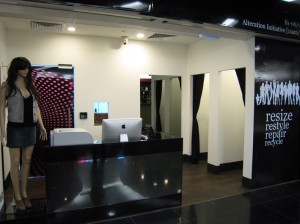
So Josephine and KC set up Alteration Initiative, which they describe as a modern alteration business. The first outlet opened in January at Dhoby Xchange on 22 January and so far there has been a steady stream of walk-in customers.

The first Alteration Initiative store at Dhoby Xchange

Josephine explains the business plan: “Using our experience in starting and growing a business, and our appreciation of marketing, we aim to modernise and corporatize the business of apparel alteration, which has a dated and unprofessional image. Our goal is to build a sustainable business that will provide work and income for these single mothers.”

Alteration Initiative is working with partners such as the CDAC (Chinese Development Assistance Council), HELP Family Support Service and PPIS As-Salaam to identify single mothers interested in being trained as associate alteration specialists.

“They are like apprentices for three months with us – not bound by any contract and they can leave us after acquiring a lifelong skill if they choose to,” she said.

There are six sewing machines at the outlet, and experienced seamstresses are on duty both to handle customers’ needs as well as train the trainees.

These trainees are paid even as they are learning how to sew. They get $4 an hour on weekdays and $6 an hour at the weekends. After the three month training period, if they have reached a certain level of competence, they will earn double this.

The alteration work will be done at the outlet until the trainees are competent enough to work on their own. They can then do the work at home, and if they need to invest in sewing machines, Alteration Initiative’s partners may be able to offer interest-free loans.

Enthusiastic as she is about her social initiative, Josephine, who is an AWARE member, is well aware of the many challenges ahead, such as finding enough single mothers who have the aptitude for alteration work. But she and her husband were prepared for this when they embarked on their venture; indeed they relish the challenge of proving that you can build a viable business around a good cause.

Appropriately, their company is called A-Changin and their corporate tagline is Let’s Do Good. Together.


  • Alteration Initiative is at Dhoby Xchange, 11 Orchard Road, B1-06/07/08 Dhoby Ghaut MRT Station Exit B, opposite Park Mall. Operating hours are 11am to 9pm, Mondays to Sundays including public holidays.
  • If you know someone suitable for Alteration Initiative, please email Josephine at jo.ng @ a-changin.com

Bamboo Women, Grass Girls: Tales of resilience

By Tan Joo Hymn

Story-telling, most of us are likely to think, is for little children.

Wrong.

Some of the most successful corporations in the world use stories to inform and motivate their staff. A corporate handbook is boring and didactic, and few employees bother even to read it. But if the values and culture of the company are captured in an inspirational story, the message is not just immediately absorbed by those listening– it can spread through the company like wild fire, passing from co-worker to co-worker with no effort on the part of the management.

This is the power of story-telling.

The oral storytelling tradition is almost as old as homo sapiens themselves. Stories were told around the fire for entertainment, and also to pass on knowledge and wisdom.  Storytelling is hardwired into the human psyche. Children crave stories and learn much from them.

As adults we forget the value of stories. But the truth is that we listen to and tell stories many times a day, in so casual a manner that we hardly realise that is what we are doing. Recounting to a colleague the terrible delay due to an accident on the PIE, telling your spouse about the meeting when your boss finally admitted his mistake…these are stories.

Stories can also be an effective springboard from which discussions on issues can be launched. Stories are disarming, they leave the interpretation to the listeners, and a richer, more textured dialogue can be built upon stories.

Bamboo Women, Grass Girls: Tales of resilience

Join us as we share with you feisty folktales from around the world and reveal to you the power of storytelling to promote positive images of strong women! Contrary to the popular belief that damsels in distress are the only female protagonists in folktales, powerful heroines also exist in traditional stories that can serve as viable role models for one and all.

AWARE will be launching the Workplace Sexual Harassment Workshop very soon. The stories we have picked relate to this theme.  The one-hour storytelling session will be followed by an open dialogue on any topic that the stories throw up.

So come and experience for yourselves the wonder and power of stories!

Date: Friday 5 March

Time: 8 pm

Venue: AWARE Centre,  Block 5 Dover Crescent #01-22, Singapore 130005

Story-tellers: Tan Joo Hymn and Verena Tay

Please email priyanka@aware.org.sg or call 67797137 to register.


Gender Core Curriculum-Debunking the Myths 1 March

This is the second in the series of three sessions of a new programme of AWARE for our members called  Gender Core Curriculm.

Debunking the Myths

This session offers enlightenment on the myths around feminism. How did these myths or fairy tales come about and get transferred from one generation to the other?  One example, why is it that passive women get the handsome and debonair Prince while the active women are mostly wicked step mothers and witches?

Date: 1 March 2010

Time: 7-930pm

Venue: Aware Centre, Blk 5 Dover Crescent, #01-22 Singapore 130005

If you would like to take part in the test run of the programme or have any questions,please send email to publiceducation@aware.org.sg or call 6779-7137.

Gender Core Curriculum- What does a feminist look like? 8 March

This is the third  in the series of three sessions of a new programme of AWARE for our members called Gender Core Curriculm.

What does a feminist look like?

This is a hands-on workshop that will explore the four tenets of feminism: Woman and Body, Women at Home, Women in the Public Sphere, and Women and Culture.

This workshop will aim to unravel participants’ relationship with the term “feminist” using images, questions and participants’ personal experiences as departure points.  And it will seek to answer three questions:

  • What does it mean to be a feminist today in Singapore?
  • What are feminist values for you?
  • What contributions to the feminist cause can be made today in globalised, economy-driven Singapore?

Date: 8 March 2010

Time: 7-930pm

Venue: Aware Centre, Blk 5 Dover Crescent, #01-22 Singapore 130005

If you would like to take part in the test run of the programme or have any questions, please send email to priyanka@aware.org.sg or call 6779-7137.

Gender Core Curriculum – History of Feminism 23 Feb

This is the first in the series called Gender Core Curriculum.

History of Feminism

Industrialisation brought economic prosperity but it also gave rise to a growing awareness of the inequalities in society based on gender.  Women began to ask “Why are we not allowed to vote?’ and the suffragette movement was born. This part of the programme runs through the key points to date  the fight for women’s rights.

Date: 23 Feb 2010

Time: 7-930pm

Venue: Aware Centre, Blk 5 Dover Crescent, #01-22 Singapore 130005

If you would like to take part in the test run of the programme or have any questions,please send email to publiceducation@aware.org.sg or call 6779-7137.