
Month: May 2010

Improve gender equality and you will raise fertility

The best way to get Singaporeans to produce more babies is to improve gender equality, AWARE says in a letter published on The Straits Times Forum page on 20 May 2010.

We wholeheartedly agree with the view of Professor Hans Rosling (ST, 12 May 2010) that Singapore has not seen a reversal in the decline of fertility rates because “fathers here are not rising to the task of child-rearing, and state support for equal parenting roles is not adequate.”

In our 2004 report “Beyond Babies: National Duty or Personal Choice”, we stated that there is a direct correlation between total fertility rates and gender equity.

Many people think that Singaporean women have achieved gender equality. However, compared to countries such as Australia, Sweden, United Kingdom and the United States where the total fertility rate is now increasing, we have a long way to go.

In the last 30 years, women have entered the workplace in droves. More girls graduate from our universities than boys. However, these changes are asymmetrical. Men have not moved into the domestic sphere at the same rate.

This asymmetry makes child-rearing much less attractive for women. The woman who derives satisfaction from her work will not be keen to have any or many kids if she has to bear the bulk of the childcare burden. In the meantime, her husband does not lose sleep about balancing work and family life.

Whose problem is this and what can be done? The State, the market and the individual all play important roles in the determination of fertility decisions. Here are some considerations:

What is the message and effect when the State mandates four months paid maternity leave but not a day of paternity leave? Are we sending the message that fertility is solely a woman’s responsibility?

Adequate support structures for families and availability of flexi-work arrangements are key factors in countries which have seen positive fertility trends. In Singapore, however, part time work amounts to a miniscule 10% of employment. Why is this?

Are family friendly arrangements in workplaces equally available to male employees or do employers treat a male employee’s request to take time off to care for his sick kid less favourably?

How can we support more active fathering? The “Dads for Life” national campaign is a commendable initiative of the National Family Council and a step in the right direction.

Traditional gender roles not only deprive men of the opportunity to play an active role in their children’s lives but create an imbalanced environment where women are discouraged from having more kids.

Can you be a friend to victims of domestic violence?

AWARE’s Befriender programme provides moral support and other help to victims of domestic violence. PATRICIA DRISCOLL, a Befriender, shared her experience and explains why the service is so important.

This article was written in 2010. AWARE has ceased the befriending service for domestic violence in 2018 as more organisations provided this service. We continue to support survivors of domestic violence through our Helpline, Counselling, and Legal Clinic services.

The experience of going to the family court to obtain a Personal Protection Order (PPO) can be daunting and lonely.  Having someone there with you to provide support can make all the difference.

AWARE’s Befriender programme aims to provide this support for women who have been victims of domestic violence and who do not have someone to accompany them to the court.  Support will also be available for women to attend the police station, hospital and other appointments that are difficult to face alone.

I am an expat living in Singapore and an AWARE volunteer.  I have accompanied women to the Family Court as a Befriender for hearings about PPOs and maintenance.  These visits have convinced me of the immense value of AWARE providing such a service.

What struck me most about the women I accompanied was how strong and brave they were.  They were victims of domestic violence, had to leave their homes because of this, and were still working hard to ensure the survival of their children and themselves.  The strongest of women, however, can be disarmed by something as confusing and intimidating as a court hearing when you do not have a lawyer and your husband is sitting across the waiting room from you.

The logistics of the court hearing – registration, purpose of the hearing, what will happen during the hearing – are not necessarily made clear to the applicant.  This is confusing for anyone, and when you’re emotionally and physically exhausted, it can push you near to giving up.

Having a Befriender there to help you with the basics and to assist you in finding out exactly what is going on and where you are supposed to be can take a lot of the unnecessary confusion out of the process.

The Befriender can also accompany the applicant into the courtroom and listen to the hearing.  This can be crucial if the applicant is unclear about the outcome of the hearing; it’s easy to be distracted by the stress of having to speak in front of a judge and a crowded court.

The abusive partner or ex-partner will almost always be in attendance.  They can also attend with as many family members or friends as they wish.  The presence of the Befriender can take some of the strain out of this unnerving situation.  The Befriender can also play a vital role in the applicant’s safety, particularly by making sure that she has a secure way to leave the court.

There is  a great deal of waiting time with court hearings and a Befriender can be someone to simply chat to and pass the time with.

AWARE is running a training programme for Befrienders starting this July.  The training will last six weeks and involve one or two sessions per week, usually in the evenings.  Topics covered will include the role of the Befriender, domestic violence and the relevant law and procedure.

These sessions will ensure the volunteer is equipped with the skills and knowledge required to provide a useful service.  Site visits will also be made to the Family Court and police station as part of the training.

You do not have to be a lawyer to volunteer for the programme.  You do, however, have to be at least 24 years old, have the flexibility to be available for daytime volunteering, and have a desire to provide valuable support to women going through a difficult, often harrowing, process.

From the Executive Director’s desk

This has been one of the most active 3-month periods of my life, says CORINNA LIM as she reports on her first 100 days as AWARE’s Executive Director.


In about 10 days’ time, I will complete my first 100 days at AWARE. When AWARE folk see me, they usually ask me one of three questions.


Question 1: So, what’s been happening at AWARE?

Those who have been paying attention to the newsletter will have noticed three major themes:

Superwomen in Concert – our most ambitious fund raiser to date with a stellar cast to be held at the Esplanade on Tuesday, 8th June. If you have not yet booked seats, there is still time to do so. But the tickets are moving fast, so hurry. Let’s make it a SELL OUT concert! I know we can do it!

Workplace Sexual Harassment Training Programme – we had a very successful launch of this programme for HR managers in late April. We are getting lots of calls and queries on this. We’ve added a NEW sexual harassment microsite for comprehensive information on sexual harassment and to share your stories on this. Check it out.

If you know of companies who are interested in this or who you think need to be trained on this, please let us know. We are happy to approach them.

And if you know of anyone who is a victim of sexual harassment, please ask them to call our Helpline at 1800 777 5555.


Professionalisation of AWARE
we are in the process of changing our accounting system and revamping our volunteer management system. (Look out for the new online Volunteer Centre which will be launched soon). We are also archiving old records and upgrading our computers.

We have had two staff departures. I would like to thank Priyanka Awasthi and Lin Phua for their work and dedication to AWARE and the cause of gender equality, and wish them the very best for the future.

We are looking for a part-time book-keeper. Please pass the word round.

The team now comprises 5 staff, 4 full time volunteers, 2 interns and 2 free lancers. We have become more cost-effective.


Question 2: How are you coping?

Seriously, it has been one of the most active 3 months of my life.  I have been constantly reminded by my AWARE family to get enough food and rest, to keep focused on the big picture and not get lost in the “lalang”.  This is all good advice which I have tried hard to follow.

I am doing fine, thanks to the wonderful people that I work with and members who care.


Question 3: When is your AGM?

The Board will soon decide on the date. Keep your eye out for the announcement. In the meantime, can I remind everyone to RENEW THEIR MEMBERSHIP so that they can attend the AGM. Call us – 6779 7137 – if you need help with your membership renewal.

State’s decisions a threat to secular society

Two recent moves by the Singapore government appear to favour one system of values over others in our pluralistic nation. This, says CONSTANCE SINGAM, could subvert the very nature of our secular society.

Indian economist Amartya Sen in his book Identity and Violence: The Illusion of Destiny argues that we are becoming increasingly divided along lines of religion and culture, ignoring the many other ways in which people see themselves, from class and professions to morals and politics.

“Our shared humanity”, he writes, “gets savagely challenged when the manifold divisions in the world are unified into one allegedly dominant system of classification – in terms of religion, or community, or culture, or nation, or civilization.”

Our humanity here in Singapore is in danger of being ‘savagely challenged’ by two recent developments.

First of these was MOE’s choice of vendors to teach sex education in schools. Four of the six approved are known to be part of conservative Christian groups.

Then there was the National Art Commission’s decision to cut the funding of theatre group Wild Rice because, the Commission said, it would not fund “projects which are incompatible with the core values promoted by the government…”.

It seems to me that the State, which had declared its determination to protect the secular nature of our society, is privileging one system of values over other value systems and in so doing is in danger of subverting the very nature of a secular society.

What do we mean when we talk of a secular society?

The British philosopher Stephen Law, editor of the Royal Institute of Philosophy journal Think, defines a secular society as, roughly, one that is neutral between different views about religion.

He writes: “It protects freedoms: the freedom to believe or not believe, worship or not worship. It is founded on basic principles framed independently of any particular religious, or indeed, atheist, point of view: principles to which we ought to be able to sign up whether we are religious or not.

“Because you live in a secular society, your right … is protected from those atheists, and those of differing religious views, that might want to take that freedom from you.”

It follows then that one of the responsibilities of a secular state is to maintain the neutrality of all public space. These spaces include institutions of a public nature, such as schools, government offices and government-linked companies.

The choice of conservative Christian groups to teach sex education in schools is a curious choice for the government of a secular society.  It is like letting a fox loose in the chicken coop!

The anxieties and fears about social breakdown, marital instability, and teenage pregnancies are real. They should be acknowledged and addressed.

But repression of alternative views and values does not work and has not worked to counter these social problems. Compromising the values of a secular society with political enforcement of conservative values, especially religious conservative values, has to be challenged.

Art tells stories, and women’s stories need telling

Women artists have been ignored for far too long, says TANIA DE ROZARIO. The void must be closed because art starts conversations and we need to have more conversations about the issues that matter to women.

One night some time ago, while discussing what is generally seen as ‘gender-appropriate’ behaviour for women, my colleague Zarina and I decided we wanted to curate an all-female project dealing with the issue of femininity as a social construct. What resulted was Etiquette, a 10-day exhibition comprising 17 artists, 1 filmmaker and 2 curators; all women.
As both an artist and a feminist, I have learned to ignore the eye-rolling that ensues whenever I address the need to showcase more women in the industry. People don’t seem to equate the exclusion of women from the creative canon passed down through generations of aspiring Van Goghs and Da Vincis as the virtual erasure of a significant portion of history, nor do they see a need to close this void.

In a world where women face obstacles far more serious than   not having a platform to showcase a painting, surely feminists have  more important things to worry about than art, some might say.  I disagree.

Why do I consider it important that female practitioners get as much of a shot at success as their male counterparts?

Because when musician Tori Amos released Me and a Gun, countless rape survivors found strength in that song, and sites like this were set up. Because when writer Nicole Blackman performed Holy, women surviving eating disorders wrote her e-mails pouring their hearts out. Because despite having her film set burned to the ground by two thousand protestors, and despite   death threats and burned effigies , Deepa Mehta  carried on creating Water, a film that addressed the plight of widows in India.

It is important that women thrive equally in relation to men in all creative spheres   because art exists to tell stories about the world we inhabit, and because women’s stories need to be told.

What struck me over the course of putting Etiquette together  were the   topics artists of different ages and backgrounds kept bringing up – childhood, language, media, sexuality, appearance. Starting conversations about these issues is fundamental to feminism. And art, in all its forms, has the power to start conversations.

It is a common misconception that equality has been achieved simply because women are now freer to work in areas from which they were previously disallowed. Look behind these cosmetic equalities –at policies, payrolls and politics- and one is sure to be appalled.  When Linda Nochlin published the groundbreaking Why Have There Been No Great Women Artists? in 1971, female artists had already started asserting themselves within an industry that, for the longest time, had been male-dominated. Since then, so much, and yet almost nothing, has changed. See for yourself.

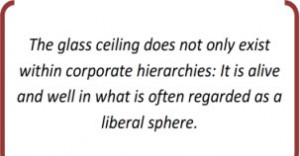
Our local scene is no different. I shudder when I look at the percentage of women who have represented Singapore at the Venice Biennale; at the state of institutions still run like boys clubs; at the number of women represented by commercial galleries; at my own experiences as a practitioner.  The glass ceiling does not only exist within corporate hierarchies: It is alive and well in what is often regarded as a liberal sphere.

NOTE: Following the exhibition, a number of artists decided to donate a percentage of their sales proceeds to AWARE. Zarina and I hope to extend Etiquette into an ongoing project that includes an online gallery and, starting from mid-May, a rotation of works from the show at the AWARE Centre, with 50% of sales going to the organization.  In the meantime, sign up for AWARE’s inaugural Film Night when we’ll be screening An Education, a critically-acclaimed film by a female director. Let’s have a conversation about it after that.

Sexual harassment: Is the tide turning?

By Nhu Pham

If you are looking for more info on sexual harassment, see here

They came, they listened carefully, and they left with a new understanding of why it is important for organisations to have a clear policy on workplace sexual harassment.

AWARE launched its Workplace Sexual Harassment programme in late April to a full house of more than 60 participants – mostly human resource (HR) managers and executives – from 46 different organisations.

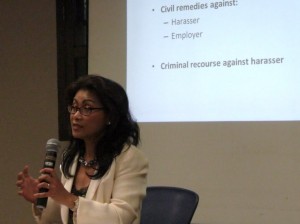
Lawyer Halijah Mohamad explains the legal implications of sexual harassment at the workplace

The launch included a preview of the workshops AWARE is running in June for HR professionals and others about how to deal with and reduce the risk of sexual harassment at the workplace.

Pei Rong Sim, a senior HR executive at the Singapore Management University, summed up the view of many participants when he said: “It’s a good introduction.  It gave us knowledge of how to move forward and create a sexual harassment policy. We do not have one and after this session I realise it is important to have a policy in place.”

More than half of those who attended the event said they believe that sexual harassment occurs at their workplace, and that they would be keen to have formal training for their management and staff in workplace sexual harassment issues.

Corinna Lim, AWARE’s Executive Director, said: “I am extremely encouraged by the turnout at the launch and the response to the session. I am glad that HR managers are taking a keen interest in this topic.

“I do think that our workshops are timely and the market is ready for this. Many of the attendees and their colleagues have signed up for the full workshop and we look forward to working with more HR people and organisations to tackle the problem of sexual harassment at the workplace.”

AWARE will run two workshops in June, one on June 17 aimed at HR professionals and other managers (FULLY BOOKED) and the other on 22 June for employees. For more information, call 6779-7137 or visit the special section on sexual harassment on AWARE’s website.