
Month: July 2010

My Short Skirt Invites You to Violate Me

When PAMELA NG asked her friends whether a woman’s dressing invited sexual violence from men, she was surprised – and disturbed – to find some of the women saying ‘Men cannot help it, it’s in their nature.‘


It was a languid train ride from Melbourne to Sydney. The deep-blue Australian sky promised a beautiful summer holiday. My friend Sarah and I had just made friends with a trio of Australian men and we were all engaged in a jolly conversation.

Then, all three of them had a sharp inhalation of breath. Sarah and I looked towards the source. A girl was walking past in the aisle. Hip-hugging mini-skirt perched atop bronzed legs that went on forever, a sporty tank top and a fresh face that stopped traffic. Looking down at us for two seconds, she breezed away with the nonchalance of someone accustomed to their beauty.

Somehow feeling snubbed, the three men suddenly released a riot of comments. “Who does she think she is, dressed like that?” And so on.

Then this gem from a seemingly-decent man called James: “Just wait, a girl like that will get what she deserves.” I asked what he meant. “I mean, dressed like that, she is just asking to get raped!” The other two men nodded in agreement, lips pursed in knowing.

Sarah and I looked at each other with shock. Through our conversation, we knew that this was a group of university graduates, who were well-traveled and held professional executive to managerial roles. How then, could they utter such obscenely ignorant comments?

A heated argument ensued and, needless to say, we did not keep in touch.

But it made me wonder – “Does a woman’s dressing invite sexual violence from men?”

I put this question to an assortment of male and female friends from Singapore, Malaysia, Vietnam, Thailand, Australia, United Kingdom, United States, Norway, and Germany. I got surprisingly mixed responses.

Men in general held the view that women who dressed provocatively, showed a hint of cleavage, or drank too much, or went out late at night were inviting trouble.

Women had a mixed reaction, with Asian women mostly supporting a patriarchal view point that the woman should assume a certain degree, if not all, of the responsibility. A few of them said, “Men cannot help it, it’s in their nature. Women must dress or behave appropriately.”

What a disturbing revelation.

Dear reader, what is your view?

My view is encapsulated in the link below.

I love this ad. I think something like this should be screened on televisions world-wide. Until people get it.

Women do not ask to get raped. Ever.
A Crime Against Faith

Recent announcements by the Catholic Church have provoked outrage from many critics. Has the Holy See opened the doors for a frank discussion about the church’s treatment of women? We look at the Vatican’s reaction to the proposed ordination of women priests.

The Crime

On July 15th, the Vatican declared “attempted ordination” of women to be a “crime against the faith” – one of the Catholic Church’s gravest crimes. Per new disciplinary rules,  attempted ordination of women is placed on par with pedophilia and sexual abuse of children by priests.

Under the released document, those who attempt to ordain women and women who seek ordination will automatically be excommunicated. The development comes shortly after the Church of England moved towards the ordination of female bishops. It also follows much public conjecture that the Church’s pedophile scandal could have been lessened or avoided with increased female participation in the clergy.

There is certainly a crime against faith being perpetrated here.

To suggest that a woman who wants to devote her life to the service of God as clergy is somehow as abominable as the sexual abuse of a child by a priest is abhorrent.

Equal but Different

The statements caused immediate uproar and the church was once again facing a PR disaster. A few days after the original pronouncement, a press conference was held at the Vatican to clarify the church’s position and to address the media frenzy they had kicked off.

Church representatives explained that although ordaining women is as “grave” as sex abuse, it was not equating the two. “This should not be interpreted as considering all these crimes to be equal,” said Monsignor Charles Scicluna of the Vatican’s doctrinal department. “They are crimes of a different nature“. – Reuters

The clarification did little to stem criticism of the Church’s treatment of women and their general approach to sexuality. Debate continues in the press and on the internet with groups such as The Women’s Ordination Conference seeing increased interest in their work.

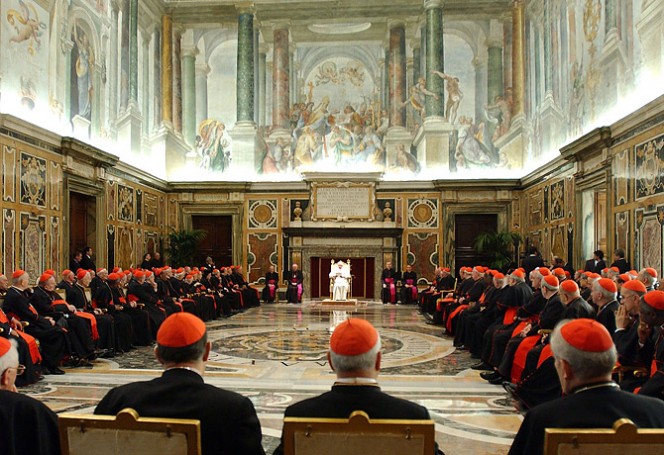
A gathering of bishops

In Context

Though huge strides have been made over the past 100 years to improve the status of women, the fact is that many religions have virtually stood still on this count. Yet few people are willing to stand up and point out the misogyny perpetrated in the name of faith.

The criticism of all things religious is usually considered a transgression of cultural respect and is taboo. But at some point one has to ask if religious leaders are really acting in line with the beliefs and best interests of their followers and their community or if their actions serve only to benefit a powerful few.

Those who profess superior knowledge and insight into the will of God tend to get a lot of leeway in our society. But the Catholic hierarchy is finding it hard to hold the high moral ground these days. Increasingly, people are questioning the religious basis for continued exclusion of women from full participation in the Church.

In recent years, the most noteworthy commentator on religious misogyny has been former US President Jimmy Carter. In 2009, Carter wrote a moving piece where he explained that due to their continued oppression of women, he had decided to sever ties with the Southern Baptist Convention (though he continues to serve as a deacon and Sunday school teacher at his local church):

The truth is that male religious leaders have had – and still have – an option to interpret holy teachings either to exalt or subjugate women. They have, for their own selfish ends, overwhelmingly chosen the latter. Their continuing choice provides the foundation or justification for much of the pervasive persecution and abuse of women throughout the world. This is in clear violation not just of the Universal Declaration of Human Rights but also the teachings of Jesus Christ, the Apostle Paul, Moses and the prophets, Muhammad, and founders of other great religions – all of whom have called for proper and equitable treatment of all the children of God. It is time we had the courage to challenge these views.

– Jimmy Carter, Losing My Religion

The Holy See hasn’t exactly shown a lot of PR acumen in recent years. Their repeated failures to do what the public considers “the right thing” in the face of the pedophilia cover up scandal now makes criticism of church practices fair game.

If this means that it has accelerated our ability to have an honest discussion about the role of women in the church, then at least one good thing has come out of this horrific debacle.

Want to take action?!
Sign the petition denouncing the oppression of women and the inadequate response to child sex crimes.
SIGN HERE

Have you said NO to censorship?


The local arts community has renewed its call for regulation rather than censorship. It has published a position paper pointing out the problems of censorship and the benefits of regulation. It has also started an online campaign to garner support for its stand.

Arts Engage, a network of local arts practitioners, has on behalf of the local arts community published a position paper renewing the call for the government to regulate rather than censor the arts in Singapore.

The position taken is that “censorship isn’t working: regulate instead.” Arts Engage is seeking support for this stand and started an online drive to get people to add their signatures to the paper.

The position paper will be submitted to the Prime Minister’s Office, the Censorship Review Committee 2009/10, and the Ministry of Information, Communications and the Arts.

Regulation, the group points out, classifies work into categories (for example, age-appropriate categories) following a set of published guidelines. As a process, it engages and empowers all stakeholders in comparison with censorship, which has a top-down approach.

Guidelines provided in several legal statutes are vague, leading to a constant testing of the “out-of-bounds” markers. ArtsEngage provides a list of works which had been censored and the arbitrary and opaque nature of the censorship process becomes evident.

The trickle-down effects of censorship can be detrimental; all too often, censorship results in disillusionment and self-censorship on the part of creators, and disengagement and passivity on the part of the public.

As consumers, regulation would give us a greater variety of content and the freedom of choice to view whatever we deem as appropriate for ourselves or our children, Arts Engage says.

The end of the censorship regime would also ease the years of friction and tension between the arts community and the authorities. Coupled with greater artistic freedom, it would ultimately aid in the blossoming of our local arts scene.

You can read the arguments or download the position paper here.
Note: the petition is now closed.


The Power of Breasts


Is it right or wrong for women to use their sexuality or feminine qualities to get what they want? Do breasts empower or hinder women? Are they a feminist power or a feminist killer? NHU PHAM describes her journey from trying to hide her femininity to being proud of it.

Puberty started off with me being embarrassed of my ever-growing chest developments and a case of very bad acne. Bad posture, baggy clothes and a lot of makeup did little to masquerade and hide what was inevitable. I was becoming a woman, at least physically.

It was not until years later that I discovered the true power of breasts. I could garner attention and get things I wanted by the simple fact that I had them. At the same time, I could garner unwanted attention and find myself in a pickle of a situation.

Knowing that I had this power did little for me as I never wanted to be labeled as one of those girls who used their sexuality to get what they wanted. I wanted to be known for my intellect, humour, wit and other ‘inner’ qualities.

From centuries of old, women have been using their sexuality to get what they want. It could be as simple as avoiding a speeding ticket, getting free drinks at a bar, an extension on a work deadline or a promotion. Many of these women would claim they are empowered through harnessing their sexuality and feminine wiles.

But is it right, moral, justifiable? Is it a feminist power or a feminist killer?

In my 20s, I was very conscious of my body and would wear only slacks and button up shirts to work. I was shy to use anything remotely sexual to get what I wanted in life. I was tough on outside to hide any insecurities that I had on the inside. I wanted to be taken seriously, and looking back, I was. Anything a man could do, I could do and I was out to prove it.

In my 30s, I slowly discovered what I like to call my feminine charm and subsequently softened my apparel. Unlike using one’s sexuality, one’s feminine charm encompassed intellect, humour, wit and many of my inner qualities. It’s a way for me to show the softer side of myself without having to compromise.

Not too long ago, I was in a lunch queue with a co-worker and I had forgotten to put some mustard on my plate. I asked him for some mustard and held out my plate thinking that he would pick up the spoon and drop some mustard on my plate. Instead he grabbed the very large bowl with one hand and offered it my way.

I had a look of amazement on my face as I exclaimed, “Rene, you are so strong. You picked up that big bowl with one hand.” As soon as I said this, he blushed slightly, his shoulders squared and he grew taller. We both started laughing.

I had no ulterior motive when I gave him this compliment but I know it flattered him even it was slightly humorous. People who are flattered often are more willing to give in and I could save my points to be redeemed later.

I use my feminine charm on both men and women of all ages and feel at ease that I am not discriminating. Age and experience have softened my exterior as there is less insecurity to disguise. I do dress more feminine now and am much more comfortable in my own skin.

I am sure that my breasts are being noticed, however they serve more as a backdrop. As for using my sexuality, I retain the use of that for nothing other than getting sex.

So what is feminism about, really?

How do you feel about your breasts? Do they empower you or limit you? Is it okay for women to use their sexuality or femininity in certain situations and not in others? Come to our Gender Matters workshops and learn how fairy tales may have contributed to your sense of self.

The Princess Ideology:
Deconstructing the Fairy Tales

By Professor Sankaran Chitra from NUS5 August (Thurs), 7pm – 9pm
AWARE Centre
Member: $9 a person, $15 for a pair
Non-member: $15 a person, $25 for a pairClick here for more details.

AWARE calls for tweaks to proposed law


Singapore intends to ratify the Hague Convention, which guides the resolution of cross-border child abductions. To support this, the government has drafted the International Child Abduction bill and invited public comment. AWARE has submitted its views.

AWARE has welcomed Singapore’s decision to accede to an international convention on child abductions and to draw up local laws to implement this convention.

The Hague Convention on the Civil Aspects of International Child Abduction came into force in 1983, and since then 82 countries, but not Singapore, have become signatories to it.

The Ministry for Community Development, Youth and Sports recently announced that Singapore intended to sign the convention by the end of 2010, and invited interested parties to comment on its proposed International Child Abduction (ICA) bill.

The two main aims of the convention are to:

  1. secure the prompt return of children wrongfully removed to or retained in any signatory state.
  2. ensure that the rights of custody and of access under the laws of one state are effectively respected in other signatory states.

In its submission, AWARE noted that Singapore’s accession was somewhat overdue. Cross-border relationships and marriages are on the rise. When such relationships and marriages sour, there can be the problem of parents disagreeing as to who should have custody and where the child or children should reside.

This has led to a growing number of child abductions – where one parent unilaterally decides to take the child or children away from the country where the other parent lives. The Hague Convention provides a framework for the resolution of such cases.

While Singapore’s move to ratify the convention is laudable, AWARE feels that the ICA should include Articles 2 and 11 from the Convention. These two articles require signatory states to act speedily in cases of child abduction. The aim is for children to be returned to their usual place of residence as quickly as possible so that the courts there can decide what would be in their best interests.

These two articles are at the heart of the Hague Convention and it is glaring, AWARE said, that the ICA does not include them. The success of the convention depends on the signatory states having laws that support it.

AWARE also feels that the ICA should have an additional section giving Singapore courts the authority to impose a fine or a custodial sentence, or both, on those found guilty of child abduction.

The final point of AWARE’s submission notes that Section 13 of the ICA allows for the court to receive advice from any person, such as welfare officers, but it is not clear if the party applying for the return of a child is entitled to hear or read this advice.

Since such information provided to the court could ultimately determine the fate of the child, the parents should be entitled to the advice and also the right to cross-examine the welfare officer or others providing it.

Click here to download AWARE’s comments on the draft International Child Abduction Bill.


The Name Game


Why do so many people believe that a married woman ought to take her husband’s name, asks JOLENE TAN.  Why are they so wedded to gender norms that they cannot respect other people’s choices about a highly personal matter?

I’ve just got married, and something I’ve taken for granted all my life – using my name – has suddenly begun to trigger vexing conversations.

Let’s be clear:  I don’t run around with a megaphone offering unsolicited recitals of the many compelling arguments for keeping one’s name.  (Perhaps I should.)  But when asked about it, and when I’m wrongly addressed, I do clarify that I remain “Ms Tan”.

Making this statement seems to be like deploying a nuclear weapon, inasmuch as it prompts others to start up triple-layered security checks.

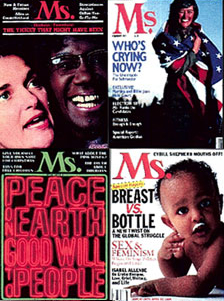
Ms. Magazine
Ms., an American feminist magazine.

“Really?”

(Yes, really – otherwise I wouldn’t have just said it, right?)

“You’re not double-barrelling?”

(No, I’m not double-barrelling – otherwise I would have just said so, right?)

“But what if you have kids?”

(What does that have to do with the price of fish?)

I don’t actually give these satisfyingly vindictive fantasy answers – I suspect they prolong discussion, and all I want is to end these tedious, predictable exchanges as soon as possible.  So I hurry things along, mumbling “I’m still Tan, I can’t be bothered”, and change the subject.

I want to look at the thought process (or total lack thereof) that generates these questions.  These days, “Ms” is a common fixture of every level of public and professional life.  Look in a directory, read your newspaper, fill in some forms – it’s there.

Many a married woman’s birth name is also a household name.  Ho Ching is famously married to a Mr Lee; Beyonce Knowles to a Mr Z.  I’m not a sparkly purple unicorn.

Why, then, the expressions of disbelief?

It seems to me these are best read not as authentic expressions of surprise or genuine requests for information, but as demands for justification.  Many people, however informed, are so wedded to an ideological system of gender norms that they have difficulty respecting other people’s individual choices about many highly personal matters.

Their questioning reflects their belief that a straight and married woman ought to take her husband’s name – that this is a normative default and that anything else is somehow deviant.  They are policing women for gender conformity.

I’m not attributing malicious intent to anyone.  Rather, I think the questions show a failure to think – the lazy refusal to see women as individual human beings.  Faced with a flesh-and-blood woman providing uncomplicated information about herself (“I am still Ms Tan”), these people erase the actual voice of the actual person speaking to them.

Rather than accept a clear statement of a woman’s preference at face value, they strive to remind her of the theory that all married women must use “Mrs”.  In effect, when told of her identity, they change the topic to focus on their own attachment to a system of gender norms.  It’s a perfect example of how systemic sexism can deny the individual humanity of women without for one moment requiring anyone to self-consciously believe in women’s inferiority.

It’s interesting to consider the post-colonial aspects of this, too.  The “Mrs” convention is of Western Christian historical origin.  Traditionally, neither Sikh nor Malay women change their names following marriage.  The practice has enjoyed only a mixed foothold in Chinese, Hindu and Muslim communities around the world.

Children are not universally named after their fathers, either: they take their mother’s last name, for example, in the matrilineal families of Kerala, where many Singaporeans have their roots.  The notion that becoming Mrs Husband is the “done thing”, or that departures from it are peculiar or unworkable or need especial explanation, is highly Eurocentric.

This critique is the sort of thing that some people refer to as “overanalysing” or “thinking too much”.  On the contrary, my suggested solution is the simplest course of action possible: if you need to refer to a married woman by her last name, ask her what she would like to be called, and then use the name that she tells you.  It’s really as easy as that.  It’s only a cultural aversion to allowing women to be ourselves that makes it look any more complex.

The writer is a charity fundraiser based in London.  She is a core team member of No To Rape, the volunteer-led campaign to abolish marital immunity for rape in Singapore.