
Month: December 2011

Our proudest achievements in 2011

We’ve had a very busy year here at AWARE. Catch up on what we have accomplished, and join us for more initiatives in 2012.

We launched the Sexual Assault Befrienders Service(SABS)
In November, AWARE launched the first support service for survivors of sexual assault in Singapore after a 6-month pilot period. We decided to introduce SABS after receiving several Helpline calls from women who had suffered from sexual assault years ago, and were still unable to get closure as they did not receive the support they needed at the time.

SABS comprises a dedicated Helpline, counselling, legal counselling and Befriending services.

The SABS Helpline 6779 0282 runs on weekdays from 10am to 9.30 pm. Sexual assault survivors can also email us at sabs@aware.org.sg for assistance.

Our response time for SABS is shorter as the needs of these women are more urgent, and we also follow up on their cases more closely. SABS clients get to see our legal counsellor within three days (depending on urgency) instead of waiting 2 weeks for our regular Legal Clinic. We can send a SABS Befriender down to the police station almost immediately, if necessary.

Our website also offers the most comprehensive information available on rape and sexual assault in Singapore.

We contributed to the proposed repeal of Section 157(d) of the Evidence Act
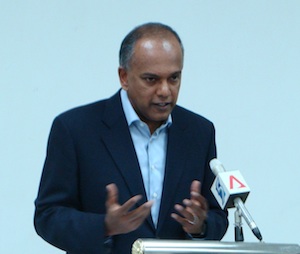
At AWARE’s SABS launch, Law Minister K Shanmugam announced the intended repeal of Section 157(d) of the Evidence Act, an archaic law that makes it possible to discredit an alleged sexual assault victim through her sexual history.

Many people contributed to this development. AWARE is proud to have participated in this process by helping to highlight Section 157(d) and discussing its disturbing implications with Minister Shanmugam. Read our detailed submission on this section of the Evidence Act here.

We reached out to more women in need of help

In 2011, a record number of women sought out our Helpline, Counselling and Legal Clinic services.

Compared to 2010, the number of calls received on our Helpline has increased by 6%, while our Counselling cases increased by 47% and Legal Clinic cases increased by 14%.

To meet this greater demand, we are looking for more female lawyers to volunteer for our Legal Clinic, as well as volunteers keen to join our SABS team.

We have also successfully completed the training for our very first batch of Mandarin-speaking Helpline volunteers, who will be able to assist Mandarin-speaking callers.

Want to volunteer with AWARE? Signing up is easy: click here to get started.

Here are some thoughts from an AWARE volunteer who has been a Helpliner for two years:

“It’s great to see more and more regular Helpliners at AWARE. What worries me is the high proportion of non-Singaporean Helpliners in comparison to their overall population in Singapore. Don’t get me wrong. I am actually very grateful to all the non-Singaporeans for helping out. What I cannot understand is why the Singaporeans are not being able to volunteer as much. Is it because Singaporeans are too busy with their own lives? Why are ‘foreigners’ more keen to help? Is it the because of the different ways we were brought up?

I like to listen to and talk with people and help them address their issues. I wasn’t familiar with what AWARE did and I didn’t know if I would be able to help those in need by volunteering here. Another organisation suggested that I could volunteer as an AWARE Helpliner. And I am happy I followed the advice.

It amazes me how people can open up very readily over the phone. I understand that the anonymity makes them comfortable. There are days when after my Helpline session, I feel quite blessed to be able to help people. Of course, there are also some days when I wish I could really help the callers more than I was able to.”

We lobbied for women’s rights at the United Nations in New York
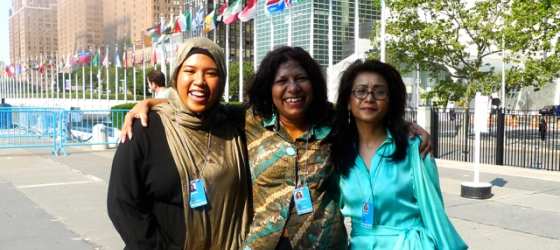
Photo taken by Dana Lam. From left: Nadzirah Samsudin, Braema Mathi and Halijah Mohamad

We believe that the United Nations’ Convention On The Elimination Of Discrimination Against Women (CEDAW), which is ratified by the Singapore government, is an important mechanism that helps keep women’s issues on the national agenda.

As part of our efforts to use this human rights framework to work towards gender equality in Singapore, we submitted our third CEDAW Shadow Report to the United Nations this year. Making the trip to the UN headquarters in New York were: AWARE CEDAW Sub-Committee chair Braema Mathi, AWARE Vice-President Halijah Mohamad, AWARE immediate past president Dana Lam and AWARE research executive Nadzirah Samsudin.

Shadow Reports are submitted by NGOs so that the UN can get a more comprehensive understanding of the lives of women in each country before making their recommendations to the governments of these countries.

Find out more about our Shadow Report, our lobbying efforts and how CEDAW works here.

We recommended mandatory paternity leave

We commissioned a survey of 1,001 working parents, conducted by students from Ngee Ann Polytechnic’s School of Business & Accountancy.

When asked whether they thought paternity leave should be made compulsory, 91% of the respondents said yes. Of these, 93% explained that paternity leave would allow fathers to be more involved in parenting.

A significant number of the parents – 57% – said they would welcome having the option of transferring parenting leave from mother to father.

These survey results back up our policy recommendations with regards to paternity leave, which include:

  • Make paid paternity leave of two weeks mandatory, with the cost shared between the employer and the state.
  • Convert one of the four months of maternity leave into ‘parental leave’ to be taken by either parent, with the state sharing the cost with the employer when the father takes this leave.
  • Offer a ‘parenting present’ of $4,000 to couples where the father takes the one month of parental leave.
  • Convert the currently mandated 6 days of paid childcare leave into dependent’s leave, with ‘dependents’ including older children and parents.

Read more about our recommendations here.

We submitted feedback about the Singapore Budget

For the first time, AWARE submitted a position paper to policy-makers about the allocation of funds and policy priorities reflected in the Singapore Budget.

We believe that women’s issues are important national issues, and that it is important to bring women’s perspectives to policy-making.

Some of our recommendations include:

  • Investing in more and better centres to care for infants, children and youths.
  • Extending the same motherhood and childcare benefits to unwed mothers.
  • Increasing the subsidies for women and men who care for dependent relatives (i.e. physically disabled or mentally ill children and siblings; elderly parents or grandparents), and peg the eligibility criteria to the prevailing median income.
  • Transparency on the Medifund criteria and a breakdown by sex and age of its impact on women.
  • A greater effort made to retain women in the workforce, via the elimination of discrimination, mentoring schemes and training programmes.
  • Eliminate discrimination against women at the workplace, including any form of sexual
    harassment. Put in place programmes that motivate and support capable women to aspire to and reach management and leadership positions.

Read our submission in full here.

We re-launched our financial education course

Our Financial Awareness & Confidence Training (FACT) workshops have been re-structured to make it more useful for women looking to gain crucial skills and knowledge to take charge of their future.

FACT classes are now offered in three parts, dealing with personal finance, insurance and investment respectively.

In 2012, we will be marketing FACT more widely to reach out to more women. Want to be a part of these efforts? Find out more here.

We invented the AWARE Awards and the Alamak! Awards

To drum up more attention for gender equality in Singapore, we launched the very first AWARE Awards, to celebrate women and men who have broken through gender barriers and helped to nurture a culture of gender equality in Singapore.

Just for fun, we also created the Alamak! Awards, which highlights instances of sexism in Singapore.

The winners of the AWARE Awards and the Alamak! Awards were announced at our Big Ball fundraising dinner this year. Find out more about the winners here.

We are now accepting nominations for the 2012 AWARE Awards and Alamak! Awards. Do your part for gender equality and submit your nominations here!

We raised a record amount of money for our initiatives

Thanks to the support of organisations like the Chen Su Lan Trust, the Margaret Mary Wearne Charitable Trust, the Kwan Im Thong Hood Cho Temple, the Lee Foundation and the Chew How Teck Foundation, our fund-raising efforts this year went extremely well, with about $800,000 raised to fund our various initiatives, including the Sexual Assault Befrienders Service and the increased outreach of our Support Services.

We’d also like to thank the AWARE members, volunteers and supporters who generously donated their time, expertise and/or money to our various fundraising initiatives, including the inaugural Big Ball gala. We couldn’t have done it without you!

We got hits

Readership figures for our website and the number of people joining our Facebook page grew significantly this year. As we continue working towards our goal of making the AWARE website the best source of news about feminism in Singapore, we will be bringing you more self-generated content.

This year, for instance, we commissioned articles from contributors like blogger Alex Au, feminist writers Lisa Li and Anu Selva-Thomson and academic Mohamed Imran Mohamed Taib, as well as our small but dedicated army of awesome interns, who brought you articles like this and this.

Besides the website, you can keep in touch with AWARE via our Facebook page. Also, anyone – not just AWARE members – who wants to keep abreast of the latest news about women’s issues both in Singapore and abroad can sign up for our new and improved Daily News Update email service, where we deliver the most topical and interesting articles about gender issues straight to your inbox every weekday.

If you want to write for AWARE, please write to media@aware.org.sg to tell us what issues you are interested in.

An eventful year for women’s rights

Regime-changing revolutions, global protests, and other landmark achievements: A look back at 2011.

By Veesha Chohan

Three female leaders win Nobel Peace Prize

Liberia President Ellen Johnson Sirleaf, Liberian activist Leymah Gbowee and Yemen activist Tawakul Karman were recognised for their non-violent struggle to ensure the safety of women and for their right to full participation in peace-building initiatives.

Mrs Sirleaf is the first and only female elected head of state in Africa. Ms Gbowee is a Liberian peace activist and Ms Karman is a leading figure in Yemen’s pro-democracy movement.

Describing this year’s decision as “a very important signal to women all over the world,” the Nobel Committee chairman stated that democracy would not be a viable institution unless women were given the same opportunities as men in contributing to developments in all areas of society.

The Arab Spring: A revolution for women

In the uprisings that took place across North Africa and the Middle East this year, hundreds of thousands of women broke with traditional cultural norms and assumed leadership roles on the frontline of revolutions aimed at overturning oppressive regimes.

Many were beaten, arrested and shot, and there are more struggles to come. As countries like Tunisia, Libya and Egypt re-group in the aftermath of the protests, there are serious doubts about whether these female activists will be able to continue in their leadership roles during the nation-building process, and help ensure that equal rights for women form a key tenet of the new regimes.

Despite daunting odds, there is cause for optimism. In Tunisia, for instance, women played an active role in administering the October election, and all the political parties that won significant seats responded to Human Rights Watch’s pre-election survey reinstating their support for gender equality.

Christine Lagarde becomes head of International Monetary Fund

As the first woman to secure the top job at the International Monetary Fund (IMF), former France finance minister Christine Lagarde was already assured of a place in the history books.

The fact that she replaced the scandal-plagued Dominique Strauss-Kahn – he resigned from the IMF amid a flurry of sexual assault allegations – was a touch of poetic justice not even the most starry-eyed feminist could have predicted.

Lagarde crafted an unusually public and global campaign for the IMF job, using Twitter to reach out to emerging economies like Brazil and India. She also held an online conference where she took questions from followers on Facebook.

Edwin Truman, a senior fellow at the Peterson Institute for International Economics, describes Lagarde as an aggressive spokesperson for the advancement of women in all areas of life. As the Eurozone crisis continues to generate global anxiety, Lagarde’s performance will certainly continue to be a subject of scrutiny in the year ahead.

Latin America embraces female leadership

In October, Argentina’s Cristina Fernandez was re-elected in a landslide victory, winning the election with one of the widest victory margins in Argentina’s history and becoming the country’s first re-elected female President.

Fernandez joins Brazil’s Dilma Rousseff and Costa Rica’s Laura Chinchilla as one of Latin America’s current female heads of state. Countries like Chile, Ecuador, Panama and Nicaragua have also seen women ascend to top leadership roles in recent years.

What makes Latin America so receptive to electing female leaders? Analysing the phenomenon in 2006, Slate cites gender quotas as one factor that has helped women to emerge as serious contenders for top government jobs: “Since 1991, 12 Latin American countries have enacted quota laws that in some cases have doubled the number of female congressional representatives. While in the United States women make up just 15 percent of the House of Representatives and 14 percent of the Senate, in Argentina and Costa Rica, women comprise fully one-third of the national congresses.”

Asian women rule the business world

Sabanci Group CEO Guler Sabanci, Pepsico CEO Indra Nooyi, President of Gree group Dong Mingzhu and President of China Power International Development Limited Li Xiaolin topped the 2011 Financial Times Global Top 50 Business Women List.

Outstanding business-women from China and India, in fact, made up over 20 percent of this list.

Singapore also did well, with Chua Sock Koong of SingTel, Olivia Lum of Hyflux and Ho Ching of Temasek Holdings making the list. This is no mean feat. As Forbes put it: “Singapore has a population of just over 5 million population –or 0.07% of the world’s population – yet made up 6% of the list.”

Mara Hvistendahl reveals the danger of valuing boys over girls

In her first book, Unnatural Selection: Choosing Boys Over Girls & The Consequences Of A World Full Of Men, American science journalist Mara Hvistendahl shines a spotlight on the pressing issue of missing women.

Since the late 1970s, 163 million female babies have been aborted by parents seeking sons. Hvistendahl traces the ideas and events that led to the prevalence of sex-selective abortions.

She also makes the provocative claim that female empowerment has led to more sex selection, not less – Women are using their increased autonomy to select sons because male offspring still bring a higher social status in many cultures.

These choices have grave consequences, with gender-imbalanced nations becoming more socially unstable and vulnerable to sex trafficking.

The book raises thorny questions about the notion of choice, perhaps unintentionally, as the Wall Street Journal speculates: “Unnatural Selection might be one of the most consequential books ever written in the campaign against abortion. It is aimed, like a heat-seeking missile, against the entire intellectual framework of ‘choice’. For if ‘choice’ is the moral imperative guiding abortion, then there is no way to take a stand against ‘gendercide’. Aborting a baby because she is a girl is no different from aborting a baby because she has Down syndrome or because the mother’s ‘mental health’ requires it. Choice is choice.”

Slutwalk goes global

This movement emerged in Canada in April, after a Toronto police officer suggested during a public forum that “women should avoid dressing like sluts in order not to be victimized”.

SlutWalks have now taken place in more than 40 different countries around the world.

On December 4, SlutWalks took place in Singapore, Hong Kong, Bangalore and Mumbai, with organisers in these cities presenting a united front against sexual violence.

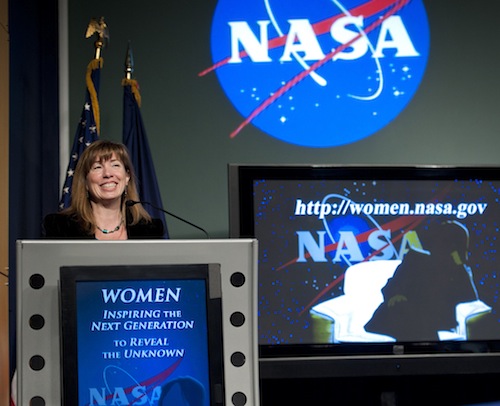
NASA celebrates women’s contributions to science and exploration

US government agency National Aeronautics And Space Administration (NASA) helped put men on the moon, and it has set its sights on boosting female participation in the fields of science, technology, engineering and math (collectively known as STEM).

This year, it launched a new website, Women@NASA, dedicated to celebrating the contributions women have made to science and exploration. The website aims to encourage more young women to pursue careers in STEM industries. In the US, women hold less than 25 percent of all STEM jobs.

The Women@NASA project shares the stories of 32 women from the organisation who have contributed to NASA’s missions, hoping to inspire girls around the world to reach for the stars.

South-east Asian women’s groups reject Obedient Wives Club

Earlier this year, The Obedient Wives Club was launched in Malaysia by the controversial Global Ikhwan group. Branches in Indonesia, Singapore, Jordan, Australia and England were subsequently established.

Despite its swift expansion, the club has not gained traction, instead attracting widespread criticism for its belief that the sexual submission of a wife to her husband will reduce the likelihood of the husband engaging in adultery and other related social ills like prostitution.

Facebook groups established against the club have described its teachings as sexist and senseless. In Malaysia, women’s rights group Sisters-in-Islam and Women, Family and Community Development Minister Shahrizat Jalil spoke out against the club.

In Singapore, the Islamic Religious Council (Muis) issued a statement that said “happiness in a marriage goes beyond receiving sexual fulfilment from one’s wife”, while Indonesia’s Women’s Empowerment Minister Linda Gumelar called the group a “setback for Indonesia”.

Hillary Clinton discusses democracy with Aung San Suu Kyi

In December, two of the world’s most famous female political figures met to discuss much-needed democratic reform for Burma.

The meeting between U.S. Secretary of State Hilary Clinton and the leader of Burma’s pro-democracy movement Aung San Suu Kyi marked an incredible sign of change in the South-east Asian country.

Aung San Suu Kyi is currently preparing for a return to politics, having confirmed that she plans to run in next year’s parliamentary elections. Her previous efforts to implement democratic reform and cultivate a decisive win for her party, the National League for Democracy, was terminated due to the military’s crackdown on pro-democracy movements.

Hillary Clinton has endorsed Suu Kyi as a member of the new parliament, supporting the latter’s aim of enforcing a rule of law and releasing all remaining political prisoners.

The writer is an AWARE intern majoring in International Relations at the University of Queensland.

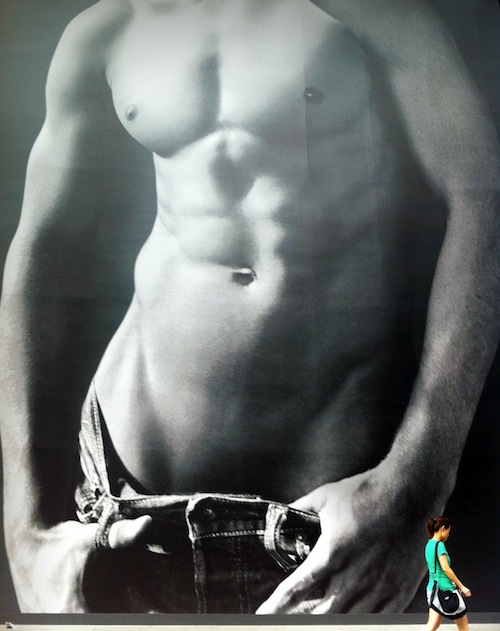
Roundtable Discussion: Gender representations in advertisements


EVENT DETAILS
Date: Thursday, January, 19,  2012
Time: 7.30pm
Venue: AWARE Centre (Block 5 Dover Crescent #01-22)
Register for this event here.
Have advertisements become more sexualized? Or are they now more gender-neutral? For our January Roundtable Discussion, four students from the National University of Singapore will be sharing their findings via a historical mapping of product advertisements. The following are some of the products we will be discussing:

Ice-cream

Advertising tells us that a woman’s body is made to be consumed – and what better way to examine this than through commercials that sell ice-cream? An analysis of ice-cream print ads over time reveals how the rise of the modern nuclear family, capitalism, consumerism, and changes in women’s status have affected the way ice-cream has been bought and sold. A further glance at contemporary ice-cream ads today also show us widespread societal notions about masculinity, race, and ideal gendered as well as sexualised behaviour and body types.

Alcohol

From the cultural, economic and biological perspective, men have consistently been the primary target group for alcohol advertisements over the past 60 years. But why? Themes of masculinity, femininity, sexuality and objectification of women will also be highlighted, to showcase how alcohol advertisements (to a large extent) still utilize gender stereotypes in order to attract their primary target audience – the male consumers.

McDonalds

The presentation will cover an introduction to McDonald’s and its advertising history and a sharing of the analytical findings. It will also highlight the trends in these advertisements – are they all inherently gendered in some way or another?

SPEAKERS

Kellynn Wee
Kellynn Wee is a Sociology and English Literature major at the National University of Singapore with a particular interest in gender and sexuality issues (especially pertaining to South-east Asia, religion, post-colonialism, and masculinity) as well as children’s and young adult literature.

Nur Fadilah
Nur Fadilah is currently a Year 4 NUS undergraduate majoring in Social Work. After graduation in 2012, she will be working as a social worker at a family service centre working with families and at-risk youths

Bryan Chia 
Bryan Chia is a 3rd year undergrad currently reading Sociology at the National University of Singapore. My interests in my field of study is in deconstructing processes and belief systems.

Real-life stories of hope and pain

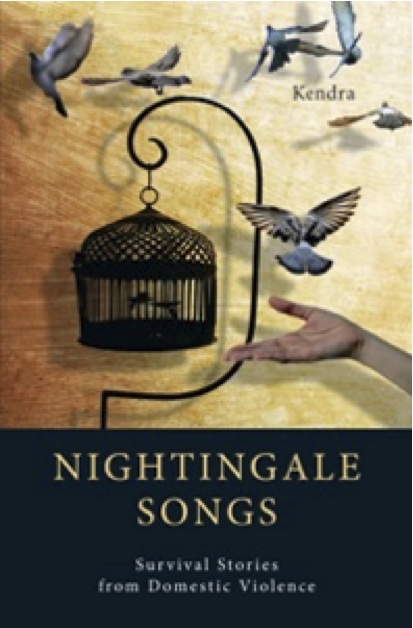
A survivor of domestic violence reviews the new book Nightingale Songs: Survival Stories From Domestic Violence.

Why it is so difficult to walk out of abuse? Because these are some of the thoughts that cross a victim’s mind: Perhaps it is just a passing cloud; you mean, I am a victim of violence? Me? No, it cannot be! What is abuse, anyway?

I applaud the efforts of publisher Marshall Cavendish the publisher, author Kendra Frazier, AWARE, and the survivors who contributed their stories to Nightingale Songs, the first book of its kind in Singapore. AWARE did really great work in its chapter on how victims of abuse can seek help in Singapore. The book also has a very diverse scope that will be of interest to survivors, counsellors, as well as those looking for more awareness and understanding of this issue.

Nevertheless, I would have appreciated a more explicit exploration of the survivors’ stories. Beneath the surface, there is a lot of suffering, agony, anguish, shame, antagonism, guilt, loneliness, isolation, humiliation, hurt, tears, struggle, tension, fear, uncertainty, pain and repeatedly giving the perpetrator the benefit of the doubt, hoping that there will be a miracle one day.

Portraying these intense emotions and conflicts will help people better understand how recovering from such insidious abuse, which usually begins in the family of origin, is extremely difficult. The ripple effects are also more detrimental when they are trans-generational. Acknowledging the co-dependency of family dynamics is one of the keys to healing.

For most victims, getting someone to believe their story is the first step to breaking the cycle of violence. In the longer term, it is important to get the time and space to develop one’s identity and instill respect for differences in individuals, instead of using power struggles to ensure cohesion and adhesion.

Nightingale Songs serenades 2 advocates, 3 counsellors, 2 survivors-turned-helping professionals, and 8 victims.

The chapter on law professor Chan Wing Cheong’s efforts to improve legal protection against domestic violence:

I have been a beneficiary to the changes in the 1996 amendment to the Women’s Charter that includes the continual harassment portion. That granted creditability to the invisible sufferings for me this year.

Paradoxically, by prioritizing family unity, Singapore law sometimes jeopardizes its own protection objectives. Perpetrators almost look more normal than the victims most of the time. Mentorship and support is critical for survivors, and it really helps when there is rising social consciousness in her support network about the typical dynamics of an abusive relationship.

The chapter on former AWARE Direct Services manager Kerry Wilcock:

Homelessness is just as intolerable as the abuse. The transient life for both mothers and their children after breaking away from the cycle of violence can be a very stressful time. It is worse when they are foreigners with limited access to their rights to home, children and money, at the mercy of the native spouse. The innocent and powerless children are the real victims in the crisis. Their inner turmoil, and being forced to grow up beyond their years, is heart-breaking.

The chapters on counsellors Benny Bong and Hamidah S.A.B., and social worker Udhia Kumar:

Bong observes that a perpetrator usually plays a victim’s role at work. These men are usually not in touch with themselves, blaming everything and everybody except themselves. Kumar says that recovery begins when we recognise that the perpetrator is also suffering deeply from inner turmoil.

What we victims want is to STOP the violence. We learned the difference between expressive anger and instrumental anger. The latter is deep-seated, entrenched, enmeshed and simmering.

Teaching respect in healthy relationships is critical. The private is a function of the public and the public an expression of the private.

Counsellor Hamidah believes that better communication and inner assertiveness are vital to helping survivors to recognise subtle psychological abuse, and not tolerate disrespect.

The chapters on survivors of domestic violence:

Yu Ming’s personal history is an inspiration – It is possible to rebuild your life. He notes that ignorance and secrecy pose the greatest threats to the welfare and safety of children in a violent home. Empowering them by teaching them to identify triggers to violence is a more proactive and pre-emptive step. The story of Bob, another survivor, also emphasizes this need for guidance and support.

The women and children caught in such situations need someone who listens, takes personal interest. The power of one such person can help to turn things around.

Survivor Akshaya was taunted and demeaned by her ex-spouse in front of friends and her children. The social isolation she describes is unbearable. I identified with her – I, too, did not realise that I had a right not to suffer, until counselling helped me to think differently. Our aspirations for our daughters are also similar – like her, I do not want my daughter to grow up fragile.

My young daughter was instrumental to my exit to freedom. She stayed sensitive to the fact that she experienced more peace externally than home. One day, she just stayed close to the door, and said innocently: “Mummy, let’s go?” Financial dependence was another enslaving factor. Walking away was not easy.

I remembered my fair share of kneeling down, apologetically begging my ex-husband to save our family, and being given the cold shoulder. The late counsellor Anthony Yeo once asked me what the one thing I regretted was. I said, almost instantly: My marriage. His next question was: Do you think that you will regret your divorce?

For a victim of abuse to get clarity and to give up hope of an equal partnership takes time. Self-love was a valuable lesson that I had to learn.

As the road to recovery continues, I can identify with Elizabeth’s Dr Jekyll and Mr. Hyde double life of flux. The fear of failure, intimacy and rejection in personal relationships is always there, even in platonic relationships. This sense of restlessness about who I can really trust is a constant struggle.

I completed reading this healing book in a day. It is a great comfort for us survivors to know that we are not alone. There are many others who care.

About Nightingale Songs
To write this book, Singapore-based counsellor and mental healthcare professional Kendra Frazier spoke to survivors of abuse and professionals who help those impacted by violence in their home. Their stories provide useful information for those considering working in the field of domestic violence, especially the importance of self-care, and will resonate with anyone whose life has been personally touched by this issue.

To commemorate the United Nation’s International Day for the Elimination of Violence Against Woman, AWARE and Marshall Cavendish launched Nightingale Songs on Nov 25, 2011. This book is the first comprehensive documentation of domestic abuse in Singapore. The launch was part of Stop the Cycle Before it Starts, AWARE’s anti-domestic violence campaign, and was followed by a discussion featuring survivors and experts. Nightingale Songs can be purchased for $19 at the AWARE Centre and all major bookstores.

Can we still trust ASEAN?

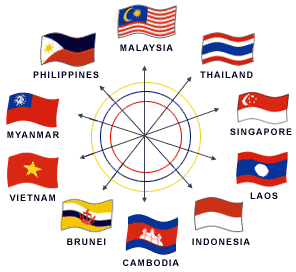
The following is a press statement issued by the South-east Asia Women’s Caucus on ASEAN, a network of women’s organisations from 11 countries which aims to engage ASEAN in advancing women’s human rights in the region.

Despite the hype surrounding the ASEAN Summit in Bali, women from the region found no signs in ASEAN towards advancing women’s human rights and gender equality. Instead they alarmed with the body’s support for the 2014 chairship of Burma, where cases of women’s human rights violations are mounting, among others. Moreover there are qualms over the civil society space in Cambodia when it starts the chairship next year.

“Although Indonesia has been quite open to civil society, this is not a nice touch as Indonesia ends its term and passes the baton to the next chair,” Rena Herdiyani of Kalyanamitra, a member of the South East Asia Women’s Caucus on ASEAN (Women’s Caucus) put it.

“The Burmese Army’s widespread attacks against ethnic civilian communities, especially against women, is an egregious violation of international law and blatantly shows the lack of the rule of law in Burma. We know that you understand the security of women is not a minor issue, but a major problem that has to be addressed before a nation can progress,” the Women’s League of Burma said. The organisation documented 81 cases of rape this year alone.

The ASEAN Summit ended just days before the 16 Days of Activism against Violence Against Women international campaign.

With this development, the Women’s Caucus is watchful of the drafting of the ASEAN Human Rights Declaration (AHRD). “Women’s human rights must never be a point of negotiations. ASEAN must acknowledge what we are born with, as affirmed by the Convention on the Elimination of All Forms of Discrimination Against Women (CEDAW) and other international human rights instruments.” Herdiyani added.

Last month, the Women’s Caucus formally submitted its input to the AHRD, reiterating human rights such as equality and non-discrimination, freedom from violence, sexual and reproductive health and rights, equal rights in marriage and family life, decent work in local and overseas employment and citizenship especially for refugees and women on the move, among many others.

As the AHRD will be deliberated and adopted under Cambodia’s chairship, the Women’s Caucus call for an open and safe space for civil society next year. “We are not just feminists and activists but we are stakeholders of ASEAN, we have to critically engage with the process, especially as ASEAN is increasingly become a part of our daily lives. There is no way we could do this if ASEAN only wants to hear good things,” Kunthea Chan of Cambodian women’s organisation, Silaka asserted.

Find out more about the Women’s Caucus here.