Year: 2013

Roundtable: Internet and the women’s movement

The next AWARE Roundtable is on Wednesday, 23 October, on how internet technologies have affected the women’s movement in Singapore.

The identities of women’s movements across the globe are shaped by the institutional contexts they are embedded in. Singapore is a compelling case study because the different phases of the women’s movement reflect sharp influences of a rapidly changing political economy. The significance of the women’s movement lies not only in its accomplishments, but also in how it negotiates a hostile terrain moulded by socio-cultural constraints and the state.

The arrival of the Internet has presented new opportunities for challengers of the state. Besides creating new modalities of collective action and facilitating traditional ones, blogs, electronic forums, and social networking sites have given collective action an extra boost by connecting like-minded individuals at unprecedented speed. Across the globe, women are responding to new opportunities for informal resistance by using digital technologies to form groups.

This discussion examines how (and if) the Internet has opened up spaces of contestation for women and for which segments of the population. We will also talk about the ways in which Internet technologies are used by emerging groups and the constraints posed by these technologies.

feminist_on_the_internet


Event Details

Date: Wednesday, October 23, 2013
Time: 7:30pm
Location: AWARE Centre

Click here to register.


About the Speaker:

Carol Soon’s work has been published in several peer-reviewed journals and her paper on blogging and collective action was selected as one of the best papers at the recent Conference for E-Democracy and Open Government. Her research interests include digital engagement, online communities, and how individuals and organisations use digital technologies to engender change.

Carol has taught courses at the Department of Communications and New Media, and the University Scholars Programme in NUS, and received several awards for her teaching. In 2012, Carol was Visiting Research Fellow at the Asia Research Centre, Murdoch University, with support from the Australian Endeavour Award.

The Big Red Success!

The Big Red Ball, AWARE’s annual fundraiser, was held on Monday, 16 September. With great entertainment, yummy food, and excellent company, the night was full of fun and laughter, and all for a good cause. More than 350 friends and supporters of AWARE joined us at the event.

Big Red Ball


We are happy to announce that with the help of our supporters and sponsors, we raised more than $250,000 for our programmes and services, beating our own record from last year. And contributions are still coming in!


The funds will help sustain our research and advocacy programmes, support services, and the We Can! End All Violence Against Women campaign. Many guests pledged to join the We Can! Campaign as Change Makers.

We also announced the winners of our AWARE Awards (Singapore’s only gender equality awards) at the Ball, for categories including AWARE Heroine and Corporation of the Year. Please click here to read about our inspiring winners, including path-breaking icons such as Constance Singam and Rachel Chung.

The dubious honour of the annual ALAMAK! Award, given to the most excruciating example of sexism over the past year, went to St. Margaret’s Secondary School for its recent wig saga. The wig saga was brought to life by the Chestnuts, who left big smiles on all our guests’ faces with their irreverent, hilarious spoofs of the five ALAMAK! nominees.

AWARE’s staff and volunteers took to the stage too, kicking off the Ball with a energetic and graceful performance as the Bollywood Babes, setting the tone for the rest of the Ball.

And of course, no account of the Ball would be complete without mentioning our generous sponsors – KOP Properties and Montigo Resorts, Hong Leong Foundation, Lee Hwa Jewellery, Bengawan Solo, Sidefame, Performance Motors, Bayview Hotel, TOTE Board and Singapore Pools.

We would also like to thank Joe Augustin and Petrina Chow for hosting the evening, and our staff and fundraising committee for putting in so much hard work to design the ball splendidly.

If you joined us this year, thanks so much for your support. If you didn’t, do come down next year for a fabulous time!

The Best and the Worst of 2013!

We announced the winners of our annual AWARE Awards, Singapore’s only gender equality awards, yesterday at AWARE’s Big Red Ball.

AWARE Award winners always stand out in their fields, shining examples of what one can achieve through dedicated work and a passion for doing what’s right. Each year, we present the AWARE Awardsto individuals and organisations doing exceptional work to further gender equality.

Optimized-RachelThis year’s AWARE Heroine Awards were given to domestic violence survivor, Rachel Chung and veteran social activist, Constance Singam.

AWARE Awards were also presented to Accenture as Corporation of the Year, for consistently and actively encouraging female leadership and empowering women in the workplace.

The Singapore University of Technology and Design won the award for Cause of the Year (Education), for attracting female students and achieving a balanced male-female cohort, an achievement few engineering schools can boast of.

Lastly, the Financial Women’s Association’s mentoring programme was named Initiative of the Year for adopting a professional and robust approach in a mentoring programme connecting younger members with senior members to develop their careers.

AWARE also declared the winner of the annual ALAMAK! Award, our tongue-in-cheek tribute to the most excruciating example of sexism over the past year.

0912_improve_Lorenzo-Morales-2

Candidates are nominated by the public, with the “winner” chosen through online voting.

With 61 per cent of the vote, the recent wig saga at St. Margaret’s Secondary School emerged the winner of the Alamak! Award 2013. Last month, Principal Marion Tan sparked the ire of the public when she demanded that students who had shaved their heads for cancer awareness wear wigs to hide their baldness.

The AWARE Awards and ALAMAK! Award will be back next year!


‘Come Out, Come Home’ in Singapore

AWARE welcomes the Come Out, Come Home movement (COuCH) launched by queer rights group Sayoni.

COuCH seeks to encourage and support LGBTQ (lesbian, gay, bisexual, transgender, queer) persons in Singapore to come out and to feel comfortable about their sexuality.

AWARE supports this effort because we respect the right of every individual to live the life they want. This includes the right to live freely and happily as an LGBTQ person. Sexual orientation is just one facet of an individual, no different from the many other facets such as gender, ethnicity, and religious belief.

As a nation, Singapore does not judge or discriminate against anyone because of their gender, ethnicity, or religion. Similarly, we should not judge or discriminate against anyone because of their sexual orientation.

While social norms are changing and there is growing acceptance of LGBTQ persons, it continues to be difficult for many to be open about their sexuality. This is not healthy. Studies show that self-acceptance and disclosure contribute positively to a person’s mental and emotional wellbeing.

The COuCH movement, launched on 3 August, will culminate on 11 October  – International Coming Out Day.

COuCH Campaign

During this period, LGBTQ persons are encouraged to sign a pledge to come out before or on International Coming Out Day, and to share on the COuCH website their experience of coming out to their family, friends, or colleagues.

Allies – those who accept, support, and love their LGBTQ relatives, friends and colleagues – are also encouraged to make their stand known.

Roundtable: Constructions of Women in Sex Ed

AWARE’s next roundtable is coming up on 19 September! The theme this month is ‘Harmful Constructions of Young Women in Sex Education’.

Sex education programmes that focus on promoting abstinence rather than providing accurate information on sexual health not only fail to adequately equip teens with accurate information, but also spread extremely harmful constructions of young women.

Women are often depicted as having no sexual agency, and merely as potential victims of sexuality. In these ‘abstinence-only-until-marriage’ education programmes, women are almost exclusive heterosexual, and ideally “pure”.

Such depictions leave women dangerously unprepared to understand and navigate their sexuality and relationships in a healthy and empowered manner.

This roundtable will examine these images of the “pure” young woman in sex education curricula, and discuss statistics that demonstrate the dangerous effects of such constructions. We will suggest alternative approaches to sex education that expand the space for women’s sexuality and sexual agency.

sex-ed


Event details:

Date: 19 September, Thursday
Time: 7:30 pm
Venue: AWARE Centre, 5 Dover Crescent, #01-22, Singapore 130005

Click here to register!


Speaker’s Bio:

Cate Smith is in the final stages of completing her PhD in Education from Monash University in Australia. She began her graduate studies in Classical Studies at the University of Pennsylvania, and switched to Education when she became aware of a greater need for work in educating teens about sex and sexuality.

For her graduate thesis, Cate designed a qualitative study that examined, among other things, the adverse effects of abstinence-only curricula on America’s teens. She has delivered several papers on sex education at conferences in Australia and Singapore, and is currently working on publications on feminist concerns about sex education and young women’s sexual agency.

NDR Speech 2013: A Step In The Right Direction But More Needed

19 August, 2013

AWARE is heartened by the policy shifts outlined by Prime Minister Lee Hsien Loong in the National Day Rally speech 2013. We applaud the government’s commitment to invest in every Singaporean to reach their full potential, through much needed reforms in housing, education, and healthcare.

Much, however, is left to be done to improve social mobility and inclusiveness in our nation, and ensure the overall well-being of Singaporeans.

Healthcare

Thank you, PM Lee, for granting Singapore and AWARE one of the key items on our wish list – universal, compulsory health insurance for life. With rising life expectancies, lifelong health insurance will meet the needs of our aging population. AWARE called for this policy in our recommendations for Budget 2013, and we are very happy to see the recommendation met.

We ask the government to adopt a gender-sensitive lens in the implementation of this policy. Healthcare must account for the fact that women live longer than men and with more years in poor health. Women, especially housewives, earn less than men on average, and are disadvantaged under the current 3M healthcare system which is tied to employment.

AWARE trusts that the government will take this into consideration in its ‘means test’ to determine eligibility for lifelong health insurance.

Housing

In the past months, the government has taken steps to make public housing more affordable and inclusive. Opening up BTO-flats to some singles, for example, is a great step that has seen a positive response from the public.

However, the current policies of the Housing Development Board disqualify all singles under the age of 35 from owning or renting public housing directly from the government. In light of the growing number of singles under the age of 35, we need a comprehensive review of this policy.

HDB policies need to be expanded to include groups such as divorcees, who are often ineligible for subsidised public housing. AWARE calls on the government to act on a recent report from the Government Parliamentary Committee on National Development, which recommends treating divorcees as first-timers for public housing. We would also like to see singles allowed to access additional government grants and financial support for housing currently reserved for married couples.

Additionally, housing policies should provide for particularly marginalised groups such as singles with disabilities or unmarried caregivers, who often fall through the cracks.

Singaporean Aspirations

The government has said that ‘Our SG Conversation’ unveiled the core aspirations of Singaporeans which will serve as a guide for government policy. AWARE is glad that PM Lee announced strategy changes related to the areas of ‘Assurance’ and ‘Opportunities’, but we hope to see landmark shifts in policies affecting ‘Purpose’, ‘Spirit’, and ‘Trust’.

Purpose: We ask the government recognise that to Singaporeans, “progress” means more than GDP growth, and to therefore include ‘quality of life’ indicators such as environmental sustainability, a sense of well-being and happiness when making decisions for our future.

Spirit: Policies governing civil society and community action need to evolve, allowing Singaporeans to take ownership of the future of our nation. The government must liberalise the Registry of Societies Act and provide more space and liberties for people to organise, advocate, and carry out community-led initiatives. We would also like to see the government recognise and award public service by civil society members and everyday Singaporeans in the prestigious National Day Awards.

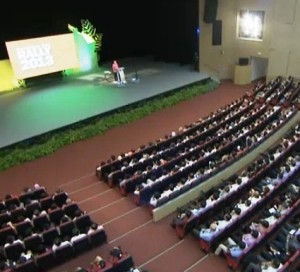
pm-rally-auditorium-viewTrust:  The government must also allow citizens to engage with it on matters that are important to the diverse communities that live in Singapore. It is crucial that Singaporeans have a say in government spending and nation building. Transparency is a critical part of building trust. AWARE calls on the government to release more socioeconomic data, disaggregated by factors such as gender, race, and age.


Young minds and bodies: Is ignorance bliss?

by Tan Jian Xiang and Catherine Smith

Sex-EducationSex education in Singapore is currently values-based, with abstinence as the main approach in keeping youth from premarital sexual activity. However, they can get information about sex from the Internet and their friends, without the supervision of parents or schools.

On this 13th anniversary of International Youth Day (Aug 12), let us consider what young people need to know so that they can develop healthy relationships. We suggest that an insistence on values does not justify ignorance.

A 2011 survey sponsored by Bayer Healthcare found that eight in 10 young respondents (100 men and 100 women aged 20 to 35) in Singapore do not use contraception when having sex with a new partner. This was among the highest rates among the nine Asia-Pacific countries surveyed.

Statistics from the Department of Sexually Transmitted Infections (STI) Control indicate a similar problem: There were 626 cases of infection among teenagers in 2010. There are also some 2,000 teenage pregnancies a year.

These statistics show that ignorance of contraceptive methods can have physical and mental consequences for these youth.

There is possibly a fear that teaching safe sex encourages youngsters to have sex. This assumption has been disproven. A 2007 study mandated by the United States Congress found that abstinence-only curricula did not postpone sexual behaviour.

Safe sex goes beyond STIs and unwanted pregnancies. It includes violence prevention, too. Many imagine rape to be a crime committed by a stranger, but sexual violence is often committed by someone known to the victim.

Failure to teach teenagers about what consent means and their right to withhold consent is likely to lead to a greater incidence of date rape.

The Education Ministry places an onus on parents to educate their children about sex, but it was reported last year that a Health Promotion Board poll, covering 1,169 Singapore households, found that less than half of parents had broached such topics with their teenage children.

To delegate sex education to parents would thus be inadequate.

The reality is that teens are involved in sexual activity. Withholding information about contraception, STIs, date rape and consent will not stop this. A comprehensive sex education programme, though, would enable teens to make better choices and thereby enjoy healthier lives and relationships.

Tan Jian Xiang and Catherine Smith are youth volunteers at AWARE. This article was initially published in Today Voices on 13 August, 2013.

Vote it if you hate it! Alamak! Award returns!

AWARE’s annual Alamak! Award is back, ‘honouring’ the most sexist behaviour over the past year.

Although we are well into the 21st century, there are still remarks, commercials, and policies that perpetuate gender stereotypes and sexist attitudes. In response, AWARE created the Alamak! Award, searching for the the most annoying, you-have-got-to-be-kidding-me instances of sexism in Singapore.

This year’s nominees were identified and submitted by the public, and shortlisted by AWARE. The winner will be announced at the Big Red Ball, AWARE’s annual fundraising event on 16 September, at the Grand Copthorne Waterfront Hotel!

We want you to choose the winner! Vote for your favourite example of sexism!


Who should win the Alamak! Award 2013?

[poll id=”6″]


Meet our nominees..

AH BOYS TO MEN

Your girlfriend has just broken up with you. You are stuck at army camp when you want to be chasing her (even though she told you not to). What do you do to get over a broken heart?

ahboystoMenMoviePoster
Why, chop her up into pieces, of course, advises one character on the popular movie, Ah Boys to Men! “There is no point sacrificing so much for her”, he says.

“Women are like clothes, ready to be discarded when you’re done”, says another. “Why are you insisting on wearing this one?”

Anyway, it’s not like you’re losing out on anything – “next time a guy picks her up, he’ll become a rag-and-bones man, because she’s used goods already”, yet another friend advises.


NEW PAPER NEW FACE 2013

What do young girls dream of? What fantasy do they want to turn into reality?
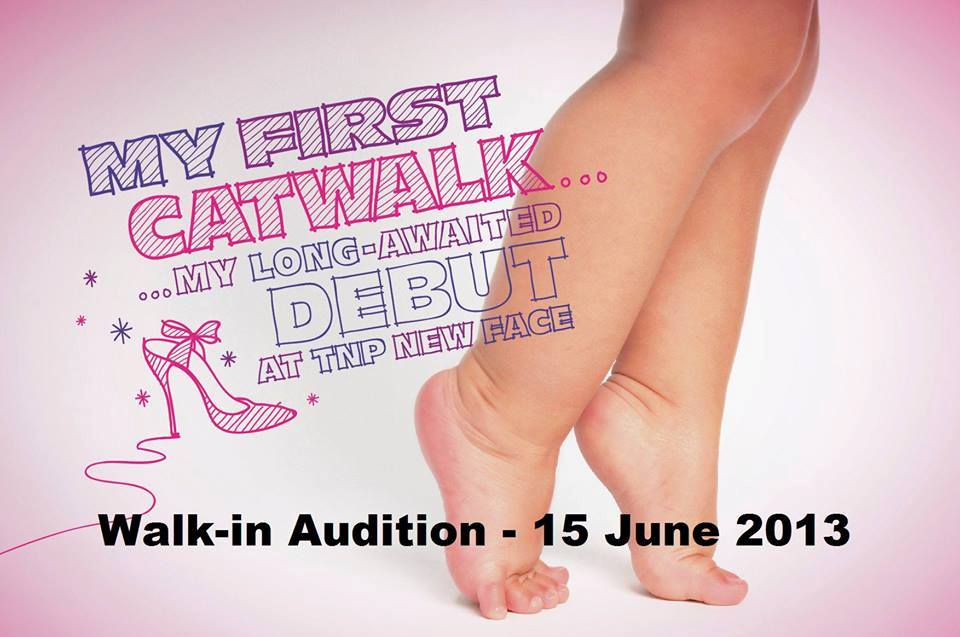

Why, their “long-awaited debut” as a model, of course! Whether you’re a toddler or a teenager, the New Paper’s advertisements for its hunt for a ‘New Face’ make it clear – young girls are just waiting for their first catwalk, tiara, or audition.


The New Paper, looking for “fresh-faced photographic female modelling talents (aged 15 to 23)”, is here to help! The girls just have to walk into the audition in “fitting top and miniskirt/shorts, high heels and light make-up” to turn their fantasy into reality!

See more details here.


 THE SINGAPOREAN FAIRYTALE

1 -Golden Goose
“The Golden Goose was prized for her eggs”, begins a “fairytale” about women’s fertility.

“Alice is wild and reckless, on top of being careless”, begins another, stating that “the extended adolescence of twenty-somethings today has a biological cost for women”.

In a third tale, the Fairy Godmother, described as a “maiden” with ten cats and branded bags “she calls her babies”, demonstrates the fallibility of fertility treatments at later ages.

These ‘Singaporean Fairytales’ are presented by a group of NTU students spreading the message that you really can have it all, if only you choose to. For women, the message is clear: don’t be wild and careless, or choose to not have children. Have babies quickly, and be prized in society!

See more details here.


“MISS (UN)DATEABLE”

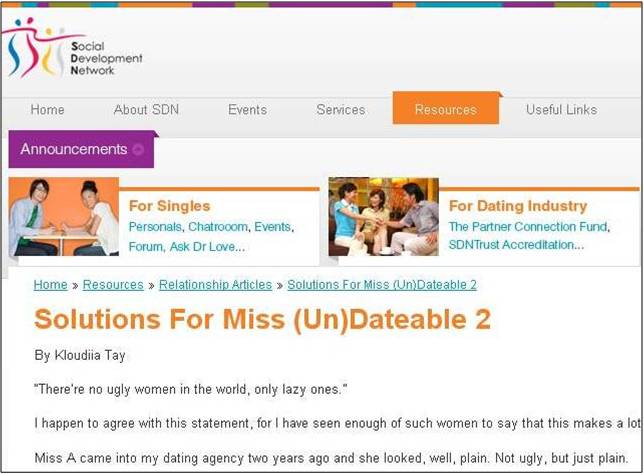
With Singapore’s total fertility rate as low as ever, Kloudiia Tay, writing for the government’s Social Development Network, has a useful tip for women on how to not be “Miss (Un)Dateable”.

“There’re no ugly women in the world, only lazy ones”, she says.

MissWhen the plain-looking Miss A came to Kloudiia’s dating agency, her belief was confirmed – Miss A’s dates don’t ask her out again, and, horror of horrors, A believes that guys should like her for who she is, and not how she looks.

“See?” Kloudiia says. “That girl just got herself busted out of the game just because she didn’t think that looking good was important.”

Didn’t A know that looking good is a critical requirement for women?

Read the entire article here.

ST. MARGARET’S WIG SAGA

To shave or not to shave, that is the question.

Girls struggle with this every day. All parts of our bodies should be hairless, except, of course, our heads, where luxuriant locks always prove our femininity.

0912_improve_Lorenzo-Morales-2However, five girls from the St. Margaret’s Secondary School, an all-girls school, crossed that line when they shaved their heads to support a cancer charity.

Thankfully, school principal Marion Tan could set them on the right path – with wigs. “The school’s rules do not allow punk, unfeminine or sloppy hairstyles”, says Principal Tan. “It’s very clear in our mission – it’s about their turnout as a young lady”.

Ms Tan knows that we can’t have an influx of bald young ladies in society! By forcing these girls to hide their un-feminine baldness under wigs, she has taught girls everywhere that their appearance is so much more important than raising awareness about cancer, and thus, saved us all.

Read the full story here.


Who should win the Alamak! Award 2013? Vote now!

[poll id=”6″]

Should singles be treated as lesser citizens in housing policy?

A Roundtable Dialogue on the housing challenges faced by unmarried people in Singapore was held at the AWARE Centre on 29 July.

Entitled ‘Housing Singaporeans – Should unmarried people be lesser citizens?’, the roundtable began with a thought-provoking presentation by the Singles Sub-committee of AWARE on the results of its research into this topic.

The presentation was followed by an engaging discussion by the participants on the right of unmarried people (who comprise nearly 35 per cent of Singapore’s population) to purchase or rent public housing from the Housing Development Board (HDB).

Under the current policies of HDB, single people below the age of 35 are unable to purchase or rent public housing, or access housing grants provided by the government. Public schemes favour heterosexual nuclear couples with children, leaving many unmarried people with few housing options.

Participants at the roundtable shared their personal experiences and stories, and offered their diverse views on the topic. For example, one of the issues raised was that many unmarried people are forced into homelessness or severe financial hardship by the current housing policies. Single mothers and divorcees, especially, suffer from policies that block their access to public housing.

The AWARE team emphasised that ‘singles’ are not a homogenous group – those who never married, divorced, disabled singles, homosexuals unable to get legally married, and many others are in the category and fall through the cracks of HDB’s current housing policies.

Former AWARE President Kanwaljit Soin also attended the event and offered her own opinions on how the policies should be modified to accommodate unmarried people.

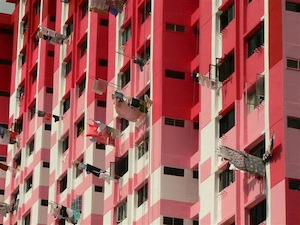
a_block_of_hdb_fla_galleryfullThe roundtable talk was a great success, as evidenced by the enthusiastic dialogue, which carried on beyond the allotted time and continued after the event.

Interested? Join in our next roundtable talk by Constance Singam, an author and civil society activist, on 17 August. Click here to register.