Year: 2015

Events elsewhere: British Women in late colonial Malaya

mandakini-photoFor a few British women who came to colonial Malaya in the 1950s and 1960s, Singapore became home. Based on oral history interviews, this talk is about British women who have lived in Singapore for fifty-odd years. Theirs are stories of choices regarding marriage, family, work, friendship and spirituality. The choices are uniquely individual and illustrate the complexity of gendered imperial histories.

Event Details

Date: 9 February
Time: 11am. Refreshments will be served at 10:30am.
Location: River Room at the Asian Civilisations Museum

About the speaker: 

Mandakini Arora teaches history at the Center for American Education and at PSB-Academy. She also teaches gender studies at NUS. She is interested, both intellectually and personally, in issues of gender, power, and powerlessness. She has a PhD in Russian women’s history from Duke University and wrote a dissertation on the world of Russian peasant women in the late 19th century, at a time when peasant men were migrating in numbers to the cities, leaving farms and households to women to manage.

Outside academia, Mandakini has worked for the past twelve years as a volunteer at AWARE in research and publications. She edited AWARE’s annual journal, Awareness. She also produced a book on the history of AWARE and its place in the history of women’s activism in Singapore. The book is Small Steps, Giant Leaps: A History of AWARE and the Women’s Movement in Singapore (AWARE, 2007).


Time for anti-discrimination law

inclusive communityIt may be timely to consider enacting a comprehensive anti-discrimination law to guide employers’ conduct in hiring, promotion and other employment matters.

In Singapore, there is widespread agreement on the principle that opportunities for work and advancement should be equally available to all, regardless of race, religion, age, gender, sexual orientation, marital status, disability or other aspects of identity or background.

Yet practice does not always live up to this aspiration.  The recent incident involving a yoghurt chain, which is said to have turned a candidate away on the irrelevant basis of language, is not an isolated case.  It is common to see recruitment notices specifying unnecessary language requirements or even an outright preference for particular demographic groups.

The Association of Women for Action and Research (AWARE) regularly receives calls on our helpline regarding workplace gender discrimination.  Many involve discrimination against pregnant women.  The Employment Act offers some protection, but its coverage is limited.  For instance, women have no recourse if, despite satisfactory performance, they receive notice of termination immediately after their maternity leave.

Other evidence corroborates our experience.  In 2013, the then Acting Manpower Minister stated that 70 per cent of its unfair dismissal complaints from women in the preceding five years related to pregnancy.

The Disabled People’s Association have called for legal protection for the rights of disabled people (“Introduce laws to protect rights of disabled people”), emphasising that public education campaigns alone will not achieve inclusion.

While the Tripartite Alliance for Fair Employment Practices (TAFEP) can initiate mediation, employees and job-seekers would have more certainty about their position and remedies, and employers would have more incentive to behave fairly to begin with, if there existed a clear, binding legal obligation not to discriminate.

In a 2010 survey of lesbian, bisexual and transgender women by Sayoni, 85 per cent of respondents reported workplace discrimination due to sexual orientation and gender identity.  Sayoni notes that TAFEP does not “explicitly acknowledge and discourage” these forms of discrimination.

Workers should not have to hope for an online post to go viral in order for fairness to be proactively enforced.

The government has taken a more interventionist approach in “naming and shaming” firms believed to have discriminated on the grounds of nationality.  Clearly, fairness cannot be left solely to the private market.  This recognition should extend to all forms of discrimination and constitute a fundamental legal principle in employment.

An edited version of this letter was published in the Straits Times Forum on 3 February 2015.

Who cares for the caregivers? Recommendations for the national Budget

budget 2015On 29 January, AWARE submitted its fifth annual set of recommendations for the national Budget through the public consultation portal REACH. This year, AWARE urges the Government to develop a caregiving infrastructure that provides adequate care of the elderly, children and disabled people, rather than expect women to provide care by leaving the workforce. Initiatives to encourage women to return to the workforce are largely in the form of skills training or upgrading. These do not address the key question of whether there are alternatives that adequately replace the care provided by women as unpaid family caregivers.

“We cannot leave caregiving as a problem for individual families to solve by making personal sacrifices,” said Dr. Vivienne Wee, Research & Advocacy Director of AWARE. “Care should be a public good available to all in need. This will enable women caregivers who have left paid employment to return to the workforce, assured that family members are well cared for by professional caregivers without the family becoming financially stressed. Women who leave paid employment become dependents themselves, with insufficient funds for their health care or old age.”

According to the Ministry of Manpower’s Labour Force in Singapore 2013, almost half of the 690,000 women who are outside the labour force stated that they had dropped out of the formal workforce because of family responsibilities, including caregiving. The financial vulnerability of these unpaid caregivers is a serious concern.

Care of the elderly

Our current dependency ratio of 6.3 working-age citizens supporting each citizen aged 65 and above will shrink to 2.1 by 2030. To prepare for this situation, our key recommendations are:

  • Review Eldershield. The current programme is too limited in terms of the payout (typically less than half of monthly hospital bills) and period of coverage (72 months, which does not allow for long-term care). In 2013, the Ministry of Health announced an intention to review Eldershield, but this has not yet taken place.
  • Increase subsidies to meet the full cost of care. At the moment, co-payment is always required, which renders care too expensive for many to access.
  • Provide “person-centric” funding independent of the identity of the care provider. A caregivers’ allowance should be provided, including to a caregiver based in the home of the person being cared for. This can come in tandem with quality and training standards.
  • Legislate eldercare leave. Public bodies, such as the Health Promotion Board, have provided employees with eldercare leave since 2014. Legislation is needed to ensure that every employee have eldercare leave to care for family members.
  • Provide a basic pension. CPF is relevant only for those who are employed. Women who have left paid employment due to caregiving responsibilities will have insufficient savings. The spouse who is the sole source of financial support for a family is unlikely to have enough retirement savings for the couple. This is particularly so since only 48.7% of active CPF members are able to meet the minimum sum, and that includes people whose property has been pledged to meet this sum.

Care of children

  • Childcare should be publicly funded and available to all children equally. Caregiving must be supported to enable mothers who drop out of paid employment to re-enter the workforce.
  • Give every child an equal chance. Unmarried mothers and married mothers who are not in paid employment should have access to child and infant care subsidies. Without these subsidies, their children are disadvantaged from the earliest possible age.
  • Abolish subsidies given as tax relief. As only one-third of wage earners pay income tax, the majority of parents are excluded from subsidies given in the form of income tax relief.
  • Invest in childcare and early childhood education, not subsidies for births.
  • Fully support childcare as a shared responsibility between parents. Paternity leave and childcare subsidies for caregiving fathers should be increased.

Care of disabled people

There are very limited subsidies for disabled people. The Interim Disability Assistance Programme for the Elderly (IDAPE), for instance, is not available to those below 65, and is limited only to a maximum of $250 a month for 72 months. This does not meet the needs of disabled people.

Means testing

Means testing should be applied only to individual applicants for public assistance, not the entire household where the applicant lives. The Legal Aid Bureau of the Ministry of Law is already using a fairer method of means testing only individual applicants, taking into consideration some disposable income and disposable capital. In contrast, vulnerable people in need of assistance are means tested by MSF and MOH in terms of gross household income, prior to deductions and fixed expenses of household members – a method which leads to having higher incomes stated that often exceeds the threshold for financial assistance schemes. This method excludes many who need assistance.

Exclusion is further exacerbated by the assumption that simply by residing in a household where per capita household income is above $2600 or where the Annual Value of the residence exceeds $13,000, a vulnerable person would be adequately cared for, with no investigation of whether other members of household are contributing to the care of the individual applicant or whether the Annual Value of the residence is used to provide financial support for caregiving.

Read the full text of AWARE’s Budget 2015 Recommendations here. AWARE has made recommendations to Singapore’s National Budgets since 2011, advocating for equitable allocation of resources to meet the needs of vulnerable groups. Our recommendations for Budget 2014 are here

Address the needs of all in caregiving

By Goh Li Sian, Research and Advocacy Coordinator, AWARE

455-old-lady-yaanAs Singapore’s population ages, more carers will be required to fulfil eldercare needs.

While volunteers have a role and their efforts are welcome, we would caution against relying on volunteering as a primary source of eldercare. (“More work needed to get more volunteers to help seniors”; Jan 16)

Such an approach would be neither sustainable nor fair. Caregiving is work, requiring physical and mental effort; it is often demanding in terms of skill, resourcefulness and resilience. Carers work long hours, potentially around the clock.

Society must recognise that eldercare has real economic value. Nearly everyone is connected to or responsible for dependent family members in some way. Without the labour provided by carers, no other economic activity is possible. Traditionally, this value has been overlooked because of the perception that domestic labour is exclusively women’s work and should be performed by female family members without compensation, which has repercussions for women’s economic security.

The Manpower Ministry report Labour Force In Singapore 2013 stated that 45 per cent of economically inactive women had dropped out of the formal workforce because of family responsibilities, such as housework and caregiving.

Leaving paid employment has an impact on carers’ retirement adequacy: They cannot accumulate enough in their Central Provident Fund to sustain themselves and finance their healthcare needs.

This may lead to greater strains on the eldercare system, when today’s uncompensated carers are tomorrow’s financially inadequate elderly.

In last year’s public consultations for the Budget, the Association of Women for Action and Research recommended that policies shift towards the provision of caregiving services as a public good, just as other public goods are made available to all.

Significant investments should be made for the care of children, the elderly and people with disabilities. The inclusive society we want must provide adequate care for all.

Caregiving is too important to leave to private market mechanisms that cater for those who can afford it, while those who cannot are relegated to volunteers on an ad hoc basis.

This letter was first published in TODAY on 23 January 2015.

All Fired Up! for International Women’s Day

iwd logo 1-1Kick off with women’s football, smash a patriarchy piñata, scrawl on our graffiti wall, chat with activists at civil society booths, and have an all-round great time with live music, spoken word, chants, a dance party, bubbles and jugglers! (That’s right, bubbles and jugglers!)

Plus a kids’ corner with games, books, art supplies and more to keep budding little feminists engaged!

Join us for a riotous carnival this International Women’s Day – get All Fired Up! at Hong Lim Park.

As Singapore turns 50 – and AWARE turns 30 – the women’s movement has much to celebrate – and more to gear up for.

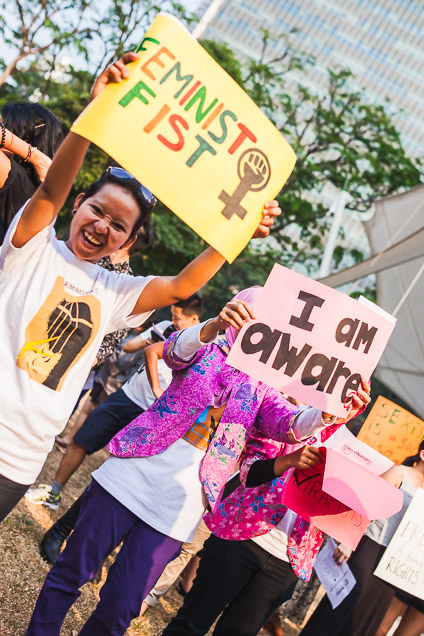
Join us on 8 March as people of all ages, genders and walks of life come together in an electrifying commemoration of International Women’s Day.

Date: 8 March 2015
Time: 4pm-9pm
Location: Hong Lim Park
Invite your friends on Facebook.

There’s something for everyone at All Fired Up! You can see photos of All Fired Up 2014 here.

Programme highlights: 

Mini soccer tournament (4 – 6.15pm)
Our teams will be playing round-robin, 6-versus-6, and only two men per team allowed during play. Come cheer them on.

IWD_Fire_it_up_HongLimPark-078


Blazing a trail (6:15 – 7pm)
Hear from remarkable speakers including Jaxe Pan sharing her experiences as a single mom; Diana discussing her experiences as a Malay-Muslim in Singapore; and more!

Civil society booths (throughout)
Chat with activists and organisations representing a whole range of causes and interests, from migrant workers to LGBT rights to women in STEM. Meet UN Women, HOME, MBI Women in Science, TWC2, Project X, Oogachaga and more.


UPSIZE//DOWNSIZE – A body-positive clothes swap
Bring pre-loved, usable clothing items, accessories and footwear, regardless of size, style and gender presentation and uncover treasures at the swap! Let’s celebrate our ever-changing bodies and all the ways we can support each other in a world that supports limited ways to feel good about our physical selves.

Patriarchy piñatas (5.30pm)
Not just one, but TWO. Come smash your heart out!

When Bellies Speak (7pm)
Celebrate the fire in your belly! When Bellies Speak, a community art project by artist and writer Dana Lam, will install plaster casts of bellies big and small of any age, colour and gender, giving participants the chance to reconsider and reconnect with a part of the body that is the subject of constant abuse.

Celebration toolkit workshop (6 – 6.15pm)
What’s a party without props? Join us for an afternoon of placard- and banner-making to set your message ablaze. We’ll work together to craft slogans and chants for the evening’s festivities.

Children’s corner (throughout)
All fired up is child-friendly! Our kids’ corner will have games, books and activities to keep children engaged.

Dance party (8 – 9pm)
The carnival becomes a dance party at night! If you know any fun feministy tunes to add to our playlist, drop us an email at media@aware.org.sg.

All Fired Up! is generously supported by the High Commission of Canada, Singapore.
High comm canada

Discussing Budget recommendations at the Pre-Budget Forum

budgetOn 24 January, 20 people attended AWARE’s Pre-Budget Forum presenting our recommendations for the Singapore Budget 2015.

AWARE has been submitting recommendations for the Budget for the past five years. This year, our focus is on the need to create a caring economy which recognises and compensates caregivers and which promotes care provision as a public good.

Dr Vivienne Wee, AWARE’s Reserarch and Advocacy Direction, and Yeoh Lam Keong, former Managing Director at GIC Singapore and current adjunct professor at the Lee Kuan Yew School of Public Policy, spoke at this forum.

AWARE is making three major recommendations to the Budget this year, which were discussed at the pre-budget forum:

  1. Provide adequate care of children, the elderly and the disabled as a public good that is available to all in need
  2. Develop long-term financial security for women who stay at home to care for family members, thereby contributing to the national economy
  3. Ensure that women are not disadvantaged in any way by the health care system.

Caregiving

Singapore still lacks a national infrastructure for eldercare, a long-term issue that the Pioneer Generation Package and Silver Support Scheme do not do much to address.

Mr Yeoh suggested that Singapore had failed to devise a framework to finance the needs of an ageing population. “How are the many hospitals and community hospitals we will require going to be staffed, and how will they be afforded by the people who use them? How, as AWARE points out, will we compensate family members, mostly women, who will leave the workforce to care for the elderly?”

Members of the audience also mentioned that the community where someone has lived or worked all their lives becomes increasingly important as a form of physical and social support as they age. Current practice allocates the elderly to nursing homes or hospitals based on availability, causing them to be isolated from their families and social networks.

Childcare and fertility 

On childcare, speakers argued that there is a strong public benefit in subsidising childcare. It is a well-recognised fact that the Total Fertility Rate in Singapore has steadily declined for decades, which can be attributed to the increasing cost of raising a child in Singapore.

Theresa Devasahayam, a fellow at the Asia Research Institute, referred to a 2011 OECD report which found that providing childcare as a public good is more effective at raising fertility than direct cash payments (of which Baby Bonus payouts are an example).

Retirement adequacy and the need for a pension 

The inadequacy of CPF was greeted by the audience with a deep sense of recognition. Given that less than half (48.7%) of active CPF members can meet the minimum sum, this was not surprising.

The outlook is even bleaker for women. CPF draws on wages, which caregivers, usually women, cease to receive when they drop out of the workforce. This has real ramifications for such women as they age.

AWARE argued that such women should be compensated for their caregiving labour, which enables other people in the household to do paid work. Women who do unpaid work at home are in fact contributing to national productivity.

Pension credits were cited as a possible solution at the forum, drawing on economist Chia Ngee Choon’s recent call for an introduction of pensions for the bottom third of the elderly population.

Ensure that women are not disadvantaged by the healthcare system

Lastly, healthcare was also found to have gendered dimensions. For both Eldershield and Medishield Life, women have to pay higher premiums. The reason given by the Ministry of Health is that women have longer life expectancies and thus face higher health risks.

Yeoh commented, “The point of health insurance though is to spread risks through the population. Such insurance schemes should not discriminate against one gender based on their ability to live longer.”

AWARE will be submitting its recommendations on the 2015 Singapore Budget through the Reach platform on 29 January. A copy of these recommendations will be uploaded to AWARE’s website.

Kick off Intl Women’s Day with some football fun

graphic_soccer_girlsWho says football is only for men?! Come show them what you’re made of at All Fired Up, AWARE’s International Women’s Day celebration at Hong Lim Park on 8 March. The electrifying day of celebration will kick off with a mini football tournament. Football beginners welcome!

Date: 8 March 2015, Sunday
Location: Hong Lim Park
Game timing: Kick-off at 4pm, prize presentation at 6.15pm

Tournament rules:

  1. Round robin play-offs, 15 min matches
  2. 10-12 players per team, 6 versus 6 during play with rolling substitution
  3. Players should be at least 15 years old.
  4. Max 2 men per team during play
  5. Registration fee is $20 per team
  6. Winning team will get a cool prize

To register, send your team info to media@aware.org.sg. If you don’t have a team, or are short a couple of players, just let us know and we’ll match you up.

If you’re not keen on sports, join us at All Fired Up! anyway – we have music, dance, lots of chanting, kids’ activities and so much more. More details coming soon!

Pre-Budget Forum

finance

Over the last four years AWARE has made recommendations to the Ministry of Finance as part of the public consultations for the annual Singapore Budget.

Join our pre-budget forum to discuss the 2015 Budget and help us formulate our recommendations for the government’s public consultation on the 2015 Budget (26 November 2014 – 29 January 2015).

This year, AWARE advocates that caregiving be acknowledged in the national economy as a valuable public good. In order to offer ‘a caring economy’ to all, we suggest that the government introduce free childcare, and offer economic compensation to currently unpaid caregivers. Such policies would lead to long-term social and economic gains for all.

To contribute to this public consultation, AWARE invites you to a discussion on caregiving and the Singapore Budget.

Event Details:
Date: Saturday, 24 January 2015
Time: 2pm – 5pm
Venue: AWARE Centre

Click here to register!

Speakers include:

Yeoh Lam Keong, an economist who co-authored the paper “Inequality and the need for a new social compact” in 2012.

Wong Pei Chi, a previous Honorary Secretary on the AWARE Board and a trained economist.

Vivienne Wee,  AWARE’s Research & Advocacy Director presenting AWARE’s position on the Budget 2015.

Join our next Change Maker workshop

we can logoBe a part of the We Can End All Violence Against Women campaign by coming for a workshop and becoming a Change Maker.

Change Makers are people who inspire each other and initiate the process of collective action. They are empowered to reflect upon their own actions, as well as to influence others to end violence against women.

The Change Maker Workshop is a novel forum where people from all walks of life meet and explore ideas, share experiences and discuss existing patterns of belief in our society that tolerate violence against women.

The workshop examines how each of us can contribute to ending gender-based violence by taking small actions in our everyday lives.

Join the workshop, take the Change Maker pledge, and help build a violence-free society.

Wednesday, 3 February 2015
Time: 7:30pm – 9:30pm
Location: AWARE Centre, Blk 5 Dover Crescent #01-22
Click here to register.

We look forward to seeing you at the Change Maker Workshop. If you have any questions, please feel free to contact Kokila at wecan@aware.org.sg