
Year: 2015

End censorship before providing ‘resources’

And Tango Makes Three

By Jolene Tan, AWARE Programmes and Communications Senior Manager

The recent Commentary piece “Why we need more light, less heat on sexuality issues” (29 Jun) rightly calls for a broader conversation and more information relating to LGBT people.

Ms Nadzirah correctly notes that current public opinion may not be based on the fullest available information.  Yet it is peculiar to ask the government to provide more resources, without acknowledging how state restrictions have barred access to existing resources.

Many materials exist that could, as Ms Nadzirah exhorts, push public conversation beyond the framework of “religion versus rights”. However, is this development likely to occur, given the continuing existence of state censorship?

For example, MDA recently banned a music video from singer Jolin Tsai.  It depicts the difficulty a woman had in securing emergency surgery for her female long-term partner, because she was not recognised as a family member who could legally consent to the procedure.  The video was based on a true story.

More awareness of such real-life experiences would help to flesh out the sociological inquiry of what it means to be “family”.  It would also add further ethical and public health dimensions to the discussion on recognition of same-sex relationships.

Likewise, access to information was curtailed, not promoted, when the National Library Board (NLB) removed – and in some cases destroyed – books featuring same-sex relationships.

These books empowered members of the public to educate their children, or even themselves, about LGBT people and their relationships.  They would have been especially beneficial to those who could not afford to buy their own books.

There is no shortage of banned material which could provide opportunities for greater understanding and discussion, by representing LGBT people, their experiences and their relationships in the everyday contexts in which they currently exist.  Both factual and fictional accounts, where they are informed by actual experiences, are useful for this purpose.

Some examples of banned material of this nature are the song “Rainbow” by Taiwanese singer A-Mei and an Archie comic which depicted a same-sex marriage.

The restrictions on access to diverse information and perspectives go beyond individual cases of censorship of specific materials.

Importantly, LGBT groups such as Sayoni and People Like Us have been unable to register as societies.  Consequently, they face additional barriers when engaging in public outreach and education.  This muffles important sources of information about what it is actually like to be an LGBT person in Singapore.

There may well be a role for the government in providing resources on LGBT people.  The Health Promotion Board’s online FAQs on sexuality are a good example of state information helping to disseminate factual content and dispel myths.

However, to leap straight to the state as a major information provider, without first eliminating censorship of LGBT people’s voices and experiences, puts the cart before the horse.  Many resources already exist – but we need to stop blocking people from accessing these.

This letter was written as a reply to this commentary on TODAY.

State support for the elderly crucial

By Goh Li Sian, Research and Advocacy Coordinator, AWARE


Recently, attention has been given to the fall in the number of nuclear families and its implications for social support.

We wish to caution against assuming that extended family support can or should be the main source of social support (“Extending the support of families”; last Saturday).

This is a simple matter of arithmetic. There are currently 4.8 working adult citizens for each elderly citizen, a fall from 8.4 in 2000. This ratio is set to decrease to 2.1 by 2030.

Yet, Singapore’s population is growing, mostly due to immigration. It does not make sense to limit the support for older people to the resources of their immediate or extended families. Rather, the taxes paid by all people working in Singapore should contribute.

Working adults are now less able to support aged parents financially, let alone extended family members. Doing so risks compromising their own financial security in old age, creating a greater burden on their own children.

Insisting on “intergenerational responsibility within families” over socialising costs will reinforce inequality between households over several generations.

High-income earners may well be able to provide for their elderly parents and other relatives, as well as plan for the future. However, low to middle-income earners will be impoverished, and their chances of social mobility negatively affected.

Recently, the Association of Women for Action and Research conducted in-depth interviews of 20 elderly, low-income women to understand their priorities and needs in old age.

Nearly three-quarters of these women reported that their children did not provide them with financial assistance, that money was a source of tension in their relationships with their children, or that their children may have been willing to support them financially but were torn between supporting their elderly parents and their own children.

Moreover, if older people are dependent on their family members for financial support, they will also be more vulnerable to elder abuse.

There is no proof that older people would rather rely on kin than receive support from the state. There is nothing shameful about social support – it is simply an expression of our collective responsibility and commitment to all members of our society, as acknowledged by the Silver Support Scheme, introduced earlier this year.

And who has a better claim to society’s support than the elderly who have spent their entire lives contributing to it?

This letter was first published in The Straits Times Forum on 26 June 2015.

Who should win the AWARE Awards 2015?

img-thing

AWARE is celebrating a landmark of 30 years of history this year and we’d like to commemorate those who have helped play a part in paving the way to gender equality in Singapore through our two annual awards – the AWARE Award honouring those who contribute to gender equality, and the ALAMAK Award, given to those who do the opposite. And we want your nominations!

AWARE Award

Do you know anyone who has contributed significantly to gender equality in Singapore? Nominate them for the AWARE Award 2015!

Since 2011, AWARE has been celebrating those who further gender equality with the AWARE Awards. The winners this year will be announced at our fundraising gala, the Big Birthday Ball, on 7 November. Click here to see the winners of 2014.

Fill this short form to nominate people or organisations who you think deserve the AWARE Award 2014! You can read FAQs and eligibility criteria here. Nominations will close at the end of August.

ALAMAK! Award

Although we are well into the 21st century, there are still remarks, commercials and policies that perpetuate gender stereotypes and sexist attitudes. So we created the Alamak! Award, an annual search for the most annoying, you-have-got-to-be-kidding-me instances of sexism in Singapore. Did you witness a jaw-dropping instance of sexism over the last year? Nominate it for this year’s ALAMAK Award.

Click here to send us your nomination.

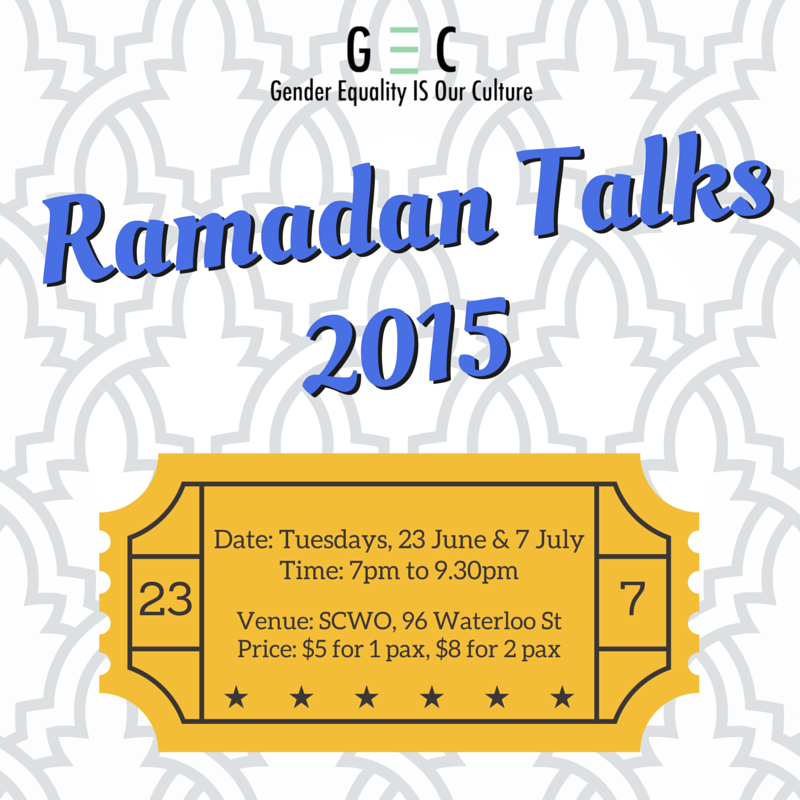
Gender Equality IS our Culture: Ramadan talks 2015

gender symbols

Ramadan Talks are back! For our second round of Ramadan Talks we will be holding a 2-part series of presentations and discussions about Muslim women.

Transcending Multiracialism: A Case Study of the Hijab Debate in Singapore
by Humairah Zainal (NTU) and George Wong (NTU)

This presentation will critically examine the hijab debate that has persisted in Singapore and show that the current discourse centres around two main aspects:
(i) the problematization of the Malay-Muslim image by the state towards national identity and social cohesion; and
(ii) the role of the state as the sole guardian of racial harmony among the different racial and religious groups in Singapore.

Tuesday, 23 June 2015
SCWO
7PM to 9.30PM
Register for this talk here!

Reflections on Muslim Women’s Role and Contributions in History
by Diana Rahim and Ariz Yusaf Ansari

Diana Rahim will be presenting on Maryam, or Mary. She is widely recognised by the Christian community as the mother of Jesus. She is however, also one of the most revered women in the Islamic tradition. This presentation will go through Maryam’s significance in the Islamic context even though she lives in a pre-Islamic time, and what exactly is it that earned her such a significant status in the Islamic tradition, to a point of even having a surah named after her in the Qur’an.

Ariz Yusaf Ansari’s presentation will be about G Willow Wilson, a journalist, novelist and comic book writer. It will cover her experiences and the themes she tries to bring across through her diverse works of literature. It will also address how she contributed to the diverse narrative of religion in comic books and discuss the sociopolitical implications of the superhero archetype for Muslims.

Tuesday, 7 July 2015
SCWO
7PM to 9.30PM
Register for this talk here!

Individual price: $5 for 1 person/session
Pair price: $8 for 2 persons/session

Price includes cost of catered food.
Prayer space is provided.

Time to stop upholding singular standard of beauty

By Zarifah Anuar, Communications Executive, AWARE

11270483_973354422676997_1914455530335340819_oWe refer to the report “HSA raises alert over high mercury levels found in 2 cosmetic products” (June 9).

Even where skin whitening products are not dangerous to one’s health, their popularity and marketing reveal disturbing attitudes toward beauty ideals and skin colour. The idea that “fairer is better” has very exclusionary implications in a multiracial society with women of all shapes, sizes and skin tones.

For instance, recently, a column published in Cosmopolitan Singapore by their senior beauty writer Elizabeth Lee described the “perfect Singapore girl” as one that is “slim and petite with shapely legs”, has a “fair, porcelain complexion”, “big eyes and a small face with a defined jawline with feminine long hair”. This not only excludes many Chinese women, it also completely excludes Malay and Indian women.

When the beauty industry pushes skin whitening products, it implies that one’s natural skin colour is a problem that needs fixing. Disturbingly, the global market for skin-whitening products has been projected to grow to US$19.8 billion (S$26.6 billion) by 2018.

Personally, I love my brown skin and I am sure many other women do, too. However, for many of us it is a common experience, even from childhood, to be told to stay out of the sun so we would not become dark, and to put on a whole variety of clothing and creams in order to protect our skin from becoming too brown. What are the implications of this message for diversity and inclusion in our society?

It is time for us to stop upholding this singular standard of beauty, especially one that is unrealistic in Singapore. We need to include and represent all skin tones in our media. Magazines and other mass media can start by having more diversity by employing more models of non-Chinese and non-Caucasian descent to grace their covers and their pages.

Such moves could even increase readership, since the publications would be appealing to a larger audience.

This letter was first published in TODAY Voices on 16 June 2015.

Guest blog: Make Contraceptives More Accessible

enhanced-2128-1432841951-12

By Min, AWARE Intern

The views expressed in this post are the writer’s own personal opinions.

28 May was the International Day of Action for Women’s Health. Being a young woman, I have many questions about women and health in Singapore. Are women allowed to make informed decisions about their bodies, lives and sexuality? Do they have access to sexual and reproductive rights and the related health services?

I remember in primary and secondary school, sex education was all about teaching us the benefits of abstinence. We were warned that although condoms and other contraceptives can prevent unwanted pregnancy, they are not one hundred per cent reliable. We were also warned about the risk of getting Sexually Transmitted Diseases (STDs).

The overall picture of sex painted was very negative – they did not tell us about the possible joys and benefits of sex. I grew to treat sex with disdain. Even after getting over that perception, I realise that despite all the preaching about practicing safe sex, contraceptives were not readily available to us anyway.

While the age of legal consent in Singapore is 16, obtaining contraceptives may not be that easy at that age. When I was 17, I went to a convenience shop to buy condoms as part of a dare. The lady at the cashier stared at me with wide, bulging eyes and asked for my IC, before telling me that I had to be 18 and above to buy condoms.

I later found out that there was no such age limit in the law. But the incident did show how difficult it is to obtain contraceptives as a teenager, due to the nature of our conservative culture. You have to face shame, embarrassment, hesitation and the fear of getting judged. It takes a lot of courage in order to obtain contraceptives, no matter what age you are. This difficulty increases the risk of young people taking part in unsafe sexual activities.

Aside from condoms, my sex education classes gave me no clue of how to obtain any other forms of contraception. How can women responsibly take care of our own health if we are not given enough information?

I believe more can be done to increase access to sexual and reproductive health services, as well as improve perceptions towards it. As prevention is better than cure, easy access to contraceptives is the first step to preventing unwanted pregnancy. Easy access does not just mean dealing with the physical barriers, but also the cultural ones.

招募华语热线义工

telephone

AWARE 援助热线是专门为需要帮助的妇女所设立,并由受过训练的女性义工为求助者提供协助。中心将开办为期5个月的热线培训课程(以华语教课)。如果你也想成为热线义工的一份子,我们欢迎年龄在23岁以上,能讲流利华语,略懂英语,及基本电脑操作的女性朋友前来报名。

课程日期:2015年9月22日- 2016年3月16日
时间: 每逢星期二晚上七点 – 九点
(12月份以及新年前后礼拜放假)

欲知更多详情,请在9月15日之前通过电话或电邮向Grace 或 Siang Hui 查询。

电话: 6779-7137
电邮: awarehelp@aware.org.sg /sianghui@aware.org.sg
地址: Blk 5, Dover Crescent, #01-22.
Singapore 130005.

Ministries should publish reports on impact of schemes

By Edwina Shaddick, Training Institute Executive, AWARE, and Goh Li Sian, Research And Advocacy Coordinator, AWARE

budget 2A debate has emerged, following the death of our longest-serving Prime Minister, Mr Lee Kuan Yew, about whether Singapore’s successes indicate that we must keep doing the same things.

On his Facebook page, Mr Donald Low, associate dean at the Lee Kuan Yew School of Public Policy, argues otherwise: That present circumstances differ from those of the past and therefore warrant different responses.

Indeed, gratitude for what we have now should not stop us from debating our future. Nor should a desire to address the needs of the present be equated with ingratitude.

As Mr Low mentions, a key element of the debate is about state accountability, both procedural accountability, which means regular, free and fair elections, and performance accountability, or the “extent to which rulers advance the broader interests of society”.

Currently, Singapore does not rank very high in government transparency. A World Wide Web Foundation study published this year showed that although we scored best in South-east Asia, we came in bottom among developed countries.

Greater accountability is needed now. The Singapore Budget 2015 saw an increase in government spending in several areas.

The Finance Ministry estimated a deficit of S$6.67 billion, which is not necessarily a bad thing if the money is used wisely.

Deputy Prime Minister Tharman Shanmugaratnam noted that the schemes to help entrepreneurs were “more generous than in any other economy … when you add up all our schemes” and that entrepreneurs must “rise to the occasion”.

Likewise, he argued that Singapore already has generous transfers to low-wage earners.

However, to ensure that the increased spending is cost-effective and that implementation meets the targeted objectives, one suggestion might be to require ministries to publish annual reports on the impact of their budgetary schemes.

Ministries in many countries do issue annual reports. Public-listed companies, statutory boards and charities are required to do so. It stands to reason that ministries in Singapore should do so.

Currently, much of the information on the impact of ministry policies comes from answers to parliamentary questions.

Alternatively, the public is informed when ministries choose to release information, which is done in an ad hoc or discretionary manner, making it difficult for the public to understand how effective government policies are.

More detailed information on allocation, expenditure, implementation and impact can foster greater accountability, which should be an essential part of our society.

As we consider what steps we should take to address present needs, we must put in place monitoring and evaluation processes, with results to be made publicly available.

In this way, we as a nation can engage meaningfully in the shaping of a sustainable, inclusive future.

This letter was first published in TODAY Voices on 8 May 2015.