

Year: 2017

S’s story: Our support matters. Reform suicide law.

Last September, AWARE called for the law criminalising suicide to be reformed – urging that it should no longer be an offence.  We also made recommendations to improve first response so that persons attempting suicide – who are already in distress – are not further traumatised by experiences of arrest.

This issue has gained attention in Parliament recently, with Senior Minister of State Mr Desmond Lee announcing in November last year that the Government is prepared to review suicide laws. Earlier in February, NMP Kok Heng Leun suggested that MSF consider having a specialist team to provide psychological support and mental health expertise and accompany the police when responding to cases of attempted suicide. MSF replied that the current approach of mobilising the Police “prioritises (the attempter’s) immediate safety” and “time taken to mobilise a larger team… may delay (their) response”.  (See full text of question and answer).

Unfortunately, accounts from suicide survivors suggest that current processes are not adequately sensitised to their needs.  Here is S’s story.

S’s story: Social worker called the police because she was having suicidal thoughts, police then threatened to send her to IMH in handcuffs

For five years, S did not have a home. She bunked in with relatives and friends from time to time or slept in the streets before moving into a women’s shelter end 2016. In February 2017, S met with her social worker to discuss how she was finding the shelter. S was staying with five other women in the shelter who would frequently quarrel with each other and they all complained to S about their conflicts. S told him that her stay was fine but sometimes, she would feel ‘overstressed’ from having to listen to her roommates fight and complain to her. When the stress felt overwhelming, S said she would have suicidal thoughts at times.

Without S knowing, her social worker then sent a text message to S’s employer, saying that she was not feeling well and unable to go to work, and also called the police. Two police officers arrived at the social worker’s office and immediately started to question S. A police officer raised his voice asking ‘why are you suicidal?’ At around 7pm, two more officers and an Investigation Officer (IO) arrived. S found the IO to be ‘very pressurising’ as he repeatedly asked, ‘Do you want me to arrest you? Do you want me to catch you?’

S was bewildered by the police’s involvement as she was not actually attempting suicide. She felt that she was just doing what one does to a social worker – expressing her frustrations and feelings to someone who was supposed to listen and offer support.

The IO then suggested that S be sent to IMH, saying ‘you go or we will handcuff you to go’. S asked a second social worker (M) if she really had to go to IMH and M said yes. Before leaving for IMH, S managed to call and inform her step-brother that she was going to IMH.

S arrived at IMH at around 10pm, where she took various blood tests and spent 2.5 hours waiting to see a doctor. The doctor said S was OK and there was no need for overnight admission.

However, even after S was cleared by the doctor, M asked if IMH could admit S for two to three days, saying that they were worried if S were to go back to the shelter, she would ‘do something stupid’.

S described IMH as ‘scary’ and protested against her admission. The doctor confirmed that she would not be admitted into IMH.

The bill for consultation and medication came to $150. However, S felt that it was unfair for her to pay as she was there against her will, and she was also in financial distress at that time.

S found the experience to be ‘very traumatic’ and is upset by the fact that she now has a police and an IMH record from this incident. She was also very disappointed with her social worker for calling the police instead of providing a listening ear to her.


S is currently on her back-to-work support journey with Daughters Of Tomorrow, an economic empowerment programme supported by AWARE.

AWARE response to AGC statement (Joshua Robinson case)

AWARE’s public response to this case is delayed as it was submitted to The Straits Times, but rejected for publishing. Click here to read the AGC’s official statement on their decision not to appeal against the sentence.

The statement offered by the Attorney-General’s Chambers (AGC) on the Joshua Robinson case points to the need for a clearer legal definition and public understanding of consent in sexual assault cases.

Consent to sexual activity must be fully voluntary agreement, untainted by factors like coercion or abuse of authority.

Singapore’s case law is fairly nuanced.  The courts have recognised, for instance, that consent initially given can be later withdrawn during sexual activity, and that consent to one form of intimacy, such as kissing, is not consent to other forms of intimacy, such as intercourse.

However, case law is not accessible to most people.  There is no single statutory definition of “consent” which clearly lays out all the key points of the law.

Section 90 of the Penal Code non-exhaustively states some factors which vitiate consent, such as the fear of injury, or misconceptions of fact.

For instance, saying “yes” to sexual activity out of fear that intimate videos will be circulated should not amount to consent.

Yet in our experience, the absence of a single clear and comprehensive statutory definition can lead to public confusion, including among sexual assault survivors and agencies who may encounter them.

The AGC has introduced a further disquieting element, by characterising sexual activity between an adult and minors aged 15 as “consensual”.

In our view, minors under the age of 16 should not ever be said to have legally consented to sexual activity with adults, given the significant and unavoidable power imbalance between the parties.

This is surely the entire principle underlying the existence of Section 376A of the Penal Code, which criminalises sexual penetration of a minor.  The act constitutes an offence precisely and only because the vulnerability of the minor and the adult’s position of authority together prevent the minor from giving fully voluntary agreement.

The AGC’s statement may have the troubling effect of deterring minors from reporting sexual abuse by adults, because they may believe these will be seen as “consensual”.

We urge proper codification of the law of consent, including a clear recognition that minors cannot be understood to consent to sexual activity with adults.  Any review of criminal justice responses should proceed on this basis, and with close attention to evidence-based best practice in other jurisdictions, including options such as restorative justice sentencing and background checks for those working with young people.

​Increase proactive coordination to meet needs of families in transition

This post was originally published as a letter in TODAY newspaper. 

The recent letter ‘Clarify HDB assistance scheme for second-time applicants’ [4 March 2017] highlights the difficulties that divorced or widowed parents face when applying for HDB housing.

The author suggested that the Assistance Scheme for Second-Timers (Divorced/Widowed Parents) (ASSIST) could be under-subscribed. As of end 2015, there were 282 applications – a low figure considering the divorce rate (7,522 in 2015).

The HDB website states that those who have disposed of a flat or a private property after divorce or demise of the spouse do not qualify. Yet divorced couples are often ordered by the court to sell their matrimonial flats, and thus typically fall foul of this criterion on its face. This is a strange outcome when the stated purpose of ASSIST is to help divorced and widowed parents with minor children.

If the intention is to exclude those who hold on to a matrimonial flat for many years after divorce, but not to disqualify those who sell promptly following a court order, HDB should make this explicit.  Otherwise, the publicly available criteria are confusing and will needlessly deter applicants.

This points to a wider difficulty with information about housing rules.  Our research into the barriers faced by single parents in accessing housing showed that many found HDB rules and policies complicated and hard to understand.

The HDB website did not always answer their questions. Some reported that HDB officers did not always offer explanations for why applications failed or what alternatives they could try. Even if relevant schemes are in place, or waivers are available for some rules, these options are not always made known to applicants.

For example, in the last three years, over 1,900 applications have been made to waive the income ceiling for rental housing, of which 273 were successful. Yet our research found individuals who, in the face of this ceiling, had been told by HDB to stop work, took lower-paying jobs, or simply scrambled with great difficulty to leave their rental flats instead of seeking a temporary waiver and extension.

Since HDB officers are the most closely acquainted with the rules and schemes, they are the best placed to proactively explain the options available to applicants, who are already facing stress from circumstances such as divorce or death of a spouse.

Currently, because of the opacity in the system, single parents rely heavily on help from their MPs. This approach is arbitrary, time-consuming and dependent on the applicant’s individual ability to challenge the system and seek the ‘right’ people for help.

To better ensure that single parent families receive the support they need, we recommend that the government establish a central coordinating unit catering to families transitioning to single-parent households. Such a unit should coordinate policies and services that would meet their needs, and reduce current reliance on this arbitrary approach.

AWARE And Alamak Award Nominations Are OPEN: Nominate The Best – And The Worst – In Gender Equality!

This year’s annual fundraising Ball will celebrate AWARE’s work on gender equality advocacy in Singapore – which wouldn’t be possible without all those who have helped to pave the way towards a more equal and inclusive society. The AWARE Awards honour those who contribute to gender equality, and the ALAMAK Awards, are given to those who, unfortunately, do the opposite. And we want your nominations!

AWARE Awards

Since 2011, AWARE has been celebrating those who further gender equality with the AWARE Awards. The winners this year will be announced at our fundraising gala, the Love Ball, on 8 September. Click here to see the winners of 2016.

Do you know anyone who has contributed significantly to gender equality in Singapore?

Fill this short form to nominate people or organisations who you think deserve the AWARE Award 2017! You can read FAQs and eligibility criteria here. Nominations will close at the end of August.

ALAMAK! Awards

Although we are well into the 21st century, there are still remarks, commercials and policies that perpetuate gender stereotypes and sexist attitudes. So we created the ALAMAK! Awards, an annual search for the most annoying, you-have-got-to-be-kidding-me instances of sexism in Singapore. Did you witness a jaw-dropping instance of sexism over the last year? Nominate it for this year’s ALAMAK Award.

Click here to send us your nomination.

AWARE collaborates with local artists to produce comics illustrating single parents’ stories

Single parents face serious difficulties accessing public housing. From unrealistic income ceilings to a lack of transparency and clarity in policies, their families can experience stress, uncertainty and financial pressure, overcrowding and tension in relatives’ homes, and frustration with poorly explained and uncertain processes.

We’ve recently embarked on a fantastic collaboration with four local artists to illustrate some of these barriers and challenges – in comic form! Huge thanks to Clogtwo, Inkten, Weng Pixin and Neo Ann Gee for bringing their stories to life. Check them out on the #asinglelove website!

Learn more about the findings from our latest report here.

P’s story: his wife had to leave Singapore, his newborn waited a long time for citizenship

In December 2016, to commemorate International Migrants Day, AWARE released a policy brief calling for greater equality and inclusion for foreign spouses of citizens. We later heard from P, a Singapore citizen, about the difficulties he has faced due to the current immigration rules.

P is a semi-retired Singapore citizen married to a Thai woman. Although their marriage was registered in Singapore six years ago, P’s wife was only given a Long-Term Visit Pass (LTVP), which has to be renewed every six months. P and his wife produced the same documents each time, but on the fourth renewal, their application was rejected by ICA without explanation.
The ICA officer then said that there was no choice but for his wife to leave Singapore for three months before she could return and stay for a month on a Short Term Visit pass. This process – which P finds unacceptable, especially in cases of marriage – repeats if subsequent applications for LTVP are unsuccessful. P’s wife was thus forced to leave the country.

P wrote an appeal, which was also rejected without explanation. He then called ICA and spoke to an officer to appeal again, and succeeded this time. He thought that this system of having to appeal and requiring applicants who are able to ‘challenge’ the ICA is arbitrary and ‘clearly not right’.

The process of making multiple trips to ICA and submitting the same documents every six months was ‘a waste of time’ and ‘unproductive’ to P. Dealing with the uncertainty of each renewal status was also stressful.

P also faced hurdles applying for citizenship for his son who was born overseas. He said it was a ‘simple’ process with little paperwork. However, his application kept getting delayed and every enquiry about its status was met with ‘we are looking into your case’. After enquiring with ICA and 11 months later, he wrote directly to a high-ranking officer in MHA. Eight hours later, an ICA officer called and informed P that his son’s citizenship was approved.

During this period, P said he could not access polyclinics for his son’s immunisations or when his son fell sick, which resulted in him having to pay higher prices at private clinics. There was also always a nagging worry about unexpected healthcare costs such as hospitalisation.

“This policy has caused a lot of unnecessary financial and emotional hardship,” said P. “Spouses of citizens should have priority in getting PRs and eventually becoming citizens.”

Our support matters. Reform suicide law.

Last September, AWARE called for the law criminalising suicide to be reformed – urging that it should no longer be an offence.  We also made recommendations to improve first response so that persons attempting suicide – who are already in distress – are not further traumatised by experiences of arrest.

This issue has gained attention in Parliament recently, with Senior Minister of State Mr Desmond Lee announcing in November last year that the Government is prepared to review suicide laws. Earlier this month, NMP Kok Heng Leun suggested that MSF consider having a specialist team to provide psychological support and mental health expertise and accompany the police when responding to cases of attempted suicide. MSF replied that the current approach of mobilising the Police “prioritises (the attempter’s) immediate safety” and “time taken to mobilise a larger team… may delay (their) response”.  (See full text of question and answer).

Unfortunately, accounts from suicide survivors suggest that current processes are not adequately sensitised to their needs.  One such survivor – M – contacted us and recounted how her arrest for suicide and subsequent referral to IHM left her worse off.  Here is her story.

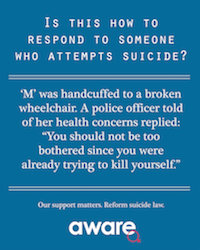
M’s story: Handcuffed to a broken wheelchair; a police officer told of her health concerns replied “You should not be too bothered since you were already trying to kill yourself.”

M experienced a series of traumatic events over four years, losing her mother, her marriage, custody of her child, her home and her job, and undergoing surgery that left her with a temporary loss of mobility. She felt like “a loser in life” and her depression eventually cumulated in a suicide attempt in October 2016.

She lit charcoal in the bathroom of a hotel room, planning to kill herself with carbon monoxide poisoning. However, police officers were at the door in five minutes, having been tipped off by someone else who knew about her attempt. A female police officer reassured M that they would only enter the room after she had gone to the toilet, so she unlatched the door. At least seven male officers dashed into the toilet within seconds, before M had barely pulled up her underwear. A frustrated and overwhelmed M then underwent two rounds of questioning.

The police handcuffed M to a wheelchair and brought her to a hospital for examination. The next morning, it was raining when M was discharged. She warned the officer that her leg had metal pins in it from an earlier surgical operation and that she had been advised by doctors to avoid contact with water. The officer commented that she should not be too bothered since she was already trying to kill herself. M was left speechless.

For one day, she was placed in lockup in a cold and dirty cell. Both her wrists were handcuffed to a broken wheelchair. Despite M’s request for a doctor due to her eczema, none arrived.

She was later warded in the High Dependency Unit at IMH for six days. There, she was traumatised by the  screams and sight of other patients being tied down and sedated. M found it difficult to sleep and could only get 3-4 hours of sleep a night. One night, at around 1-2am when she could not fall asleep, she decided to read. A nurse on duty said that she could not read at that hour and that if she continued reading, she would be tied to her bed and sedated. Welcoming the thought of being sedated so she could fall asleep, M challenged her to do so and she ended up being tied down to her bed without sedation. M tried to bite herself free and another nurse had to intervene to stop her from doing so.

Overall, M felt that her she is worse off both mentally and emotionally after her stay at IMH and wished that the staff from both IMH and SPF had treated her with more empathy.

It’s time we talk: Two courageous speakers on their experiences of sexual assault

On 1 March, AWARE’s Sexual Assault Care Centre (SACC) invited South-African born Claire McFarlane to speak about her experience with sexual assault. Around 30 people attended the event, including a former client of SACC, Emily, who shared her own traumatic experience of sexual assault in Singapore.

Emily discussed the pervasive myth that sexual violence just doesn’t happen in Singapore – and indeed, that this was something she didn’t think would happen to her either. She went into detail about the discouraging experiences from people/authorities she wanted to seek help from. Eventually, she found solace at the SACC; and she praised our services and staff for telling her what she needed to know, while empowering her to make her own decisions without judgment and with plenty of empathy and support.

Finally, she pushed for more open dialogue to bring some lasting change, as so many cases go unreported due to unsupportive responses from authorities, peers and family members.

Claire then opened her talk by recounting her own ordeal, which happened over 18 years ago while she was studying abroad in Paris. She described her experience of being first a ‘victim’ and then a ‘survivor’ – the victim within the initial criminal process; and the survivor, an empowered victim, at the turning point of recovery. She speaks of her own journey to recovery, which sadly took over much of her adult life.

Sexual violence is one of the biggest epidemics of our time. It is still often seen as a “women’s problem” – though, as Claire points out, sexual violence can affect anyone, and crosses all boundaries.

She shares with the first speaker the same belief: that plenty of courage is needed to break silence, as well as the need to empower other survivors. Her project ‘Footsteps To Inspire’ seeks to unite survivors through running. She aims to run 3,000km of beach, barefoot, across 184 countries, in support of rape survivors around the world. She will engage local communities to start speaking up and creating dialogue around sexual violence. She will be running in Singapore on 4 March (Saturday) and invites anyone and everyone to join her.

SACC manager, Anisha, shared that SACC has seen over 1000 survivors of sexual assault. Many felt alone and unsupported, because people think sexual violence just doesn’t happen in Singapore. The centre has seen survivors who have experienced different forms of sexual assault , from verbal sexual harassment to rape. 8 out of 10 survivors knew their perpetrators. It’s time we talk about this. The more we talk, the more we can create a community of support for survivors. The more we talk, the more we encourage survivors to seek help. And the more we talk, the more accessible justice is to them.

Find out more about Footsteps To Inspire here: https://www.projectbra.org/register

It’s time we talk. Different shades of sexual assault – A talk by Claire McFarlane

In collaboration with Footsteps to Inspire and in conjunction with International Women’s Day, AWARE’s Sexual Assault Care Centre (SACC) invites you to show your support for sexual assault survivors – and raise awareness on the many unspoken forms of sexual assault.

Date: 1st March 2017 (Wednesday)
Time: 7.30 – 8.30pm
Venue: AWARE Centre, Block 5 Dover Crescent #01-22

In 1999, Claire McFarlane was brutally raped and left for dead on the streets of Paris, France. What followed was an arduous, long battle to find justice, which only came to a close on 1 October 2015. Her ordeal lasted 16 years. On 18 July 2016, she began a mission to run 3000km of beach barefoot across 184 countries in support of rape survivors. She is coming to Singapore, her 13th country, to share more about her journey of recovery.

SACC has seen over 1000 survivors of sexual assault. Many felt alone and unsupported, because people think sexual violence just doesn’t happen in Singapore. It’s time we talk about this. The more we talk, the more we can create a community of support for survivors. The more we talk, the more we encourage survivors to seek help. And the more we talk, the more accessible justice is to them.

Speaking at this event together with Claire McFarlane is a client of the SACC who faced sexual assault in Singapore.

If you or anyone you know have experienced sexual assault in any form, register for the talk here and break the silence.

About Claire McFarlane

Claire McFarlane is an advocate for survivors of rape. On 18 July 2016, she began running 3000 kilometres of beach across 184 countries in support of rape survivors, as part of Project Beach Run for Awareness (ProjectBRA). ProjectBRA is about peaceful dialogue and a positive vision of change for survivors of sexual violence. She has met with local NGOs and services in over a dozen countries to share stories and understand what the issues, complexities, difficulties and hopes are for survivors in each country.

About SACC

The Sexual Assault Care Centre (SACC) is Singapore’s only specialised service for women who face sexual assault. SACC’s counsellors, lawyers, befrienders and social workers provide empowering, supportive assistance to help clients in their recovery.