

Year: 2017

2017 Budget a missed opportunity to tackle care economy

This post was originally published as a press release on 20 February 2017. 

This afternoon’s Budget speech by Minister of Finance Heng Swee Keat sought to set out directions for the future economy, but could have done substantially more to tackle the significant issue of the care economy in the face of an ageing population, said the Association of Women for Action and Research (AWARE).

“Neither the Budget nor the Committee for the Future Economy directly addressed the critical impact of caregiving pressures on the economy, or how to systematically support the people – usually women – who perform it,” said Jolene Tan, Head of Advocacy & Research at AWARE. “This pressure will grow as the needs of older people in particular increase significantly in years to come.”

“In our pre-Budget recommendations, both AWARE and NTUC specifically highlighted female labour force participation as an area requiring greater governmental investment,” said Jolene Tan.  “AWARE was disappointed that the Minister did not touch on this expressly, despite acknowledging the need to look at the labour force in a granular way.”

When women are pushed out of the labour force by caregiving pressures, this harms their economic well-being, imposes costs on businesses – due to lost talent and turnover – and sets the stage for future financial inadequacy on retirement, with all its attendant social costs.

Support for older people

While the Minister offered increased support for the employment of older workers, AWARE urges a more explicit recognition that longer-term financial and care needs for older people cannot be met by opportunities for paid work alone.  We hope to see the Government look more into developing long-term care, facilitating caregiving through measures such as eldercare leave, and building on non-contributory schemes such as Silver Support.

Support for housing

The Minister also announced increased grants for first-timers – particularly married couples – purchasing HDB flats, a policy intended to support families.  Yet there was a missed opportunity to consider the housing needs of single parents – whether unmarried, divorced or widowed.  These families, as highlighted in AWARE’s recently released study, face barriers in obtaining stable, secure homes, with serious implications for the welfare and social mobility of their children.

“Resources should not only be invested in housing to encourage people to have more children,” said Jolene Tan.  “It is also important to address the current unmet needs of existing families, and children who are already among us.”

Support for childcare

The announcement of increased infantcare capacity is very welcome.  We urge the Government to also do more to improve the affordability of childcare, and in particular to reassess the preconditions of infantcare subsidies (as discussed in our Recommendations).  When work is a precondition for subsidies, this sets up a chicken-and-egg barrier to women’s employment – since childcare is often a precondition for finding and keeping employment.

Similar issues affect the success of skills upgrading programmes – women with childcare responsibilities cannot benefit from such programmes if they do not have alternative care in place.  This can limit the effectiveness of skills upgrading initiatives.  We thus welcome the announcement of shorter, more modular skills courses and urge the Government to closely assess the accessibility of such programmes for those with caregiving responsibilities.

Support for persons with disabilities and mental health conditions

We welcome the announcement that more moves will be made to address barriers faced by persons with disabilities, and those with mental health conditions, in the area of employment.  We also welcome, as a step in the right direction, the news of more initiatives to support caregivers of persons with disabilities. We hope that the government will closely monitor the impact of the services provided by the Support Centre and expand their availability as needed.

Read our recommendations for the 2017 national Budget here. (Click here to read the accompanying press release).
AWARE welcomes initiatives to better support sexual assault victims in criminal justice system

This post was originally published as a press release on 17 February 2017. 

The Association of Women for Action and Research (AWARE) strongly welcomes the government’s newly announced initiatives to promote a more victim-centric approach in the handling of sexual assault cases by the criminal justice system.

In AWARE’s experience at the Sexual Assault Care Centre (SACC), the sensitive and empathetic response to survivors of sexual assault is critical to both their psychological and emotional recovery, as well as their willingness to engage with the reporting process and thus help the criminal justice system to hold perpetrators accountable.

“A victim-centric process is better for everyone,” said Jolene Tan, Head of Advocacy & Research at AWARE.  “It better meets victims’ needs, and it assists investigators by eliciting greater cooperation and confidence from victims, making it easier to find out the facts.”

AWARE hopes that these improvements will help to address under-reporting and attrition of sexual assault and sexual harassment cases in the criminal justice system. “In our experience at SACC, such incidents are substantially under-reported,” said Jolene Tan. “A majority of our clients do not report their experiences to the police.”

The main reason cited by clients for not making police reports is a fear of not being believed or not having enough evidence. Other top reasons were worry about how family and friends would react, and fear of public exposure. The most frequently reported offence was rape (more frequent than either physical or non-physical sexual harassment).

In 2016, 338 people reached out to SACC – 41% of them did so in connection with an incident of rape.

Among young people, a 2014 survey by AWARE found that only 6% of those who had experienced sexual assault or harassment sought help of any kind (including but not limited to police reports).

AWARE has worked closely with the Serious Sexual Crimes Branch (SSCB) of the Singapore Police Force (SPF) over the last three years. We regularly provide SSCB with our clients’ feedback on their experiences with the police investigation process. SSCB has been receptive to this feedback and has been committed to ensure a supportive experience for the cases that we have referred to them.

“The current initiatives will help to ensure that police processes and capabilities are improved on a systemic level, not just on a case by case basis,” said Jolene Tan.

AWARE’s further comments on specific elements of the initiatives are found below.

a) Training video

SACC is delighted to collaborate with the police in developing this new training video to help supplement police officers’ understanding of a victim-centric and trauma-informed perspective, by giving them a better idea of how victims feel, why victims speak or behave as they do, and how police and other first responders can have an impact on them.

Since we have begun offering services to sexual assault victims, we find that their experiences with police have been uneven.  We greatly appreciate SPF’s move, in conducting this training, to proactively ensure a more consistent understanding of the victim perspective among officers, as everyone needs to be able to approach the police with confidence.

In society at large, we see many misconceptions about sexual assault and a lack of understanding of the reality of victims’ experiences.  For example:

– There is a tendency to criticise victims for irrelevant choices such as their clothing, appearance or actively socialising.

– There is widespread misunderstanding that there is no “perfect” or “normal” way to behave after an assault – some people cry, or make reports immediately, or physically struggle against a perpetrator, but not all behave in these ways.

– People do not realise that trauma can affect how victims give their accounts, leading to what may appear to be gaps in memory.

When we let these and similar misunderstandings about what the victim “should” do affect how we talk to them and what we believe, this can discourage them from engaging further – which may impact the ability of investigators to gather facts – and it can also harm victims psychologically and emotionally.

These gaps in understanding exist across society.  Because police occupy a special position, it is particularly important that they are systematically sensitised to ensure that they can fulfil their mission of seeing to justice and the safety of victims.

b) OneSAFE pilot

We welcome this pilot programme and hope to see similar services rolled out with greater availability in the future.  Clients of SACC have frequently reported frustration and difficulty due to the number of trips, long waiting times, and multiple statements about the assault, when reporting sexual assault.  By combining medical assistance, forensic examination and police reporting, this initiative has the potential to make the reporting process much less onerous and stressful.

c) Punishment

We believe that it is important to hold perpetrators of sexual assault to account, including appropriate punishment in accordance with due process when they are found guilty.  In our experience, what our clients primarily need is supportive reporting and investigative measures, and an assurance of accountability. Victims tend to seek greater certainty of enforcement rather than severity of punishment.  In fact, overly harsh punishments can actually deter reporting, especially as many perpetrators are known to the victims.

We hope that the government, in conducting its research, will consider the extensive criminological evidence collected by researchers and the lessons of best practices in other jurisdictions, which have seen positive outcomes from restorative justice approaches.  Punishments should be proportionate and support both rehabilitation as well as justice.

d) Information Pamphlets for Victims

We welcome this as a good first step to address the reality of under-reporting.

Single parents need more inclusive policies on public housing

This post was originally published as a press release on 10 February 2017.

10 February 2017 – Public housing policies create serious difficulties for single parents and should be amended to be more inclusive, according to a report released by AWARE today.

The study (with accompanying Annexes) involved in-depth interviews with 55 single mothers and found 95% of interviewees who sought public housing faced problems, from unrealistic income ceilings and long debarment periods to a lack of transparency and clarity in policies. Their families experienced stress, uncertainty and financial pressure, with many reporting overcrowding and tension in relatives’ homes, and frustration with poorly explained and uncertain processes – such as the need for multiple applications or appeals to MPs.

The respondents were mothers who were unmarried, divorced, widowed or with spouses in prison. Many faced financial disadvantage, particularly divorced women who contributed years of unpaid caregiving during their marriages, putting into question the common misconception that single parents are well-resourced due to post-divorce sales of matrimonial flats.

“Everyone needs decent and stable housing, regardless of marital status or family structure – and single-parent families are growing in number,” said Jolene Tan, Head of Advocacy and Research at AWARE. “Access to housing has a strong impact on family life and intergenerational social mobility.”

Key recommendations in the report include:

  1. Increase the $1,500 income cap for rental housing – this is a barrier and disincentive keeping single parents from increasing their earnings to better support their families. (For reference, average monthly income for the 1st to 10th percentile of resident-employed households was $1,927 in 2015; and income ceiling caps for ComCare Short-to-Medium Term Assistance and the Community Health Assistance Scheme are $1,900 monthly household income and $1,800 per capita respectively.)
  2. Lift debarment periods for rental housing and HDB purchases, for single parents who have care and control of children, including if care and control is split. The debarment rules are intended to prevent property speculation and should not apply to those who need homes due to changed life circumstances.
  3. Treat an unmarried mother and her children as a “family nucleus” for the purpose of HDB schemes.
  4. Improve service delivery, including creating a unit to coordinate services to families transitioning to single-parent households.
  5. Empowering HDB to enforce court orders for sales of matrimonial flats.

One respondent was Uma*, a divorced mother of four, who struggled with the HDB rental and purchase application processes. She said, “As long as you don’t meet the criteria or you fall short of one category, you are rejected. They do not offer a second chance or (tell you) how you can go about doing it… To them, no means no, so then you have to go appeal, and you have to repeat the whole process again.”

“This is quite typical of the respondents’ experiences. Many had to appeal to their MPs or HDB’s discretion – though 38% could not access housing even with help from MPs,” said Jolene Tan. “Rather than clogging up the system with multiple appeals, policy-makers should take into account single parents’ specific needs to design more inclusive rules.”

AWARE will hold a press conference on 15 February (Wednesday) for the public release of the research findings. The conference will include a panel discussion with experts working on public housing and social service providers working with single mothers – Jolene Tan (Head of Advocacy and Research, AWARE), Dr Neo Yu Wei (Research Fellow, Social Service Research Centre), Carrie Tan (Executive Director, Daughters of Tomorrow).

At the press conference, AWARE will also screen a video interview with a single mother, Rene, on her experience with finding a home. Rene is a divorced mother of two who was could not apply for public rental housing because of the debarment rule. Unable to afford the expensive rental fees in the open market, her only option left was to move in and live with her parents in their one-room rental unit.

Accompanying this public release will be a comic by local artist Clogtwo, following the story of a single mother who faced multiple difficulties when she attempted to rent a flat from HDB. It is the first in a series of four comics inspired by the interviews with single mothers – the others are crafted by comic artists Weng Pixin, Neo Ann Gee and Nadirah Abdul Razak (a.k.a. ‘Inkten’). The comics will be released publicly in digital format on AWARE’s and the artists’ online platforms.

More details of the study can be found in the full text of our report and accompanying Annexes (both of which are embargoed until the press conference).
* All names used in the report are pseudonyms

Economic inclusion requires gender parity

This letter was first published in The Straits Times on 10 February 2017.

Recently, Minister Chan Chun Sing stressed the need to “make sure the fruits of our growth is fairly distributed”, emphasising the “responsibility” of the successful to take care of others.

This is an important vision. Yet findings from a new World Economic Forum (WEF) report on inclusive growth and development suggest that Singapore can do more to meet this aspiration.

Among the 30 advanced economies considered, Singapore has the highest level of net income inequality, and the highest Gini-coefficient – a measure of inequality – even after taxes and transfers. It ranks second last in social protection.

We may be one of the most competitive economies in the world, and do well in several areas – ranking third in business and political ethics, and having a high quality education system. However, this does not automatically translate into a better life for everyone, when there are insufficient mechanisms to redistribute wealth or provide adequate social protection for vulnerable groups.

The report specifically highlights gender parity as a major component of economic inclusion. It states that Singapore “ranks poorly on female participation in the labor force and the economy would benefit from narrowing the gender pay gap”.

In 2015, women were 64% of residents outside the labour force, a number totaling 670,000 individuals, with 41% citing family responsibilities as the reason. Furthermore, women on average earn less than men – for every dollar a man makes, a woman earns 89 cents.​[1]​

Notably, Singapore is listed as the only country in the group of advanced economies that does not provide any form of coverage of old-age pension. The emphasis on Central Provident Fund savings for achieving financial security in old age tends to disadvantage women, who have both lower lifetime earnings and longer lifespans. In 2015, the median CPF savings for women (aged 51-54) were 14% less than those for men.

Finally, Singapore could do better on producing and releasing comprehensive public data for the purposes of social and policy research. While highlighting particular areas of concern, WEF could not give Singapore an overall rank due to missing data on the poverty line and median income.​[2]​

​Singapore is the only country among the 30 advanced economies without a poverty line.

For growth to be sustainable, it must be inclusive. We hope that the Government takes the opportunity offered by the forthcoming Budget to address these concerns.


​[1] http://reports.weforum.org/inclusive-growth-and-development-report-2017/scorecard/#economy=SGP (under ‘Employment and labour compensation’ → ‘wage and non-wage compensation’​
​[2] The calculation of median income by WEF is different from that used by Singapore​

Position Filled: Programme Executive for Sexual Assault Care Centre

We are no longer accepting applicants for this role.

AWARE’s Sexual Assault Care Centre (SACC), is looking for a case manager who can support survivors of sexual assault in their journey of recovery, help the centre in its day-today functions as well as programme development. The role also requires significant time to be spent supporting SACC team in advocacy and project based work.

You can read more about Sexual Assault Care Centre here – www.sacc.sg

Details of the position are below:

  • Position: Programme Executive, SACC
  • Commitment: Full time, Mon-Fri
  • Last date of application: 20th February 2017

Job description:

  • Ensuring adequate and timely response to people reaching out to SACC through calls, whatsapp, emails, walk-ins, referrals and other medium.
  • Intake interview, client support and management of SACC cases (case work), including providing and arranging for SACC services
  • Liaising with authorities, including the police and hospitals and lawyers, to facilitate the above
  • Regular data management and filing for reporting and analysis
  • Work closely with volunteers (helpliners, counsellors, befrienders, lawyers, etc.) to identify and improve current processes for better case management and client experience
  • Assist in promoting AWARE’s SACC programme through marketing projects
  • Provide support for SACC trainings and support group
  • Provide support for advocacy, action and/or research

Requirement:

  • Minimum of 2 years of related experience
  • Relevant educational qualification like social work, counselling, psychology or related field
  • Strong project planning and highly creative, adaptable and a self starter.
  • Excellent inter-personal,, empathy and communication skills in English (verbal and written).
  • Good analytical skills and committed to confidentiality
  • Superb time management skills and ability to meet deadlines
  • Able to use initiative and judgment to solve problems independently
  • Proficient with computers and MS office, especially Excel and Word
  • Strong belief in gender equality and the values of AWARE
  • Experience or interest in supporting or empowering individuals is a bonus.

If you are interested in this position, please fill up the interest form by clicking this link – SACC job posting interest form. If you are facing any issues with the interest form, please send an email to ssvolunteer@aware.org.sg

If you have any questions/ clarification regarding the position, please feel free to add that as part of the interest form.

Application deadline: 20 February 2017 

Celebrate International Women’s Day at the AWARE Block Party

Come check out the awesome AWARE Block Party, in conjunction with International Women’s Day! Get your hands on yummy cupcakes and brownies, buy exquisite handmade jewellery, art and pre-loved clothes and accessories, swap out your old favourites, or get your very own portrait drawn – with all items going for under $30, or free of charge!

Learn more about us at an eye-opening session on AWARE and the women’s movement in Singapore, and challenge your unconscious bias at a special public training conducted by our corporate training arm, Catalyse Consulting.

Absolutely FREE and open to all. So get your friends and family to come down for a celebratory day of community and solidarity.

Get to know AWARE! (2pm – 3:15pm) http://bit.ly/2jQ3S5D
Are you passionate about women’s issues and want to contribute to the cause of gender equality in Singapore? If your answer is ‘Yes!’, then this gathering is for you! Come and learn more about what we do to support women and improve women’s rights in Singapore. You will meet other amazing people, and experience the spirit that has kept our flame burning strong for the last 31 years.

Are you secretly biased? (3:30pm – 4:45pm) http://bit.ly/2kTRK7J
We all have biases we act on – sometimes without knowing that we do. Join this training to understand what “unconscious bias” actually is, where it stems from, and how we can overcome our own personal biases for a more diverse and inclusive society. This training is conducted by Catalyse Consulting, AWARE’s corporate training arm and Singapore’s leading training and consultancy provider on workplace harassment issues.

New initiative to train underprivileged women as caregivers for the elderly

AWARE & Daughters Of Tomorrow, with the support of J.P. Morgan, launch new initiative to train underprivileged women as caregivers for the elderly

Up to 100 Singaporean women from lower-income families will undergo functional and soft skills training, as well as confidence building, to find work in the eldercare sector.

 
January 19, 2017 – Singapore’s gender equality advocacy group, the Association of Women for Action and Research (AWARE), together with non-profit group Daughters of Tomorrow (DOT), have rolled out an industrial preparation program to help the country’s financially disadvantaged women find employment as professional caregivers for the elderly.  The two-year initiative, funded by global financial services firm J.P. Morgan, targets women from families earning less than S$400 per capita per month.
 
The initiative has received the backing from Singapore’s key players in the healthcare and eldercare sectors, including NTUC Health, ECON Healthcare and Homage, an internet start-up for professional caregivers for the elderly.
 
AWARE and DOT will also work with community partners Lions Befrienders and iCare Life in this induction cum training program. The women will start off as volunteers with Lions Befrienders in caring for the elderly before being professional trained as caregivers for the elderly by iCare Life.
 
“AWARE is pleased to drive this new initiative together with DOT and J.P. Morgan. Through this program, we hope more lower-income women are empowered to gain professional skills in the burgeoning eldercare industry. Our work with lower-income single mothers over the last year underscores the importance of economic empowerment for the women in this community, and we are dedicated to creating such opportunities that will alleviate the financial burden and responsibilities that many of them face,” said Corinna Lim, Executive Director of AWARE.
 
Singapore’s eldercare industry is a fast-growing sector in the context of the country’s rapidly aging population.  According to statistics from the Ministry of Health (link to information), while about 1 million residents are expected to be over 60 by the year 2030, the ratio of Singapore’s pool of nurses/midwives to the overall population was at 7:1000 in 2015.  
 
J.P. Morgan has been in Singapore for more than 50 years and we have never been more committed to supporting economic growth and inclusion in these markets. Workforce readiness is very close to our hearts here at J.P. Morgan as we believe helping people develop the skills they need to compete in today’s job market can transform lives and strengthen economies. We hope by the end of the two-year program, we are able to help many women become meaningfully employed in the increasingly important and relevant eldercare sector,” said Edmund Lee, Senior Country Officer for Singapore at J.P. Morgan.
 
The pilot ran from August 2015 to November 2016, which saw 12 beneficiaries from DOT complete their training and one find permanent work. Since J.P. Morgan began funding as an equal partner in December 2016, six more beneficiaries have gone through basic caregiver training with iCare Life; two among them are currently interviewing for roles and another two have found full-time employment.
 
“With medical services competing for healthcare providers, especially nurses, the 100 women put through this initiative after two years will form but a drop in the ocean.  Nonetheless, DOT recognizes that our national eldercare needs is a pressing one and we really want to make a difference in this area.  Through this initiative we hope to see our beneficiaries grow and develop into confident, empathetic caregivers who are able to carry out high standards of care for our elderly,” said Ms Carrie Tan, Executive Director of DOT.

Join our focus group discussion!

Are you facing trouble finding or keeping work while caring for your children? Would you like to talk about your situation and voice your opinion? Come join us for a discussion so we can promote change!

Are you:

  • 25 – 62 years old
  • Taking care of children below age 18
  • Household income below $4000

We offer you:

  • $30
  • Childcare during discussion
  • Refreshments
  • Safe and confidential setting

When: TBC
Various dates & time slots in February, March, April and May 2017

Where: TBC
Likely @ AWARE, Block 5 Dover Crescent #01-22 Singapore 130005

To sign up or for enquiries, please contact Syfra at consultant@aware.org.sg or call 6779 7137


AWARE calls for more shared responsibility for older people for 2017 National Budget

This post was originally published as a press release on 17 January 2017. 

Gender equality group AWARE submitted its seventh annual set of recommendations for the National Budget through the public consultation portal REACH on 13 January.  

“The Budget will be announced on 20 February, the World Day of Social Justice,” said Jolene Tan, Head of Advocacy and Research at AWARE. “We hope the government commemorates the day with a stronger collective commitment to the dignity of older people.”

“This particularly helps women: first, women tend to face more financial insecurity in old age; second, when older people’s needs go unmet, women in the family make disproportionate sacrifices to ensure their care.”

This year’s recommendations urged the state to consider the needs of two groups who will be most affected by Singapore’s ageing population:

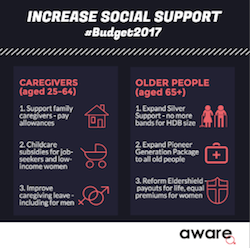
1. Older people (aged 65 and above), most of whom are women and many of whom lack resources to meet their own care needs. AWARE recommends:

  • Expanding the availability and quantum of Silver Support, including by removing the different bands for HDB flats of different sizes
  • Making healthcare in old age more affordable: exploring the possibility of adapting the Pioneer Generation Package for all generations
  • Reforming Eldershield, including by removing the 72-month limit so that payouts are for life, and removing the gender difference in premiums

2. The next cohorts of women (aged 25-64) on track to becoming elderly persons, particularly those who, due to caregiving responsibilities, cannot participate in the workforce to accumulate private resources for their care needs in old age. AWARE recommends:

  • Supporting home-based care by family caregivers
  • Making formal childcare facilities more accessible to all mothers, including by relaxing and (for households with the lowest incomes) removing the employment preconditions for childcare subsidies
  • Supporting all working adults in caregiving, regardless of gender, including by introducing eldercare leave and increasing the gender neutrality of parental leave

“We must face demographic realities. With a shrinking number of children within each family, we can nevertheless sustain social support if we look at the tax base as a whole, including the growing proportion of the working population who are migrants,” said Jolene Tan. “This is fairer and more realistic than relying primarily on private transfers of wealth within families to meet care needs.”

More details can be found in the full text of our submissionsRecommendations that we have made for the national Budget in recent years can be found on our website: 2016, 2015, 2014, 2013