Year: 2019

Closed: Recruiting interviewers for AWARE’s research on migrant domestic workers providing eldercare

We are hiring interviewers for our next qualitative research project, which explores the role of migrant domestic workers in providing eldercare in Singapore.

Interview details:

  1. Each interview will be one hour long and conducted at a time and place of the respondent’s convenience.
  2. Interviewers must be willing to travel to the interview location independently. Travel expenses will not be reimbursed.
  3. Interviews will be conducted between November 2019 – February 2020.
  4. Each interviewer is expected to conduct at least three interviews.
  5. Interviewers must also transcribe the interview and submit the transcript to AWARE within two weeks of the interview.
  6. Interviewers will be paid $100 for each interview they conduct and transcribe satisfactorily.
  7. Interviewers must attend at least one training session in mid-late October, prior to conducting the interviews.

If you are interested, please fill in this google form by 11 October 2019. If you have any questions, please email Preethi at projects@aware.org.sg.

*Please note that due to payment restrictions, we will only be able to pay Singaporean/PR interviewers.

Closed: Recruiting respondents for AWARE’s research on migrant domestic workers providing eldercare

We are interested in interviewing live-in migrant domestic workers currently employed to provide care for an older person in the household (above the age of 65), by Singaporean/PR family caregivers or the care recipients themselves. We will be conducting qualitative interviews with migrant domestic workers to find out more about their experiences providing eldercare.

The profile of respondents we are looking to interview is as follows:

  1. Must be currently providing care, or have provided care within the past two years, to an older person in the household (above the age of 65)
  2. Must be employed by a Singaporean/PR family caregiver, or by a Singaporean/PR care recipient (above the age of 65)
  3. Must be residing in the same residence as the care recipient
  4. Must be providing care for an older person that needs help with at least one Activity of Daily Living (washing, feeding, dressing, transferring, toileting or mobility), or needs help due to a mental condition (dementia, Alzheimer’s, etc.)
  5. Preferably English-speaking

The interviews will be one hour long and conducted at a time and place of the respondent’s convenience. They will be conducted between February – April 2020.

If you are interested, or know a migrant domestic worker who might be, please email Preethi at projects@aware.org.sg. Do feel free to ask for more clarifications about whether you, or the migrant domestic worker you know, fits the profile. Please also indicate in your email if the migrant domestic worker is English-speaking.

We are also interested in interviewing some pairs of migrant domestic workers and their employers, if the latter are family caregivers for older people. Both interviews can be conducted on the same day, but the migrant domestic worker and her employer will be interviewed separately. Do indicate in your email which kind of interview (single or pair) you are interested in.

All respondents will be given a $30 NTUC voucher as a token of appreciation for their time.

Better enforcement of court orders needed

This post was originally published in The Straits Times on 30 August 2019.

By Chong Ning Qian, Senior Research Executive

In recent years, the Association of Women for Action and Research (Aware) has advocated improving housing access for single-parent families via changes to Housing Board rules, such as by allowing unmarried mothers and their children to form a family nucleus to buy and rent from HDB.

In my work there, I have come across at least two cases of divorced mothers who had trouble securing alternative housing because their ex-husbands did not comply with court orders to sell the matrimonial flat.

Without first selling the matrimonial flat, neither party can buy or rent from HDB. Single parents who cannot access public housing either seek housing from the private market – which is costly and economically unsustainable – or live with their friends and family, often resulting in strained family relations.

One single mother we assisted has been trying to sell her matrimonial flat for close to two years. However, her ex-husband has failed to comply with multiple court orders to sell it, including one that states that he has to allow potential buyers to view the flat. He has occupied the flat since the finalisation of the divorce, changed the locks and refused to open the door for flat viewings. As a result, she cannot sell the flat despite engaging property agents to do so.

It was revealed in Parliament that the enforcement of such court orders is not tracked.

It is unfair to expect those like her to go back to court multiple times to enforce the order, as it is a time-consuming and emotionally draining process. What else can be done to ensure that individuals comply with court orders, and that these single parents have timely access to affordable housing?

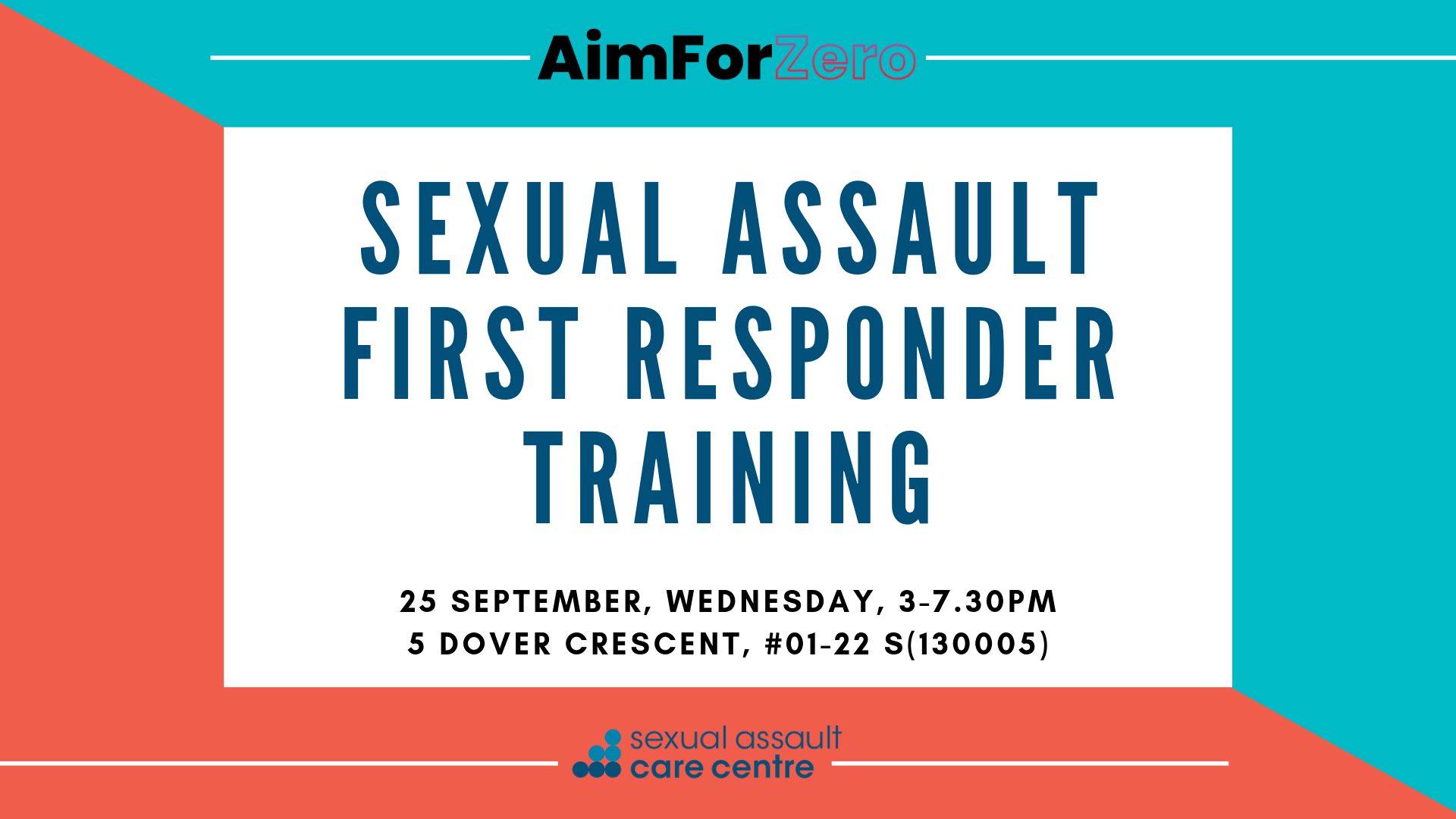
25 September 2019: Sexual Assault First Responder Training

Understand trauma reactions and learn tangible skills to support sexual violence survivors at this workshop by AWARE’s SACC.

We can use our own words and actions to convey zero tolerance for sexual assault. But while we can all agree that sexual assault should never happen to anyone, we may not always know the right thing to say when it does.

It is not always easy for survivors to tell someone about what happened. In fact, for some survivors, it can be especially daunting. First response that is sensitive to the survivor’s needs and choices is necessary in preventing re-victimisation.

SACSACC’s First Responder Training helps familiarise participants with trauma reactions and symptoms to better contribute to a survivor’s well-being. In this workshop, SACC will share more on the following:

1. Definition of sexual assault and harassment
2. Recognising Singapore’s legal framework
3. Understanding consent
4. Understanding the impact of sexual assault and trauma on survivors
5. Role of a first responder
6. Providing support to survivors of sexual assault
7. Resources available for help
8. Key skills such as ensuring safety, active listening and empathy

Under AWARE’s #AimForZeroSG campaign, this popular workshop has been made as affordable and accessible as possible. While you are welcome to pay what you can, we suggest a sum of $10 per workshop attendee.

When: 25 September 2019, 3.00pm – 7.30pm [4.5 hours]
Where: 5 Dover Crescent #01-22 S(130005)
For whom: Parents, educators, all NGO/VWO staff and volunteers, social sector professionals or students above 16 years old studying a relevant discipline (e.g. psychology, counselling, social work etc.)
Cost: Pay what you can; suggested donation $10 (Light refreshments will be provided)

Slots for this workshop are limited to 60 sign-ups only. Persons of all genders and nationalities are more than welcome to attend. Walk-ins are welcome!

We strongly request that all participants commit to the full duration of the 4.5-hour workshop to ensure that everyone will get the opportunity to engage in interactive discussions and learn useful skills.

Register here!


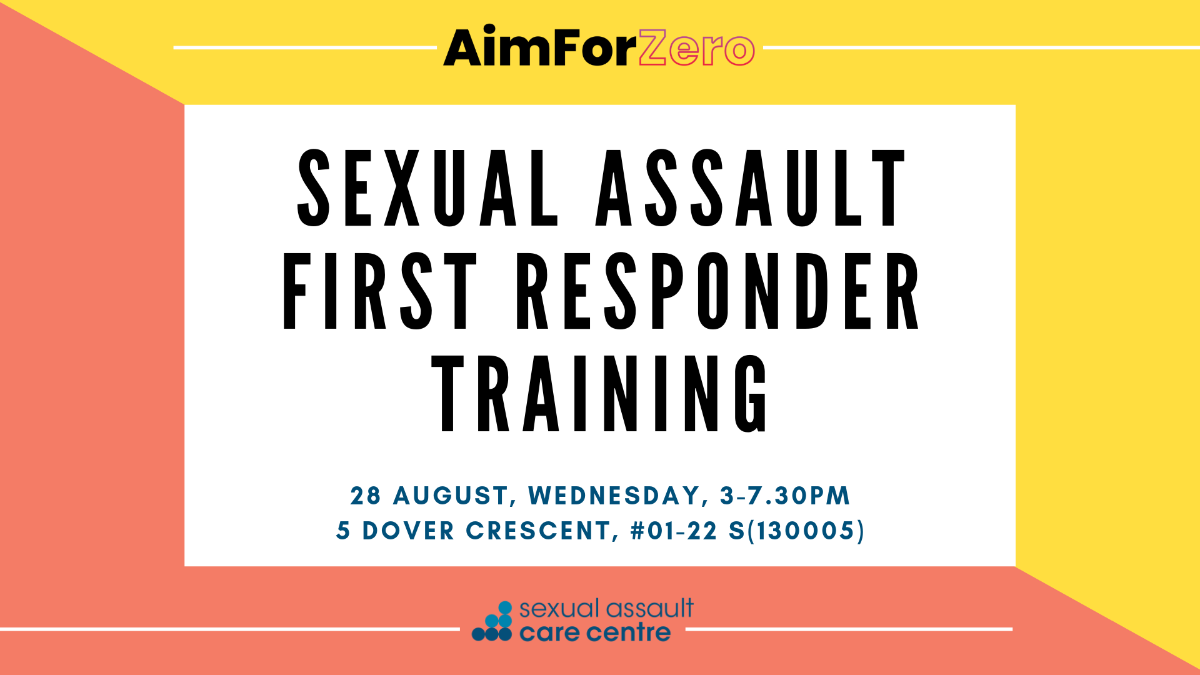
28 August 2019 Workshop: Sexual Assault First Responder Training

“Are you sure that happened? Why didn’t you fight back? You should have known better.”

One experience of sexual assault is one experience too many. We may not always know the right words to say, but we can all agree that sexual assault should never happen to anyone. One way to show zero tolerance for sexual assault is through our own words and actions.

It is not always easy for survivors to tell someone about what happened. In fact, for some survivors, it can be especially daunting. First response that is sensitive to the survivor’s needs and choices is necessary in preventing re-victimisation.

SACC’s First Responder Training helps familiarise participants with trauma reactions and symptoms to better contribute to a survivor’s well-being. In this workshop, SACC will share more on the following:

1. Definition of sexual assault and harassment
2. Recognising Singapore’s legal framework
3. Understanding consent
4. Understanding the impact of sexual assault and trauma on survivors
5. Role of a first responder
6. Providing support to survivors of sexual assault
7. Resources available for help
8. Key skills such as ensuring safety, active listening and empathy

As part of our Aim for Zero campaign, SACC is offering this workshop at a highly discounted price. Details are as follows:

When: 28 August 2019, 3.00pm – 7.30pm [4.5 hours]
Where: 5 Dover Crescent #01-22 S(130005)
For whom: Parents, educators, all NGO/VWO staff and volunteers, social sector professionals or students above 16 years old studying a relevant discipline (e.g. psychology, counselling, social work etc.)
Cost: $10 (Light refreshments will be provided)

Slots for this workshop are limited to 60 sign-ups only. Persons of all genders and nationalities are more than welcome to attend. Walk-ins are welcome!

We strongly request that all participants commit to the full duration of the 4.5-hour workshop to ensure that everyone will get the opportunity to engage in interactive discussions and learn useful skills.

Note: For participants who are unable to pay the sign-up fee, please contact Yan Bing at saccintern@aware.org.sg to request a waiver. Please note that all proceeds go towards SACC and that the fee is non-refundable.

Register here!

17 August 2019 Workshop: Birds & Bees – starting open conversations about sex, consent and relationships at home

“This was valuable… it made me reflect on my own values regarding sex and what I may project onto my children.”

“It opens up our inhibitions and gives us real opportunities to put [our thoughts into] words.”

“Often boys are let off the hook, but I think they should be mindful and learn about boundaries, especially in this day and age when lines are blurred and there’s so much to access online.”

“Can they do this in school for our children?”

– Previous Birds & Bees workshop attendees


How do you talk to your children about sex? It’s a topic that many parents are happy to put off discussing for as long as possible. But what are the consequences of making home an environment where talks about physical intimacy are off-limits?

Birds & Bees is an experiential workshop for parents, run by parents, to help you start and sustain the important conversation about sex – in a non-judgmental way. No matter where you are in your parenting journey, this workshop will allow you to:

  • Understand the lasting, positive impact of talking to your children about sex and relationships
  • Introduce crucial information about consent, personal boundaries, and safety to your children
  • Talk openly about the difference between respectful, healthy relationships, and abusive, unhealthy relationships
  • Improve your communication with children on difficult or uncomfortable topics
  • Create a home where your children are not afraid of approaching you if they have questions or are troubled about a relationship or sexual encounter.

Through case studies, role-play and facilitated discussions, the workshop will give you a chance to think more deeply about your values and sexual health knowledge, and improve communication with your children. All parents are welcome, though we’ll deal with issues most relevant to parents of teenage children (12-18 year olds).

Date: 17 August 2019 (Saturday)
Time: 10am – 1pm (3 hours)
Venue: AWARE Centre (5 Dover Crescent #01-22)
Workshop Fee: $25

Survey: After you sign up, you will be asked to complete a short pre-workshop survey about the age(s) and number of your children. We will try to group participants with children of similar ages together during the workshop.

Refunds and cancellations: Unfortunately we will not be offering refunds. However, with minimum two days notice, you may switch to a future workshop date. If you need to do so, or if you have any other questions, please email Joo Hymn at publiceducation@aware.org.sg.

Register here!


2 November 2019: Back to the Future – The Time Traveller’s Ball

Announcing Back to the Future: The Time Traveller’s Ball!

On 2 November, we promise another wonderful evening of delicious food and drinks, great company and wicked, unforgettable fun, as we raise funds to create a more gender-equal, fair and caring society. Our all-time favourite entertainer, Pam Oei, will host this year’s show with award-winning comedian Rishi Budhrani. The well-loved Alamak Awards return with a twist as we showcase Singapore’s most atrocious and ridiculous sexist moments—from the last 200 years. This year’s special edition 200 Years of Alamaks will be written and directed by the prodigiously talented team of Joel Tan, Jo Tan and Elaine Chan.

When: Saturday, 2 November 2019, 6.30 pm
Where: Island Ballroom, Shangri-la Hotel
Dress Theme: Retro/Futuristic (We have prizes for best-dressed guests so we highly encourage you to be as creative and outrageous as possible!)

Why support the Time Traveller’s Ball? As our main fundraiser of the year, our Ball is critical in raising 25% of our funds. This keeps our work alive—from the day-to-day specialised support provided by our Women’s Helpline and Sexual Assault Care Centre, to our long-standing research and advocacy.

This year, we are shining the spotlight on our research and advocacy work: how it has contributed to changes in the legal and cultural landscape, including the repeal of discriminatory and egregious laws such as marital immunity for rape. It took up to a decade of steadfast and persistent advocacy to achieve that monumental change in our country’s sexual violence laws. But we cannot and will not stop here.

How can you support the Time Traveller’s Ball? We hope that you will stand with us and continue to support our work by:

If you are interested to sponsor our Ball, email Corinna (ed@aware.org.sg) or Desiree (fundraising@aware.org.sg), or call us at 6779 7137.

Read more about the Time Traveller’s Ball!

How to attract and retain local workers in Singapore’s long-term care sector: Lessons from a two-year programme

This post was originally published on The Straits Times on 26 July 2019.

by Corinna Lim, executive director of AWARE, and Carrie Tan, executive director of Daughters of Tomorrow.

Singapore has traditionally been heavily dependent on foreign workers in the long-term care (LTC) sector. This renders the workforce unstable, as foreign workers are easily drawn to nearby countries that offer better pay for direct care workers.

Around 70 per cent of direct care workers in Singapore’s LTC sector are foreigners – compared with 32 per cent in Australia, less than 10 per cent in Japan and 5 per cent or less in Hong Kong and South Korea.

A recent poll, conducted by philanthropic organisation Lien Foundation with 250 direct care workers and 50 hospital workers, found that among this group, the average tenure of a foreign worker in an LTC job was 2.8 years, compared with 3.4 years for locals (Singaporeans and permanent residents). This tenure is much lower than that of hospital workers as a whole: The average tenure for the combined local and foreign hospital workforce is 7.8 years.

At an industry dialogue on July 3, women’s rights organisations Aware and Daughters Of Tomorrow teamed up with financial service multinational corporation JP Morgan to present learnings from a joint eldercare workforce programme.

The two-year programme was aimed at providing workforce readiness training and employment for low-income women (Singaporeans, permanent residents and long-term visit pass holders) in the eldercare sector.

Despite the relative success of the programme, in which 35 women were placed as direct care workers, the initiative revealed challenges local workers face in joining and remaining in the LTC workforce. They are:

LONG HIRING PROCESS

Filling eldercare roles typically involves a long hiring process, which includes applications, interviews, health check-ups and placement. All in all, it can take up to eight weeks. Job seekers applying for multiple roles will generally accept the offers that come through first, which means eldercare jobs will likely be at a disadvantage compared with jobs in other sectors with a faster hiring process.

LOW PAY

Eldercare jobs do not pay well compared with other jobs that low-income women are eligible for, such as childcare assistants, or jobs in food and beverage, retail or cleaning. A local worker in hospitality turning over rooms in a hotel is paid $1,600 to 1,800 a month, whereas an eldercare worker assisting with showering, feeding and toileting duties is paid $900 to 1,400 a month.

Although wages for direct care workers have increased over the past few years, they are still not attractive enough to draw the volume of applicants the sector requires. (The Lien Foundation study estimated that the LTC workforce needs to grow by at least 45 per cent between 2017 and 2020).

EXTENSIVE HOURS

Working in LTC often means providing 24/7 residential care. However, women with family responsibilities are often unable to commit to the necessary evening and weekend shifts. Aware and Daughters Of Tomorrow’s research has shown that many low-income women are also unable to make adequate childcare arrangements in order to commit to shift work. Having said that, some eldercare employers in the programme were able to address this challenge by accommodating their workers with flexi-hours.

MISCONCEPTIONS ABOUT ATTIRE

A prevalent belief among healthcare employers was that headscarves are linked to the spread of infections. Accordingly, some employers were hesitant to hire LTC workers who wear a tudung or hijab. However, we found that hospitals in many Muslim countries do not have similar concerns and freely employ women who wear headscarves.

For our programme, we conducted a systematic review of the numerous studies investigating links between clothing and infection transmission, and did not find any compelling evidence to show that healthcare workers’ uniforms or workwear (including headscarves) contribute to healthcare-associated infections, or pose any additional risks to patients or staff.

With this review, we managed to convince a number of employers to employ workers who wear headscarves and look forward to more employers adopting similar flexibility in their hiring.

LONG-TERM VISIT PASS MYTHS

Another misconception we discovered was the belief that long-term visit pass (LTVP) holders – typically foreign spouses of Singapore citizens – contribute to an employer’s foreign worker quota.

As our programme included LTVP holders, we were able to clarify this with the Ministry of Manpower. We then helped disseminate this information to employers to disabuse them of the notion that hiring LTVP workers is tantamount to hiring foreign workers.

The success of the programme was seen in the low attrition rate among the care workers it placed: Of the 35 women placed, only one left her job in the first six months. Achieving this required a close working relationship with human resources and operations teams of LTC providers, enabling participants to transition successfully into working life after years of unemployment.

Despite the success of this pioneering effort, longer life expectancies and growing rates of chronic conditions point to a rising demand for direct care workers who provide the majority of hands-on, non-medical care to older adults.

The dismal combination of low wages, shift work and misconceptions about hiring certain workers makes it difficult to match demand with supply.

The pressing challenges surrounding supply and quality of care beg further reflection. How do we care for our elderly and balance that with affordability?

What opportunities are there for collaborations between LTC providers, volunteer welfare organisations and civic initiatives to innovate and excavate new local pools of talent for our future “care force”?

How can the Government support the evolution of care in Singapore with policies that improve the wages and conditions for local workers? Can we tap the pool of women on LTVP who are localised and living here with their Singaporean children? Can sector training subsidies and retention bonuses currently available for Singaporeans and permanent residents be extended also to women on LTVP?

The ability of the sector to retain care workers, and attract more to meet demand, requires more work and collective effort. We are all likely users of LTC in the future as we age.

Xin Hui’s story: The toll of balancing work and childcare

Our “Your Stories” series are submissions shared with us via email or in one-on-one interviews, for the purposes of our research and campaigns. All names have been changed (unless the use of real names was explicitly permitted by the author), and we have sought permission to publish from the authors/interviewees themselves. The opinions expressed in these posts do not represent those of AWARE.

Xin Hui: When I first stepped into the working world, I was an over-zealous greenhorn, unafraid to voice opinions. As a young woman, I was quickly promoted to be one of the youngest managers in my company.

I immersed myself fully into my career. Even while pregnant, I still put in long hours. I participated actively in committees and hauled my huge belly into construction sites to oversee the progress of my projects.

I thought I was unstoppable… until the baby came out.

Motherhood is, without a doubt, the hardest thing I’ve ever done in my life. I was eager to prove that because I could manage teams of employees at work, I could easily add a child into the mix. But you know the phrase “sleep like a baby”? It must have been coined by a childless philosopher.

I was reluctant to ask others for help with my daughter. I took to breastfeeding to soothe her every time she cried. So by the time my maternity leave ended and I returned to work, she could only be put to sleep by being breastfed. On average, she woke up five times a night to nurse.

The extended sleep deprivation, and a mounting resentment towards my husband’s inability to help with childcare, made me very miserable. My husband, on the other hand, was discouraged by his daughter’s lack of interest in him. He parented mostly in my shadow.

*

With barely five hours of disrupted sleep, my plans to reach the office on time would often be derailed by some unexplainable meltdown or a spectacular vomit incident. After finally arriving, I would multi-task between work and making endless plans—for baby care procurement, school logistics and healthcare. In between meetings, I would pump in switch rooms, toilet cubicles or prayer rooms while trying to figure out breastmilk storage.

The evenings were worse. Very often, in order to rush home on time, I would hastily conclude work meetings or excuse myself from draggy discussions. After finally putting the child to bed and packing her school bags, I would then return to my laptop to work until I dozed off.

My company did not offer flexible work arrangements. Even if it had, my management role wouldn’t have worked well with flexible arrangements, given the amount of time I had to be on ground to support operations. Also, the culture involved many (unnecessary) meetings that required everybody to be present.

My superior, who did not have children, would chide me to “get my act together” and report to work on time. I was given counselling and told that I was expected to do more. I was even reminded to check my emails and submit work on days when I took childcare leave to care for my sick child.

Eventually, my appraisal ratings fell. I hit a plateau in my career.

*

I often thought about how men balanced fatherhood and their careers.

I have always felt that the ideal co-parenting model would be an equal 50:50 split. Reality, however, is far from my dream. The stark contrast in parental leave entitlement between mothers and fathers has set the foundation for mothers to form deeper bonds with their infants while fathers are relegated to take a more passive role. Societal views too, mostly assume mothers as the main caregivers. We see child-related marketing materials mostly targeting mothers instead of fathers.

When I had to stay late at work functions, many colleagues would ask about my baby, concerned —ignoring the fact that I had a co-parent who was equally responsible for putting our child to bed. When I said that my husband was taking the kid that night, I was often given congratulations on having a hands-on partner. 

In contrast, my husband spends nearly a third of every month on overseas business trips. Nobody has ever asked him about his child’s bedtime logistics.

And I have never been praised for being able to tuck my child into bed without his help.

Whenever my husband and I had discussions on how he could take some loads off my shoulder, I would sense his eagerness to help but, at the same time, his dismay at his own cluelessness. We were used to seeing examples of successful men without family baggage. And conversely, horrible husbands who have no parental involvement, examples that many fathers would proudly compare themselves against before proclaiming that they themselves are much better. We very rarely hear about successful fathers who cut back on their work requirements to spend time with the family. As for examples of families with a 50:50 split in childcare responsibilities? As rare as unicorns. So the men honestly did not know how to do better.

*

After one particularly stressful day, during which I snapped and yelled at my child, I became overwhelmed with guilt. I realised the words she heard most often out of me were “faster”, “come on” and “hurry” instead of “I love you”. What’s more, the things that had triggered my anger were just normal toddler behaviours. I was the one who was struggling to get my act together, and my stress had manifested in unrealistic expectations about my own child.So, after 10 years of building a name for myself in my company, I resigned.

I am fortunate enough to have a significant amount of savings and a supportive husband to rely on while I take a break from my career. The past six months have been filled with laughter, lazy mornings snuggling in bed and a renewed focus on my wellness. While my child is in school, I spend my time reading, resting, exercising and volunteering with a charity that helps disadvantaged women.

Now, I’m blessed with baby number two! The thought of a new family addition without my income worries me. But I’m looking forward to a much lower-stress pregnancy and a quicker recovery so that I can again pursue my passions beyond my home.

One day, I will make it out into the arena again. By then, I’m sure I will be stronger and better equipped to take on the world. Until that day, we should be moving towards a society where both men and women are able to enjoy a work-family balance—so that both parents can choose to pursue something other than child-rearing, while being assured that their partner has their back in caring for the kids.