By Shailey Hingorani, Head of Advocacy & Research, AWARE
At the Exemplary Father Award ceremony on Sunday 14 July, President Halimah Yacob said that employers should do more to encourage their workers to take paternity leave. We strongly agree with this statement.
All workers should be equally supported to care for their children, regardless of gender. A recent study shows that men desire flexible working arrangements, while feeling pressure to provide economically for their families (“Nearly as many men as women want flexi-work: Survey”, May 20). However, there remains stigma against men balancing work commitments with care responsibilities. It is perceived as carrying a cost to career progression, instead of being normalised as an ordinary part of working life which is compatible with all levels of advancement.
This is rooted in a cultural expectation that mothers should be primary caregivers. Even in daily language, we see fathers described as “helping” mothers, instead of parenting in their own right.
As a result, men are not taking their full allocation of leave, even where there is full income replacement. According to parliamentary data, the median days taken of government-paid paternity leave (GPPL) and shared parental leave (SPL) last year were 11 and 10 respectively. These figures exclude men who took zero days (as Madam Halimah noted, about half of all new fathers don’t take leave at all), and thus overstate the use of leave.
Law and policy can set the tone to counter stereotypes and promote changes in attitudes and practice. Unequal GPPL and maternity leave benefits reinforce the idea that women are primarily responsible for care, and men only auxiliary. We urge the government to increase paternity leave to sixteen weeks, so that it is equal to maternity leave. This will also remove the need for the transferable SPL component.
This should be coupled with close monitoring of the use of leave, and employer education. The government can encourage men in senior management to be role models, by visibly spending time on caregiving. Resources can also be provided to HR and line managers so that they truly understand the importance of paternity leave.
More parenting by fathers is good for families, society and companies. When fathers take leave to be immediately involved after birth, they are more likely to be involved later on in a child’s life as well. Research shows that fathers taking parental leave has a positive effect on maternal earnings, more so than a simple reduction in the mother’s own leave. Paternity leave also helps mothers return to the same employer, meaning that companies can retain good talent.
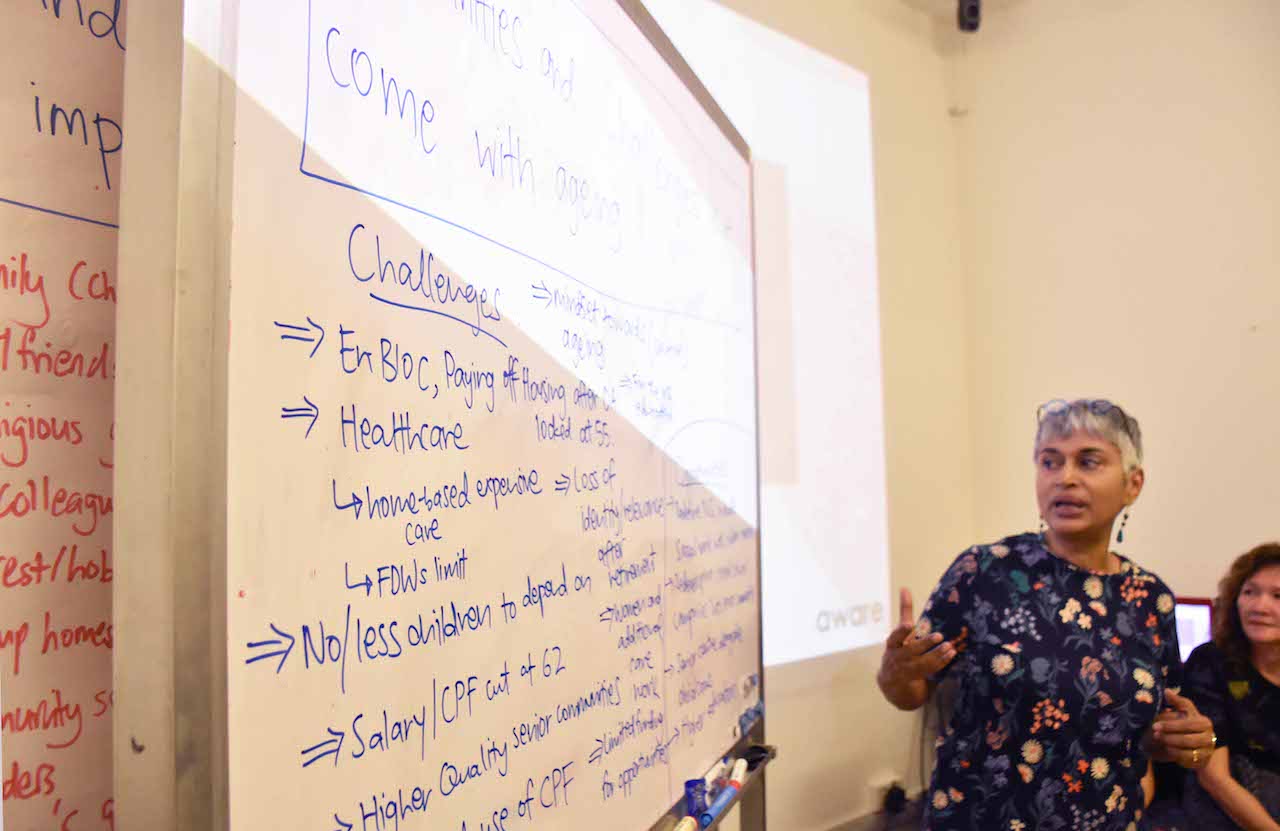
AWARE Past President Dana Lam at “Engaging Ageing”
Written by Meryl Yu, AWARE intern. Photographs by Megan Tan.
Ageing. Some of us dread it, some of us make peace with it, but how do we talk about it?
On the evening of 27 June 2019, AWARE hosted “Engaging Ageing”, an open conversation for women to come together and connect over their worries, struggles and hopes about growing old. Emotions oscillated between joy, exasperation and sorrow, as the 40 women present engaged in topics spanning changing social networks, injustices at the workplace and loneliness.
Shailey Hingorani, AWARE’s Head of Research and Advocacy, kicked off the event on a high note with the opening question: “What is one thing you look forward to about growing old?” While one participant conceded that “your body betrays you”, she “look[s] forward to every day where I can be myself”. Her words were heartening and soon murmurs of agreement filled the room. Travelling more, better government welfare and hopes for a second career were amongst some of the joys shared for the future.
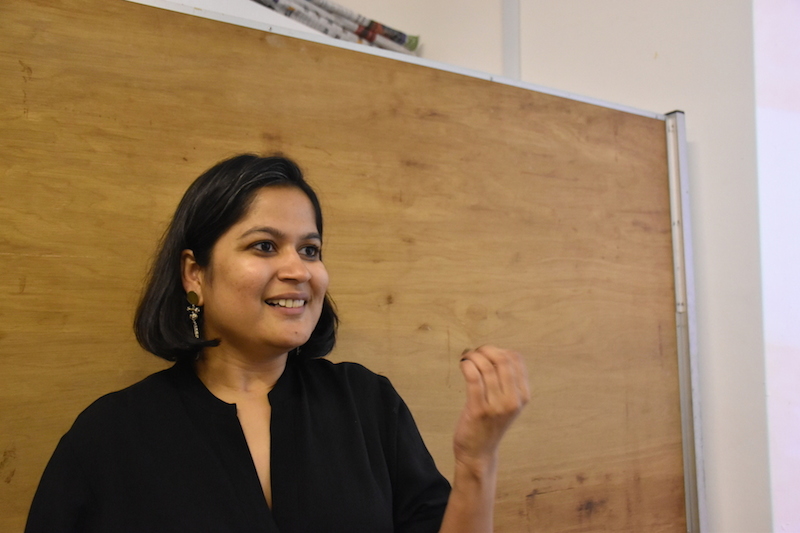
AWARE Head of Research and Advocacy Shailey Hingorani
Constance Singam, past president of AWARE and one of the guest speakers, turned the conversation towards the loss of community as one ages: “We need a community, to be useful, to be relevant… we need the autonomy to tell our own story, our own narrative.”
She emphasised that community is not always bounded to a geographical location, but rather encompasses the sense of belonging and interdependence that comes from being part of something bigger than oneself. Her main message for the audience was for them to build like-minded communities that can be pillars of support, familiarity and stability.
The next guest speaker was Margaret Thomas, founding member and current president of AWARE. Speaking about the hurdles older workers face staying relevant in the workplace, and how these hurdles conflict with one’s sense of identity, she suggested that “journalism is one area where the people with experience can continue to contribute”. Older workers have a wealth of knowledge and wisdom that is not only underutilised, but also undervalued by wage cuts – which do not always come a commensurate reduction in working hours. Old-age contracts can penalise older workers simply forgrowing old, and this message of depreciation affects their sense of self-worth.
With the audience warmed up over food, they were then free to choose one of three topics to discuss further in smaller groups. Here is a brief rundown on what was shared:
1. New Financial and Social Obstacles
Participants grappled with the financial realities of ageing, such as constraints on one’s Central Provident Fund (CPF) account, expensive home-based care, and pay cuts for older workers. Social realities such as disengagement from one’s community, loss of relevance after retirement and loss of autonomy were brought up as well. Nevertheless, on the brighter side, participants hoped to have more time and energy to pursue higher education and overseas travel.
2. Loneliness and Changes in Social Networks
How does the physical state of ageing contribute to loneliness? With lower energy levels, finding the motivation to go out is a challenge. Nor is it only a question of energy. One participant made clear that loneliness is not solved by simply finding new ways to keep busy: “Even if your life is filled with activities, it doesn’t mean you’re not lonely.”
Despite the complexities of loneliness, many came forward with solutions that worked for them. Harnessing social media in a way that connects, not disconnects, us is vital. One participant shared that simply utilising the audio message function on her WhatsApp, or choosing to have a Skype call instead of a series of check-in messages, could go a long way in “humanising” her interactions.
3. Support Networks for Ageing
Women-centric spaces, family, religion and interest groups were cited as important sources of support. However, some were disgruntled with the state mandate of “family first” as the predominant way to help seniors age happily. While family members might be able to take care of older persons’ emotional needs, they most likely lack medical training. And many family members aren’t in positions to look after their older relatives financially. The expectation for older persons to exhaust all forms of family support before requesting state support, some participants concluded, is unfair.
Participants share the results of their brainstorming sessions with the larger group
All of us, female or male, will age. However, older women suffer from worse health, are at a higher risk of isolation, and have lower financial security, compounded by the years outside of the workforce spent caregiving. A 60-year-old woman, on average, will spend an estimated eight of her remaining years in disability, while a man of the same age will spend only three years in disability. Moreover, women’s longer lifespans mean they have a higher likelihood of experiencing bereavement, increasing their risk of social isolation. Having spent years outside the workforce caregiving, women have lower financial security at a later age.
Of course, the concerns of growing old often seem irrelevant to younger individuals. When should the young start caring about ageing? Megan Tan, an AWARE intern, spoke about how the dialogue session changed her perspective on ageing: “Hearing what the elders said about ageing helped me empathise with my grandpa a little bit more. It also taught me the importance of community, which is what I will aim to have when I get older.”
So how do we engage ageing constructively and meaningful? The first step is to talk about it, and we hope that the conversations that emerged that evening will extend beyond our single session.
We are no longer accepting applicants for this role.
Are you interested in working start to finish on a website re-design project for a high-impact corporate consulting company? Do you enjoy designing and creating useful features to bring value to web users? If yes, Catalyse Consulting, the corporate training and consulting arm of AWARE, is looking for you.
You will work directly with the CC marketing team in this role.
“Are you sure that happened? Why didn’t you fight back? You should have known better.”
One experience of sexual assault is one experience too many. We may not always know the right words to say, but we can all agree that sexual assault should never happen to anyone. One way to show zero tolerance for sexual assault is through our own words and actions.
It is not always easy for survivors to tell someone about what happened. In fact, for some survivors, it can be especially daunting. First response that is sensitive to the survivor’s needs and choices is necessary in preventing re-victimisation.
SACC’s First Responder Training helps familiarise participants with trauma reactions and symptoms to better contribute to a survivor’s well-being. In this workshop, SACC will share more on the following:
1. Definition of sexual assault and harassment
2. Recognising Singapore’s legal framework
3. Understanding consent
4. Understanding the impact of sexual assault and trauma on survivors
5. Role of a first responder
6. Providing support to survivors of sexual assault
7. Resources available for help
8. Key skills such as ensuring safety, active listening and empathy
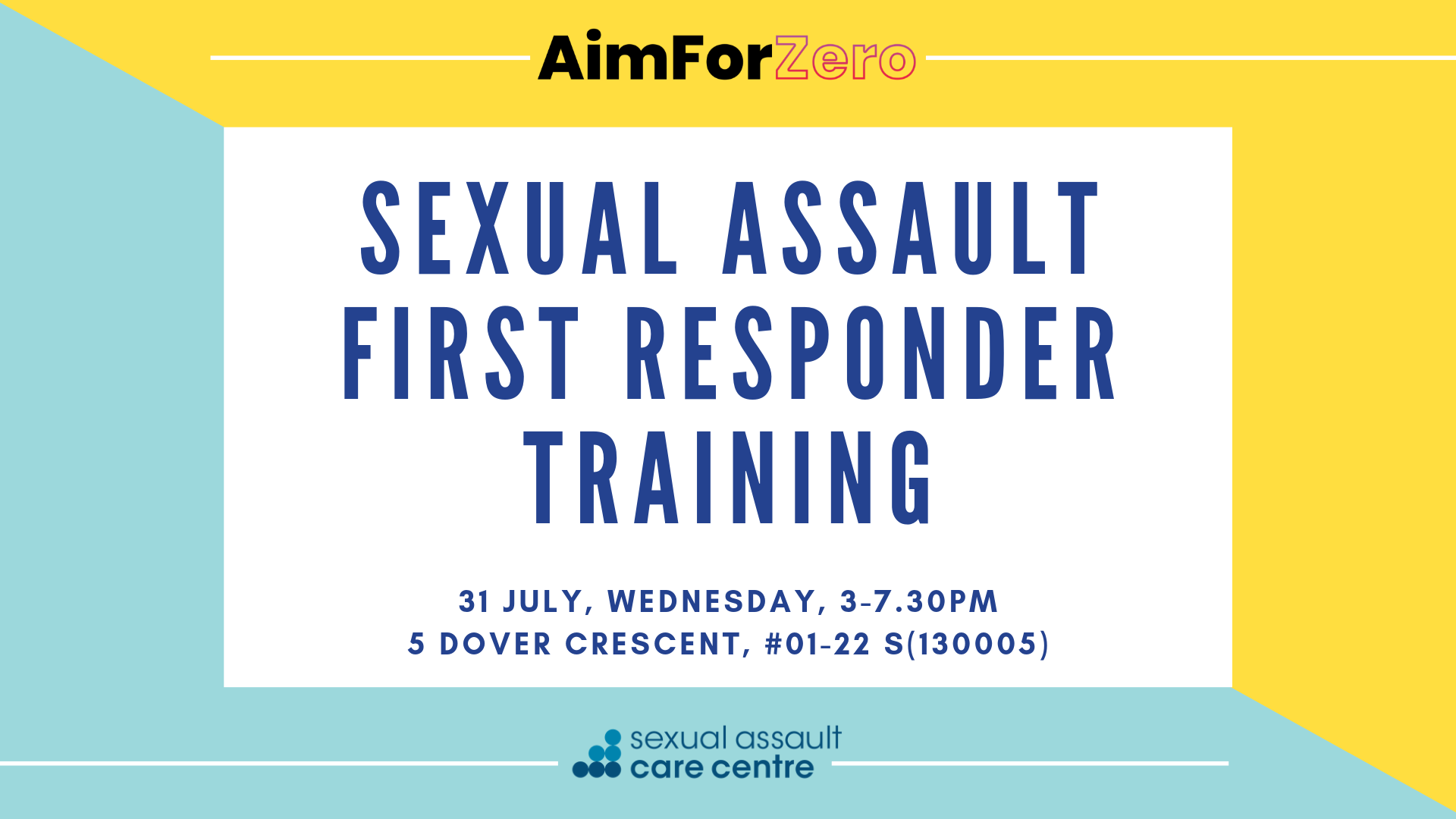
As part of our Aim for Zero campaign, SACC is offering this workshop at a highly discounted price. Details are as follows:
When: 31 July 2019, 3.00pm – 7.30pm [4.5 hours] Where: 5 Dover Crescent #01-22 S(130005) For whom: Parents, educators, all NGO/VWO staff and volunteers, social sector professionals or students above 16 years old studying a relevant discipline (e.g. psychology, counselling, social work etc.) Cost: $10 (Light refreshments will be provided)
Slots for this workshop are limited to 60 sign-ups only. Persons of all genders and nationalities are more than welcome to attend. Walk-ins are welcome!
We strongly request that all participants commit to the full duration of the 4.5-hour workshop to ensure that everyone will get the opportunity to engage in interactive discussions and learn useful skills.
Note: For participants who are unable to pay the sign-up fee, please contact Yan Bing at saccintern@aware.org.sg to request a waiver. Please note that all proceeds go towards SACC and that the fee is non-refundable.
We are no longer accepting applicants for this role.
Are you excited by the idea of being part of the team that is pioneering Asian-centric diverse and inclusive workplaces? Are you passionate about Learning & Development (L&D) and how it transforms life? Are you excited to join a fast-growing boutique training and consultancy firm that is rapidly expanding in SEA? Do you want to be a part of a fun, caring, professional team that is committed to bringing out the best in you?
If this sounds like the perfect place for you, Catalyse Consulting wants to hear from you!
Position: Administrator – Business Ops Term: Permanent Department: Catalyse Consulting
What you’ll do:
Keep all administrative matters in meticulous order
Support functional teams on daily operational tasks, including:
– Sales (inbound enquiries, sharing about workshops and programmes)
– Marketing (event support)
– Training (work closely with trainers and acquire data, coordinate with clients and trainers for logistics and preparation of workshops, compile feedback summaries for clients)
– Finance (invoicing of clients, ensuring timely payment)
Ensure CRM is always updated
Interact effectively with clients on administrative matters
Data management and analytics
Who you are:
A diploma or degree-holder
1-3 years of related experience (Candidates with less experience and/or fresh graduates will still be considered)
Written by Constance Singam. Photographs by Megan Tan.
This post was originally published on Constance Singam’s blog on July 2 2019.
“I am a foreigner in the land of old age and have tried to learn its language.”
“The trouble is old age is not interesting until one gets there. It’s a foreign country with an unknown language to the young and even to the middle age.”
– American poet and novelist May Sarton, who died in 1995 at the age of 83
I had not thought much about it ’til I arrived in this land of old age, and then only when I thought I had become irrelevant. And I have not stopped thinking about it since. I have written about it, talked about it and probably will go on talking about it.
I have written about loneliness and isolation. Which, I now think, comes out of being irrelevant and driven by a fear of illness.
So when did I start feeling old? I didn’t begin to feel old in my 60s. I didn’t begin to feel old in my 70s nor when I turned 80. But, last week, when I was talking about loneliness and old age, the penny dropped.
Loneliness and its resultant depression are the bedfellows of isolation and the feeling of irrelevance. That’s when I began to feel old. Two years ago, when I stepped off the fast lane of busy activities, I began to feel lonely and irrelevant. I have now worked myself out of that, thank goodness!
“Old age” becomes a condition in our view of ourselves when we feel irrelevant. That feeling of irrelevance and loneliness was dispelled when I realised that I have a community of friends. A community is a relationship of interdependence. It follows then that we are relevant to each other.
Busyness and activities are not what makes me feel needed and relevant. Meaningful relationships do. I didn’t come into this realisation that logically. Working through it helped and I did that when I talked at a gathering at AWARE.
AWARE had organised a session “Engaging Ageing: An open conversation for women”. The session, to my surprise, attracted about 40 people, many of them fairly young women. During the session we evolved into a community—a community that shared a concern. As we talked about our concern openly, we created a sense of togetherness.
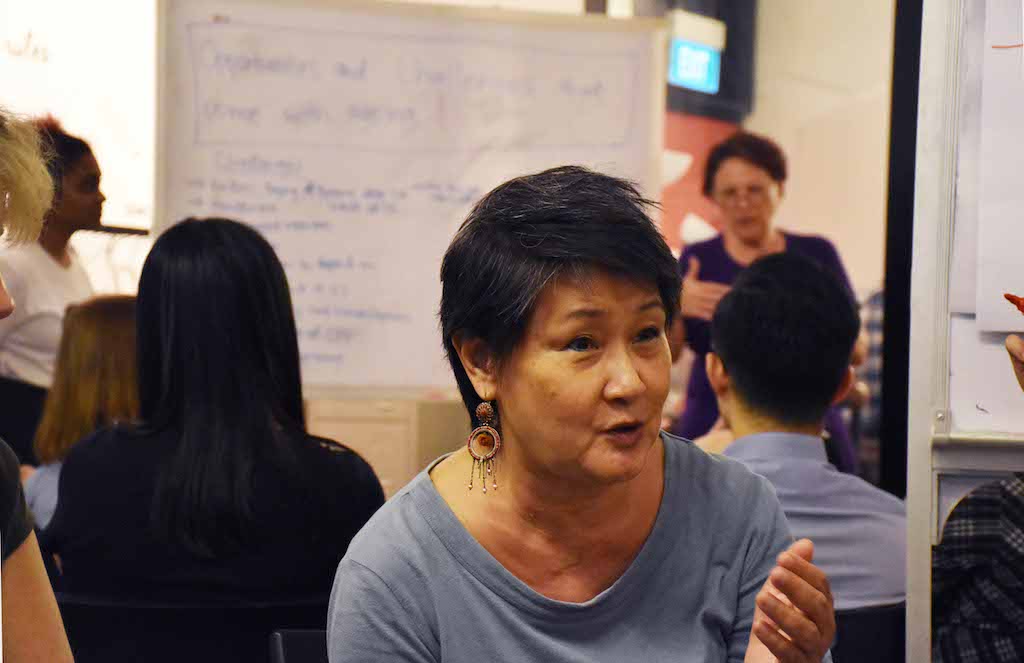
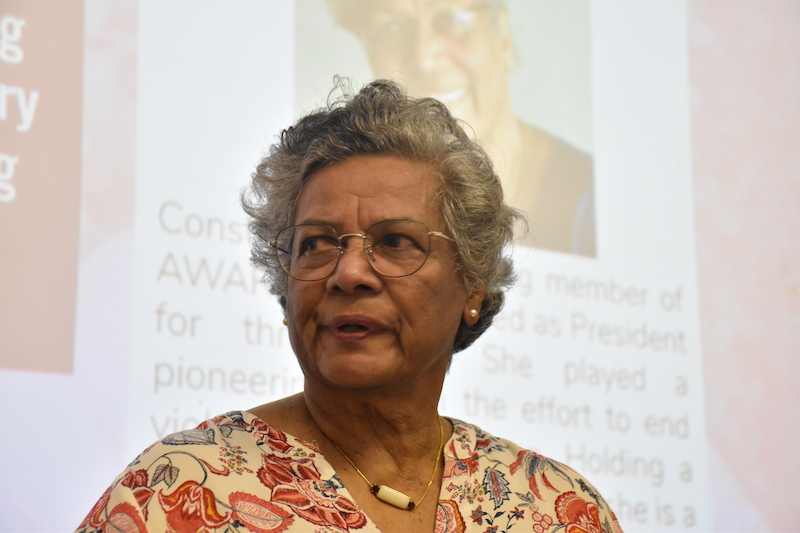
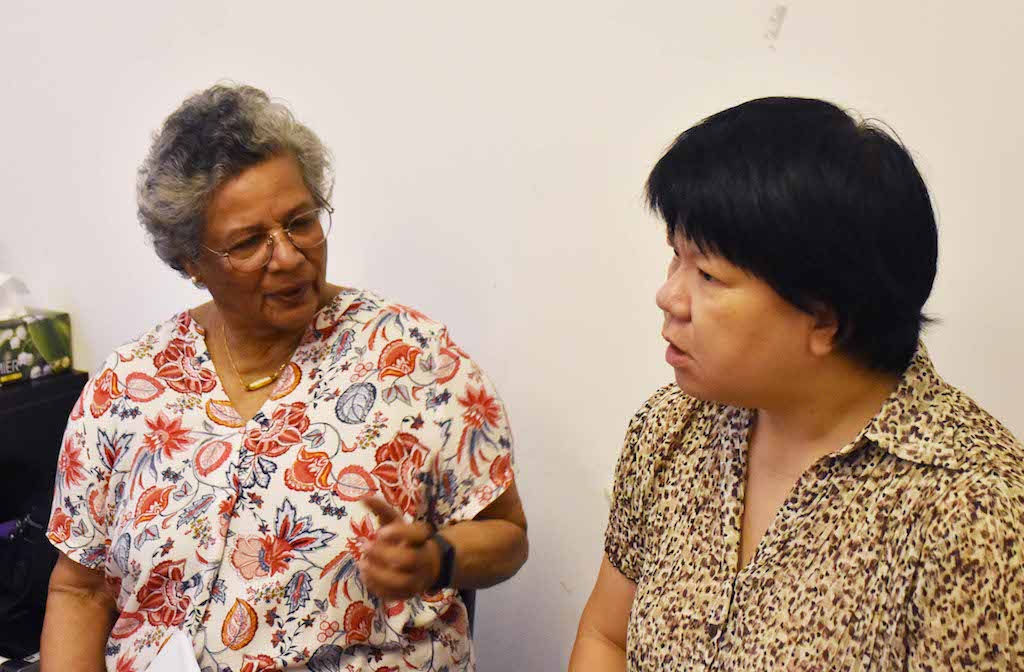
Constance Singam (L) at AWARE’s “Engaging Ageing” event on 27 June 2019.
A study in Finland found that a sense of community meant not only living with like-minded people but also communal activities, doing things together, learning from each other and having reciprocal support, all of which created a sense of togetherness, belonging and trust.
Church communities have historically succeeded in nurturing such communities. My mother, for instance, had for the longest time lived in Serangoon and had been involved in the Catholic Church in Serangoon Gardens. She was traumatised, lonely and isolated when she had to move away when she was 72 because the government acquired her land for redevelopment.
Earlier, when her children had grown up, with many leaving Singapore, she joined the community services at the Church, made friends and found that she could be useful, relevant and contribute to a community. She was happy again. But the move away at the age of 72 led to a long period of depression and feeling of isolation. I don’t think she fully recovered from that move.
A friend, also in her 70s, suffered a stroke the day she moved from her house to a new house and neighbourhood. She had lost a home she had lived in for almost 50 years, a familiar neighbourhood with friendly and supportive neighbours. She too never fully recovered.
For both my mother and my friend, their community—for my mother the Church, for my friend her neighbours—offered not just stability and the familiarity of a place and people but also an emotional connection. The more quality time spent in a community, the stronger the emotional connections. That emotional connection is important for any meaningful relationship and for individual wellbeing.
The other morning I was up early and I walked down to the local market. I seldom do this since my day usually begins only at 11am and the wet market closes at noon. But most of the hawker centre stalls remain open for the lunch-time crowd. The market is the centre of community life for the estate. It is a small estate and the hawker centre is a lively meeting place for the older residents.
I am a bit of an outlier partly because I am not Chinese and don’t speak the language and partly because I am not a regular. But having lived here for more than 20 years, I am a familiar face. I do get acknowledged with smiles, nods and occasional chats. And so it was that morning—the smiles, nods and chats, however insignificant, did lift my spirits.
But beyond the community life we find at the food centre, there is little in my HDB estate that creates opportunities for meaningful connections. We are a diverse group of people living in uninspiring blocks of buildings, and we are, for the most part, disconnected.
What can we do to create a greater sense of place in our HDB estates, a stronger sense of belonging and stability especially for older residents? The answer, I think, lies not so much in what the planners and policymakers should do but in what they should not do.
Yes, we need the policymakers to show more imagination and a greater sense of humanity as they plan, develop and manage our public housing estates. But perhaps what we most need is for the policymakers, the bureaucrats, to step back and create the conditions for residents to come up with their own ideas for community-building.
Ease up on the rules and regulations bit, and encourage residents to, for example, start cosy corners with potted plants in void decks where people can drop by for a cup of coffee and a chat. Let people be creative and experiment. Too much in Singapore is top-down, shaped by policymakers and implemented by bureaucrats. You don’t create communities with this approach.
DPM Heng Swee Keat says he and his team want to work with the people rather than for the people, and will partner Singaporeans in designing and implementing policies together. They can start by listening, really listening, and being open to fresh ideas, possibly crazy ideas. Encourage experimentation, try new things, be ready to make some mistakes and learn from them. In the process, we just might create communities.
For an ageing population the kind of neighbourhood communities we nurture would make a difference between ageing well in place and loneliness, isolation and depression.
Constance Singam is a six-time past president of AWARE.
We are no longer accepting applicants for this role.
AWARE is embarking on a study on Household Budgets for Families in Singapore in collaboration with researchers from NTU and NUS. The study will determine how much resources households need to achieve a basic standard of living in Singapore, using the Minimum Income Standard approach. The results will have a wide range of applications in income analysis, social service design and policymaking.
We are hiring a part-time Project Manager who will be responsible for the administration of the study. The manager will have opportunities to learn about research processes and methods, and be part of an innovative research project.
Read about a previous study on household budgets by the same team here.
Position: Project Manager
Commitment: Part-time, over 12 months
Starting: July 2019
Last date of application: 11 July 2019
Responsibilities:
Monitor project schedule
Maintain record of project accounts and assist with payment of salaries and claims
Assist with recruitment of Research Assistants
Supervise Research Assistants
Coordinate communications with collaborators
Recruit participants for focus groups
Set up and ensure the smooth running of focus groups
Compile and ensure accuracy of budget spreadsheets
Support data analysis, report writing and dissemination of results
Job requirements:
At least 2 years of work experience
Confident working with spreadsheets and formulas in Microsoft Excel
Skillful at literature and information searches
Strong administrative skills, including time, budget and event management
Good communication and interpersonal skills
Meticulous with practical and numerical details
Responsible, independent, able to take initiative
Basic degree in the social sciences an advantage
To apply, please send a cover letter, CV and one letter of reference from an employer or supervisor to ngkokhoe@nus.edu.sg with the subject line: “Project Manager Application”.
This post was originally published on TODAY on 27 June 2019.
By Shailey Hingorani, Head of Advocacy and Research
Recently, governments around the world voted overwhelmingly for a new International Organisation (ILO) convention, the first since 2011.
This groundbreaking treaty recognises that employers must be responsible for ensuring that everyone, regardless of contractual status, enjoys working conditions that are free from violence and harassment.
Disappointingly, Singapore was one of six governments — along with Russia, El Salvador, Malaysia, Paraguay and Kyrgyzstan — to abstain.
No one should have to endure workplace abuse or harassment from colleagues, clients or other parties. Yet, for many, this unwelcome dilemma is a daily reality.
These cases are only the tip of the iceberg.
Cases are likely under-reported to the authorities because employers’ obligations are poorly defined. The Tripartite Alliance for Fair Employment Practices — which promotes fair, responsible and progressive employment practices — has only limited enforcement powers.
Violence or harassment may carry individual criminal liability, but that is beside the point. Not all workers wish to pursue legally punitive action. Many simply want their employers to step in and stop the harassment, and provide safe conditions.
At present, employers are not obliged to do so.
The Tripartite Advisory on Managing Workplace Harassment guides employers and employees on preventing and managing workplace harassment. But the Government has not collected data on employers that have voluntarily followed the advisory.
Aware’s experience in providing support to women suggests that few employers have comprehensive policies and robust training in this area.
Employers benefit when workers interact with others at the workplace. In the same way that employers must ensure workers’ safety, such as in using equipment, it is fair that they should be held responsible for ensuring a safe and violence-free workplace.
This principle is not wholly foreign to Singapore.
The courts, for example, have held an employer liable for workplace injury compensation when a worker set another on fire. The Public Order and Safety (Special Powers) Act holds employers responsible for creating a corporate culture that ensures their workers comply with the law’s provisions.
Why should this approach not be applied to creating corporate cultures that do not tolerate workplace harassment?
We urge Singapore to ratify and adopt the ILO convention, and to oblige employers to create environments that are free from discrimination and harassment. In particular, as the number of freelance workers increases, it is important for the country to support this treaty, which recognises that the working conditions of such workers should be regulated and protected.
We are no longer accepting applicants for this role.
AWARE’s Secretariat department is looking for a Ball Project Coordinator for its annual fundraising gala on Saturday, 2 November 2019.
The Ball Project Manager will work with a team to plan and execute the AWARE Ball from the initial conception of the event to its successful completion. This role requires excellent event-planning skills along with the ability to define project milestones and deadlines and coordinate both teams and external contractors to ensure a successful and enjoyable event that meets organizational goals and expectations.
They need to balance creativity with logistics, project and vendor and sponsor management duties. They should excel at multitasking and balancing big-picture concerns like fundraising strategy with details like décor and menu selection, effectively utilizing resources and personnel to stage the large-scale event.
Responsibilities – Support Fundraising Senior Executive to carry out the following tasks:
Setting, communicating and maintaining timelines and priorities
Vendor and Sponsor Management
Manage event logistics including transportation of collaterals, gifts and auction items, venue set-up, entertainment schedule to ensure that the event runs smoothly and according to schedule
Manage other operational and administrative functions to ensure project is delivered efficiently
Record and track project budget
Recruit and train volunteers for the event
Prepare contingency plans for event
Analyse the event’s success and prepare post event reports to improve on future Balls
Support Ball Committee’s progress
Organise meetings with staff and Ball Committee to ensure productive outcomes
Other tasks necessary to ensure a successful event
Requirements:
Strong project management and event planning skills: highly creative, adaptable, a self-starter, able to work independently
Relevant experience in and adept at managing logistics and people
Excellent written and verbal communication skills
Proficient with Google App, especially Google Docs and Sheets
Superb time-management and organisational skills
Competency in maintaining positive and effective working relationships with a broad range of stakeholders
Strong belief in gender equality and the values of AWARE