Year: 2025

Starting 1 January 2026: Revision of AWARE’s Counselling Fee Structure

With effect from 1 January 2026, the fee structure for the Women’s Care Centre (WCC) and Sexual Assault Care Centre (SACC) counselling services will be changed.

These changes apply to all new clients seeking counselling from 1 January 2026 onwards.

Fee changes as of 1 January 2026

Counselling fees will be revised and applied according to the sliding scale below, based on the client’s monthly income:

  • Below $3,000: $40 per session
  • $3,001- $4,000: $60 per session
  • $4,001- $5,000: $80 per session
  • $5,001 and above: $150 per session

If you have concerns about the revised fees or would like to discuss your situation, please reach out to our team at careadmin@aware.org.sg. We are committed to working with you and supporting you in accessing the care you need.

For the last 15 years, we have done our best to keep AWARE’s counseling fee structure as low as possible, despite the increasing demand for services and operating costs. We have looked closely at the current market rates with other social services and analysed the impact this fee increase will have on our clients. This level of increase will mean that our services remain affordable, but also ensure that we can continue to provide quality counselling.

Forum: Share more data on spousal violence to strengthen protection

This forum letter was originally published in The Straits Times on 18 December 2025.

Written by Bharathi Manogaran.

The Ministry of Social and Family Development’s 2025 Domestic Violence Trends Report is a valuable step towards understanding the state of family violence in Singapore (More new cases of spousal, elder abuse in 2024 amid greater awareness of domestic violence, Dec 10). It provides detailed statistics on child, elder and vulnerable-adult abuse, broken down by gender, age group, type of abuse and even severity of cases.

Yet the section on spousal violence, one of the most common and socially significant forms of domestic abuse, remains surprisingly limited. We are told that new spousal abuse cases rose from 2,008 in 2023 to 2,136 in 2024, but little else.

There is no information on the gender of victims and perpetrators, the types of abuse involved, or how many cases were new or recurring. These data points are already collected by family service centres and protection specialist centres, yet they are not included.

Such details would not only improve public understanding but also strengthen prevention and policy design. Knowing, for instance, the proportion of women and men affected, the common age ranges, or the types of abuse most frequently reported—whether physical, emotional or financial—would help identify who is most at risk and where interventions should focus. Data on how many cases were repeat incidents or how they were referred (through police, hospitals or helplines) would also shed light on how well our systems detect danger early.

It would further strengthen the report to include information from the National Anti-Violence Hotline, which has become a key first point of disclosure for many survivors. Hotline data, such as the number of calls relating to spousal or dating violence, peak times and referral outcomes, would give a fuller picture of help-seeking behaviour and the real demand for services.

Comprehensive, transparent data helps everyone—not just policymakers or researchers, but also the social-service and mental-health professionals who support survivors daily. It enables better planning for shelters, counselling and legal aid, and builds public trust that our systems are responsive and evidence-driven.

Singapore has made important strides in tackling family violence. Sharing fuller data on spousal violence would deepen that progress, helping both the public and professionals work together for prevention and protection.

Bharathi Manogaran is the Deputy Executive Director at AWARE.

Photo by Volodymyr Hryshchenko on Unsplash.

AWARE Centre Closure (23 Dec to 1 Jan) and WCC + SACC Closure (26 Jan to 30 Jan)

The AWARE centre, including Women’s Care Centre (WCC) and Sexual Assault Care Centre (SACC) helplines and services, will be closed during the year-end. Additionally, WCC and SACC will be closed in the last week of January 2026.

Details of closure are as follows:

AWARE Centre Closure (includes closure of all helplines and services)

  • 23 Dec 2025 – 1 Jan 2026

Normal services will fully resume on Friday, 2 January 2026.

WCC and SACC:

  • 26 Jan 2026 – 30 Jan 2026.

Normal services for WCC and SACC will fully resume on Monday, 2 February 2026.


If you have experienced sexual assault within the last 72 hours, you may refer to this page for suggested actions.

If you require support, you may reach out to these alternatives:

  • National Anti-Violence Helpline (24-hour, for reporting of domestic and sexual violence): 1800 777 0000
  • Samaritans of Singapore (24-hour, for coping with self-harm or suicidal ideation):
  • IMH Helpline (24-hour, for mental health crisis): 6389 2222
  • ComCare Helpline (7am-12am, to locate your nearest Family Service Centre): 1800 222 0000
  • Care Corner Helpline (10am-10pm, for emotional support for Mandarin speakers): 1800 3535 800
  • Community Justice Centre (Mon-Fri, 10am-12.30pm, 1.30pm-4pm, 20 minutes free legal information, walk ins only, first-come-first-serve basis)
  • Law Society Pro Bono Legal Clinic Services (Free legal information, appointments needed)
  • Police 999, Medical assistance 995 (If you or someone you know is in danger or has an emergency)

We seek your kind understanding and patience. Thank you, and we wish you and your loved ones a wonderful holiday season.

Closure of WCC and SACC services (28 Oct to 29 Oct)

The Women’s Care Centre (WCC) and Sexual Assault Care Centre (SACC) helplines will be closed on 28 October to 29 October 2025.

Services for WCC and SACC will fully resume on Thursday, 30 October 2025.


If you have experienced sexual assault within the last 72 hours, you may refer to this page for suggested actions.

If you require support, you may reach out to these alternatives:

  • National Anti-Violence Helpline (24-hour, for reporting of domestic and sexual violence): 1800 777 0000
  • Samaritans of Singapore (24-hour, for coping with self-harm or suicidal ideation):
  • IMH Mindline (24-hour, for mental health crisis): 1771
  • ComCare Helpline (7am-12am, to locate your nearest Family Service Centre): 1800 222 0000
  • Care Corner Helpline (10am-10pm, for emotional support for Mandarin speakers): 1800 3535 800
  • Community Justice Centre (Mon-Fri, 10am-12.30pm, 1.30pm-4pm, 20 minutes free legal information, walk ins only, first-come-first-serve basis)
  • Law Society Pro Bono Legal Clinic Services (Free legal information, appointments needed)
  • Police 999, Medical assistance 995 (If you or someone you know is in danger or has an emergency)

We seek your kind understanding and patience during this period.

Forum: Next NMP slate should have at least one woman who is a senior

This forum letter was originally published in The Straits Times on 23 September 2025.

Singapore continues to navigate the complexities of an ageing population, with citizens aged 65 and above increasing from 12.4 per cent in 2014 to 19.9 per cent in 2024. By 2030, around one in four Singaporeans will be aged 65 and above.

Singapore’s Forward SG road map envisions a fairer, more inclusive future where caregiving and ageing are shared societal priorities. The Government has made commendable strides in supporting seniors.

Yet, these frameworks risk overlooking a key perspective – that of older women at the intersection of ageing, caregiving, and systemic inequities.

The lived realities of these older women are shaped by challenges that stem from the triple pressures of caregiving responsibilities, retirement inadequacy, and workplace discrimination.

Given Singapore’s super-ageing society and the fact that the bulk of caregiving continues to fall on women (including older women), impacting their careers and retirement adequacy, it is increasingly urgent to have a platform where the concerns of older women can be heard. The 15th Parliament is an ideal platform, and we recommend that our next slate of Nominated MPs (NMPs) should include at least one senior woman who can empathise with and speak to these challenges.

Older women are often “sandwiched” in later life, caring for frail spouses, grandchildren, and elderly parents. Unlike younger caregivers, older women often do so while managing their own health issues and financial insecurity.

Singaporeans provide an estimated $1.28 billion worth of unpaid caregiving for seniors annually, valued at about 11 per cent of the Government’s healthcare expenditure. Those caring for elderly family members put in an average of 33 hours weekly.

One in seven older adults (aged 48 to 79) juggles jobs, chronic illness, and unpaid caregiving; 45 per cent of whom work full-time and over 57 per cent of whom are women.

A senior woman NMP would signal the Government’s recognition of the importance of these issues.

However, the challenges faced by older women impact all of society, and as the 15th Parliament begins, we hope all our parliamentarians will consider policies with this in mind.

Areas that warrant urgent attention:

Enhanced caregiver support: meaningful grants, respite care expansion and health support for older caregivers;

Retirement adequacy reforms: to encourage proactive retirement planning, implement financial literacy courses; and

Employment support: to address ageism and build inclusive workplaces.

Our society is long overdue for caregiving to be properly valued and supported.

Koh Yan Ping
CEO of the Singapore Council of Women’s Organisations On behalf of the Singapore Alliance for Women in Ageing – an alliance by AWARE, PPIS, SCWO and the Tsao Foundation

Helpline closure for Women’s Care Centre and Sexual Assault Care Centre

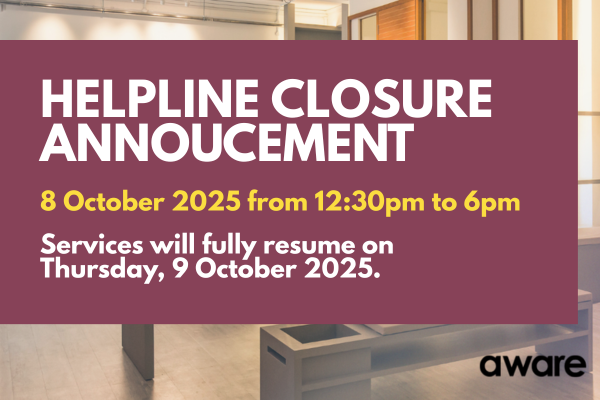
The Women’s Care Centre (WCC) and Sexual Assault Care Centre (SACC) helplines will be closed on 8 October 2025, from 12:30pm to 6pm. 

Services for WCC and SACC will fully resume on Thursday, 9 October 2025.


If you have experienced sexual assault within the last 72 hours, you may refer to this page for suggested actions.

If you require support, you may reach out to these alternatives:

  • National Anti-Violence Helpline (24-hour, for reporting of domestic and sexual violence): 1800 777 0000
  • Samaritans of Singapore (24-hour, for coping with self-harm or suicidal ideation):
  • IMH Mindline (24-hour, for mental health crisis): 1771
  • ComCare Helpline (7am-12am, to locate your nearest Family Service Centre): 1800 222 0000
  • Care Corner Helpline (10am-10pm, for emotional support for Mandarin speakers): 1800 3535 800
  • Community Justice Centre (Mon-Fri, 10am-12.30pm, 1.30pm-4pm, 20 minutes free legal information, walk ins only, first-come-first-serve basis)
  • Law Society Pro Bono Legal Clinic Services (Free legal information, appointments needed)
  • Police 999, Medical assistance 995 (If you or someone you know is in danger or has an emergency)

We seek your kind understanding and patience during this period.

Interview: Why is so much of domestic violence targeted towards women?

“It’s not enough to respond to violence—we must prevent it. That means shifting the norms that allow it to happen in the first place.”

In this interview with Channel News Asia on 26 Aug 2025, AWARE’s Director of Advocacy and Research, Sugidha Nithiananthan, discusses why domestic violence remains a gendered issue, with women disproportionately affected and men making up the majority of perpetrators.

This pattern is not a coincidence: it stems from patriarchal structures and sexist beliefs that continue to shape societal norms and institutional power dynamics. When men are taught to seek dominance, and women are socialised to be submissive, it creates a dangerous imbalance that enables and excuses violence.

Sugi highlights the urgent need for comprehensive sexuality education, starting in childhood. Teaching young people about gender equality, respectful relationships, and consent can disrupt the beliefs that fuel gender-based violence.

Podcast: Challenging Gender Norms in Singapore and the Region

In this episode of the Unity Podcast by Global Human Rights Defence (published 21 Aug 2025), AWARE’s Director of Advocacy and Research, Sugidha Nithiananthan, takes a wider look at how patriarchal structures and gender norms impact equality, rights and opportunities—both in Singapore and across the region.

From rigid expectations around masculinity to unequal caregiving roles, gender norms shape everything from policy decisions to personal freedoms. Sugi discusses the cultural roots of these expectations, and how they often go unquestioned, even when they harm everyone—men included.

She also explores the balance between respecting cultural traditions and pushing for progress, offering insight into how we can challenge harmful norms without alienating the communities we serve.

“The goal isn’t to erase culture—it’s to build a society where everyone, regardless of gender, can live with dignity, safety, and opportunity,” she says.

Forum: Accept diversity of perspectives to realise ‘we first’ Singapore

This forum letter was originally published in The Straits Times on 20 August 2025.

In his National Day Rally, Prime Minister Lawrence Wong called on Singaporeans to build a “we first” society, one where “we” must precede “me”. It is a vision worth embracing.

At its heart, “we first” recognises that government alone cannot create a caring society. Change spreads through countless small acts, through communities and institutions, and through people who look out for one another.

Civil society groups are part of this ecosystem by providing help on the ground, gathering lived experiences, and shaping policies so they better reflect the realities of Singaporeans.

We see every day how care and courage can transform lives: survivors of sexual violence who choose to make a police report, not only for themselves, but also so the next woman may be spared. We see it in volunteer helpliners who give their time to listen with patience and compassion, guiding callers through difficult options, and in advocates who push for reforms so that laws protect families from harm.

These are the voices of “we first” – people who know the well-being of others is their concern too.

But solidarity requires more than neighbourly goodwill. It also needs systems that guard against inequality and abuse. Survivors of sexual violence need not only support services, but also police officers trained to respond sensitively, and laws that recognise emotional and physical abuse.

These are not “me” issues; they are “we” issues because when women are safe, families and communities are stronger.

At Aware, we try to make the “we first” spirit practical. Through our bystander training, people learn how to step in safely when they witness harassment or abuse.

When multiplied across society, such skills help create a culture where everyone knows they have a role in preventing harm.

Crucially, “we first” should never mean only one view. Respectful critique and alternative perspectives are part of caring for society. Different voices are not a threat; they are an expression of collective responsibility. If we engage in good faith and listen across divides, policies will be stronger and trust deeper.

A “we first” Singapore is an important aspiration. To realise it, we must embrace not only small acts of kindness, but also the diversity of perspectives that move us closer to justice.

Corinna Lim
Executive director
Aware