Author: AWARE Media

AWARE’s 29th AGM – 26 April 2014

AWARE was very pleased to hold our 29th Annual General Meeting on 26 April at the AWARE Centre.

Forty-five members came together to hear about AWARE’s work and achievements in 2013 as well as our plans for the future.

President Winifred Loh began the meeting with a video of significant events in 2013, then shared AWARE’s strategic plan for the next five years. Following that, the Research & Advocacy, Support Services, and Programmes & Communications departments as well as the We Can! campaign shared some of their most remarkable work in 2013.  Members and staff engaged in lively discussion about past project and future directions.

This being an election year, a new Board was elected. Winifred Loh retained her position as President, and will lead a Board of both old and new faces. The members of the new Board are:

President: Winifred Loh
1st Vice-President: Faeza Sirajudin
2nd Vice-President: Tan Joo Hymn
Honorary Treasurer: Zeng Li Hui
Vice-Treasurer: Stephanie Chu
Honorary Secretary: Teh Hooi Ling
Board Members: Teo You Yenn, Jasmine Ng Kin Kia, Deeksha Vasundhra, Margaret Thomas

photo

The new Board will serve a two-year term.  We are confident that they will take AWARE to new heights.

Civil society responds to the proposed anti-trafficking bill

Dear Member of Parliament Mr Christopher De Souza and the Inter-Agency Taskforce on Trafficking-in-Persons,

parliamentThank you for hosting the public consultation sessions on the proposed “Prevention of Human Trafficking Bill” between 19 March 2014 and 15 April 2014. Many representatives from civil society attended the introductory session on 19 March 2014, as well as other sessions, through which we learnt more about the proposed Bill from the handouts and ensuing discussions. As part of the public consultation process, we would like to reiterate our views and concerns that we have expressed at these sessions, as inputs for the Bill that is being drafted.

At the outset, we are glad that the State has decided to address the issue of human trafficking in Singapore. It was encouraging to see that the proposed Bill plans to adopt the broad and comprehensive UN Trafficking-in-Persons (TIP) Protocol, which defines trafficking in persons as occurring across the migration process and being undertaken by means of “threat…of deception, of the abuse of power or of a position of vulnerability… for the purpose of exploitation.”  We understand that the proposed Bill will cover different forms of trafficking, including sex trafficking, labour trafficking and child trafficking. However, as civil society organisations which work closely with affected individuals, we are disappointed by the serious limitations of the proposed Bill, which does not adequately address issues of deceptive recruitment, loss of liberty and debt bondage.

Labour Trafficking

With regards to labour trafficking, the Bill intends to focus on “forced labour or services, slavery or practices similar to slavery, servitude.” Given this context, many of us at the public consultation sessions raised our concern about current exploitative practices, such as working and living conditions, wages, restriction of movement, and so on. In response, we were told that the proposed Bill would not take into account such indicators because migrant workers are supposedly covered under the Employment of Foreign Manpower Act (EFMA).

However, many of us who have worked extensively on migrant worker issues have come across several cases whereby the EFMA has been unable to deliver justice to workers. As examples, the SGD 5,000 security bond, the lack of freedom to change employers, poor protection against long working hours, lack of wage protection, poor enforcement of the Passports Act and the ability of employers to repatriate workers, are all not addressed by existing legislation, thereby encouraging trafficked and forced labour. Unless these issues are considered, the proposed Bill will not be comprehensive in its protection, as it is now contingent on an inadequate EFMA to cover gaps.

Sex Trafficking

We understand that according to the proposed Bill, consent of the victim will not be an impediment to enforcement, and those who are deceptively recruited into working in the sex industry shall be protected. However, we are concerned about the process of victim identification.

At the 19 March, 2014 consultation session, Mr De Souza said, based on his past experience as a lawyer dealing with similar cases, that it is difficult to gather evidence to prove whether or not a woman who is caught in a raid is a victim of sex trafficking. In such cases, he elaborated, officials will have to make a call ‘on the ground.’ We are worried about this process because the decision of who is a victim is left to the subjective judgement of individual officers. If there are no criteria to determine a victim of trafficking, how will the proposed Bill serve as protection?

‘Victim-Centric Approach’

This leads to another key aspect of the Bill which was discussed –the incorporation of a ‘victim-centric approach’. Interestingly, what is proposed as victim protection — namely the provision of temporary shelter and video-conferenced trials– are framed as ‘a key pillar of Singapore’s work to combat trafficking in persons.’ However, at the 19 March, 2014 consultation session, a taskforce panellist from the Ministry of Home Affairs explained that these measures exist to enable the victim to play a crucial role in assisting authorities to get to the perpetrators. This implies that the sole purpose of legalizing certain protection measures is to ensure that the victim can serve the interests of the State, as opposed to ensuring his/her well-being in and of itself.

When some of us at the session suggested other measures to assist the victim, such as finding alternative employment or arranging a temporary stay visa, the panellists did not commit to addressing any of these. Not responding to any of these needs will leave the victim vulnerable to further victimisation through repatriation or deportation.

Thus, while we can appreciate that the proposed Bill attempts to recognize the nature of human trafficking, we feel that it is inadequate in providing protection and support to marginalised migrant workers in certain industries. We would therefore like the draft Bill to consider:

  • Adequate protection for marginalised migrant workers in all industries, including but not limited to fishing, construction, service, sex, entertainment and domestic work, several of whom face exploitation as a result of long working hours, poor conditions, low pay and debt bondage
  • Specific mechanisms to ensure that victims of sex trafficking are properly identified and protected
  • A supportive victim-centred approach that deters further victimisation

As we would not like for Singapore to be an economy built on the exploitation of migrant labour, a solid anti-trafficking legislation that acknowledges all the characteristics of trafficking is crucial to protecting the vulnerable.

Thank you.

Sincerely,
Corinna Lim, Executive Director, AWARE

On behalf of:

Association of Women for Action and Research (AWARE)
Jolovan Wham, Executive Director, Humanitarian Organisation for Migration Economics (HOME)
Vanessa Ho, Project Coordinator, Project X
Vincent WijeysinghaWorkfair Singapore
Vincent LawCivil Society Activist
Timothy CheongCivil Society Activist

It is everyone’s responsibility to ensure diversity

By Moana Jagasia and Edwina Shaddick for the Straits Times

Pedestrians_cross_road_in_Mong_KokRounding up the Parliamentary debate on the Budget this year, Deputy Prime Minister Tharman Shanmugaratnam said that government policies will encourage a culture that enhances every Singaporean’s productive capacity, including that of older workers. Significantly, he also acknowledged that the issue was not simply about “business and financial strategies” but also included “changing the way we think about every Singaporean”. He had a point.

Since 1964, for example, Singapore has avoided overt racial conflict. But is the absence of such dramatic incidents proof of the presence of racial harmony?

The reality is that any assessment of racial harmony and multiculturalism must also deal with racial discrimination. Last year’s Institute of Policy Studies’ (IPS) study on race relations in Singapore revealed that 67 per cent of Malays and 60 per cent of Indians said that they experienced discrimination during job applications. In contrast, 61 per cent of Chinese said they had never faced racial discrimination in employment.

These findings were recognised in Parliament last month, when MP Hri Kumar proposed the adoption of anti-discrimination legislation to send a strong signal about accountability in employment practices. MP Zaqy Mohamad further cited by Suara Musyawarah, an independent committee that does research on the Malay/Muslim community. The report highlighted discriminatory practices in workplaces where employers prefer non-Malay employees.

The statistics are discomforting. But while discussions about discrimination can be difficult, they are also necessary. And there is no better time for them than now, when the Government is itself focusing on the issue. Research suggests that workforce diversity leads to greater productivity and innovation. A 2011 Forbes Insight study surveyed 321 top executives from several MNCs. Fully 85 per cent believed that greater social diversity helped drive innovation by encouraging different perspectives and ideas. Acting Minister for Manpower Tan Chuan-Jin echoed this in November 2013, saying that “diversity makes good business sense.” The government-linked Tripartite Alliance for Fair Employment Practices (TAFEP) also tries to persuade businesses that diversity is in their best interest.

But are these exhortations being well-received by employers? Of the 22,000 businesses registered in Singapore, only 2,893 have signed TAFEP’s pledge to commit to fair employment practices. In 2013, TAFEP found that of 550 small and medium enterprises surveyed, 64 per cent did not see the importance of implementing inclusive employment practices. This suggests that the elimination of discrimination cannot be an option left to the discretion of employers.

Unlike innovation, which the Government can encourage businesses to adopt voluntarily, it is inappropriate to allow the market to tackle workplace discrimination. In October 2013, AWARE publicly called for the government to pass legislation prohibiting all forms of employment discrimination. Proactive intervention through legislation and administrative monitoring is essential to ensure the universal participation of employers.

Accommodating people with diverse needs requires certain adjustments. Beyond material adjustments, such as wheelchair ramps or halal canteens, there must be a shift in mindset to ensure equal opportunities to everyone, regardless of age, gender, ethnicity, religion, language, ability status or sexual orientation. The Constitution says that all citizens are equal, regardless of race or religion.

Meritocracy, widely believed to be one of Singapore’s dominant values, promises the possibility of social mobility based on merit alone. It should not be up to individual employers to choose whether they wish to adhere to these shared values. This is especially important, given the existence of the psychological bias of homophily, the tendency of humans to associate with those who are similar.

AWARE has been advocating gender equality at the workplace for 28 years. Discrimination against women is compounded when a woman is elderly, when she is disabled, when she is a member of a minority, or when she belongs to other groups that are marginalised.

Although all Singaporeans are equal before the law, every Singaporean is not like every other Singaporean. A workforce where the productive capacity of every Singaporean is maximised has to be inclusive. To ensure this, the state must intervene to ensure equal opportunity for all.

Moana Jagasia is Research and Advocacy Coordinator at the Association of Women for Action and Research (AWARE). Edwina Shaddick is a teacher at a private school and a member of AWARE’s Budget sub-committee.

This article was originally published in the Straits Times on 8 April 2014.

This is your life. Get tested.

The way that we talk to those around us about HIV, marriage and sex can put women’s health at risk.

HIV videoThis insight lies behind ‘This is your life. Get tested.’, a new video released today by the We Can! campaign to mark World Health Day. The video depicts a woman sitting at a doctor’s office, trying to decide whether to take an HIV test, as she believes her husband has been having sex with other women.

As she waits for the doctor, memories of encounters with various figures in her life flash in front of her. These include her husband coercing her to have sex without protection despite her wishes, and her family and friends expressing scepticism and disbelief at her situation, or blaming her for it.

“This video illustrates how societal support for women’s sexual empowerment within marriage can be crucial to women’s health and well-being”, said Kokila Annamalai, the We Can! Campaign Coordinator. “Research on women who report contracting HIV from their husbands shows that sexual disempowerment plays a key role in their experience. As a society we must affirm women’s right to say no to sex, or to insist on a condom within marriage. We also want to encourage all women who think they may be at risk of STIs (sexually transmitted infections) to get tested”.

The video has been crafted based on a five-year qualitative study commissioned by the Association of Women for Action and Research (AWARE). The study was led by a team from the Saw Swee Hock School of Public Health, National University of Singapore, and supported by the Department of STI Control, National Skin Centre and the Communicable Disease Centre.

Through in-depth interviews with 60 women, the study shows that among respondents who were married and diagnosed with HIV/AIDS, more than half reported that their husbands had infected them. Many of them knew that their husbands were having sexual relations outside of the marriage, but felt disempowered to protect themselves from STIs by refusing sex or ensuring the use of condoms.

This may be attributed to unequal power relations between husband and wife, as well as traditional gender norms expecting women to be sexually submissive to their husbands. This is reflected in some of the women’s reports that their husbands became violent when asked to use a condom. As a result, some women have been forcibly infected by HIV/AIDS through marital rape. Yet the Penal Code (Section 375(4)) continues to put women’s health at risk by giving immunity to husbands who rape their wives.

The study also found that HIV-infected women’s difficulties were compounded by stigmatisation by unsympathetic family, friends, workplaces and community. This deters some women who are at risk from getting tested and seeking support. The video aims to raise awareness of the importance of women prioritising their own health and lives, even if friends and family are less than supportive.

‘Opting out’ and the glass ceiling

By Jolene Tan

We would all like to believe that Singapore society is unprejudiced, valuing contributions – not gender – when deciding on employment matters.

Research Woman ImageFaced with women’s under-representation in leadership, many reach for the explanation that women willingly “opt out” or “choose” to “hold themselves back”, ignoring structural barriers to women’s advancement.

This under-representation is significant. A recent report found that only 23 per cent of senior-management roles in Singapore are held by women, the lowest percentage in Asean.

Only 7.9 per cent of directors of Singapore Exchange-listed companies are women, leaving us behind neighbours (Malaysia, Indonesia) and comparable economies (Hong Kong).

We should resist the comfortable idea that this is, simplistically, a question of women’s “choices”. Sexist attitudes remain. In a recent survey by Robert Half, 71 per cent of human resource (HR) managers in medium-sized firms in Singapore cited “societal perceptions of women” as holding women back. Forty-three per cent at large firms perceived a “lack of promotional opportunities for women”.

Women in various fields regularly report to the Association of Women for Action and Research (Aware) experiences of sexist condescension in their professional lives.

Last week, MyPaper reported that Ms Joanne Chua of Robert Walters described the sexist labelling of high-achieving women, but characterised its impact as rooted in women’s “choices”, saying that women “limit themselves” out of “fear of being labelled as aggressive, iron ladies or overly ambitious”.

Women indeed have “choices” as to how to respond to sexist labelling, but those of us who care about fairness should focus on why that labelling takes place to begin with, and how to end it.

Men do not face similar social penalties for taking on leadership roles. Unlike women, they simply need not choose between success and societal approval: They can have both. This is a clear example of gender inequality damaging women’s prospects.

In thinking and talking about women’s “choices” to “opt out”, we need to go beyond the mere fact of a choice to ask: What structures shape the options that the women must choose between? Why are they different from – typically more restrictive than – the options available to men? How can we expand them?

It is disingenuous to say women “choose” or “take on themselves” the primary burden of housework and caregiving, when state policy and societal norms reinforce the unequal division of domestic labour. Paternity leave is extremely limited, compared to maternity leave, and childcare subsidies are structured around a model of female primary caregivers.

In an Aware survey of 1,322 people, 58 per cent of male respondents thought that women should take care of household chores and caregiving, compared to 47 per cent of female respondents.

A woman who does not desire this responsibility may have little alternative if her male partner is uncooperative, especially if general societal expectations support him in his position.

Employing an underpaid domestic worker may stave off negotiations between heterosexual spouses for more equality – but the work is still done by a woman, and who instructs and supervises her?

Everyone has domestic needs. Men’s underwear needs laundering no less than women’s, and men are generally as likely as women to have children and parents who need care.

The entire concept of an employee with no need for work-life balance rides on the hidden assumption that the employee can offload domestic responsibilities onto someone else – an arrangement usually available only to men, at the expense of women.

Little wonder then that 71 per cent of HR managers in large firms in the Robert Half survey said that lack of work-life balance held women back – and 0 per cent thought these women lacked ambition.

These barriers to economic participation have detrimental consequences on women’s welfare. According to the Ministry of Manpower, 43 per cent of women who are economically inactive cite domestic responsibilities as the main reason; the figure is 1.8 per cent for men.

As a result, women in general retire with significantly less CPF savings than men, leading to greater dependence on others to meet their daily and health-care expenses.

As they climb the career ladder, some women may duck their heads to avoid smashing into the “glass ceiling” – but that doesn’t mean it has vanished. It will only go if we actively work to dismantle it, rather than pretend that it doesn’t exist.

The writer is the programmes and communications senior manager of the Association of Women for Action and Research, a gender-equality advocacy group.

This article was first published in MyPaper on 26 March.

Flexi-work enables equal division of labour

The idea that flexi-work conditions are economically undesirable is rooted in a sexist division of labour and must be changed (“Fewer firms opting for flexi-work conditions”; March 17).

stockphotoIn reality, all employees have domestic needs and responsibilities, including housework and caregiving. Everyone has clothes that need washing and floors that need cleaning, and very many have family members who need care.
The concept of an employee who has no need for flexi-work arrangements is based on the hidden assumption that someone else, behind the scenes, is taking care of those needs.

Overwhelmingly, that person is usually a woman – either performing unpaid labour as a family member or underpaid labour as a domestic worker.

When businesses say “local work culture” is incompatible with flexi-work options, this implies that “local work culture” is reliant on the sexist and exploitative practice of expecting women to do all or most domestic work, with fewer contributions from men.

This marginalises women.

Recently, 52 per cent of human resource managers surveyed by Robert Half said women are not getting the same career opportunities as men – 71 per cent cited lack of work-life balance arrangements as the reason in large firms; 71 per cent said “societal perceptions of women” held women back in medium-sized firms.

Flexi-work arrangements should be available to all. This will help partners in a household share domestic responsibilities equally and not force women to bear the whole burden and consequently drop out of the workforce. Manpower Ministry statistics show 43 per cent of economically inactive women cite domestic responsibilities as the reason. The figure for men is 1.8 per cent.

Additionally, flexi-work arrangements enhance worker productivity by improving morale and labour retention. Firms should give workers ownership over tasks, prioritising engagement over inefficient “face time”. We are glad that the Government recognises the need for flexi-work in its Work-Life grants, and hope to see more support to make such possibilities available to all.

The Association of Women for Action & Research has had positive experiences with flexi-work as an employer. When necessary, staff members, many of whom have caregiving responsibilities, can work from home at modified working hours. The move away from a face-time-based office culture has proven beneficial – we can tap into more talent, and our employees are more satisfied, focused and productive.

By Sumedha Jalote (Ms), Communications Executive, Association of Women for Action & Research

This letter was first published in the Straits Times Forum on 24 March 2014.

Modeling good values by treating domestic workers with respect

by Teo You Yenn

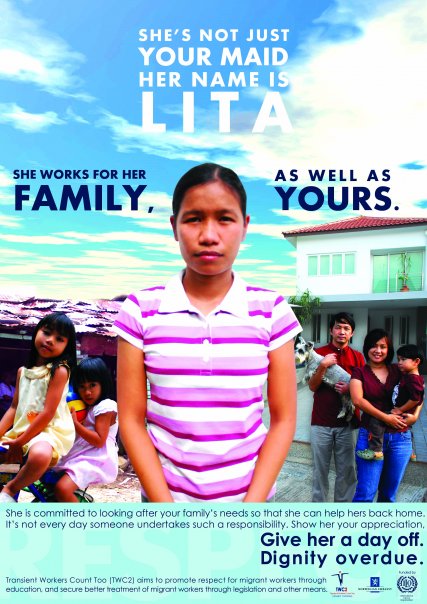
poster1The ongoing discussion on the rights of domestic workers to days off and leisure spaces is not just about how the Singapore state should treat foreign workers who contribute to the economy. Nor is it only about relations between domestic workers and employers. Ultimately, it reveals who we are as a society, and the kind of culture and values we embody. The way we treat domestic workers sends strong signals to our children on the ethics we live by.

The values and beliefs that make up a culture are not passed on through textbooks or formal education alone. Culture is produced through everyday practice. Values are learnt through micro interactions and everyday observations. 
This is demonstrated embarrassingly to parents when children parrot kid-inappropriate words, or mimic the anti-social behaviour they observe in adults.

When people resist efforts to improve the dignity of workers, they embody values of injustice. When we protest every little “inconvenience” whenever the maid is on annual leave or when we are obliged to share space with people from different classes or ethnic backgrounds, we put into practice attitudes of superiority and intolerance.

Sociologist Raka Ray and anthropologist Seemin Qayum argue in their book, Cultures of Servitude, that children growing up with servants learn much about inequality, class, gender and ethnoracial differences from experiencing the employer-servant relationship every day. Too often, children learn that some humans – their needs, opinions and aspirations – are less valued and valuable than others.

In Singapore, some children learn that their caregivers are different from them when they see their “aunties” sleep in spaces with little privacy. They see this person attend social gatherings only to help with menial tasks.  Most also learn that this is the only person in the household doing chores before others are up and long after others have finished work. 
The domestic worker is the only person working every day – often with only one or two days off a month, sometimes with none at all. Many children also hear adults flippantly discussing their “maid problems.” 
Despite this, many such children love their caregivers and listen when given instructions. But a fair number can also be heard discussing their caregivers with language like “my maid” and “your maid”; or barking orders and making loud demands. Many even rely on domestic worker caregivers to do things that non-disabled human beings their age should be able to do themselves.

It is true that the needs of some families cannot be met by family members alone. Many Singaporeans also treat domestic workers decently. The employer-domestic worker relationship can be a positive and fair one.

Days off, living wages, access to leisure and public space are basic requirements for human wellbeing. 
In 2012, when one rest day was announced for migrant domestic workers, AWARE pointed out that this was an important step toward upholding human rights, which are meaningful only insofar as all people have them (“The right to rights”, Today, March 16, 2012). Two years on, we continue to see resistance to the introduction of this basic human right.

As a society, it is time to set higher standards for ourselves. Singaporeans should stand up for domestic workers’ rights because our culture and values are at stake.

Who are we? Who do we want our children to be?
Do we hope our kids will treat people with respect and not take their privileges for granted? Do we want our children to learn that being human is not just about doing well in exams, but about performing basic tasks to take care of themselves? Do we want them to see the home as a place of equality and respect rather than injustice and exploitation? If so, we have to start here. 
The relationships with domestic workers shape many of our homes, and increasingly influence our social ties and interactions beyond the home. As society ages, there will also be a greater need for paid caregivers in various forms.

All Singaporeans, regardless of whether or not they employ domestic workers, are responsible. We live in a society that is cultivating new norms about gender practices, as well as racial and class inequalities. All of us, like it or not, produce “cultures” around domestic labour and the people who perform them. The attitudes we take, the behaviours we model for the children, shape our present and future.


Teo You Yenn is Assistant Professor in Sociology at the Nanyang Technological University, board member at the Association of Women for Action and Research (AWARE), and author of the book Neoliberal Morality in Singapore: How family policies make state and society (Routledge, 2011).

An edited version of this article was published in the Straits Times on 18 March 2014.

Recommendations for the Harassment Bill

In preparation for the Parliament debate on the Protection from Harassment Bill, AWARE wrote an email with our recommendations on the bill to all members of Parliament and Ministers. The email is below.


parliamentDear MP,

We understand that the Protection from Harassment Bill will be debated soon.  We are pleased to share our recommendations on the Bill, which we hope you will take into account when deliberating on it.

The Association of Women for Action and Research (AWARE) provides support to victims of harassment, including through our Sexual Assault Befrienders Service.  We have also conducted research into sexual harassment in Singapore and worked closely with the Ministry of Law as they developed the Bill.

A welcome step forward

The Bill reflects a recognition that harassment and stalking are serious problems.  We welcome the stronger civil remedies available to victims and the explicit recognition that stalking and harassment may include online and/or extra-territorial conduct.  However, we have concerns about some features of the Bill.

Employer responsibility

Disappointingly, the Bill does not require employers to institute policies against workplace sexual harassment (WSH), even though the Bill seeks to address WSH. Please urge the Government to require employers to have WSH policies, which should include formal processes for resolving WSH complaints from workers.

The Ministry of Manpower website states that employers “who create workplace safety and health risks will be held accountable”.  The lack of policies and procedures to prevent and address workplace sexual harassment does indeed create a workplace safety and health risk for employees.

Apart from the current Bill, this gap can be filled by amending the Employment Act and/or the Ministry of Manpower announcing and enforcing a binding code of conduct.  The Fair Consideration Framework shows MOM’s willingness to intervene to ensure fair workplace environments – so why not against WSH?

There are five key advantages of mandating employer WSH policies instead of relying only on the Protection Order (PO)/civil suit regime in the current Bill.

  1. It is fairer.  Employers benefit from co-worker collaboration and should be responsible for safe workplace environments.
  2. It is better at preventing WSH from occurring.  Legal remedies often seem remote.  Employer policies pro-actively integrated into organisations will be much more effective in fostering an atmosphere of zero tolerance for WSH.
  3. It offers a more effective way of addressing WSH.  Perpetrators are often in more senior positions than victims, who hesitate to use the law without explicit assurance from employers that they will not be victimised for it (e.g. terminated).  Police action in response to a PO breach is cumbersome, where a company can take swift, straightforward measures.
  4. It is less costly for society.  Employer processes are less resource-intensive than court processes, however simplified.  In practice, ensuring compliance with a PO against a co-worker will involve employers in any case.  It is more efficient to mandate employer investigation, reserving state action for cases where employer inaction makes it necessary.
  5. It is better for businesses.  Victims who feel unsupported by employers often simply leave, affecting staff retention.  Moreover, staff relations may be unnecessarily damaged by employees seeking POs and lawsuits, rather than resolving complaints through less polarising internal grievance processes.

Some WSH facts:

  • Our 2008 survey shows that 54% have experienced WSH. 79% of victims were female.  11% received career threats for not complying with sexual demands.  WSH affects how inclusive workplaces are for women.
  • A recent Straits Times report (9 Mar) referred to interviews with 10 victims. All were dissatisfied with their employers’ responses.  This is consistent with our experience.  TAFEP’s guidelines are insufficient – they are non-binding and give little prominence to WSH.
  • WSH damages morale and productivity, and raises labour turnover costs.
  • All other leading business centres (e.g. Hong Kong, South Korea, Taiwan, Australia, Britain, the US) impose obligations on employers to address WSH.

Civil remedies: access and scope

  1. Protection Orders.  The introduction of POs against harassment and stalking is a sensible extension of the well-established Women’s Charter regime for protection from family violence.  However:

a) How will the Government ensure that obtaining POs is quick, easy and inexpensive?  Currently, victims do not take action against harassment because the legal processes are expensive and complex.  They should not have to engage lawyers or navigate bureaucracy in order to obtain relief.

b) Under what circumstances will the police take enforcement action?  Under the Bill, breach of a PO is a non-seizable offence, unlike under the Women’s Charter Personal Protection Order (PPO) regime.  This means that police have no obligation to investigate or initiate charges.  Unless they pro-actively exercise their discretion to do so, harassers can breach POs with impunity.  We welcome clarification from the Government and the Singapore Police Force about enforcement action.

  1. Will claims for damages for emotional injury be allowed?  We welcome the availability of civil damages for stalking and harassment.  However, the Bill does not specify that these claims can include damages for emotional injury – often a major component of the harm done to victims.  We urge the Government to state expressly that claims for such damages will be allowed.

Thank you for your time and attention.  If you would like further information, we would greatly welcome further discussion of these issues with you.  Please feel free to contact me at ed@aware.org.sg.

Yours sincerely,

Corinna Lim
Executive Director, AWARE

Harassment Bill: Employers should be involved

AWARE emailed Acting Minister for Manpower Tan Chuan-Jin on 10 March 2014. The email is reproduced here.


Dear Minister,

office1Last November, you stated that no workplace sexual harassment (“WSH”) can be tolerated.  With the Protection from Harassment Bill reflecting governmental recognition that WSH is a significant problem, we urge you to announce that you will introduce a legal obligation for employers to address WSH.

On 9 March, in the Straits Times, journalist Radha Basu noted that all ten victims of WSH she spoke to were “disappointed” with their companies’ responses to their complaints.  This has also been our experience of WSH cases.  Voluntary TAFEP guidelines are insufficient – employers must be required to take action.

The Fair Consideration Framework shows the Ministry’s ability to intervene in business decision-making to ensure equitable workplaces.  We ask you to act on your stated commitment to gender equality by taking decisive anti-WSH action.

Lately the Government has emphasised productivity.  WSH damages productivity and morale, and generates turnover costs (e.g. victims leave firms, often without employers knowing why).  It is in Singapore’s economic interests to mandate anti-WSH policies, though employers wrongly emphasise their short-term costs over the long-term benefits.

Mandatory employer responsibility for WSH has clear advantages over leaving workers to seek Protection Orders (“POs”) and/or damages under the Bill:

1. It is more in line with Singapore’s values of fairness.
You have emphasised that businesses must not cut corners on safety to increase profits.  This also applies to WSH.  Employers benefit from requiring co-worker collaboration and should be responsible for safe workplace environments.

2. It is better at preventing WSH from occurring in the first place.
Legal remedies often seem remote to ordinary people.  Employer WSH policies made known to all workers and pro-actively integrated into organisations will be much more effective in fostering an atmosphere of zero tolerance for WSH.

3. It offers a more effective and accessible way of addressing WSH cases.
WSH perpetrators are often in more senior positions than victims, who hesitate to seek legal remedies without assurance that they will not be victimised for it (e.g. terminated).  Police action in response to a PO breach is cumbersome, where a company can take swift, straightforward measures.

4. It is less costly for society.
Employer processes are less time- and resource-intensive than court processes, however simplified.  In practice, ensuring compliance with a PO against a co-worker will usually require employer involvement.  This creates a duplicative system where cases are assessed first by the state and then again by businesses.  It is more efficient to mandate employer investigation, reserving state action for cases where employer inaction makes it necessary.

5. It is ultimately better for businesses.
Businesses benefit when WSH disputes are resolved without escalation.  Staff relations will be unnecessarily damaged by employees seeking POs and lawsuits, rather than resolving complaints through an internal grievance process, which is likely to be less polarising, and more constructive and future-oriented.

For these reasons, we urge you to take this valuable opportunity to announce that you will require employers to do their part to tackle a serious social problem which the Government has committed to addressing.

Please do not hesitate to contact me if you should require further information.

Yours sincerely,
Corinna Lim
Executive Director, AWARE