
Author: AWARE Media

The right of every woman to choose what to wear

By Sahar Pirzada, Training Institute Executive, and Jolene Tan, Programmes and Communications Senior Manager, AWARE

Recent discussions about whether Muslim women should be allowed to wear headscarves at work have focused on the voices of political and community leaders, as well as the needs of “communities” and the importance of “social harmony”.  Perhaps it is time to shift our attention.  The most crucial person to listen to on the question of whether a Muslim woman should wear a headscarf is the woman herself.

12511148182020482402hijab.svg.medSingapore is a multi-cultural society which values freedom of religious worship.  Whether and how to worship – and how to express that worship – is not for the state to decide, or for any non-state group to press onto their neighbours.  Rather, it is to be privately determined by every individual’s conscience.

Globally, there is a troubling history of state coercion in connection with the headscarf, for instance with Iran mandating it for all women and France banning it in some contexts.  Non-state groups have also interfered with women’s religious freedom and rights over their own bodies.  This can take seemingly opposing forms: the racists in Europe physically assaulting hijabis in public, and abusive families intimidating unwilling daughters into donning the scarf, are two sides of the same coin.

AWARE supports the right of every woman to choose what she wears.  Women must enjoy equal access to work regardless of their sartorial choices.  It is important that women do not face discrimination when their dress indicates their belonging to a particular religion or is associated with a particular ethnic group, especially when that ethnic group is a minority that feels marginalised.  They should not have to hide their beliefs or group membership to participate in public life.

At the same time, the meaning and importance of the headscarf or any symbol of faith must be decided by every woman for herself, as a matter of individual religious conviction.  A Muslim woman who does not wear a headscarf should not be attacked as less of a true member of her faith or community than one who does.  Only with pluralism can religious freedom be equally enjoyed by all.

AWARE’s staff, members and volunteers include many Muslim women (including a writer of this letter).  Some wear headscarves, some do not, and some have changed their minds on the issue more than once.  We celebrate their right to change their minds.  Whatever their decisions about their bodies and dress, they deserve respect and inclusion from all.

An edited version of this letter was published here in TODAY on 12 November 2013.

Please also read this letter published in TODAY on this issue.

More than bookkeeping – Budget advocacy for CSOs

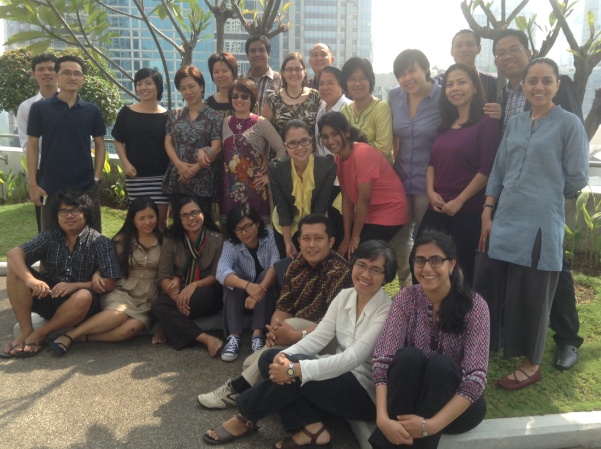
IBP1On 20-24 October 2013, AWARE’s Research and Advocacy (R&A) Coordinator, along with two volunteers from AWARE’s committee on formulating recommendations for Budget 2014, attended a Budget Analysis and Monitoring workshop for South East Asian Civil Society Organisations (CSOs) in Jakarta.

The five-day workshop was organised by a Jakarta-based budget advocacy non-profit, SeknasFitra, in collaboration with the International Budget Partnership (IBP) and sponsored by The Ford Foundation. CSOs from Singapore were represented by the AWARE team and the Director for the Centre for Research on Islamic and Malay Affairs (RIMA). We were joined by colleagues from Myanmar, Vietnam and Cambodia.

As one of the most important economic policy tools, the nation’s budget allocations determine how policies meet society’s varied needs, from healthcare and education access to reducing income inequality. The budget thus has a significant impact on vulnerable groups such as older people, children, poor people and disabled people. As a key link between communities and policymakers, CSOs play a critical role by monitoring and engaging in the national budget process. By foregrounding the needs and concerns of the communities they work with, CSOs help members of these communities gain representation in the budget process.

The workshop provided a detailed overview of the general Budget Cycle, including the key stages of the budget process, the relevant stakeholders involved at every stage, and the key budget documents that are produced. Participants were shown a ‘Best Practices’ model for the Budget Cycle and given the opportunity to draw comparisons to their own country’s national budget, as well as to identify the key processes and timeline for the implementation of budget programmes.

The workshop also outlined various ways that CSOs can get involved in the budget process. There are several budget analysis tools CSOs can use, such as conducting a socioeconomic analysis of the budget to understand the impact of new programmes and policies, organising discussions with community representatives, and conducting surveys with community members.

image

Participants examined case studies from Tanzania, India, Mexico, and Argentina. In each of these countries, CSOs have attempted to resolve misallocation of public funds through budget advocacy, using tools to track and monitor public expenditure and engaging key stakeholders such as local government leaders, the media, and grassroots organisations.

At AWARE, we will strongly consider using some of these methods to offer recommendations for forthcoming Budgets. We hope to engage more with community stakeholders through focus group discussions and to partner with other CSOs in Singapore to better understand how current policies and programmes have been meeting needs, while identifying areas which require more attention. This type of outreach and research will enable us to better formulate a set of budget recommendations that allows for a more inclusive and equal society.

Please click here to see AWARE’s recommendations for the Singapore Budget 2013.

Work injury compensation for sexual harassment?

By Jolene Tan, Programmes and Communications Senior Manager, AWARE

The High Court judgment that “Victims of workplace attacks qualify for compensation” (Oct 25) means that the Work Injury Compensation Act (WICA) is not limited to accidental acts, as was previously thought.

In this case, one worker set another on fire. But abusive or hostile acts from co-workers can be damaging to well-being even if they do not take such dramatic forms.

workers-compensationCould this decision have implications for cases of workplace sexual harassment in Singapore?

Central to the ruling was the principle that “interaction between fellow employees/workers” is an “ordinary incident of employment”. The judge stated that this was especially so “when they are working on assigned tasks in a shared workspace”.

This is a welcome recognition of the social component of workplace safety. Employers profit from requiring employees to work cooperatively on tasks, or at least to occupy the same physical space, such as a factory floor, shop or office, often for long periods.

The law rightly acknowledges that interaction between colleagues are part of workplace conditions.

The Association of Women for Action and Research (AWARE) has long argued that workplace safety and health regulations should include measures against sexual harassment.

Harassment can involve unwanted physical contact, sexually-coloured remarks, showing co-workers explicit material and sexual demands.

It has an impact on workers’ physical and psychological well-being, in some cases driving them to leave their jobs.

In a 2008 survey of 500 people, AWARE found that 54 per cent of respondents had experienced some form of workplace sexual harassment, and 25 per cent of them knew of others who had experienced it.

Employees whose employers ignore their complaints have few options now for redress. Criminal charges or civil lawsuits against co-workers are cumbersome and expensive. By contrast, the WICA regime is easier to navigate, and no lawyer is required.

Claims are made by submitting bills and medical certificates to the employer, or filling in a form to notify the Ministry of Manpower if compensation is not paid. The employee need not show that the employer is at fault, merely that the injury occurred due to the employment.

This is potentially of assistance to some victims of workplace sexual harassment. Medical leave wages and medical expenses can be claimed under WICA, which might be relevant should victims seek psychiatric help due to the incident.

Most cases do not result in medical expenses but in an unsafe, hostile working environment for the victim. So, although the threat of WICA liability might cause employers to take complaints more seriously, most cases would not be adequately covered.

Moreover, victims are usually less interested in placing blame or extracting compensation than in simply continuing their work in safer conditions. Legislation requiring employers to adopt formal processes for resolving these complaints, therefore, remains the best solution.

Employers are the main beneficiaries of employee collaboration and should justly be responsible for ensuring that it does not subject workers to sexual harassment.

This article was originally published here in TODAY Voices on 1 November 2013.

‘Fair employment’ must go beyond nationality

By Corinna Lim and Jolene Tan

Employment must be fair. This simple imperative lies at the heart of the Fair Consideration Framework recently announced by the Ministry of Manpower (MOM). The new policy takes aim against nationality- based discrimination in employment decisions. But its implications go far beyond the single lens of citizenship.

diversity1Two important principles underlie this new framework. The first is the Government’s implicit understanding that in order to tackle discriminatory employers, it is not enough to leave the market to itself. Proactive intervention, through both legislation and ongoing administrative monitoring, is necessary to stamp out problematic human resources practices and ensure all employees are treated fairly. Moreover, as the Government has acknowledged, such safeguards are compatible with maintaining a dynamic and competitive economy.

Second, the Government’s approach recognises that mandating formal processes can produce shifts in business culture. The specific mechanisms of a job bank and MOM scrutiny are not ends in themselves. Rather, they give structure and force to a wider change in employer mindset. “Fair consideration” is to be a pervasive ethos informing every level of corporate decision-making.

These insights deserve wider application. After all, employment discrimination takes many forms – besides nationality, job- seekers and workers may receive unfair treatment due to their age, race, gender, sexual orientation, gender identity, marital status, disability and religion. Consider the cases of pregnant employees dismissed without sufficient cause, or the complaints of older workers who feel stigmatised.

Aware’s helpline regularly receives complaints of workplace discrimination based on gender, including sexual harassment. Our 2008 survey of 500 people found that 54 per cent of respondents had experienced some form of workplace sexual harassment, and that 79 per cent of these victims were female. This suggests that many people in Singapore experience work environments that, far from embodying “fair employment”, are explicitly hostile to and unsafe for women.

As a state party to the Convention for the Elimination of All Forms of Discrimination Against Women, Singapore has a particular duty to remedy this situation.

The Fair Consideration Framework can serve as a starting point for a holistic initiative to end all forms of employment discrimination in Singapore. The central plank of this would be a single comprehensive statute prohibiting all forms of employment discrimination. Compliance could be monitored and enforced by a specialised administrative body, with complaints of infringement heard by a tribunal with specific expertise.

The experience of the United States shows that piecemeal law-making, targeting first one kind of discrimination and then another, generates uncertainty and inconsistency. For example, different levels of protection may be provided against different types of discrimination at various stages of the recruitment process for no clear reason. The Singapore Government has a valuable opportunity to ensure that the country’s legislation is thoroughly and coherently drafted, and that it addresses all types of discrimination at once, not just nationality.

In particular, organisations should be legally required to adopt formal procedures for resolving workplace sexual harassment complaints. Currently, employers may ignore such incidents altogether. This leaves complainants few options other than criminal charges or civil suits, which are unnecessarily punitive and cumbersome. The law can play an important role in developing a business culture that deals with harassment not by assigning blame but by mandating that employers and employees work together to end it.

Finally, as Aware recommended as part of the Employment Act review, the fundamental protections of the Act should be extended to all workers equally. “Managers and executives” and “domestic workers” should not be excluded. Nor should the Act distinguish between “employees” and “workmen”. The Fair Consideration Framework’s move to specifically protect higher-income PMEs signals a welcome shift from the traditional view that these workers have sufficient bargaining power to obviate the need for legislative protection.

While discussing the need to be “fair to Singaporeans”, it is important to remember that neither citizens nor non-citizens are homogenous groups. Fixing attention on nationality is a start. But we must go further to consider other forms of discrimination if we are to provide truly fair employment to all workers.

Corinna Lim is Aware’s executive director, and Jolene Tan is the association’s programmes and communications senior manager.

This article was originally published in the Straits Times on 25 October 2013.

Gender dimension to inequality in Singapore

By Vivienne Wee And Sarah Hill

Poverty DayEradicating poverty remains at the core of the United Nations (UN) development agenda. Indeed, International Day for the Eradication of Poverty is observed by the UN each year on Oct 17. In Singapore, however, poverty often appears to be a peripheral issue.

Singapore has not attempted to establish a national poverty line. Nevertheless, there is clear evidence of relative poverty, as manifested in a glaring wealth divide and an unequal remuneration system. Singapore’s Gini coefficient, a recognised method of measuring income inequality, has risen from 0.4 in the 1980s to 0.473 in 2011, and to 0.478 last year, indicating increasing income inequality. In fact, according to this measure, Singapore ranks as the second most unequal economy among the world’s advanced countries.

There is also a strong gender dimension to economic inequality in Singapore. Statistics from the Ministry of Manpower (MOM) show that women earn less than men, even when they have the same working hours and qualifications as their male counterparts.

In 2011, MOM estimated that in blue-collar industries in particular, men earn approximately 30 per cent more than their female colleagues. Furthermore, this gender wage gap widens with age.

Unequal incomes deprive women of financial stability, access to essentials such as adequate health care, and the opportunity to accumulate adequate Central Provident Fund (CPF) savings. Women have approximately 40 per cent less savings in their CPF accounts compared with men. This explains why 64 per cent of women, compared with 38 per cent of men, rely on their immediate families to assist with medical expenses, according to a National University of Singapore-Singapore Health Services 2010 study on health- care financing.

Women are also under-represented in the workplace. Last year, labour force participation for the 25-64 age group was 70.9 per cent for women and 92.5 per cent for men, indicating a huge disparity in economic participation and income-earning capacity across all socio-economic classes. According to a 2012 study by the NUS Business School and BoardAgender, more than 60 per cent of Singapore Exchange-listed firms do not have a woman on their boards, and only 7.3 per cent of the current 5,000 board positions available are held by women,

Additionally, women’s financial well-being is directly affected by the unequal burden of domestic responsibilities. Globally and in Singapore, a disproportionate responsibility for caregiving for children, the elderly or disabled family members falls on women, often as unpaid labour.

Pushed into shouldering this demanding role, women are often hampered by inflexible workplace conditions and lack of access to affordable caregiving alternatives. Without a regular income, women sacrifice financial autonomy, adequate funds for health care, a decent standard of living and opportunities for self-development.

This has consequences for global business too. Dr Klaus Schwab, executive chair of the World Economic Forum (WEF), notes: “Empowering and educating girls and women and leveraging their talent and leadership fully in the global economy, politics and society are fundamental elements of succeeding and prospering in an ever more competitive world.”

The WEF’s 2012 Global Gender Gap Report ranks Singapore as 55th out of 153 states (or 26th among 45 high-income countries). The Philippines, despite being less developed than Singapore, ranks eighth on the list.

Countries succeed in reducing the gender gap through policies that enable both parents to cope with work and family. The result is shared participation in caregiving, and a more fulfilling home life for all. It also produces a more equitable distribution of domestic labour, higher female employment participation rates and a more robust, productive and equitable economy.

If Singapore truly intends to create a fair and inclusive society where everyone benefits from national progress, it must address the issue of inequality and its disproportionate impact on women.

The first writer is the research and advocacy director at Aware, and the second is an Aware member.

This article was originally published in the Straits Times on 18 October 2013.

A new face for National Service?

By Jolene Tan, Communications Manager, AWARE. An edited version of this letter was originally published in TODAY Online on 17 October 2013.

Much ink has been spillled on whether women should be required to perform National Service (“Military NS not in sync with women’s physical and emotional abilities”; “Objective of NS is to bolster defence, not foster equality”).  Perhaps it is useful to look at the other side of the coin and ask: should men?

Some men find NS a positive experience.  However, for many people, regardless of gender, the military is not suited to their aptitudes, values and aspirations. Treating compulsory military service as a single gold standard of citizen belonging ignores the many other ways that people can contribute to the strength of our society, for instance through social services for older people or the poor, teaching in community settings, and civil defence.

It is worth noting that Singapore has recently faced two major crises – the SARS outbreak and the Sumatran forest fires – and in neither case was a military response necessarily helpful or relevant in ensuring our collective resilience.

Rather than pushing military service onto all, perhaps it is time to rethink the shape of National Service altogether.  A period of community service and contribution could be required of women and men alike, with military training forming merely one of several available options under the scheme.

Singapore-National-Service-Recruits-To-Receive-300x211Some women find the military fulfilling and have what it takes to make good soldiers (as many female SAF regulars demonstrate).  At the same time, many would not be a good fit – and the same is just as true of men.  Instead of pegging people to rigid roles based on narrow views of gender, we suggest giving everyone an opportunity to do something for society, in ways that better utilise their potential and serve a wider range of important needs.

AWARE’s views on National Service were also discussed in the October 16 episode of Talking Point on Channel NewsAsia. Click here to watch Moana Jagasia, Research & Advocacy Coordinator, AWARE, talk about women and NS.

Experiences of ageing among women in Singapore

by Ranjana Raghunathan and Tan Jian Xiang

This year’s theme for International Day of Older Persons (Oct 1) is: The Future We Want: What Older Persons Are Saying.

The Association of Women for Action and Research (AWARE) held a focus group discussion at the Society for WINGS (Women’s Initiative for Ageing Successfully) in June with seven women aged 55 and above, to learn about their experiences of growing old.

Five were working as cleaners, and two were unemployed for health reasons, fitting the profile described in Tsao Foundation’s 2011 report, that many older women who are employed tend to be cleaners and labourers.

Getting by on their incomes was a challenge for these women, but with little family support, their jobs remained their main source of livelihood. They could only get part-time work and had few alternatives to meet the rising cost of living, except cutting down on everyday needs.

They wondered how long they could keep working and what to do should their health fail. They were confused over public schemes to assist the elderly. Most did not know about ComCare or the Community Health Assist Scheme.

They felt they would need to know English or use the Internet to get the information. They said that sometimes even the social workers they encounter do not understand all the details of such schemes.

None knew about the minimum sum required for their Central Provident Fund (CPF) accounts. When informed of this, a few became concerned. They had been contemplating selling their flats to pay for their livelihood needs, but the proceeds would then go into their CPF.

Recent policy changes highlight the need to provide effective healthcare at rates affordable to the aged and the nation at large. But Singapore does not yet have a well-developed support system for women in old age, who face a relatively high risk of chronic illnesses, due to longer life expectancy and lower access to appropriate healthcare.

Two-thirds of national healthcare spending was paid out-of-pocket in 2011, not only by patients but also their children and other relatives, who thereby have reduced resources for themselves. Out-of-pocket healthcare costs are still a hurdle for the underprivileged and the elderly.

Lifetime differences in income produce different healthcare outcomes for women and men. Tsao Foundation’s 2011 report noted that 75 per cent of older women and 43 per cent of older men depended on their children and grandchildren.

CPF is the first source of financial support for only 2 per cent of older women and 5 per cent of older men with children. Without better social support, the caregiving burden falls disproportionately on women, leaving them without a retirement safety net.

455-old-lady-yaan

The report also shows that older women are more likely than older men to have higher levels of depression requiring clinical attention.

The World Health Organization ranks Singapore fourth for life expectancy, with women expected to live to 85 and men to 80. In this context, low-income women should experience more positive ageing, with less anxiety about their future.


Ranjana Raghunathan and Tan Jian Xiang are part of the Research & Advocacy Department at AWARE. This article was originally published in TODAY Voices on 30 September 2013. You can read the original version here.


Harmful constructions of women in sex education

Sex education is a controversial and hotly debated issue around the world. AWARE’s latest roundtable discussion took this topic on, focusing on the harmful constructions of young women in some sex education curricula.

Twenty participants gathered on the evening of 19 September to share their views and experiences, and listen to Cate Smith, a PhD student who has done her graduate thesis on the adverse effects of abstinence-only curricula on America’s teens, discuss her research.

sex-edTypically, there are two common types of sex education: a science-oriented comprehensive curriculum, aiming to help youth minimise risks related to sexual activity; and a values-based curriculum, advocating only abstinence until after marriage.

Sex education in Singapore is largely based on the second, using abstinence as the main approach in keeping youth from premarital sexual activity, and leaving out information on contraception and sexual health.

Cate Smith’s research on abstinence-only sex education showed that not only do such curricula often disseminate false facts on contraception failure rates, but also promote very harmful images of young women and their behaviour.

“Every guy wants a wife who is beautiful inside out”, says one of the sex-ed pamphlets Cate collected in her study, describing a woman who has premarital sex as a person without character, tainted with diseases.

The ‘abstinence-only’ curriculum claims that there is a natural difference between the sexes. While boys are driven by sexual urges that they should – but might not be able to – control, girls are gatekeepers without a sexuality of their own, responsible for controlling the men.

“Doesn’t this give permission to rape?” was one of the first questions raised when the discussion began. Indeed, research has shown that the promotion of such gender roles can lead to sexual violence against women. When boys are “biologically” freed from taking responsibility for their own actions– and this responsibility is transferred to the girls – the boys become perpetrators and the girls, victims.

Additionally, the depiction of women as having no sexual agency leaves them dangerously unprepared to understand and navigate their sexuality and relationships in a healthy and empowered manner.

The roundtable group shared their varied personal experiences of sex education. The discussion left the participants with a question to consider.

“How can a good sex education be provided in various societies, despite parents, schools and governments functioning as the culture’s gate-keepers?”

The Big Red Success!

The Big Red Ball, AWARE’s annual fundraiser, was held on Monday, 16 September. With great entertainment, yummy food, and excellent company, the night was full of fun and laughter, and all for a good cause. More than 350 friends and supporters of AWARE joined us at the event.

Big Red Ball


We are happy to announce that with the help of our supporters and sponsors, we raised more than $250,000 for our programmes and services, beating our own record from last year. And contributions are still coming in!


The funds will help sustain our research and advocacy programmes, support services, and the We Can! End All Violence Against Women campaign. Many guests pledged to join the We Can! Campaign as Change Makers.

We also announced the winners of our AWARE Awards (Singapore’s only gender equality awards) at the Ball, for categories including AWARE Heroine and Corporation of the Year. Please click here to read about our inspiring winners, including path-breaking icons such as Constance Singam and Rachel Chung.

The dubious honour of the annual ALAMAK! Award, given to the most excruciating example of sexism over the past year, went to St. Margaret’s Secondary School for its recent wig saga. The wig saga was brought to life by the Chestnuts, who left big smiles on all our guests’ faces with their irreverent, hilarious spoofs of the five ALAMAK! nominees.

AWARE’s staff and volunteers took to the stage too, kicking off the Ball with a energetic and graceful performance as the Bollywood Babes, setting the tone for the rest of the Ball.

And of course, no account of the Ball would be complete without mentioning our generous sponsors – KOP Properties and Montigo Resorts, Hong Leong Foundation, Lee Hwa Jewellery, Bengawan Solo, Sidefame, Performance Motors, Bayview Hotel, TOTE Board and Singapore Pools.

We would also like to thank Joe Augustin and Petrina Chow for hosting the evening, and our staff and fundraising committee for putting in so much hard work to design the ball splendidly.

If you joined us this year, thanks so much for your support. If you didn’t, do come down next year for a fabulous time!