Author: AWARE Media

An opportunity for gender equality at home

AWARE sent this letter about mandatory days off for foreign domestic workers to the Straits Times Forum last week.

AWARE applauds the decision to implement mandatory rest days for foreign domestic workers here (“Weekly day off for maids a must from next year”, Straits Times, March 6).

Beyond the issue of rest days being a fundamental human right for all employees, as many NGOs have already pointed out, this is also a valuable opportunity to start changing the fact that the domestic sphere is still overwhelmingly women’s domain in Singapore.

The huge influx of female foreign domestic workers has further entrenched gendered expectations regarding household chores as well as the care of children and the elderly in families.

Women who hire domestic workers may be freed from some domestic and caregiving tasks, but nonetheless continue to be responsible for the management of domestic affairs in their households.

Within this gendered system, men have limited space to learn and partake in the labour and privilege of care.

Although a single day off a week will do little to alter the system as a whole, it will perhaps give men some opportunity to share in household work and caregiving. Gender egalitarianism should start at home; in this way, the mandatory day-off for domestic workers can mean not just a healthier work-life balance for them but also for their employers, both men and women.

The dignity offered to foreign domestic workers as workers is also necessary if we are to teach our children good values. Singaporean children who grow up with domestic workers as caregivers should know that the women who care for them are workers in the same ways their parents are workers – with rights to rest, leisure, and sociability. They should see that their availability as caregivers is not infinite and that there are boundaries that should be respected. Moreover, girls and boys should have opportunities to see that their mothers and fathers are equal partners in the family. We owe our children at least these lessons.

Assistant Professor Teo You Yenn
Board Member, AWARE

Parliament Primer: A strike against victim-blaming

The following is an excerpt of the debate on the repeal of Section 157(d) of the Evidence Act and the issue of marital rape during the February 14 sitting of Parliament.

K Shanmugam
Law Minister; Foreign Affairs Minister; Member of Parliament for Nee Soon GRC

Section 157(d) of the Evidence Act provides that the credit of the victim in a rape or attempted rape case may be impeached by showing that she is of generally immoral character.

This provision has existed since 1872. It is premised on antediluvian assumptions that a sexually active woman is less worthy of credit. It gives an opening for sexual assault victims to be
subjected to gratuitous, traumatising and insulting cross-examination.

The Office for Women’s Development under the Ministry of Community Development, Youth and Sports had given us feedback that this amendment ought to be made. Likewise, AWARE also gave us feedback that this provision ought to be deleted, by making this amendment. When the amendment is made, any cross-examination of a sexual assault victim must proceed on the basis of relevance. I thank both MCYS and AWARE for raising this issue with us and helping us on this particular issue.

Lina Chiam
People’s Party’s Non-Constituency Member of Parliament

I commend the repeal of section 157, paragraph (d), in which the sexual history of victims of sexual assault and rape may be used against them in court. This move is long overdue. Blaming a victim is not merely an outdated concept that only “chaste” women should be afforded legal protection, but it was simply bad law. A crime should be redressed simply because it is a crime.


Desmond Lee
Member of Parliament for Jurong GRC

I note that the transitional provision in Clause 23 retains this rule for cases that are started or pending before the date of commencement of the provision that abolishes the rule. As this is a rule of procedure, and an archaic one at that, would the Minister consider implementing this retrospectively to the date this Bill is enacted in Parliament as opposed to the date that the provision is brought into force in the future?


Vikram Nair
Member of Parliament for Sembawang GRC

I would like to address the abolition of section 157(d) of the Evidence Act. I was quite heartened that support for this has been almost unanimous, especially from the men in the House, and I think that is quite right.

This is essentially the section that actually goes against the grain of allowing more evidence because the abolition of this section means that people who are accused of rape would not be allowed to impinge the character of the accuser. The reason why I think it is all right to allow less evidence in this particular section is because it protects the victim.

More often than not, victims of rape would be reluctant to come forward anyway, and having their entire previous sexual history brought up in court would definitely be an even greater deterrent. Removing this rule is quite timely and it is definitely a move in the right direction.

Since everyone here is unanimous that rape victims should be protected, I am flagging the abolition of Section 375(4) of the Penal Code hopefully for consideration by this House at a future date. I understand that that would probably come under the Ministry of Home Affairs rather than the Ministry of Law. I am just flagging that.

This section is commonly known as the marital immunity to rape. What that means is that if a man were to commit sexual violence – I would not use the word “rape” because it is not rape – on a woman without her consent, and they happen to be married, then that is an absolute defence.

There are some limitations now. The law has been cut back so that if the couple are separated, that is no longer a defence. But the fundamental rule is still there.

I think the main reason for abolishing this rule is that violence against women, non-consensual sex, is really the same, whether or not that happens in marriage or outside marriage. By abolishing the rule though, what we actually do is we basically say that violent sex against women, even in the confines of marriage, is unacceptable.

I understand that this is a controversial issue. One of my good friends was actually behind the No To Rape campaign, which was a campaign against the section, and I was myself a little bit sceptical at first. So let me maybe deal with some of the arguments that the sceptics of abolishing the rule might bring up.

I think the chief concern they could have is that there might be an increase in the number of false cries of rape, that when a marriage goes wrong, the woman might make a false allegation of rape. But I think the answer to this is that false allegations of rape are punishable anyway, and if that is the real mischief we are concerned about, then perhaps we should either enforce those rules tighter or perhaps make stricter rules against that.

But that is not a reason to not offer protection to women who are married. I think it is possible to deal with that particular concern.

I understand that this is a controversial issue and it is not before the House today, and there are probably other arguments as well, including what the duties of parties in a marriage are. But I will just leave that on people’s minds for a future date.

K Shanmugam

On credit of rape victims in Section 157(d): I think that is generally welcomed by all Members. What would happen as a result of the amendment is not that previous history would automatically be inadmissible but rather it is left to the courts to decide when it should be admissible. That depends on issue of relevance. It is just that we should not legislatively provide that certain issues will be relevant.

On the issue of marital rape: I think that issue falls outside the purview of the present rule, as Mr Nair himself recognised. That has got to be dealt with by the Ministry of Home Affairs. What I can say is when I was wearing that hat, the NGO No To Rape saw me as well. I found many of the arguments they put forward worth looking into. They made good points. I will certainly pass over Mr Nair’s comments to the Ministry of Home Affairs.

Read the debate in full here.

China’s National Population And Family Planning Commission visits AWARE


By Foo Jiayu

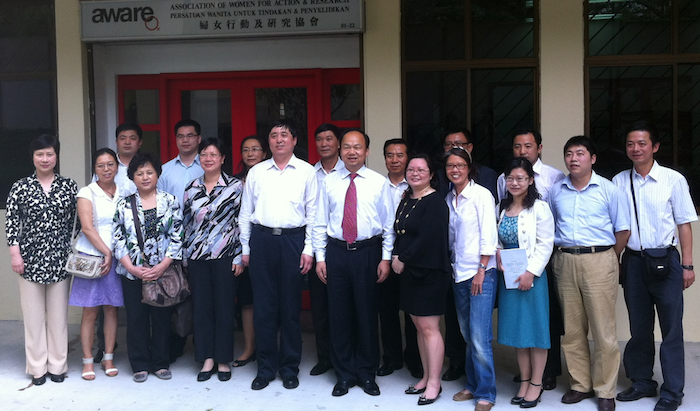
On 24 February, AWARE welcomed a delegation of 16 officials from China’s National Population And Family Planning Commission (国家计划生育委员会) at the AWARE Centre.

Headed by Deputy Director-General of the General Office Mr Yao Hongwen, the delegation consisted of officials from various provinces, including Guangdong and Guizhou. The main purpose of their visit to Singapore was to learn ways to control China’s population size.

Speaking in Mandarin, AWARE President Nicole Tan gave a short presentation on AWARE, focusing in particular on our Sexual Assault Befrienders Service (SABS), the AWARE Training Institute, and our Research and Advocacy work.

Members of the delegation asked questions about domestic violence, gender discrimination, as well as the issue of singles conceiving through artificial means.

In 2003,  the Chinese government banned IVF for single women. An official asked if people in Singapore were entitled to free in vitro fertilization (IVF) to conceive. Nicole replied that IVF is not free in Singapore, not even for married couples. Furthermore, single mothers face significant discrimination in Singapore – their children would be last in the balloting for seats in primary schools, for instance.

Another official remarked thatInterestingly, the officials also seemed particularly concerned about Singapore allowing polygamy under the Syariah law. This was mentioned in Nicole’s answer to a question of whether there were any particular differences between the rights of women and men in Singapore.

Nicole explained that this law originated during the British colonial period as a retainment of traditional Muslim practices. Further, she understood that approval is needed for a second wife, and this approval is difficult to obtain. The officials were of the view, however, that polygamy should be eradicated as Singapore is essentially a secular country.

Nicole also stressed the importance of the media in encouraging women to seek help. Taking the example of domestic violence, Nicole remarked that when media reports about domestic violence increase, calls by battered women and/or friends of these women to AWARE’s Helpline also increased.

Similarly, the media is an influential tool that should be used to clearly highlight that behaviour like sexual abuse and sexual harassment is deplorable and unacceptable.

Prior to visiting AWARE, the delegation also visited the Singapore Planned Parenthood Association, Fei Yue Community Services, the Housing Development Board (HDB), and various universities.

AWARE’s response to Budget 2012

pie chart

AWARE welcomes the 2012 Budget’s focus on building a stronger Singapore by ensuring that we are an inclusive society. We are glad that special attention is being paid to the needs of three socially vulnerable groups: older Singaporeans, Singaporeans with disabilities and lower-income Singaporeans. We look forward to getting more details about the various measures in the days ahead.

Measures to help older workers

The plan to help older workers by raising CPF rates and offering more incentives for employers to hire older workers is good. But these measures only benefit people who are in, or can return to, the workforce.

Many older women are not in the workforce. In 2011, only 55.1 per cent of women aged 55 to 59 were in the workforce, compared to 85.7 per cent of men in the same age group. Many of these women left employment to become homemakers and it will not be easy for them to find jobs in the formal sector.

We urge the government to look into the needs of these women.

Why should MediShield coverage stop at 90?

We welcome the extension of MediShield coverage from age 85 to 90. But why are we stopping at 90?

As Minister Shanmugaratnam stated himself, “more Singaporeans are living to 90 and beyond”. We believe Medishield should offer lifetime coverage.

Eldercare

Families who are coping with the financial burden of caring for an elderly family member will certainly welcome the various initiatives that will help to lighten their load.

The minister announced a $120 monthly grant for families who hire a foreign domestic helper to look after elderly family members.

However, not all elderly Singaporeans are cared for by their immediate family. Some may live alone, while others may be cared for by members of their extended families, or even by friends. We trust that the $120 grant will be extended to such cases.

In addition, we note that most of the benefits are in the form of subsidies to help pay for the cost of home care or community based services. However, there is no financial support for caregivers (usually women) who take time off work (fully or partially) to take care of their elder folk. We believe that many lower income women may choose to care for the elderly themselves as they are not able to afford to pay for the care services, even with the subsidy. This is a gap which should be addressed.

Employees with disabilities

We welcome the extension of the Special Employment Credit scheme to employers who hire graduates of Special Education (SPED) schools. But what about people with disabilities who are not SPED graduates?

Measures for low-income Singaporeans

We are heartened by the extension of support for children of lower-income families. We must ensure that they break out of the poverty trap.

Help needs to be extended to other low-income groups. For example, low-income
singles, single mothers, and couples without children. Such people should not be left on the margins of society just because they do not fit the norm of the conventional family.

A truly inclusive society must include everyone.

Read AWARE’s Budget submission here.

Calling for an inclusive 2012 Singapore Budget

The needs of vulnerable groups like older women and those in financial distress, in particular, should be addressed – No one should fall through the cracks.

In response to the government’s call for public feedback for the Singapore Budget 2012, AWARE has submitted a position paper with recommendations for an inclusive budget to address women’s priority issues. This is the second year in which we are submitting such feedback.

AWARE calls for an inclusive 2012 budget to support a caring society. To ensure a truly inclusive society, women’s issues must be addressed fully as national issues. AWARE thus calls for a budget that adequately meets the needs of all women in Singapore, regardless of age, marital status and disabilities. This is aligned with the State’s commitment and obligation to the United Nations Convention on the Elimination of All Forms of Discrimination Against Women (CEDAW).

Most caregivers in Singapore are women, who often experience adverse results for professional advancement and long-term financial security, due to lack of support. The Budget needs to reflect the state’s commitment to supporting women in both the workplace and at home.

AWARE also calls for a national budget that cares for vulnerable groups, particularly older women, persons with disabilities and those in financial distress. No one should fall through the cracks.

Our policy recommendations include:

Comprehensive healthcare for an ageing population

  • All Singaporeans over 85 should be provided with free Medishield coverage for life, and Medisave accounts should be periodically topped up from budgetary surpluses, in proportion to the age of the recipient as well as household income.
  •    It should be mandated that a specified percentage of a husband’s CPF be deposited into his stay-at-home wife’s Medisave account. Or, incentives (e.g. tax reliefs or additional top ups) should be provided for husbands to top up their stay-at-home wives’ Medisave account.
  • Subsidies should be given for the long-term care of elderly family members.

Comprehensive support of lower-income and vulnerable groups

  • Public spending on social programmes should be restored to the pre-1990 level of around 20% of GDP and should gradually increase in the next few years to around 25% as the population ages.
  • Eligibility criteria for ComCare and Public Assistance should be revised upwards to include household incomes of more than $1,500 per month up to the 30th percentile.
  • Public assistance and other forms of social support currently available to Singaporean women should be made available to the foreign wives of Singaporeans when they are in distress, as they are without any other form of social safety net.

Widened access to subsidies for infant care and childcare

  • Access to childcare subsidies, motherhood benefits and housing benefits should be widened to include all mothers, without discrimination against unwed mothers or stay-at-home mothers.
  • Paid paternity leave of two weeks should be made mandatory.
  • One month of the current four-month maternity leave should be converted to parental leave to be taken by either spouse.

Enabling persons with disabilities to be equal members of an inclusive society

  • Free or subsidized medical benefits for persons with disability, including financial support for the cost of rehabilitation, medicines, treatment and health insurance.
  • Measures to protect women and girls with disabilities from all forms of violence at home and in the community should be promoted in all institutions, services and programmes.


Publicly available database of vulnerable groups in Singapore society

  • Research resources with scientific support should be mobilised to collect data of vulnerable groups in Singapore, so as to provide data that is sufficiently detailed, consistent, regularly updated and disaggregated by sex, age and citizenship.

Read the full text of AWARE’s submission here.

Parliament Primer: Debate over ministerial pay

The following are excerpts of speeches made by six female parliamentarians on the subject of ministerial pay. They spoke during the Jan 9 to 18 sitting of Parliament.

Denise Phua
Member of Parliament for Moulmein-Kallang GRC

Although I do not completely agree with the recommendations carried in the Report of the Ministerial Salaries Committee, I cannot, in good conscience, say that the Committee has done a poor job. By boldly recommending pay slashes up to 50% – measures which are hardly cosmetic – the Committee has moved in the right direction.

Like many in Singapore, I thought it was important that if reference was drawn from what I felt was a more punishing private sector in terms of pay and accountability, then it was only right that common compensation principles in that sector be applied.

I am heartened that some of the recommendations I made were considered and applied, and in some cases, enhanced:

  • An independent and external Salary Review Committee was set up, for the first time so that executives do not write their own paychecks
  • The line of sight linking an incumbent’s Pay and his Performance is now clearer
  • The previously simplistic link of Bonus to GDP growth rate is now expanded
  • The Salary Benchmarking formula now targets a much bigger group of 1000 instead of 48 top wage earners
  • Keeping the annual base pay package to comprise only monthly salaries and a 13th month bonus by removing items like Special Allowance and Public Service Leadership Allowances is a more acceptable compensation practice

I would like to offer 5 recommendations:

1. Peg political pay to a broader base of income wage earners and discard discount

The proposed salary benchmark of the entry level minister, is now pegged to the top 1000 wage earners, instead of 48, in Singapore. A discount of 40% is then applied.

The selection of the 1000 top wage earners, albeit more reasonable, is arbitrary and still smacks of elitism because the base is about 0.05% of the workforce, assuming a workforce size of 2 milion. The application of the discount, whether the current one-third or the proposed 40%, is also arbitrary and often forgotten and unappreciated.

I propose that political leaders’ pay be pegged to a simple top percentile income bracket, eg 10% of 20% of Singaporeans. Discard the discount feature. A quick poll I conducted revealed that more Singaporeans are likely to understand and accept that their leaders belong to the top 10-20% income bracket in our country.

2. Strengthen the line of sight between pay and performance

a. Remove 1 of the 3 components of the Variable Pay Component ie the Annual Variable Component (AVC) and retain only (i) Performance Bonus which relates to the performance of the individual portfolio; and (ii) National Bonus which is linked to how the country performs;

b. Publicise the Key Performance Indicators or KPIs for individual portfolios so that Singaporeans have a better understanding of how they are linked to Performance Bonuses of the office bearers. Developing and publishing KPIs that relate to both the routine operations and new initiatives in, especially essential services such as housing, transport, social services, and education, are important for better understanding of the size of the individual portfolios and promote better quality dialogues;

c. Expand the National Bonus indicators which are now 100% linked to jobs and incomes. This is to reduce the potential of excessive risk-taking or undesirable tactics to boost the numbers. For instance, starting a third casino to boost the economy may well boost all 4 components of the National Bonus – real median income growth rate; real grow rate of the lowest 20th percentile income; lower unemployment rate; and enhance real GDP growth rate; but the move may well be an easier path to developing or own tourism products and is detrimental to the long term competitiveness and social well-being of our people.

3. Review the benefits package and not over-extend the ‘clean-wage’ principle.

It is a little ludicrous that the dental benefit of our Prime Minister and Ministers is $70/- per year and outpatient subsidy capped at $350 a year. Consider the provision of common benefits such as car and annual health screening packages that are typically provided to executives. Let us not over-extend the application of the principle of ‘Clean Wage’ so far that it becomes artificial.

4. Clarify the job scope and expectations of political appointment holders.

One of the underlying factors leading to the constant unhappy undertone when the subject of political pay is discussed in our country is the lack of awareness of the duties of political appointment holders from Members of Parliament to Ministers and even Speakers.

Members of Parliaments have differing views of their roles. The latest episode during which several Opposition MPs opine that it is the job of Government, and not MPs, to directly help their poor and needy residents and referral is the key strategy; caused a debate of its own outside the House. The clarity of duties and goals would be useful even to MPs of the ruling party.

The man in the street, for instance, does not understand the role of the Speaker of the House and does not have sufficient information to comprehend how it equates to a Cabinet Minister.

Clarity is also useful in the case of office bearers who hold multiple portfolios, sometimes up to 3 roles. It takes more than a human being to do 3 roles effectively and leave little time and space for the incumbent to reflect and reform policies where needed.

Instead of sweeping these rumblings under carpet, it is needful to clarify the job scopes and expectations of political appointment holders.

5. Conduct a review of the civil service leadership pay

One of my deepest concerns is that the Review excluded the some 300 top civil servants in the elite Admin Service. The title of the Report is entitled “Salaries for a Capable and Committed Government” but the review has deliberately excluded top civil service leaders specifically the Permanent Secretaries and others in the elite Admin Service.

This is the group that has been often been kept below the radar from public eye though they play a significant role in supporting the Prime Minister and his Cabinet in the development and execution of national policies. Due to their critical role, some of these elite talents are pegged on the same salary band with the ministers.

If and when the recommendations of the committee of political pay review are accepted, some civil servants will receive much higher packages than their ministers. Unlike the political appointment holders, they will continue to enjoy the retention of benefits such as the pension schemes which will be removed from the former.

Paying for top talents especially for those who opt for a career in the civil service is not an issue. However, the same principles of rigour in job evaluation, accountability for KPIs and disclosure must be applied. If private firms and charities are expected to disclose the highest paid executives and their salary bands, there is no reason why there should be a cloak of secrecy over the Admin Service incumbents.

I ask the Prime Minister to commission an independent review of top civil service leadership that will go beyond pay to attract, develop and retain talent for a capable and committed government.

In conclusion, the review of political salaries is a work-in-progress. It needs refinement but it is moving in the right direction. To reject it and to wait for it to be perfect and acceptable to every interested Singaporean, simply may mean that the current system stays. And that to me, is not an option.

Read her full speech here.

Josephine Teo
Minister of State for the Ministry of Finance and Ministry of Transport; Member of Parliament for Bishan-Toa Payoh GRC

On the pegging of ministerial salaries to the income of the top 1,000th citizen taxpayer, it is incorrect to label it as “elitist”. By itself, the peg says nothing about the value and importance of people at whatever level of income. It makes no value judgement at all.

The correct way to think about the peg is “would we like to draw our top political leadership from that level in our population?” This is how sound HR practitioners think about salaries too, to peg them at the level which you want to draw people from.

Remember that we are talking about people with heavy responsibilities – to oversee defence, our reserves; to manage our economy, maintain law and order; to educate our young, to plan for an ageing society. Again, as HR people would know, having the right person in charge makes a big difference.

We can certainly peg political salaries to the 10,000th or 100,000th. But by doing so, we are also expressing a view that it is good enough for Singapore to draw from those levels for our top political leadership. Singaporeans will have to decide if that is so. Can we find people to fill Parliament and Cabinet at those salaries? Yes, of course. We will find people whatever the salary levels are. The question is whether we will be satisfied with the selection.

Read her full speech here.

Amy Khor
Minister of State for the Ministry of Health; Mayor of South West District; Deputy Government Whip; Member of Parliament for Hong Kah North SMC

We must bear in mind that this is the first time the review has been made by an independent committee comprising well respected and experienced individuals from the private sector, the labour movement and the social sector. The Report is not the work of politicians or civil servants who may be perceived to have vested interests.

This eight-member committee individually and collectively have impeccable management and human resource expertise. In turn, they are ably supported by Mercer, a firm recognised to be an international expert on remuneration issues. They spent seven months painstakingly seeking feedback and deliberating on the issue before coming up with the recommendations.

That this independent, expert committee has, after careful deliberation, chosen to affirm the three principles of competitive salaries, a “clean wage” and the ethos of political service which entails making sacrifices indicate that these are sound principles which we should not easily dismiss. I note that the Workers’ Party has also stated its support for these the principles.

We must also bear in mind that the contentious salary benchmark, the benchmark for entry level Ministers, has been broadened considerably compared to before, although some people take the view that this resulting salary is still too high.

A key contention is why the need to link Ministerial salary to the pay of the top 1,000 Singaporean earners? We should not forget that there is a 40% “public service discount” to the benchmark. The discount would effectively drop the effective salary to maybe the median of the top 2,000 Singaporean wage earners.

The Workers’ Party has proposed what it calls a more “people up approach” in setting Ministerial salaries following what they consider are practices elsewhere in the world. This is based on what they judge as a “reasonable” multiple of a Member of Parliament’s allowance, and this in turn is pegged to the salaries of divisional directors in the civil service, excluding the Administrative service.

The presumption that the Workers’ Party makes is that political service is in the genre of public service. That is only partly true. Political service is more than public service. Civil servants are not subject to the votes of citizens nor do they need to carry the ground in policy making. So, pegging ministerial salaries to civil service salaries is an inadequate mechanism to account for the burdens and responsibilities that come with the job.

In order for the civil service to draw capable people into the service as a career, it also adopts the principle of competitive salaries taking into account relevant private sector salaries at all grades. So why is this principle not acceptable to the Workers’ Party when it comes to pegging Ministerial salaries?

Instead of first pegging MP’s allowance to the pay of divisional directors which is already pegged to market norms, and then arriving at the Ministerial Salaries using some multiple, which is arbitrary, would it not be much more transparent to peg Ministerial salaries to the competitive salaries that the calibre of people we are looking for in Ministers earn, or have the potential to earn, coupled with a discount for the ethos of public service?

Currently as the MP allowance is a percentage of the entry level Minister’s salary (17.5% of MR4 benchmark), the latter is already conversely a multiple of the former! I do not see how their proposed formula is an improvement over the Committee’s recommendation.

What multiple should be applied to the MP’s allowance so calculated to arrive at the Ministerial salary? Arithmetically speaking, if the multiple is high enough, the outcome could be the same as what the committee is recommending which is so in this case where the Workers’ Party has come up with a similar base salary of $55,000 per month for a new Minister.

Another aspect of the Committee’s recommendations that deserves credit is the removal of the pension scheme, the replacement of the GDP bonus with a National Bonus that uses four socio-economic outcomes as measures and five yearly reviews by an independent committee.

All these are direct responses to public’s concerns about the previous salary formula. While welcoming the new national bonus, some economists feel that not all the four indicators reflect accurately citizen’s welfare and could be replaced with other indicators. Yet others feel that the four indicators could be prioritise and given different instead of equal weightage.

Ultimately there is no single formula that can satisfy everybody and a judgement call has to be made. The committee had noted that it had considered a wide range of indicators before settling on the four.

Moreover, the Committee’s recommendation for a regular five yearly review of the salary framework by an independent committee would ensure that the framework remains appropriate over time and that the process remains transparent to the public. The time frame of five years which is about equivalent to a term of government is reasonable as it provides a sufficient time horizon over the length of a typical economic cycle for the Committee and the public to assess the appropriateness of the formula and propose any changes to be made.

Read her full speech here.

Halimah Yacob
Minister of State for the Ministry of Community Development, Youth and Sports; Member of Parliament for Jurong GRC 

I hope that when we discuss this issue, we will look at it in the proper context. We need to link this salary system to the Government’s performance, especially in the effort to assist those who are less well-off. In fact, the Government had also enhanced support to the middle classes. As the proverb goes; the political leadership that fights for the people is like a big piece of wood in the middle of the field that provides protection from the sun and shelter from the rain.

In debating this issue, I also urge you to look at the outcomes that we had achieved over the years and how this leadership had served the people. In just one generation, this Government had completely transformed Singapore.

The Government plays a major role in re-distribution to ensure fair opportunity for everyone. And as we move ahead, I can see that re-distribution role expanding. Other than heavy investments in education, healthcare and housing, we also have subsidies in the form of Workfare, ComCare, Medifund and educational bursaries, to name a few.

I was also very happy to read about the Ministry of Finance’s recent study which shows that social mobility, a subject close to my heart, is still very alive in Singapore. The study shows that children from poor Singaporean families stand a good chance of moving up in life. The son of a father in the bottom 20% of the income earners has at least two-thirds chance of breaking out of his low-income group. And he has a 10% chance of moving all the way up to the top 20% of income earners in Singapore.

As social mobility is closely related to educational achievement, strong government efforts to uplift educational standards and help needy students have paid off. And we are not standing still. Like housing, healthcare and social assistance, education too has gone through a lot of changes, benefiting our people. And I welcome the recent announcements by the Minister for Education that it is looking at ways to help students study in private educational institutions pay for their education. As I know that parents of children cannot get into the public universities, really struggle to support their children. Again, such efforts require leaders in public service with vision and foresight as education is a long-term investment and we need to attract more of such people into public office.

Read her full speech here.

Lina Chiam
Singapore People’s Party’s Non-Constituency Member of Parliament

My first point relates to the formula of pegging the ministers’ base pay to 60 per cent of the median income of the top 1,000 Singaporean income earners. Mathematically, it is not clear how the salaries will go from here. Yes, this is a huge cut now. But there is a possibility that the new formula may even result in a higher base pay than what the old formula could provide, on a long-term basis.

There are many ways that the median pay for the top 1,000 earners can rise substantially in the next 5 years. Wealthy foreign business people could be given Singapore citizenships en masse. It could even be that the median pay for this group will rise much faster than the median of the top 48 earners.

But for me to form a more accurate opinion, I would need to see how the old and the new formulas would apply to the period from the year 2000 to 2010, on a backdated basis.

To do so, the Government would have to provide us with these figures. More importantly are the figures for the ministers’ bonuses as paid out each year according to the old and new formulas.

If the Government and the review committee are truly serious about promoting a ‘clean wage’ approach for Singapore’s ministers, without additional perks and allowances, then they must follow through with the spirit of that approach.

All these data on salaries and the specific amount of bonuses paid out each year must be published and made transparent for public scrutiny. To date, I believe such data is never released.

In the UK, the Freedom of Information Act allowed for the release of details of MPs’ expenses claim for the British public in the year 2009. If we in Singapore want to talk about ‘clean wages’, let’s go all the way – publish the bonuses paid out every year.

My second point, is that ministerial pay should be primarily driven according to KPIs that are specific to their ministerial portfolio.

Each ministry should create a set of KPIs for their minister, and the minister’s pay is to be objectively decided by a formula that is ministry-specific. As a guide, the KPIs for the Permanent Secretary of the relevant ministry, as the most senior civil servant, should be taken into account.

Yes, I know that there is the Performance Bonus component, which is rewarded based on the individual performance of ministers. But it is not clear what the criteria are in attaining this Performance Bonus. The review committee’s report says that “the Performance Bonus quantum will be reduced substantially”. I am not sure whether the bonus formulas are well structured to drive ministers towards fulfilling their portfolio KPIs, and for the purpose of accountability.

The committee’s recommended formula for the National Bonus may be an improvement on the old GDP Bonus formula, but it is still too broad. Some cynics have even speculated that the recommendation for the old formula to be changed has come at a time when Singapore’s GDP growth will be slowing down.

For example, the Minister for Trade and Industry’s KPI for all his bonuses could be Singaporeans’ wage growth. The Minister for Transport’s KPI could be tied with the Minister for National Development’s KPI to control population growth and thereby, vehicle numbers.

Otherwise, the bonus structure gives me discomfort. For example, our transport system might be in disarray, or a major terrorist might escape from prison, but the ministers responsible for these incidents may still collect a full National Bonus, just because the economy has done well due to the good work of other ministers like the Minister for Finance and the Minister for Trade and Industry.

And that brings me to an overarching point – if the Government’s decision is still to match ministerial pay to the top earners of the private sector, then their accountability measures and KPIs must also match the rigour of the private sector.

I turn the focus now to the junior minister’s new recommended starting salary of about $1.1 million per annum, bonuses included.

Mr Chiam See Tong once worked out what ministerial pay should be, in order that ministers would still be able to enjoy a comfortable lifestyle with hardly any “financial sacrifices”. He tabled the figure to be $50,000 per month, taking into account the mortgage and cost of a bungalow, the hiring of servants, two cars, annual holidays, and their children’s education. This was proposal was supported by then-NMP Professor Walter Woon.

To update that to today’s levels, the figure would be about $60,000 per month, or $720,000 per year. That amount, including bonuses, will be a good benchmark to prove their worth for a young minister with a young family. Moreover they still have their MP’s allowance of $192,500 to top it up.

This represents an approach that can be explained to people and be accepted by them.

For some of the new ministers, this new salary could be quite much more than their last drawn salary. Moreover there is no risk factor in the job like what stockbrokers face, for example.

Read her full speech here.

Indranee Rajah
Member of Parliament for Tanjong Pagar GRC

Everyone agrees that we should have a “clean wage” system. However I find that whenever there is a discussion on a “clean wage” system, there is always a distorted comparison with other countries. The Workers’ Party mentioned that their proposals were derived after reviewing the remuneration systems in 12 developed economies including the UK and US.

Now, the UK and US are the two most often cited examples of where their politicians earn far less than ours. And I thought that because they are cited so often, it is worthwhile to examine the politicians’ remuneration packages in these two countries in a bit more detail. And you will see that in these countries, political office is not only a privilege, it is also about privileges. In fact, our more is less, and their less is more, more or less!

When citing the remuneration of UK Ministers, one must take into account the Green Book. The Green Book is the Guide to the UK MPs’ allowances. The UK Ministers’ salaries may be lower but they get a whole host of allowances contained in the Green Book. Now, I encourage our MPs and members of the public to look up the Green Book 2009 Edition which is available online. It is seemingly transparent, yet totally opaque. It seems to be transparent because the type of allowances allowed are listed out, but it is totally opaque because you have no idea what amounts these claims come up to.

Workers’ Party has cited Britain as an example of a country where information on political salaries and allowances is available and they have stringent disclosure rules. The UK system is not transparent. Transparency on the allowances was only forced upon them after an investigative journalist pursued the matter and even then it was only after years of trying to force disclosure under the Freedom of Information Act. The House of Commons resisted it on the basis that it was “unlawfully intrusive”. It took a court action to get the information and it was discovered that the perks came up to millions of pounds.

So I know that the Workers’ Party is not suggesting that we should have the same kind of allowances provided in the Green Book. But the point is this: the UK Ministers have lower salaries precisely because their system gives them the Green Book allowances which are not transparent. So to cite one part of the equation without also citing the other part is not giving the Singapore public the full picture, which is not right.

I move on to the US. It is often said that our Prime Minister gets less salary than the US President. Our Prime Minister makes more salary but he gets far less in terms of the value of the total benefits package of the US President. There is an article on the Internet titled “10 Most Expensive Presidential Perks”. You should read it. It makes for interesting reading. This is what the US President gets and this list is not exhaustive. In addition to the US$400,000 salary, he gets US$100,000 for travel expenses, US$19,000 for official entertaining. The salary is taxable, the allowances are not. And I also saw in Tuesday’s New Paper that he gets an allowance of up to US$1 million a year for “unanticipated needs”. One has no idea what “unanticipated needs” are.

The point is that if you wish to compare what the US President gets against what our Prime Minister gets, then you must take these things into account.

At the end of the day, while I support the Committee’s recommendations and I would endorse the motion – because it significantly brings down the remuneration which was a cause of concern – but at the end of the day, from the public’s perspective, the issue of Ministerial salaries is not about logic, economics or formulas. It is about the connection between Singaporeans and their elected leaders.

In any age, in any country and in any culture, what do people want of their leaders? They want good, capable people of integrity who can provide leadership and have the right technical competencies. They want leaders who they can identify with and, more importantly, leaders who can identify with them. They want leaders who empathise with them, who feel their pain, their worries, will listen, address their concerns, and provide solutions to the problems that people face.

And the thing is this: most people do not earn this kind of salaries. So the instinctive feeling is: how can you connect with me? How can you feel what I feel when you do not have the same financial constraints that I have? How do you know what it is to feel like to live day after day in fear that you cannot pay your rent, your mortgage, or something as basic as food? How can you know what it is like to be afraid that you might lose your job because someone else, a foreigner who is a younger and cheaper option for your employer? How can you know this when your pay is so high? That, I think, is the real issue with Ministerial salaries.

And the answer does not lie in pegging Ministers’ salaries so low that everyone has to struggle alike. No, the answer lies in this. That the Ministers, with the abilities that you have, with the skills that you have acquired, that you place these skills and abilities at the service of Singaporeans and help solve their issues for them. People do not object to good pay when it is well-earned. And if they feel that a Minister is really working hard for the people then they are fine with that. Where they get upset is if they feel someone gets a good pay just because he or she happens to land the job of a Minister, and they do not see a real or visible effort on the part of that person.

What this means is that for each and every Minister, he or she must show that he or she is truly indeed deserving of the pay, and the policies that he or she initiates and implements must address Singaporeans’ needs. Equally important is the Minister’s connection with people. People respond well to Ministers who are in tune with issues of concern to Singaporeans, who identify the solutions and take action on behalf of the people. These are the ones that Singaporeans are happy to work with to achieve a better result for all.

Singaporeans do not appreciate it if a Minister talks down to them or in a way which they feel is patronising or condescending, or who brushes aside their concerns or worries. These, to me, are the key to public acceptance of high ministerial salaries: sincerity, compassion and high performance by Ministers, coupled with a real connection and close bond to the people they serve.

Read her full speech here.

Sex sells – but what messages about gender are you really consuming?

Are today’s advertisements more sexualized? Or are they moving towards a more gender-neutral stance? Our January 19 Roundtable Discussion explored these issues by focusing on gender representations in the advertising industry.

By Veesha Chohan

Sarah Chalmers, an AWARE volunteer and a member of our Convention On The Elimination Of All Forms Of Discrimination Against Women (CEDAW) committee chaired the discussion. She opened by reviewing Article 5 of CEDAW, which links gender representations to advertising. Article 5 states that the social and cultural patterns of men and women should be modified with a view of achieving the elimination of prejudices based on stereotypical roles for men and women.

Three students from the National University of Singapore then shared a historical account of product advertising. Through their findings, we can see that there is a lack of advertisements that truly challenge pre-existing gender roles.

Sociology student Bryan Chia spoke about gender issues and sexuality in McDonald’s advertisements. His project was conducted as part of a Gender Studies module in 2011, and his qualitative study focused on gender stereotypes in McDonald’s advertisements. He found that almost all television commercials display some element of sexual stereotyping, due to the need to capture the audience’s attention through using relatable everyday norms, such as that of gender roles.

Singapore’s McDonald’s commercials seem to be shaded with moderate undertones of gender roles that are based on ‘family values’. It could be said that the purpose of these commercials is to “tug at the heartstrings of individuals” who could potentially identify with the protagonist in the advertisement. Most of these commercials highlight the difficulties of being a woman in today’s society.

A recent Singapore McDonald’s advertisement on Chinese New Year specifically mentioned: “My daughter has to juggle her job and look after the family.” In contrast, the men are shown to be sitting at a table during dinner, playing only inconsequential background roles. These commercials powerfully reflect social expectations with regards to the segregation of gender roles.

Sociology student Kellynn Wee looked at ice-cream advertising from both a historical and contemporary perspective. She drew our attention to the different ways in which advertisements have sexualised the female body, comparing the selling of silk stockings in the 1920s to the selling of ice-cream today. Just as silk stockings made legs a sexual asset, ice-cream commercials now use the female body as a sexual reference. The consumption of ice-cream is frequently represented in advertisements as an orgasmic act, for instance, and some ads play with sexual innuendo by not-so-subtly inviting comparisons between oral sex and the act of consuming ice-cream.

Kellynn believes that there is a need to de-naturalise the poses in these advertisements. Such sexualised ice-cream advertisements induce dual appetites implying the consumption of both the ice-cream and the woman.

Ice-cream advertisements have also shifted towards hyper-sexualising ethnic minorities, with cookies and cream ice-cream being marketed with African American women in the United States, for instance. The appearance of women in sexually inviting positions with their faces blocked out almost disembodies the woman. The woman’s body is not connected to her mind nor her emotions.

Social work major Nur Fadilah spoke about alcohol advertising, raising questions about why men seem to be the target audience for alcohol advertisements despite the increase in women’s socio-economic status.

If women appear in these ads, they appear as accessories to the man, who is normally depicted as being physically fit, masculine, and almost always white. According to Nur’s historical account of alcohol advertising, the 1950s was when hegemonic masculinity was linked to the consumption of alcohol.

This hegemonic masculinity was associated with middle-class men who played polo and golf. From the 1960s onwards, the good life for men was represented by women serving men alcoholic beverages while being placed in sexualised positions.

Because most alcohol advertisements are primarily targeted at younger males, women in these ads are generally portrayed as “man-eaters”, “rebels”, “party girls” or “prizes”. These representations of women are highly sexualised. Their body parts are sold to consumers along with the alcoholic beverage itself. Girls in these ads are permitted to be rebellious and daring, as long as they act in a cute and flirty manner. This is in sharp contrast to the representation of men, who are typically depicted as powerful, in control and strong.

Nur quoted prominent author and educator Jean Kilbourn, who believes that despite frequent criticisms that the media’s portrayal of sex is blatant and encourages promiscuity, sex is ultimately trivialised rather than promoted in the media. The problem is that the media tends to present sex as something that is “synthetic” and “cynical”.

Gender-based advertising that codes sex in this way almost inevitably reinforces negative connotations about women. These advertisements continue to marginalise the presence of women and their socio-economic position in society, despite the fact that we are living in a world where women are becoming increasingly independent and economically savvy.

Find out more about AWARE’s monthly Roundtable Discussion events here.

MOE responds to queries about sex education

On Jan 26, AWARE received the following response from the Ministry of Education (MOE), in reply to a letter containing our feedback on alleged revisions to sexuality education in schools here.

Dear Ms Lim,

I refer to your letter to the Minister for Education in which you raised concerns about the news article “Abstinence over Contraception?” (The New Paper, Dec 26, 2011).

I would like to reassure AWARE that MOE’s Sexuality Education programme is not just about abstinence, but helping our young understand the physiological, social and emotional changes they experience as they mature. We believe it is important to help our young develop healthy relationships with the opposite sex and teach them to make responsible life-long choices.

To do that, our review and delivery of the sexuality education programme in school had taken into consideration the sensitivities of our multi-racial and multi-religious society. We have held consultation sessions with parents, school personnel, students, health professionals and religious leaders to listen to their views as well as their concerns.

While abstinence is promoted as the best option for teens, MOE recognises that, beyond knowing how to say no, students need to be taught about the consequences of contracting sexually transmitted infections (STIs/HIV) and teenage pregnancies, and how to prevent them. For this, we have worked very closely with the Health Promotion Board since 2006 on the Breaking Down Barriers (BDB) programme.

Thank you for writing to us. We have noted your inputs. With the support of the parents and the community, we can achieve better outcomes for our young in terms of their sexual health and well-being.

Warm Regards
Grace

Ms Grace Ng
Deputy Director, Guidance Branch, Student Development Curriculum Division
Ministry of Education

Read AWARE’s letter here.

Concerns about revising sex ed in schools

On Jan 4, following a news report about possible changes to the Sexuality Education Programme in schools here, AWARE sent the following letter to Education Minister Heng Swee Keat, Health Minister Gan Kim Yong, Director-General of Education Ho Peng, Health Promotion Board (HPB) CEO Ang Hak Seng and Director of the HPB Youth Health Division Dr K Vijaya.

Dear Sirs and Mesdames,

We read with much concern the recent news article “ Abstinence over contraception?” (The New Paper, Dec 26 2011).

According to the report, the Ministry of Education is in the final stages of revising the Sexuality Education Programme (SEP), and the revamped SEP will have a greater emphasis on abstinence and a diminished focus on contraception.

We write to ask if The New Paper report was accurate, and for more information about the reasons for the revision and the key changes that will be made to the programme.

It is AWARE’s stand that accurate and responsible information on contraceptive methods is a crucial part of sexuality education, particularly for upper secondary students and students in junior colleges and centralized institutes.

According to the 2006 Student Health Survey conducted by the Health Promotion Board, the median age of respondents’ first experience of sexual intercourse is 15. It is vital that young Singaporeans be equipped, at a time when many of them start to become sexually active, with the necessary information on how to protect themselves and their partners from sexually transmitted diseases and unwanted pregnancies.

Surveys have also found that parents typically do not engage their children in conversations about safe sex. This puts the onus on schools to provide students with the necessary information.

Diminishing the SEP content on contraception will worsen an already worrying situation. According to a Bayer Healthcare survey conducted in 2011, 8 in 10 young people in Singapore do not use contraception when having sex with a new partner. This is one of the highest rates of unprotected sex among the nine Asia Pacific countries surveyed. The survey also highlighted the confusion over contraceptive options among young people in Singapore. Highly unreliable contraceptive methods, such as the “withdrawal” method, were considered to be effective forms of birth control.

It is likely that our youths will engage in pre-marital sex given that the age of first sex engagement is about 15 and that of first marriage is between 27.7 to 30. If our schools do not provide this education, then our youths will turn more to the Internet and their friends, which are both unreliable sources.

It has been accepted that taking a moralistic approach towards sex education will not be effective. The Ministry’s stand in the past has been that as society becomes less conservative, sex education must move forward to provide information on contraception. The Breaking Down Barriers programme was developed in 2006 to address the rising trend of STDs among youths. It is odd that the Ministry would want to back peddle on this sex education programme. Since 2006, society has less, not more, conservative.

AWARE believes it is important for young women and men to have access to reliable information about contraception and be empowered to insist on the use of contraception. This is a fundamental part of their sexual and reproductive rights that should not be taken away from them.

We would like to recommend that MOE consult relevant stakeholders and members of the public in this discussion about sexuality education in our schools, before launching the revised SEP. Educating our youths about responsible sexual behaviour is an important national issue and it deserves input and perspectives from all Singaporeans.

We look forward to hearing from you.

Read the Ministry of Education’s response here.