Author: Media Intern

25 April 2026: AWARE’s 41st Annual General Meeting 2026 (In-Person)

Join us in person at AWARE’s 41st Annual General Meeting on Saturday, 25 April 2026, at 2pm at the AWARE Centre.

Details of the Notice and Agenda for the 41st Annual General Meeting are now available.

As this is an election year, members will not only receive updates on AWARE’s work over the past year, but will also vote to elect a new Board for the 2026 to 2028 term. The Board plays a vital role in guiding AWARE’s direction and ensuring strong governance. Your participation is important in selecting the candidates who will carry this responsibility forward.

If you are interested in running for the Board, the Nomination Form and Nomination Procedures will be emailed to members on 14 March 2026. Our Meet the Candidates session will take place on Zoom on Saturday, 18 April 2026, at 10:30am. More details will be shared closer to the date.

Light refreshments will be provided. The AGM is also a wonderful opportunity to connect with fellow members, reconnect with familiar faces, and welcome those who are new to AWARE.

If you are a current member*, kindly RSVP your attendance for the AGM through Eventbrite. Please note that if your membership has expired or is close to expiry, you will need to renew it to attend the AGM.

If you have any questions or concerns, please do not hesitate to contact Aqilah at membership@aware.org.sg.

AGM Details:
Date: Saturday, 25 April 2026
Time: 2pm to 6pm
Venue: AWARE Centre (5 Dover Crescent, #01-22, Singapore 130005)

RSVP here!

*This event is open to current members, renewed members whose past membership lapsed no earlier than 25 April 2024, and new members who joined us as a member before 14 March 2026. We look forward to seeing you there!

18 November 2023: Sexual Assault First Responder Training (Online Session)

“Are you sure that happened? Why didn’t you fight back? You should have known better.” These are some common responses survivors of sexual assault have heard, which may further their feelings of doubt, guilt and shame.

It is not always easy for survivors to tell someone about what happened; in fact, for some survivors, it can be especially daunting. So the way their loved ones respond becomes pivotal in their journey of recovery. First response that is sensitive to a survivor’s needs and choices is necessary in preventing re-victimisation.

This Sexual Assault First Responder Training helps familiarise participants with trauma reactions and symptoms to better contribute to a survivor’s well-being. In this workshop, we will share more on the following:

  • Definition of sexual assault and harassment
  • Recognising Singapore’s legal framework
  • Understanding consent
  • Understanding the impact of sexual assault and trauma on survivors
  • Role of a first responder
  • Providing support to survivors of sexual assault
  • Resources available for help
  • Key skills such as ensuring safety, active listening and empathy

We want this workshop to be accessible to everyone, and require your generous contribution to keep it running. While you are welcome to give any amount you wish, we suggest a minimum of $30 per person. No tax deduction will be provided. Note that Eventbrite requires a minimum contribution of $1. If for financial reasons you require a waiver of this minimum contribution, please email gec@aware.org.sg.

Note as well that we are unable to accommodate transfers and cancellations if participants are unable to attend after payment has been made.

Persons of all genders and nationalities are more than welcome to attend.

We strongly request that all participants commit to the full duration of the 3-hour workshop (there are breaks!) to ensure that everyone will get the opportunity to engage in interactive discussions and learn useful skills.

Date: Saturday, 18 November 2023

Time: 2 – 5PM

Venue: Online (Via Zoom). Please note this workshop will be online only (Singapore time). Participants will be emailed the Zoom link shortly before the session date. As a commitment to this training we will be asking all participants to turn on their video throughout the session.

Entry Fee: This event is contribute-what-you-can. Suggested contribution of $30 per person.

Register Here! 

Statement on the Presidential Elections 2023

We share the public’s concerns that a candidate, who has a history of objectifying women, has been cleared to participate in the upcoming Presidential Elections.

Consistently posting about “pretty girls”, recording videos of women in public without their consent, or commenting about their appearance isn’t merely a matter of personal preference or light “amusement”. It’s an act of objectifying women, reducing them solely to their appearances for their personal entertainment. Such behaviour from anyone in or aspiring to a position of influence suggests that it’s acceptable to trivialise women and overlook their myriad abilities and contributions.

But here’s a more systemic worry: The granting of a Certificate of Eligibility to such an individual doesn’t only reflect on him but suggests a systemic endorsement. It signifies that these views and behaviours are not just acceptable, but perhaps even acceptable enough for a potential presidency.

Do we want a society where behaviours that objectify half its population get a tacit nod? Or do we push for a nation that evaluates every individual beyond the surface level, acknowledging their full worth and potential? Our President should embody the values, ethics, and principles that reflect the nation we want to be.

We urge the Presidential Election Commission to thoroughly consider the broader implications of such endorsements in the future. The assessment process should not only take into account financial and management qualifications but also wider societal impacts to ensure our leadership truly upholds the values of respect, equality, and dignity for all Singaporeans.

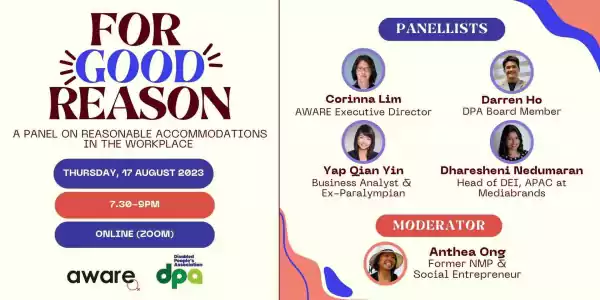
17 August 2023: For Good Reason—A Panel on Reasonable Accommodations in the Workplace

While the upcoming Workplace Fairness Legislation is a major milestone in Singapore’s fight against discrimination, one critical ingredient may be left out of our fairer future: reasonable accommodations.

The interim report by the Tripartite Committee on Workplace Fairness notably leaves out the right to request reasonable accommodations—that is, adjustments or modifications to an employee’s role or work environment that can help meet their specific needs.

Reasonable accommodations are key in supporting a wide range of workers: people with disabilities, caregivers, pregnant women, older persons and more.

Yet although the pandemic may have normalised flexible working arrangements, other reasonable accommodations remain frustratingly out of reach. Employees might worry they are inconveniencing their company and potentially hurting their career, while employers may worry about how such measures could impact their bottom line.

How can companies create policies to help all individuals thrive? How do such inclusive measures in turn benefit the companies, themselves?

Join Anthea Ong, Yap Qian Yin, Dharesheni Nedumaran, Corinna Lim and Darren Ho for a panel discussion on reasonable accommodations in the workplace.

This event is pay-what-you-can. Suggested donation of $5 per head.

About our Speakers

Moderator: Anthea Ong

Anthea Ong served as a Nominated Member of Parliament from 2018–2020 in the 13th Parliament of Singapore. She is a mental health advocate, social entrepreneur, impact investor, certified executive coach, published author and certified yoga instructor, amongst many other roles. An experienced board member and savvy board chair, she also served on several boards and committees including UN Women.

She enjoys bringing disparate groups of people together, especially where this highlights their common humanity amidst their differences. A sought-after speaker on human-centred leadership, mental health and social entrepreneurship, Anthea has also published more than 30 articles and authored two books. With a foreword by the Prime Minister of Singapore Lee Hsien Loong, her latest book ‘The NMP Scheme: Are Unelected Voices Still Necessary in Parliament?’ was launched last year in Parliament by former Prime Minister Goh Chok Tong.

Prior to devoting herself to civil society and social impact work full-time, Anthea spent over 25 years in the corporate world as a C-suite leader.

DPA: Darren Ho, Board Member, DPA

Darren heads the digital arm for mm2 Asia Ltd, a listed company on the SGX. Under his care, he oversees the digital transformation of the organisation and the rollout of new digital initiatives and businesses, particularly in the areas of customer loyalty, web3 and artificial intelligence. He is also a mental health and wellness advocate and inclusion ambassador for invisible disability. In his spare time, he competes in tennis and pickleball tournaments and races on the Ironman circuit.

AWARE: Corinna Lim, Executive Director, AWARE

Corinna Lim is the Executive Director of AWARE, the Association of Women for Action and Research. Lim joined AWARE as a member and volunteer in 1992 and has been a women’s rights activist for close to 30 years.

Since becoming Executive Director in 2010, she has been responsible for a range of initiatives including the setting up of the Sexual Assault Care Centre, the only specialised service in Singapore that provides support to sexual assault victims. She also led teams at AWARE to successfully advocate for the enactment of the Protection from Harassment Act, the repeal of marital rape immunity, better access to housing for single parents, gender equal workplaces and greater support for low income families and caregivers of the elderly.

In recognition of her contributions to civil society and the advancement of women’s rights, Ms Lim received a Fulbright Scholarship (1998 – 1999). In 2021, she was appointed as the 8th S R Nathan Fellow for the Study of Singapore by the Institute of Policy Studies.

Yap Qian Yin

Yap Qian Yin is a former paralympic sailor who has been sailing since 2011. At the age of 17, she experienced complications from chemotherapy for leukemia treatment and was left paralyzed from the waist down.

Qian Yin represented Singapore in numerous international competitions. Highlights include winning the first Singapore Gold medal for the Incheon 2014 Asian Para Games and 2015 ASEAN Para Games held in Singapore. She also participated in the Rio 2016 Paralympic Games. She has since picked up wheelchair badminton on top of sailing.
Currently, Qian Yin is a Business Analyst with Accenture Singapore. Aside from her work and sports, she is a volunteer with SmartBFA in enabling barrier-free access for Singapore and giving motivational talks to schools.

Dharesheni Nedumaran

Dharesheni (Sheni) is a global Diversity & Inclusion specialist, with more than 10 years international experience spanning tech, NGOs, global businesses and government. She has worked on data-driven projects and programmes with underrepresented communities, tailored to countries’ regulations and culture.

In her current role as Mediabrands’ APAC Head of Diversity, Equity & Inclusion, Sheni works across a network of more than 4,000 media and marketing professionals in multiple agencies across 13 Asia-Pacific countries. She leads the development of a long-term strategy and roadmap to increase representation, create a culture of belonging and contribution, and promote respect, equity and fairness.

Accredited with Campaign Asia’s Women Leading Change Award for Diverse & Inclusive Workplace for Mediabrands Singapore in 2022, Dharesheni has a Master’s in Work & Organisational Psychology from the Vrije Universiteit Amsterdam, where she was also an alumni speaker.

Register Here!

Recognising emotional abuse in family violence is a landmark shift

This op-ed was originally published in The Straits Times on 13 July 2023. 

New mother Diana (not her real name) was suffering from depression, had trouble sleeping and eating, and was crying all the time, after her husband became coercive and controlling following the birth of their child.

If she angered him for whatever reason, he would not let her touch their child, not even to shower him. Sometimes he would scream at her in public or in front of other family members.

Desperate to get away from her husband, Diana left to stay with her mother, but that only served to put more distance between her and the child, whom she was not allowed to see.

We thought of Diana, and the many other women who called the Association of Women for Action and Research’s (Aware) Women’s Helpline with similar experiences of abuse, when the Women’s Charter (Family Violence and Other Matters) (Amendment) Bill was passed on July 4.

The Bill updates its existing definition of family violence to make clear that this includes physical, sexual and emotional or psychological abuse.

It signals a landmark shift in how the Government conceptualises and responds to family violence – one that we hope heralds cultural and societal growth in this arena.

The need for the change

Family violence is any abusive behaviour that occurs within the family setting.

This can take various forms – physical, sexual, emotional, psychological, financial and more – and can include behaviour that intimidates, terrorises, manipulates, humiliates, injures, threatens or curtails the victim.

Like all types of violence, it is centred on an urge to exert power and control over another person – in this case, someone in the perpetrator’s family, typically in a position of vulnerability and powerlessness.

Singapore has for decades had legislation prohibiting family violence, but the scope of this legislation did not capture the full breadth of such abuse, allowing cases to slip through the cracks.

The Women’s Charter previously defined family violence as wilfully or knowingly causing hurt or putting a victim in fear of hurt (“hurt” referring specifically to “bodily pain, disease or infirmity”), confining or restraining a victim against her will, or continually harassing a victim with the intention of causing anguish.

Beyond the vague concept of “anguish”, and the heavy emphasis on physical injury or confinement – which might have contributed to the misconception that only physical violence warrants concern – one inadequacy of this definition was its focus on perpetrator intention.

International understanding of abuse has moved past using intent as a determinant. Harm is harm, whether or not one is “wilfully or knowingly” causing it.

We applaud the new Act for rejecting the grounding of family violence in the abuser’s wilful actions or knowledge, and the requirement to establish intention for inflicting abuse.

Moving away from attempts to divine what a perpetrator was thinking at any given time, and focusing on the objective impact of their actions, is in line with trauma-informed and survivor-centric legislative approaches around the world.

Another step forward is the introduction of three clearer categories of abuse: physical abuse, sexual abuse, and emotional or psychological abuse.

The legislation also acknowledges that family violence can take the form of not just single, discrete incidents of violence, but a pattern such as described in cases of coercive control.

New spotlight on coercive control

In Parliament, Minister of State for Home Affairs, and Social and Family Development Sun Xueling, referring to controlling behaviours, noted situations in which perpetrators might “constantly call their spouses to check on their whereabouts, and isolate them from their friends or family, including disallowing them to leave the house”, at the risk of threats.

“These egregious forms of controlling behaviour – which fall within the definition of what some other jurisdictions call coercive control – can cause distress or mental harm to a survivor,” noted Ms Sun, “and would be considered emotional or psychological abuse under the new Bill.”

While the new Act falls short of overtly naming coercive control as a category of family violence, as Aware had suggested, we cheer the official entry of this form of abuse into the national lexicon.

Coercive control comprises a pattern of behaviour ranging from where the abuser threatens, humiliates, intimidates, manipulates and/or assaults the victim, to controlling, which can include social isolation, surveillance and monitoring, dictating movements, setting unreasonable criteria, and making financial and career decisions on the victim’s behalf.

While these may not be immediately recognisable as violence – particularly under the previous, more limited Women’s Charter definition – taken together, they deprive a victim of independence, autonomy and resistance.

Individuals experiencing coercive control often struggle to identify that they are victims of such abuse, sometimes only recognising they have to “walk on eggshells” around their spouse or family member.

Worse, coercive control is sometimes interwoven with seemingly loving behaviour, sometimes termed “love-bombing”; perpetrators might cast their abusive behaviour as care or need to cultivate confusion and dependency. This can have traumatic effects, eroding a victim’s sense of self.

More jurisdictions around the world have been seeking to legislate against coercive control.

Given this, Aware has tried to drive more public education around the issue locally, for example, by publishing a comic series in 2022 in collaboration with Ms Charis Loke based on the experiences of some coercive control survivors we knew.

These comics garnered waves of positive feedback, including comments from women who finally had a means to put their experiences into words. (“Thank u (sic) so much for this series,” one wrote, “as someone still healing from an abusive relationship.”)

We are also conducting qualitative research into what coercive control looks like in the Singapore context.

There is plenty more work to be done on the framework and relationship dynamics that underpin coercive control.

Research in other jurisdictions has shown that criminalising coercive control without adequate awareness-raising efforts may even backfire on survivors, if those supporting them do not fully understand the issue.

Training relevant personnel, from those working on helplines, and social workers, to police officers and judges, is a critical step in the light of the updated law.

For now, we celebrate this recent development. Before, victims of coercive control in Singapore were hard-pressed to seek justice under the law. More help is now available to them.

The question of financial abuse

Another type of family violence mentioned in Parliament was financial abuse, though Ms Sun said it was “an emerging issue (that) requires further study”.

While one illustration under the new emotional or psychological abuse definition does contain an example of financial abuse (threats to stop a monthly allowance) – and a person may seek protection against financial abuse if they can prove it caused them intimidation, harassment or distress – the Women’s Charter, for that reason, leaves financial abuse out as a category of family violence.

Some might dismiss financial abuse as merely the improper use of another person’s income or assets. Yet, financial abuse has implications similar to coercive control in how it erodes a victim’s personal liberties.

Belle (not her real name), a migrant spouse, used to give her Singaporean parents-in-law a monthly sum as they had offered to manage payments towards the house for which she and her husband had applied.

But they used her money for personal expenses. Their financial requests escalated to an amount higher than Belle’s monthly salary. When she refused to hand over the amount, they kicked her out of the house.

Apart from actions like incurring debts in the victim’s name or coercing them to hand over property or control over finances to the abuser, financial abuse can also include preventing or restricting the victim’s ability to work, or even to get an education.

Several jurisdictions such as the United Kingdom, Australia, New Zealand, Canada and many US states protect against financial or economic abuse in their legislation.

We hope legislation here will one day cover this as well.

Where do we go now?

The features of the amended Women’s Charter, plus other freshly installed levers (such as stay-away orders and no-contact orders, protectors and enforcement officers, and new options for mandatory treatment orders) may provide much-needed protection to victims of family violence.

Yet, the full potential of the legislation will be realised only through a more concerted trauma-informed approach – one that remembers victims suffer loss of power and control at the hands of their abusers, and that the law should help return agency to them.

This trauma-informed lens must be instilled in all practitioners in the family justice system through comprehensive training in the nuances of violence, including coercive control.

More than that, to truly address family violence at its roots, we need to go beyond the law.

Considering the gendered nature of family violence – with men making up the vast majority of perpetrators, and women and girls the majority of victims – we must not overlook the importance of “upstream” measures, such as education on gender dynamics and stereotypes, as a means to develop a more progressive culture, and a less violent way of relating to one another.

Sugidha Nithi is AWARE’s director of Advocacy, Research and Communications.

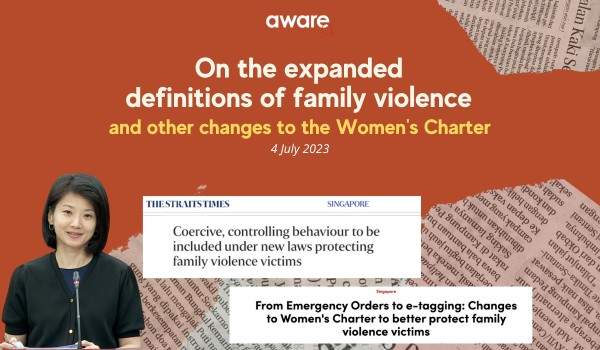
On the expanded definitions of family violence and other changes to the Women’s Charter Bill

AWARE celebrates the passing of the Women’s Charter (Family Violence and Other Matters) (Amendment) Bill on 4 July 2023 in Parliament.

We were especially heartened to hear Minister of State Sun Xueling state that controlling behaviours, such as those seen in coercive control, will now be covered under the Women’s Charter. For far too long, violence has been misunderstood as primarily physical in nature, resulting in many victim-survivors of non-physical violence going unheard. This wider definition of family violence will empower more survivors to speak out and seek help.

We hope that a set of guidelines or a fact sheet can be published to complement these updates and clearly state what different types of abuse comprise, i.e. physical, emotional/psychological and sexual abuse. This will help practitioners in the justice system and support services as well as the general public.

With understanding of coercive control increasing of late, AWARE has been exploring ways to expand the scope of case management and befriending services to survivors of coercive control, beyond our current helpline, counselling and legal clinic. We plan to roll these changes out soon, while continuing our ongoing research, advocacy and public education efforts.

Other Observations

  • In her speech, MOS Sun also stated that MSF would, alongside partners and stakeholders, study the possibility of including financial abuse in the definition of family violence. We keenly await more developments in this area, and hope financial abuse can be covered to ensure comprehensive protection against all forms of family violence.
  • MP Louis Chua sought clarification on the need for an age limit to apply for Personal Protection Orders (PPOs), citing concern about youths under 18 who face family violence but are unable to rely on family members or other persons to apply for PPOs. Though MOS Sun explained that protectors will be able to apply for PPOs on behalf of minors, we worry that other barriers might prevent minors from accessing protectors’ assistance and obtaining PPOs. We therefore hope that MSF will consider providing additional kinds of support to this group.
  • MP Louis Chua also reiterated the importance of raising public awareness about family violence and encouraging bystander intervention. He proposed more holistic support for survivors via access to housing, timely employment, immigration support, mental health and psychological support. We echo this call for greater support, particularly for migrant spouses and children, who typically face more precarity in Singapore.
  • MP Louis Ng raised concerns over the electronic monitoring arrangements (including bilateral monitoring, i.e. of both perpetrator and survivor) that will be put in place if there is a risk of PPOs being breached. Having expressed similar concerns when the bill was first tabled, we urge MSF to take into consideration the impact on survivors when implementing electronic monitoring.
  • We are glad to hear that MSF is considering the possibility of enacting a standalone Domestic Violence Act to enhance protection for persons in intimate, non-familial relationships. We look forward to more details on this.

27 September 2023: Sexual Assault First Responder Training (Online Session)

“Are you sure that happened? Why didn’t you fight back? You should have known better.” These are some common responses survivors of sexual assault have heard, which may further their feelings of doubt, guilt and shame.

It is not always easy for survivors to tell someone about what happened; in fact, for some survivors, it can be especially daunting. So the way their loved ones respond becomes pivotal in their journey of recovery. First response that is sensitive to a survivor’s needs and choices is necessary in preventing re-victimisation.

This Sexual Assault First Responder Training helps familiarise participants with trauma reactions and symptoms to better contribute to a survivor’s well-being. In this workshop, we will share more on the following:

  • Definition of sexual assault and harassment
  • Recognising Singapore’s legal framework
  • Understanding consent
  • Understanding the impact of sexual assault and trauma on survivors
  • Role of a first responder
  • Providing support to survivors of sexual assault
  • Resources available for help
  • Key skills such as ensuring safety, active listening and empathy

We want this workshop to be accessible to everyone, and require your generous contribution to keep it running. While you are welcome to give any amount you wish, we suggest a minimum of $30 per person. No tax deduction will be provided. Note that Eventbrite requires a minimum contribution of $1. If for financial reasons you require a waiver of this minimum contribution, please email gec@aware.org.sg.

Note as well that we are unable to accommodate transfers and cancellations if participants are unable to attend after payment has been made.

Persons of all genders and nationalities are more than welcome to attend.

We strongly request that all participants commit to the full duration of the 3-hour workshop (there are breaks!) to ensure that everyone will get the opportunity to engage in interactive discussions and learn useful skills.

Date: Wednesday, 27 September 2023

Time: 6 – 9PM

Venue: Online (Via Zoom). Please note this workshop will be online only (Singapore time). Participants will be emailed the Zoom link shortly before the session date. As a commitment to this training we will be asking all participants to turn on their video throughout the session.

Entry Fee: This event is contribute-what-you-can. Suggested contribution of $30 per person.

Register Here! 

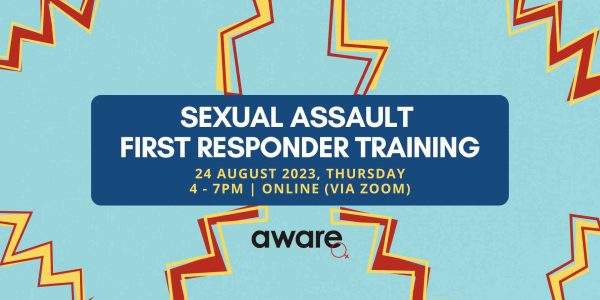
24 August 2023: Sexual Assault First Responder Training (Online Session)

“Are you sure that happened? Why didn’t you fight back? You should have known better.” These are some common responses survivors of sexual assault have heard, which may further their feelings of doubt, guilt and shame.

It is not always easy for survivors to tell someone about what happened; in fact, for some survivors, it can be especially daunting. So the way their loved ones respond becomes pivotal in their journey of recovery. First response that is sensitive to a survivor’s needs and choices is necessary in preventing re-victimisation.

This Sexual Assault First Responder Training helps familiarise participants with trauma reactions and symptoms to better contribute to a survivor’s well-being. In this workshop, we will share more on the following:

  • Definition of sexual assault and harassment
  • Recognising Singapore’s legal framework
  • Understanding consent
  • Understanding the impact of sexual assault and trauma on survivors
  • Role of a first responder
  • Providing support to survivors of sexual assault
  • Resources available for help
  • Key skills such as ensuring safety, active listening and empathy

We want this workshop to be accessible to everyone, and require your generous contribution to keep it running. While you are welcome to give any amount you wish, we suggest a minimum of $30 per person. No tax deduction will be provided. Note that Eventbrite requires a minimum contribution of $1. If for financial reasons you require a waiver of this minimum contribution, please email gec@aware.org.sg.

Note as well that we are unable to accommodate transfers and cancellations if participants are unable to attend after payment has been made.

Persons of all genders and nationalities are more than welcome to attend.

We strongly request that all participants commit to the full duration of the 3-hour workshop (there are breaks!) to ensure that everyone will get the opportunity to engage in interactive discussions and learn useful skills.

Date: Thursday, 24 August 2023

Time: 4 – 7PM

Venue: Online (Via Zoom). Please note this workshop will be online only (Singapore time). Participants will be emailed the Zoom link shortly before the session date. As a commitment to this training we will be asking all participants to turn on their video throughout the session.

Entry Fee: This event is contribute-what-you-can. Suggested contribution of $30 per person.

Register Here! 

Under-reporting workplace discrimination a far greater concern

This letter was originally published in The Straits Times on 14 May 2023. 

The Opinion commentary, “Can workplace fairness law deter errant employers and avoid worsening work conflict?” (June 12), highlights some valid points with regard to the proposed anti-discrimination legislation.

However, the writers’ fears of “frivolous” claims by employees appear overblown. While the protections accorded by the Workplace Fairness Legislation (WFL) should certainly not be misused, I believe under-reporting to be a far greater concern than false reporting in the arena of discrimination.

In 2022, an Aware-Milieu survey found that one in two respondents who experienced workplace discrimination did not report it to any channel. The top reasons for not reporting were believing the discrimination to be not “severe” enough, not trusting the authorities to act on the complaint, and not having enough evidence.

The writers suggest stringent evidentiary requirements for claims and timely dismissal mechanisms for the courts. Aware recommends, rather than raising the evidentiary burden of employees, which can deter reporting, that under the WFL, as in many jurisdictions, employees should be required to provide only a “prima facie” case, that is, sufficient initial evidence that discrimination could have occurred.

After this, the burden should shift to the employer to offer a valid non-discriminatory reason for the adverse action.

It’s also important to note that lack of awareness or malicious intent are not acceptable excuses for discrimination. We recommend that intent need not be established for discrimination claims under the WFL.

The law should provide objective criteria to evaluate employers’ actions, obliging them to cultivate an inclusive workplace. This must be complemented by public education and employer training to counteract ignorance-driven discrimination.

We must ensure the WFL encourages victim-survivors to speak up and protects those who do, instead of inadvertently silencing them for fear of a potential wave of false allegations.

Apoorva Shukla is the Workplace Harassment and Discrimination Advisory Executive at AWARE.