Author: Media Intern

Why child sexual abuse can often be a sustained, hushed up ordeal over many years

This op-ed was posted on CNA on March 25 2021. 

It is not enough to increase jail time for those who sexually abuse children. Comprehensive understanding and education is needed to deal with this very complex issue, says AWARE’s Shailey Hingorani.

SINGAPORE: Recently, a man was sentenced to 33 years’ jail for raping or sexually abusing all three of his daughters over 14 years.

Beyond the shock at the ghastliness of his crimes, observers have been aghast at the prolonged nature of the sexual abuse. How was it possible for a man to carry on the abuse for more than a decade without being found out?

It is horrifying to think that child sexual abuse can be so protracted, but many other cases have demonstrated that it can be drawn out over many years.

Earlier this year, a bus driver was sentenced to nine years for molesting his stepdaughter over more than 20 years. In another case in November 2020, a freelance cameraman was convicted for sexually abusing his girlfriend’s two underage daughters over six years.

Disclosing or detecting abuse is a critical first step that allows intervention and provides victims with supportive and therapeutic resources. Those resources can mitigate negative long-term consequences after the fact.

But a complex interplay of familial, cultural and societal factors make it difficult for children to even disclose abuse, and for parents and caregivers to uncover such wrongdoing.

WHY DO CHILDREN FIND IT DIFFICULT TO DISCLOSE ABUSE? 

Disclosure – when a survivor tells another person that he or she has been sexually abused – can be a confusing, difficult process for adults, and even more so for children.

A 2009 retrospective survey of 804 Canadian adults abused as children found that while one in five reported the abuse within a month, three in five delayed disclosure for five years or longer, and the remaining one-fifth had never disclosed the abuse.

In the absence of comprehensive sexuality education, a child may not recognise the abuse for what it is. Experts say children become confused if they experienced physical pleasure, arousal or even emotional intimacy during the abuse. This may deter them from speaking up.

In fact, such confusion is often deliberately sown by paedophiles, through a concerted process known as sexual grooming.

This process may include the paedophile establishing trust with the child and paying special attention with sweet words and gifts, before escalating his actions to exposing the child to pornography, his own genitals, and other forms of sexual abuse.

Celestine Tan, a teenage girl who was groomed online at 13, told CNA in an interview that the paedophile who targeted her had made her feel understood.

Position Filled: Marketing and Communications Senior Executive

We are no longer accepting applicants for this role.

We are looking for a marketing/communications senior executive who is strategic, creative and well-versed in feminism and social justice topics. As an integral part of our small communications team, you will work to amplify AWARE’s core advocacy messages to the public, the media and our diverse community of members, donors and clients. Driven by data, you will help to grow our online presence to reach new audiences and convert them into passionate champions of gender equality in Singapore.

Position: Marketing and Communications Senior Executive (Full-time; five-day work week)
Department: Advocacy, Research and Communications (ARC)
Salary range: SGD$3,700 – $4,000
Term: 24-month contract

Job Description

● Helping to manage AWARE’s social accounts (Facebook, Instagram, Twitter, LinkedIn), with a key focus on insights and analytics, as well as community engagement
● Producing meaningful content (both organic and paid, including copywriting, graphic design and video) that aligns with advocacy and overall organisational goals
● Developing and executing AWARE’s public advocacy campaigns to accompany the publication of new research
● Conducting research on market trends, tools, keywords and competitor reports to optimise overall communications and marketing effectiveness
● Recruiting and maintaining relationships with potential partners, influencers and advocates to grow AWARE’s network of collaborators and supporters
● Marketing AWARE’s existing slate of services and programmes to the appropriate audiences
● Helping the ARC department to conceptualise, organise and promote events (both online and, in the long term, offline)
● Serving as custodian of the brand across different digital and offline points
● Delivering biweekly reports across all channels
● Other miscellaneous administrative tasks

Requirements

● A diploma/degree in Marketing, Communications or Media is strongly preferred
● At least 2-3 years experience in digital marketing and social media management
● Very strong attention to detail
● Responsible for copy standards in communications and media, proficiency in English is a must
● A keen editorial sense, with an ear for clean, sharp and impactful copy
● Proficiency with visual design and editing software, such as Adobe CC or others
● Working knowledge of Facebook Ads, Google Ads, Google Analytics,
Wordpress and MailChimp
● Strong familiarity of Singapore social media landscape, particularly as pertains to the civil society community

Read our privacy policy here.

Please note that due to the large number of applications, only shortlisted applicants will be contacted for an interview. If you have any questions about this position, please email careers@aware.org.sg.


Why make it harder for spouses of foreign workers to take up jobs in Singapore?

This letter was posted in Today on 14 March 2021.

The Association of Women for Action and Research (Aware) is dismayed by the policy change on employment criteria for dependant’s pass holders in Singapore, where they will have to apply for a work pass to be hired here rather than on a Letter of Consent issued by the Ministry of Manpower. (“From May 1, dependant’s pass holders will need to obtain work passes if they want to work in S’pore”; March 3)

A dependent’s pass is issued to the legally married spouse or unmarried under-21 children of employment pass or S pass holders, who are foreign professionals or workers holding a job here.

As of 2020, about 11,000 of dependant’s pass holders were working on Letters of Consent.

From May this year, dependant’s pass holders will need to apply and qualify for a work pass before they can be employed in Singapore.

This move makes it more difficult for these dependents to be employed, since they would have to be subject to quotas, levies and qualifying salaries.

From our experience, many dependant’s pass holders are women who have followed their husbands to be in Singapore.

Aware often receives calls on its women’s helpline from these women, who express a great sense of insecurity as a “trailing” spouse.

Being wholly dependent on their husband for their right to stay in Singapore is already a disempowering experience in itself.

Restricting their access to employment — thereby cutting off a basic source of financial resources — further skews the power imbalance between these couples, with women being on the disadvantaged end.

Our experience has shown that “trailing” spouses who did not work found themselves in very vulnerable positions when they faced marital difficulties or abusive situations, especially since they did not have the support of their family and networks, and were unfamiliar with the legal system.

This inequality is exacerbated by a class bias embedded in the policy: Those whose skills are not highly valued by the market and who cannot command a high enough wage could essentially lose their right to work here.

One may argue that these dependents should just rely on their spouse for financial support. However, for reasons outlined above, such reliance could potentially put them in a more vulnerable position.

Dependant’s pass holders are already making contributions to Singapore’s society and economy, through the provision of their skills and services such as teaching in international schools or doing marketing and communications work. Why should we deny them the opportunity to contribute?

By making it difficult for spouses and partners to work, are we risking losing talents to other destinations?

Hong Kong allows spouses of professionals to work without prior permission of the immigration department.

Similarly, countries such as Australia, Canada, Germany and New Zealand provide a direct and unrestricted permission to work.

We strongly urge the Ministry of Manpower to reconsider this policy change, and to allow dependant’s pass holders to work on a Letter of Consent.

Chong Ning Qian, Senior Executive Research, AWARE

More insight needed on low-wage and self-employed workers

This letter was originally published in The Straits Times on 12 March 2021.

We hope that the Government will continue to engage with low-wage workers in Singapore, including workers with no formal contracts or employee benefits (Better support for gig workers to be looked into, says DPM Heng, Feb 24).

Low-wage earners and their households were greatly affected by Covid-19. They were already in precarious positions even before the pandemic.

The Association of Women for Action and Research (Aware) knows of many individuals who have not applied for the Self-Employed Person Income Relief Scheme (Sirs) or declared themselves to the Central Provident Fund Board or Inland Revenue Authority of Singapore as self-employed, because they earn less than $22,000 (beyond this amount, a person must pay tax), or simply do not think of their work as “self-employed work”.

We applaud the Jobs Support Scheme and its impact on many households, and hope that it can be extended to more workers.

Part-time workers, casual workers and other low-wage workers can be further engaged so that more support can be extended to them for the sake of their employment.

More information on the reasons behind these workers’ application outcomes would lend valuable insight into groups of low-wage workers that do not fit into schemes’ eligibility criteria, so that they may be better integrated into the social safety net in future.

More research could also be conducted, and feedback solicited from the public and social service organisations and agencies on these topics.

We hope that the Government can build its knowledge about the profiles and needs of the self-employed persons it has recently identified.

That way, the community can be more prepared with targeted support during the next crisis.

Elizabeth Quek

Programme Manager, Support, Housing and Enablement (S.H.E.) Project, AWARE

Have more measures to reduce incidence of non-payment

This letter was published in The Straits Times on March 8 2021.

We are heartened to see efforts by the Family Justice Courts and Ministry of Social and Family Development to strengthen the enforcement of maintenance orders and simplify the process of serving summonses (More efforts to deal with maintenance defaulters, March 1).

Enforcing maintenance remains challenging, especially when the defaulting spouse is elusive.

Court proceedings to enforce an order, if required, can also be time-consuming, stressful and costly.

The Association of Women for Action and Research (Aware) has encountered numerous women facing such difficulties.

In Home Affairs Minister K. Shanmugam’s written reply to Sembawang GRC MP Poh Li San’s parliamentary question on the issue last November, he said the number of applications for enforcement of maintenance made under the Women’s Charter was 2,527 in 2017, 2,422 in 2018 and 2,295 in 2019.

Valuable court time should not be used for securing the implementation of orders already issued by the courts.

We support the introduction of a separate body to facilitate the enforcement of maintenance orders and handle other related matters.

This has already been implemented in other countries such as Finland and Canada.

The Social Insurance Institution of Finland, which is empowered to handle the enforcement of maintenance, also pays child support to parents receiving maintenance if their former spouse can pay only partially or not at all.

Other measures can also be put in place to lower the incidence of non-payment. For example, in Britain, defaulters may have their driving licence suspended or revoked.

The Family Court of Australia may order a property to be temporarily placed in a sequestrator’s hands.

The sequestrator can collect rent, takings or profits of a business, or prevent persons from entering the property, and pay amounts owed to the spouse receiving maintenance.

Such proactive enforcement will help to reduce the stress that women experience and improve families’ quality of life.

Lee Yoke Mun, Research Executive, AWARE

International Women’s Month 2021: all AWARE events and promotions

International Women’s Day is Monday, 8 March 2021—and as usual, we have a month-long array of events and promotions to celebrate, alongside some wonderful partners. Check out our line-up of exciting activities below. We’ll also be updating this post throughout March, so keep checking back, and follow us on FacebookInstagram and Twitter to stay in the loop!

Promotions

Jump to:

Carrie K.

Pearls are the queen of gems. Born of grit, they represent resilience, tenacity and sisterhood. Carrie K. re-invented traditional pearls by giving them a modern twist and allowing wearers to express their unique personalities. To support women in need, 10% of sales from the Love Knot Collection and $50 for every pearl necklace sold will be donated to AWARE.


FITTA Active

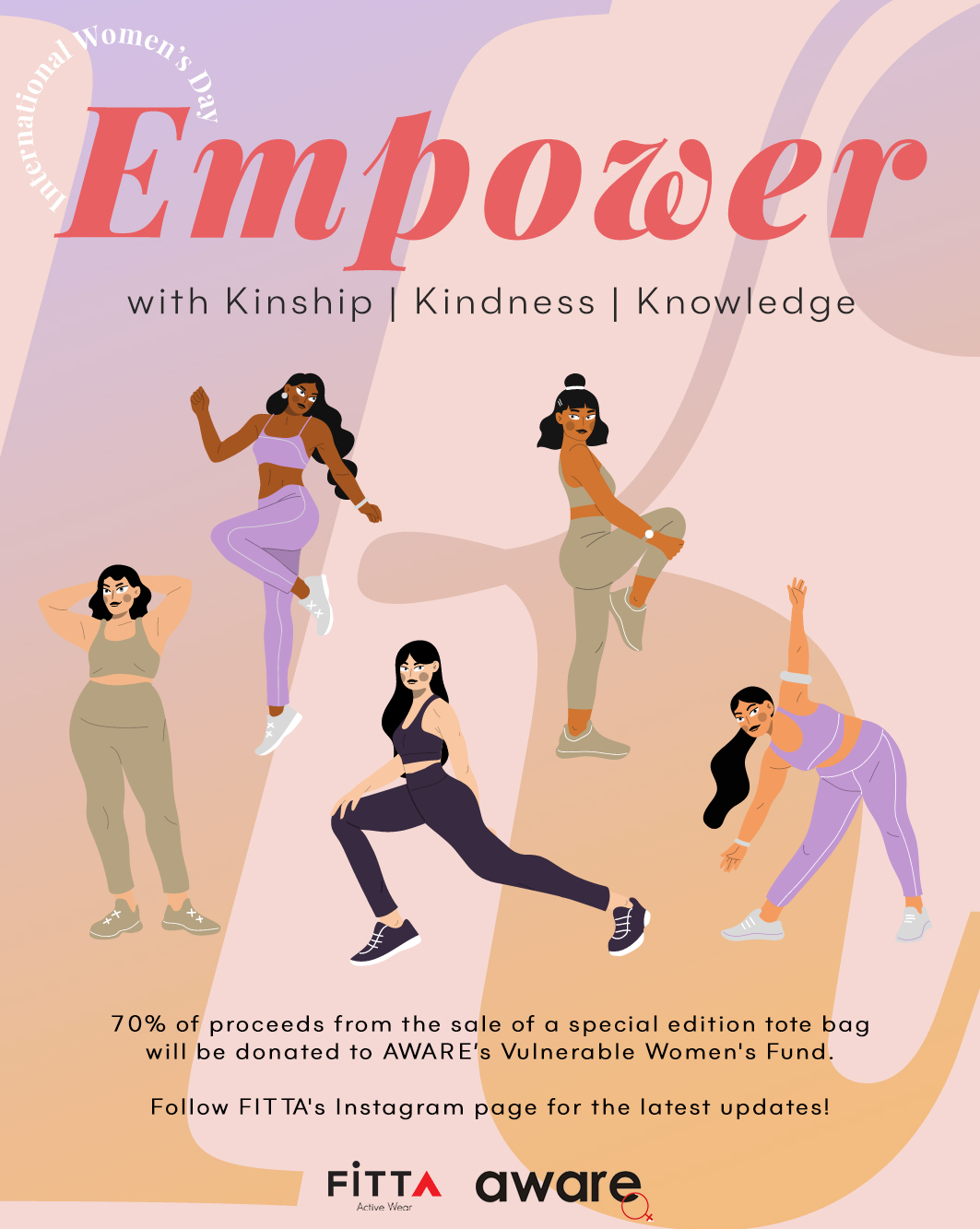
FITTA’s Empower with the 3Ks campaign aims to lift other women up during these trying times through Kindness, Kinship and Knowledge. A special edition tote bag will be launched, for which 70% of proceeds will be donated to AWARE’s Vulnerable Women’s Fund. Follow FITTA’s Instagram page for the latest updates.


Rael

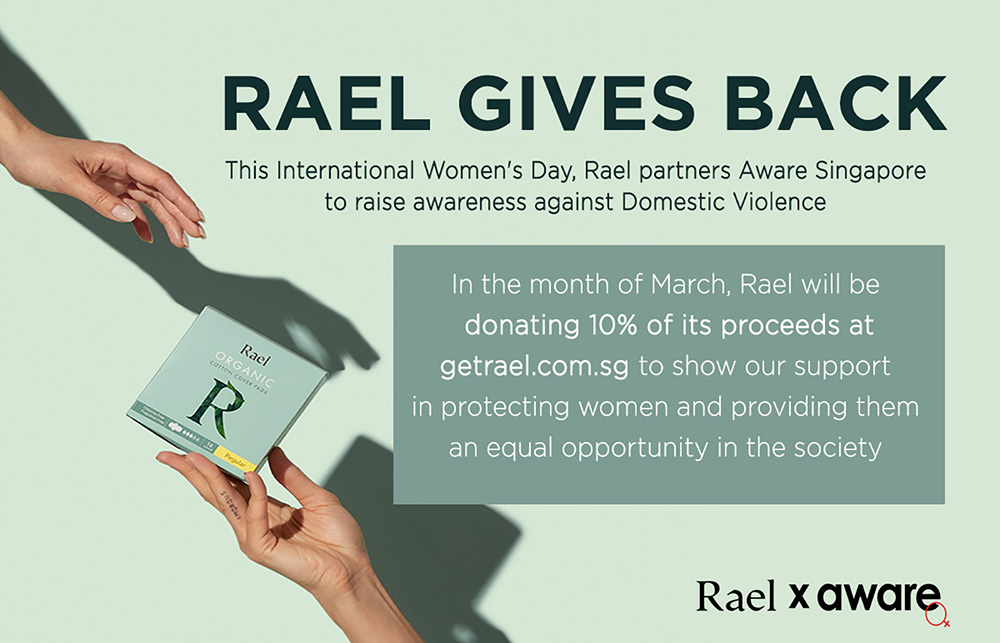
In line with International Women’s Day, organic feminine care brand Rael Singapore is partnering with AWARE to raise awareness against domestic violence. With every purchase you make, 10% of the sales proceeds will go to helping victims of violence and providing them with an equal opportunity in society. Shop here!


Straits Wine

Together with Seppeltsfield, Straits Wine will donate $4 to AWARE for every bottle sold between 1-31 March 2021. Straits Wine believes that everyone should have equal opportunities. They would like to support AWARE in removing gender-based barriers and empowering individuals to develop their potential to the fullest, so we can have more leading women—just like Fiona Donald, who leads the winemaking team as Chief Winemaker at Seppeltsfield. Visit their website for more information.


BooksActually

BooksActually will be celebrating International Women’s Day with a $3 donation to AWARE for every copy of We Make Spaces Divine or My Lot Is A Sky sold in March. Come join us to continue to give voices and action to women— who are not just mothers, wives or daughters, but individuals who have the right to be who they want to be, and live how they like. Visit BooksActually for more information.


Olive Ankara

Olive Ankara is donating 10% of the sales of their OA masks throughout the months of February and March to the NextGen Fund by AWARE.⁠ The new 3-D origami style comes with a filter pocket, adjustable nose wire and adjustable behind-the-head elastic band to offer maximised fitting and comfort.⁠ ⁠Their masks are washable and reusable, made with 100% cotton.⁠⁠ Buy two to get free shipping to Singapore!⁠ Shop here.


Sour & Spicy Kimchi

Sour & Spicy Kimchi is a family-run home-based business that was born during the difficult times of the coronavirus lockdown. They specialise in freshly made small-batch kimchi without MSG or preservatives. Your taste-buds and gut will enjoy this beloved probiotic-rich creation. This IWD, Sour & Spicy Kimchi will be donating $5 for every kilogram of kimchi ordered ($30). Place your orders here!


The WYLD Shop

Our new norm. Rock your daily outfits with colourful cotton masks from The WYLD Shop! These reusable cotton face masks with elastic straps and slots for non-woven filters are lovingly made by senior citizens at Sowing Room, a social enterprise that supports senior citizens who want to work and be self-reliant. Some of these individuals support themselves, and others donate back to organisations such as Tamar Village in Singapore. Proceeds from these face masks will be donated to AWARE! Visit The WYLD Shop to check out the collection.


Skin Inc

Skin Inc is a multi-award-winning global leader in high-tech skincare with customisation at the core of its DNA. Enabling you to embrace your best self with skincare personalised to you, the brand is pledging 15% of proceeds from their trial facial treatment ($88) throughout the month of March to AWARE. Customise, don’t compromise! Visit Skin Inc for more information.


Kintsukuroi Studio

Kintsukuroi Studio is a local brand that creates mindful crystal and essential oil-based products around the ideas of self-love, self-acceptance and self-discovery. In celebration of strong independent women and challenging the status quo, they will be releasing a special edition 24K gold crystal essential oil roller named Onna Bugeisha: inspired by the female warriors of pre-modern Japan, all naturally scented with yuzu, sandalwood and pink peppercorn. From 8 March – 8 April, they will be donating 50% of profits from the sale of this roller to AWARE. Visit Kintsukuroi Studio for more information.


The Sustainability Project

The Sustainability Project will be donating 15% of proceeds from the sale of Freedom cups, wetbags, vegan soap bars and shampoo bars to AWARE! But it doesn’t end there: They are also holding a DIY deodorant workshop for $55 (U.P. $60), with 15% of the fee going to AWARE. Shop here for amazing vegan and organic products. Register for the workshop here.


D’jamias Vu

D’jamais Vu is a local brand that creates upcycled, self-designed, made-from-scratch apparel and accessories. They are anti-animal cruelty and strive to reduce textile waste while creating a wide range of products. It’s the brand’s first time participating in an IWD initiative, but definitely not the last! They are donating 20% of profits under their IWD tab this March to our NextGen fund. Shop now!


Bynd Artisan

Born from a rich heritage of craftsmanship, Bynd Artisan offers customised and personalised leather and paper gifts for everyone, for any occasion. Bynd Artisan encourages its audience to immerse themselves in the process of creating the perfect gift and offers workshops to share the joy of craft. Bynd Artisan will be running an initiative to donate 10% of sales from purple products to AWARE. Bynd Artisan retails in five stores across Singapore and has an online presence on byndartisan.com, which ships internationally.


Plural

Artist Delia Prvački‘s witty and provocative Dulcinea ceramics set adds a wink and a smile to any table setting. The limited edition Dulcinea consists of 11 multi-functional pieces, including six breast-shaped cups in various sizes. Produced from prototypes hand-built by the artist in her studio, Dulcinea is microwave and dishwasher-safe and comes in five gorgeous colours. The only problem you’ll have is picking a favourite! Plural is donating 10% of the proceeds from the sale of the cups to AWARE. Visit Shop Plural to place your orders.


Style Lease

Celebrate International Women’s Day with Style Lease all month long with 20% off their standard selection (U.P. $180) and 40% off premium selection (U.P $880). In addition, 5% of all proceeds for the month of March will be donated to AWARE’s NextGen Fund in support of gender equality. Head to @style_lease and stylelease.com.sg for more information.


Mum’s Kitchen

March is International Woman’s Month for Mum’s Kitchen! They will be celebrating this beautiful month by contributing back to society. From 8 March – 31 March, for every International Women’s Day Bento Set ordered, they will donate $1 to AWARE. Hurry! Join them now and place your order at mumskitchen.com.sg

In a year designated for celebrating women, AWARE notes surprising lack of gender focus in 2021 National Budget

This post was originally published as a press release on 17 February 2021.

Gender-equality organisation AWARE expressed approval of some measures in Singapore’s “Emerging Stronger Together” National Budget, announced yesterday by Deputy Prime Minister Heng Swee Keat. These measures were aimed at alleviating the challenges of low-income workers and senior workers, groups that traditionally contain a large proportion of women. AWARE was also pleased to see a Green Plan 2030 budget being set aside to develop a more sustainable island. 

However, AWARE found a disappointing dearth of measures to explicitly uplift and support the caregivers in society, who are predominantly women. In its Budget submission last month, AWARE had urged policy-makers to adopt a gender-sensitive approach, with (among other measures) the introduction of a state-funded income for caregivers, mandatory paid eldercare leave and investment in long-term care infrastructure for ageing-in-place.

“Given the announced 2021 theme of ‘Celebrating SG Women’, the ongoing gender equality review and Singapore’s rapidly ageing population, we had hoped that this year’s budget would acknowledge the unequal road to success and security for women, whose vulnerabilities are well-documented,” said Ms Corinna Lim, AWARE’s Executive Director. “We are glad that the government announced salary increases for nurses and healthcare workers, but we wished to see more measures to support unpaid, informal caregivers, especially family caregivers to the elderly.”

Research by AWARE in 2019 looked at eldercare’s negative impact on women’s finances, finding that many respondents had experienced a change in employment status due to their care responsibilities. These suffered an average 63% loss in income, or an average annual loss of $56,877.

“DPM Heng rightly observed that Singapore must never stop thinking about its future,” said Ms Lim. “We are glad to see the government taking necessary steps to raise its revenues to fund the increased healthcare needs of our ageing population. But we also need a plan for the country to develop healthcare and social infrastructure to meet these needs. This is not news—every year that passes brings Singapore closer to an eldercare emergency.” 

One announcement that AWARE commended was the government’s aspiration to expand the Progressive Wage Model (PWM) beyond its current sectors. However, Ms Lim added that universal application of PWM should be a more immediate goal. 

“We hope that this expansion can be rolled out at a quicker pace, especially to women-concentrated sectors such as the long-term care and social care sectors,” she said. “We know that the pandemic has shaken up low-income workers’ livelihoods, so let’s assure them of a living wage and reduce their reliance on the vagaries of global economic forces.” 

AWARE looks forward to more gender-specific concerns being addressed by various ministries in the Committee of Supply debates.

AWARE’s 11th annual Budget submission was submitted on 8 January 2021.

Why anti-harassment programmes are often ineffective

This op-ed was originally published in The Business Times on 5 February 2021. 

Ask any company how it plans to combat workplace sexual harassment, and it will likely mention “anti-harassment training”. Sounds great in theory. But, in practice, are anti-harassment training programmes really effective? The short answer is: it depends. On their content, their delivery and a host of other factors.

Aware’s training and consultancy arm, Catalyse (formerly known as Aware Training Institute), has delivered anti-harassment training programmes to more than 300 companies since 2010. Our evidence-based and field-tested training programmes have enabled us to distil the key issues that companies should consider when carrying out such programmes. These training programmes are all the more important now that we have the results of the first-ever national survey, conducted by Aware and Ipsos, on the prevalence of workplace sexual harassment in Singapore.

WHY OFFER SUCH PROGRAMMES?

Anti-harassment programmes have a chequered history. Research shows that programmes are not effective in addressing workplace harassment when they are carried out for self-serving reasons, for example to protect the company from legal liability. Reducing the likelihood of workplace harassment has to be the primary objective; otherwise, the training programmes often end up devoid of any clear goals, follow-up and measurement criteria. This renders them ineffective.

On the other hand, training programmes do play a crucial role in tackling harassment when done properly. They are instrumental in increasing knowledge about sexual harassment.

The Aware-Ipsos survey found a big gap in people’s understanding of what counts as sexual harassment: when asked if they had been sexually harassed at work, one in five said yes. However, when specific harassment scenarios were described to them, the number of respondents who said yes went up to two in five.

Training programmes help establish a baseline of basic knowledge about what constitutes sexual harassment. This is especially important for companies with employees from diverse backgrounds. Reaching in for a hug may be acceptable in some cultures, but not in others. Training programmes can help bridge this knowledge gap in acceptable workplace behaviour.

Research shows that employees who received training are more likely to recognise unwanted sexual gestures and touching as sexual harassment than those who have not received any training. Anti-harassment programmes also aim to provide information on company anti-harassment policies and who to approach to report harassment. These sections of the training are naturally only as robust as the policies in place.

WHAT DOESN’T WORK?

Companies make three key errors when designing anti-harassment training programmes.

First, they rely too much on canned programmes. Many companies are content to offer training modules without customising them for the specifics of their organisation or industry. Of course the reporting structure may differ from company to company. A small and medium-sized enterprise (SME) may not have a human resources department, in which case complaints of sexual harassment may have to be filed with the chief executive or the SME’s board of advisers.

Often, these programmes also do not provide concrete, contextualised examples of behaviours that constitute harassment. Generic or abstract statements on harassment are unlikely to resonate with any employee.

Second, in a bid to increase interactivity, many anti-harassment training programmes rely on role-playing, that is using imaginary scenarios in which employees act out how they could react if they witness harassment, or hear about a colleague’s experience. Role-playing can often be a powerful exercise. Unfortunately, most of the time these scenarios tend to involve a male harasser and a female victim.

Although this perpetrator-victim combination is still the most prevalent, same-sex harassment and situations with female harassers and male victims also need to be included. Doing so would make the training inclusive and empower all employees, regardless of whether they fit the stereotype of a typical “victim”, to report cases of harassment.

Third, many companies also fail to see the link between the wider organisational culture and employee attitudes to training. If the organisational culture is generally perceived to be tolerant of workplace sexual harassment, employees are likely to be cynical about the content and intent of the training.

Other seemingly minor issues, such as using legal terms to describe people as “perpetrators” or “victims”, can also have an impact on whether the employees pay attention to the training or not. Individuals may reject the training wholesale because they do not feel like such labels apply to them.

A BETTER APPROACH

Training is most effective when it is offered frequently, is instructor-led (whether in person or virtual), and includes a combination of different exercises (case studies and small group discussions) to retain the attention of employees. Offering anti-harassment training on a regular basis not only conveys a company’s seriousness about tackling workplace sexual harassment, it also allows for time to go over the nuances or grey areas of what can be, after all, pretty complex.

In situations when in-person training is not possible, companies could offer blended training instead. This combines in-person and online training, and can be made interactive with the help of an experienced training developer and facilitator.

While all employees should receive training, there should be separate programmes for managers and non-managers. Managers, including the senior leadership team, need to be informed of their additional responsibilities, such as how to respond in the moment when someone reports harassment to them.

Furthermore, managers should be trained to proactively respond to harassment situations even without a complaint. This is absolutely crucial – managers might be seen as condoning unacceptable workplace behaviours if they do not intervene in situations unfolding before them.

In both workplace and campus settings, there is a growing recognition of the role bystanders can play in stopping harassment. We therefore also recommend that anti-harassment training programmes incorporate bystander training. Bystanders are often aware of harassment before managers. Yet they may not be incentivised to report, or (as witnesses, not targets, of the harassment) may not know how to report. They can also be trained to intervene in harassment situations without causing further harm to themselves or victims.

If a company’s ultimate goal is to reduce the likelihood of workplace sexual harassment, it should remember that training is only one part of a suite of measures to adopt. At the end of the day, it will take a multi-pronged effort to stamp out workplace harassment, including creating office cultures that promote respect and inclusion.

Caroline Callow, Senior Facilitator, Catalyse 

Position Filled: Administrative Assistant for Secretariat Department (Part-Time)

We are no longer accepting applicants for this role.

AWARE’s Secretariat department is looking for an Administrative Assistant who will provide administrative support to the various functions of the Secretariat team.

Position: Administrative Assistant
Department:
Secretariat
Commitment: Permanent, part-time (4 days/week)
Salary range: SGD$2,400 – 2,800
Starting date: Immediate

Job Description

To provide administrative support to Secretariat Team for AWARE in the following areas:

HR Function (5% of overall scope)

  • Administer HR-related letters, confirmation letters (including confirmation tracking), employment letters and contracts for new hires and renewals.
  • Assist with recruitment scheduling where required
  • Update staff benefits budget tracking

Finance Function (5% of overall scope)

  • Record and bank in incoming cheques and cash
  • Perform administrative tasks relating to Accounts and Finance management (e.g. staff reimbursement management)

Fundraising Function (70% of overall scope)

  • Assist with administration of donations and memberships
  • Update CRM database with donations through import and data entry
  • Identify donations on bank statement
  • Reconcile monthly donation reports
  • Prepare import file for QuickBooks Online
  • Issue monthly official receipts
  • Submit tax deductible donation records to IRAS annually

Volunteer Management (5% of overall scope)

  • Assist in procurement of logistics and setting up of events when needed
  • Perform any other tasks that may be assigned in relation to support for the Volunteer Manager

Office Administration (15% of Overall scope)

  • Respond to emails received through the general email and redirect to relevant staff if necessary
  • Open mailbox and distribute letters received, including the scanning of financial letters/documents/cheques to the Finance Manager and Fundraising Executive wherever relevant
  • Arrange for name cards for new staff
  • Manage movement of access cards and keys to the centre
  • Assist with managing and ensuring safety and cleanliness of the centre
  • Liaise with vendors and suppliers
  • Perform any other tasks that may be assigned in relation to administrative support for the Secretariat department

Requirements

  • Minimum 5 years’ experience as an office administrator, office assistant or relevant role
  • Experience in the social service industry is advantageous
  • Excellent interpersonal, collaboration and strong organisational skills
  • Strong knowledge of Microsoft Office (PowerPoint, Excel, MS Word)
  • Able to use initiative and judgment to solve problems independently
  • Strong belief in gender equality and the values of AWARE
  • Able to meet deadlines in a fast-paced environment while balancing workload and competing priorities
  • Able to maintain strict confidentiality of sensitive information

Read our privacy policy here.

Please note that due to the large number of applications, only shortlisted applicants will be contacted for an interview. If you have any questions about this position, please email careers@aware.org.sg.