
Author: Media Intern

In tackling sexual violence, let’s take a landscape view and not a portrait

This op-ed was originally published in TODAY on 14 September 2020.

Sexual assault is being treated with more seriousness than ever before.

But this was not always the case. A few years ago, when I told people that I work as a social worker, providing support services to women who face sexual assault in Singapore, I would meet with confused faces. “But that doesn’t happen over here. Are you sure?”

Once, I told a cab driver about my job. He angrily responded that he would stop the car on the highway and ask me to get out if I spread the false notion that even one case of sexual assault has ever happened in Singapore.

When the team at the Association of Women for Action and Research (Aware) started a helpline in 2011 for women who had faced sexual assault, we also thought to ourselves: “We are not going to get that many calls.”

Within six months of the pilot, Aware had given support to around 40 cases, or one case every three days. Fast forward to 2020: Aware supports close to 800 cases a year or about three cases a day.

Today, I quote these numbers whenever I am greeted with disbelief about the prevalence of sexual violence in Singapore. But then I grapple with another set of follow-up questions: “Why do these victims go to unsafe places alone, meet this person in a hotel, or stay out at night?”

I remember the same cab driver looking at my knee-length skirt and commenting in his rage: “It’s because of what you girls wear, that this happens.”

Stories portrayed in the media today also tend to focus on what the survivor did or did not do to warrant an unfortunate event like sexual assault. When we look at perpetrators, we often see them as individuals with a mental illness, or as someone sexually deprived. It’s human nature to want to make sense of a senseless act of violence.

But by doing so, we perpetuate sexual assault myths.

We tell our daughters not to wear certain clothes, instead of telling our sons not to objectify women.

Institutions and organisations end up focusing on encouraging victims to find newer ways to protect themselves, or on making punishments harsher in the name of deterrence.

The issue with this narrow view of focusing only on the victim and/or perpetrator is that we remove responsibility from everyone else.

It’s a bit like blurring the background behind the subject in portrait photography.

By using a wide-angle lens to see the expanse of the landscape surrounding the subjects — institutions that directly or indirectly condone sexual violence, and a society that excuses these acts of violence — we get a more holistic perspective.

And if we accept shared responsibility, we will be able to end sexual violence sooner than later.

Singapore has only just begun to see sexual violence from a landscape view and we have a long way to go.

Last year, a university student took voyeuristic videos of another student while she was showering.

From a portrait perspective, we could argue that the survivor could have been more vigilant about her surroundings, or that the perpetrator needed help and perhaps harsher punishment.

But when the survivor spoke up about her experience, it highlighted the landscape of campus sexual assault.

It emphasised the responsibility of educational institutions to provide a safe environment for students, which led to the review of campus policies, and the establishment of the first-ever Victim Care Unit in a local university.

When the #metoo movement erupted in 2017, survivors took to social media to share their experiences of sexual assault.

While Singapore did not see as much an outcry as other countries, Aware’s Sexual Assault Care Centre saw a 79 per cent jump in the number of cases reported, around the time #metoo went viral.

And the caseload has remained high since.

Portrait analysis would not allow us to see beyond an increase in individuals reaching out for help.

But a landscape analysis would show that when many people openly speak about sexual violence, other survivors are encouraged to reach out for support. This view gave birth to Aware’s public education campaign Aim For Zero, to promote zero tolerance to sexual violence in Singapore.

For many decades, husbands who committed marital rape had immunity embedded within the law. It took many survivors sharing their stories and a handful of organisations taking up their cause to change the law.

The Government listened to these stories and, in 2020, repealed marital rape immunity.

The Ministry of Home Affairs has also taken many steps towards training police officers to handle cases of sexual violence with more sensitivity.

But in a landscape view, sexual violence cannot be the responsibility of a few.

One survivor, one organisation, and one government body cannot overcome it alone. The pressure that survivors face to “speak up” is unfathomable.

We need more dedicated sexual assault crisis centres – for children, men, women, families, and survivors from vulnerable populations.

Creating specialised service arms, more research, and more training for professionals to understand various aspects of sexual violence (such as technology-facilitated sexual violence, sex trafficking, sexual abuse by a helping professional) is the need of the hour.

And we need more funding for social service agencies to support these efforts.

We need social workers to look at sexual violence not just from a micro perspective but also macro perspective.

We need to ask ourselves why families we are working with are more likely to disclose other forms of family violence than sexual violence.

We need the media to be curious and publish broader, more expansive stories about sexual assault, whether or not these cases go all the way to court.

They can look deeper into under-explored topics, such as the prevalence of sexual violence among people with disabilities.

We need all employers to review their policies and build a zero-tolerance culture to make workplaces safe for their employees.

We need medical professionals to see sexual violence as more than a law and order issue. Given the impact of sexual violence on mental and physical health, sexual violence is a public health concern.

One case is too many. But many cases also share a theme — that sexual violence is a reality in Singapore.

Let’s start by moving away from the portrait mode and looking at the issue from a landscape mode.

So that next time I tell someone what I do, I hope to be met with a different question: “What can I do to end sexual violence in Singapore?”

Anisha Joseph

Head of Sexual Assault Care Centre and Women’s Care Centre

AWARE

Grant automatic extension of short-term visit passes for foreign spouses of S’pore residents amid border closures

This op-ed was originally published in TODAY on 14 September 2020.

In a written reply to a parliamentary question filed on Sept 4, Minister for Home Affairs and Law K Shanmugam said that from February to July 2020, the Immigration and Checkpoints Authority received 8,395 applications from migrant spouses of Singaporeans to extend their short-term visit pass. Of these, 2.8 per cent were rejected.

The Association of Women for Action and Research (Aware) is relieved to see that the majority of short-term visit pass extension applications have been approved. Yet we remain cognisant of the fact that living on 30-day passes is still a stressful experience for many families amid prevailing border closures.

Many Singaporeans with foreign spouses have reached out to us in the last month to share their frustrations and distress at having one member of the family be on a STVP during already uncertain times.

Some scrambled to apply for an extension a few days before the pass is due to expire — they had hoped that their application for a long-term visit pass would be approved in the meantime, allowing them to reside with their family in Singapore for a longer period of time.

Those whose long-term visit pass applications were rejected have to continue relying on these 30-day short-term visit pass passes for their right to stay here.

The New Zealand government recently announced that those presently in the country on visitor visas due to expire before the end of October 2020 will receive an automatic five-month extension, in view of global travel restrictions.

We hope that Singapore would consider implementing a similar policy of granting an automatic five-month extension for foreign spouses of Singaporeans and permanent residents.

In his reply, Mr Shanmugam said that to assist those with genuine difficulties arising from the pandemic, the authorities will consider additional factors, such as prevailing travel restrictions and flight connectivity, when assessing the extensions of renewal of passes.

At the same time, extensions are already generally approved — meaning that the vast majority of applicants actually meet the requirements. It would be more resource- and time-efficient to grant extensions automatically instead while travel restrictions are still in place.

More importantly, it would bring great relief to families who presently have to worry every 30 days or so about whether they are going to be physically separated.

Chong Ning Qian

Senior Executive of Research

AWARE

Address gaps in aid for vulnerable groups

This letter was originally published in The Straits Times on 14 September 2020.

We are heartened to see Members of Parliament recognise the impact of Covid-19 on vulnerable groups (Do not leave vulnerable groups behind as economy transforms amid Covid-19, say MPs, Sept 2).

However, there are gaps that still need to be addressed, specifically, the complexity in applying for financial relief and the exclusion of migrant spouses from receiving certain types of aid.

Through the Mind The Gap (MTG) fund, the Association of Women for Action and Research (Aware) and a team of volunteers have been providing financial and logistical support to 52 low-income families, whose members include single mothers, caregivers, migrant spouses and the self-employed.

These families have been hit especially hard by the pandemic, with 80 per cent of them suffering a significant loss in household income.

Many of our MTG recipients described facing obstacles in applying for Covid-19-related financial schemes, such as the Self-Employed Person Income Relief Scheme (Sirs).

They were often unaware of what they were eligible for. They were also unsure of their own working status (that is, whether they were considered self-employed) and had trouble producing evidence of this status.

Without sufficient guidance, many people simply forgo the application entirely.

Migrant spouses, in particular, found it hard to navigate financial relief. Most Covid-19 schemes exclude migrant spouses, despite their contributions to our nation and the fact that they have Singaporean children.

We do have some success stories. One individual, Shah, had never applied for government schemes and did not initially know about Sirs. An MTG volunteer encouraged Shah to apply, and he eventually did so successfully with the volunteer’s guidance.

The approval of his application enabled Shah – the breadwinner of a family of five – to make payments towards his utilities, rent and bank loan.

We echo many advocates’ calls for more proactive assistance with rental payments for low-income families like Shah’s, and a simplified application process for financial relief.

We also urge the Government to extend greater compassion to migrant spouses by giving them additional aid during crises, if not the same as what’s afforded to Singaporeans.

Lee Yoke Mun

Projects Executive

Association of Women for Action and Research

Does the ride-hailing industry have a sexual harassment problem?

This commentary was originally published in Channel NewsAsia on 1 September 2020.

SINGAPORE: The recent case of the Grab driver who drove young women, including one 17-year-old, to secluded areas and harassed them is not an isolated case of harassment via ride-hailing service.

Multiple local reports have surfaced since 2016 of drivers committing acts of sexual violence – molesting passengers, masturbating in front of passengers or, in one case, assaulting a passenger who fell asleep in the backseat during the ride.

Nor is this issue exclusive to Singapore.

In December 2019, Uber released its first-ever safety report, revealing that 3,045 sexual assaults had been reported in rides in the United States in 2018.

Closer to home, in Asia, an attack on a female rider by a Grab driver in Indonesia triggered a national conversation on sexual harassment in 2019.

A 2014 rape case caused widespread outrage against Uber in India, leading to the service being temporarily banned.

China’s largest ride-hailing giant, Didi Chuxing, came under fire after two explosive murder-and-rape cases made headlines in 2018.

We have to ask: Does the ride-hailing industry have a sexual harassment problem?

Gig economy and sexual harassment

Sexual harassment cases have been reported in the context of other services that are mainstays of the gig economy, such as Airbnb and food-delivery apps.

For example, a foodpanda deliveryman in Singapore was blacklisted recently in August after he reportedly entered a customer’s flat without permission and sexually harassed her.

All these incidents should be viewed within the larger issue of violence against women, which must be met with zero tolerance. Yet there seem to be conditions inherent to gig economy companies, and ride-hailing services in particular, that create the potential for abuse – whether of customers or workers.

The typical customer tends to have some faith in the recruitment processes of these companies, believing that ride-hailing drivers are thoroughly vetted for prior history of harassment and assault.

However, that is far from standard in the gig economy. In 2017, Airbnb was sued for negligence by a woman who claimed that the company had allowed her to rent a room from a man previously accused of domestic violence.

In Singapore, a GrabHitch driver previously convicted of outrage of modesty was found guilty in 2019 of molesting two passengers within an hour of each other.

When complaints of sexual harassment at the hands of a worker are indeed filed, the companies’ responses frequently disappoint.

In Indonesia last year, Grab came under fire for allegedly trying to convince a victim to meet privately with a driver, after she reported him for kissing her forcefully on the lips, so he could “give an explanation directly”.

When the traumatised woman declined, the company publicly faulted her on Twitter for refusing the meeting “despite already receiving an explanation from [Grab’s] side”.

When such cases of sexual harassment occur and crimes have been alleged, should ride-hailing giants bring in law enforcement or dismiss these cases as misunderstandings that can be privately resolved?

One further concern: People may go away with the impression that women’s safety is less important until it gets public attention. Uber was compelled to drop its forced arbitration requirements for sexual harassment reporting after a CNN investigation in 2018.

Workers too in the gig economy could do with stronger protections. After all, the 2019 Uber safety report actually found that female drivers experienced sexual harassment and abuse at similar rates as passengers.

Companies have notoriously avoided responsibility for sexual harassment against their drivers by claiming that they are just platforms enabling peer-to-peer service.

In 2019, a Guardian investigation found that female drivers of Uber and Lyft in the United States who experienced a range of harassment received little or no support from the companies.

In Singapore, a passenger was sent to jail in 2018 for repeatedly molesting his Uber driver while she was driving. She waited until the trip was over to report the case.

Some attempts to shift gears

Over the last couple of years, ride-hailing companies have put out a mixed bag of preventative policies to address sexual harassment.

In Singapore, Grab bans drivers who commit sexual assault, and provides digital training on what constitutes harassment to all its employees. It also outlines in its code of conduct for drivers what inappropriate actions to abstain from to avoid being inadvertently accused of sexual harassment.

While those measures appear to have been well thought through, others – such as Chinese company Didi’s trial move in 2018 to limit drivers who can accept late-night passengers (to those who have driven for at least six months, with more than 1,000 safe trips logged) – seem to be based on erroneous beliefs that sexual violence only happens at night. We weren’t able to find any publicly available data on the programme’s impact on increasing the safety of female passengers.

Companies have also turned to technology for solutions. For example, since 2017, Grab has introduced a new feature in Southeast Asia that allows passengers to notify security and share their ride trajectory with emergency contacts.

This action triggers a call from an external security company that assesses the passenger’s situation and escalates matters to the police if required.

Meanwhile, in the hopes of deterring harassment and improving dispute resolution, Gojek has since 2019 allowed drivers in Singapore to opt for the installation of inward-facing recording devices in their vehicles. Recordings are stored for seven days and can be accessed by authorised data controllers in cases of dispute.

In Indonesia, a team of women have launched a ride-hailing service, Ojesy, populated with only female drivers. PickMe, a ride-hailing service in Sri Lanka, allows rider opt-in, allowing female drivers to only drive female passengers.

These moves are reminiscent of the practice in India, Japan and elsewhere to introduce dedicated women-only cars on trains.

A university student in Singapore started a similar women-only carpooling group on Telegram last year, after experiencing harassment by a male driver.

While such ground-up actions are to be lauded for finding new ways to create safe spaces for women, such ideas can be inadvertently problematic: They place the burden of preventing sexual harassment on women, sending the message that women should curtail their freedoms to avoid violence.

Holding companies accountable

Companies in Singapore should use the national attention generated by the recent Grab case to put serious measures in place against sexual harassment of both workers and customers.

While ride-hailing giants have for years condemned such crimes and vowed to put up stronger precautions, these cases seem to recur at alarming rates.

The fluid, private nature of the gig economy, where service exchanges between worker and customer take place inside cars and other private settings, makes data on sexual harassment even harder to obtain than regular workplaces.

Where the same concerns plague the ride-hailing sector as a whole, it would be a missed opportunity to strengthen public safety if only implicated companies take corrective steps to close loopholes.

Following Uber’s lead, all ride-hailing companies should release statistics regarding sexual harassment and assault, and information about remedial action taken to investigate each case and prevent recurrence.

If they don’t already have formal systems in place for sharing records, they should share pertinent information with each other about drivers banned for misconduct, so perpetrators don’t get passed from one company to another.

They should also improve support for female drivers. During orientation, drivers could be educated about the risks of sexual assault or harassment by passengers, actions that companies will take and guarantees that remuneration will not be affected. Companies can provide real-time recourse to help if such incidents arise.

One of the reasons why Grab was established was precisely to address taxi safety concerns, according to interviews with cofounder Tan Hooi Ling.

One hopes that companies would be motivated by the moral impulse to do what’s right, but there is also a strong business case to put in place stronger safeguards.

Firms looking for a more utilitarian reason to take sexual harassment seriously need only to look at a 2018 report released by the International Finance Corporation and Accenture, which analysed attitudes towards ride-hailing in countries such as Indonesia and the United Kingdom.

It found that many women cite sexual harassment as a chief reason to avoid ride-hailing services entirely.

Shailey Hingorani is Head of Research and Advocacy at AWARE.

10, 17, 24 October 2020: Birds & Bees, a workshop for parents about sex education

“This was valuable… it made me reflect on my own values regarding sex and what I may project onto my children.”

“It opens up our inhibitions and gives us real opportunities to put [our thoughts into] words.”

“Often boys are let off the hook, but I think they should be mindful and learn about boundaries, especially in this day and age when lines are blurred and there’s so much to access online.”

“Can they do this in school for our children?”

– Previous Birds & Bees workshop attendees

Most parents believe that it is important to talk to their children about sex, but many are uncertain how to do it. But what happens when you keep putting it off until the children are “older”? Where do your children get answers to questions they can’t ask you? (The internet is one such place, and young people say they are most likely to ask peers and romantic partners.)

Birds & Bees is an experiential workshop for parents, developed by parents, to explore what works for you when talking to your child about romantic relationships and sex. A variety of formats will be used, including opportunities for dialogue, discussion and reflection

Most parents want to be an “ask-able” parent: to be the approachable adult who is open to questions and who their child turns to for answers. Attend this workshop to explore how you can work on developing your own strategies to enhance the trust and bond with your child!

All parents would find the content useful and applicable. For this online workshop, we are giving priority to parents of children aged 10-15 so that the discussions can be more age-targeted.

Places are limited so do sign up quickly!

Date: Saturdays – 10, 17, 24 October (Participants are expected to attend all three sessions)

Time: 10-11.30am (1.5 hours)

Workshop Fee: $15 (in total, covering all three sessions)

Survey: After you sign up, you will be asked to complete a short pre-workshop survey about the age(s) and number of your children. This is very important so that parents with children of similar ages can be grouped together to that you will get the most out of the workshop.

Special instructions for online workshop: As small-group discussions will be a big part of the workshop, participants are expected to switch on their video as well as audio whenever possible, and to join in the discussions for maximum benefit.

Refunds and cancellations: Unfortunately we will not be offering refunds. You are expected to attend all three session of the online workshop. In exceptional circumstances, if you are unable to attend the subsequent sessions, you will be able to join the next set of workshops if you write in to publiceducation@aware.org.sg in advance giving your reasons.

**If you would like to join the workshop but cannot make it at this time, please fill in the indication of interest form.

Register here!

What do advertisements tell us about the state of gender relations in Singapore?

This commentary was originally published in Rice Media on 27 August 2020.

We open on Shaza Ishak, a young woman who runs the Malay theatre company Teater Ekamatra. In a voiceover, Shaza talks about the meaning she has found in bringing minority voices to the stage. While her work requires her to sacrifice family time, she ultimately accepts the trade-off in exchange for creative fulfilment and societal change.

This Singtel ad, titled “In Return”, played in Singapore in 2019. If you’d seen it, it might not have struck you as remarkable. After all, its narrative, about a driven female business-owner, shouldn’t be groundbreaking.

Yet in the landscape of local advertising, “In Return” is a rare gem. We’re more likely to see ads like the recent one for new residence Uptown@Farrer, featuring a condescending, self-centered man and his beleaguered pregnant wife—an ad that has been called misogynistic and reductive by members of the public and industry leaders alike.

Portrayals contained in commercials are important to analyse for two reasons.

First, media portrayals are drawn from society at large—they are often reflections of prevailing cultural values. Second, these portrayals likely play an active role in socialisation—i.e. men and women may take cues from media portrayals on how to act out their masculinity and femininity.

When they rely on traditional gender roles, advertisements maintain hierarchical gender relations. But when they portray men and women as equals, our ads may provoke society at large to imagine a different—more just—world.

A CONTENT ANALYSIS OF 200 TELEVISION ADS

Recently, gender-equality organisation AWARE and marketing consultancy R3 Worldwide embarked on a project to analyse gender portrayals contained in Singapore commercials. We looked at 200 television advertisements spanning a range of industries, including telecommunications, financial services, beauty and government. They were produced by Singapore’s top 100 advertisers, and broadcast in Singapore between 2018 and 2020. From this sample, we aimed to develop a snapshot of gender relations in Singapore today.

We set about identifying a shortlist of ads that could serve as exemplars for gender equality. While guidelines on gender portrayal have been published for advertisers in other countries (e.g. by the Advertising Standards Authority in the UK), there has been no such endeavour in Singapore. We therefore hoped our list would give local advertisers a nudge to think more critically about their own depictions of gender.

First, we tallied men and women in lead and supporting parts across the 200 ads to derive a ratio of male to female characters. We also listed out some common roles relating to gender and power—such as “expert/novice” or “saviour/saved”—and tallied the characters who fell into those roles. Finally, in evaluating individual ads, we considered their treatment of gender stereotypes, beauty standards, violence against women, and sexual objectification.

Our first exercise, meant to indicate representation, was immediately disappointing. The 200 ads featured 23% more male lead characters (179 vs. 146), and 8% more male supporting characters (328 vs. 304), than female.

THE SACRIFICE OF WORKING WOMEN

Branching from there into gender roles, we found that ads were 48% more likely to depict men (62 ads) than women (42 ads) as having paid employment of some sort.. In reality, men do outnumber women in the Singapore workforce; however, the difference in male and female labour force participation is not nearly as wide as the above would imply.

A few ads stood out to us for their portrayals of working women, especially in male-dominated fields. A favourite was Apple’s “Daughter”, which sympathetically tells the story of a single mother eking out a living as a cabbie while toting her young daughter along.

Another high-scoring ad, Vaseline’s “Visible Scars, Invisible Strength”, features 71-year-old Lee Hwee Chin, who overcame discrimination as a blade-sharpener for 40 years.

“[Customers] compared me against my father and felt I was not as skilled,” Lee confesses. It’s inspiring to observe Lee’s evident skill, and hear her describe her scarred hands not as disfigurement but a representation of professional “achievement”.

Even so, these high-scoring ads reveal an unfortunate pattern: When women’s careers are spotlighted, their work is always shown alongside sacrifice. Lee’s trade is physically demanding, and presumably low-paying; though elderly, she mentions being “unable to stop work”. For Apple’s single-mum cabbie, work comes into conflict with her parenting. On the other hand, men in our ads were comparatively free to pursue their careers without the suggestion that they were taking time away from family.

This difference, coupled with the exaggerated lack of working women in our ad set, drives home the antiquated idea that women don’t belong at work—they belong at home.

Correspondingly, ads were almost six times more likely to depict women performing some sort of domestic work—e.g. cleaning, cooking or childcare—than the male equivalent (23 vs. 4 ads).This speaks to an underlying belief that housework is the sole purview of women. Since that housework is often unpaid, experts locate in this belief injustices like the gender wage gap (which, unadjusted, was 16.3% in Singapore in 2018).The pastimes enjoyed by women in our ads tended to be things like shopping and dining: stereotypically “feminine” hobbies that require little in the way of physical exertion.

Only a few ads made an effort to think outside this box. A FWD ad entitled “My Girlfriend’s Such a Fighter” centres on a female boxer valiantly fighting cancer as her boyfriend looks on. The UOB ad “Black Belt” features a girl who trains hard at judo under the coaching of her father, eventually winning a medal.

Both these ads revolve around women’s physical and psychological strength. Neither places the focus explicitly on the protagonists’ gender, but their subtext—of women facing adversity with the support of the men in their lives—is clear.

ADHERENCE TO CONVENTIONAL BEAUTY NORMS

When it came to body image, we hoped to see ads that featured, in a positive light, women with diverse sizes, skin, hair, and other attributes. This would have reflected more accurately the realities of female physique and appearance—the normalisation and celebration of which have been shown to increase viewers’ self-acceptance and confidence.

Instead, the vast majority of ads featured slim, fair-skinned and pretty women, sometimes coupled with more homely/plain-looking men in a clear display of gendered double standards.

Again, only a handful of ads distinguished themselves here. For example, Apple’s “Behind the Mac” is a simple, powerful montage of well-known female artists and leaders, from Lady Gaga to Malala Yousafzai, who all look distinctively radiant in their own skin.

Meanwhile, Singtel’s “GOMO feat. Preetipls” is shot through with the body-positive local entertainer’s signature mix of glamour and satire. With the full-figured Preetipls doing sultry beach yoga in the manner of skinny Instagram influencers everywhere, or comically sporting a fake unibrow, the ad defiantly flips off the rigid beauty standards that would typically cast its star as the butt of a joke (if it cast her at all).

The ad that performed best in this category belonged to Dove. In “Rachel’s Story”, a woman with eczema talks openly about learning to be proud of her skin, after years of disparagement from others: “I look at every mark on my body as … a point where I’ve gotten through the pain and I’ve come out stronger.”

The ad’s no-frills authenticity stands in stark contrast to the relentless parade of perfect-skinned models that typically star in beauty campaigns.

MISOGYNY BOTH SUBTLE AND POINTED

What else did our study reveal about gender in Singapore?

We found a number of ads to lean on cringeworthy clichés, portraying men as romantic aggressors, heroes or omniscient beings, and women as romantic conquests, damsels in distress or ignorant neophytes. Indeed, there were 2.5 times more ads (35 vs. 14) depicting men providing knowledge—e.g. teaching others or answering questions—than the equivalent for women. This despite the fact that ads depicted men and women receiving knowledge at around the same rate.

What’s more, this knowledge provision isn’t always polite. One egregious ad shows a sternly patronising father explaining mobile banking to his ditzy, vain daughter. In another, a woman is scolded—at length, with expletives—by a disembodied male voice for wasting food.

One particularly discouraging ad took an approach that explicitly pits women against men, in a simplistic and unproductive way. A frazzled housewife immediately flies off the handle when her husband forgets to put the toilet seat down, and fantasises about starting a hyperbolic, petty online movement around this incident.

Reducing legitimate debates about the unequal burden of domestic labour to literal toilet humour, the ad centres on a (sadly, all too familiar) refusal to take women’s problems seriously.


CAN WE REWRITE THIS SCRIPT? 

Much of our advertising, it seems, is predicated on a number of retrograde ideas about gender that help to hold women back. These ads reflect the unideal state of gender equality in Singapore society, but do little to offer solutions.

We hope for more advertisers to deepen their understanding of gender. Even from a purely economic perspective, a wise brand would not underestimate the purchasing power of women. After all, women in Singapore today earn an average base pay of $61,653 a year. In fact, the 2019 Labour Force Survey found that female millennials aged 20-30 earn more than men on average.

It behooves advertisers to make an effort to catch up with today’s gender landscape and produce the nuanced, intelligent work that audiences desire: in which women are individuals with equal abilities and footing in the world.

Kelly Leow, Communications Manager, AWARE

How to Navigate the Financial Realities of Divorce: Part Three (Post-Divorce)

written by Bernard Foong and edited by Ashley Chua

Divorce takes up time, energy and money, and demands a lot of emotional resources. Regardless of whether or not you are prepared for it, the legal and financial reality of the process can hit hard for all parties. However, some basic knowledge of financial management and planning can empower you to know your rights and options during divorce. You could start planning to have funds put away—for expenses during divorce, and for financial needs after divorce.

Divorce looks different for every individual. Hence, you should seek more specific advice from experts familiar with your situation. Nonetheless, these financial tips should point you in the right direction.

This three-part article provides advice on three phases of divorce:

This is part three: the post-divorce phase.

POST-DIVORCE PHASE

You may have received the final judgment of divorce. A new life may have accompanied this, with changes in your career or working arrangements, new housing and childcare needs, and other adjustments.

You may have regained some ability to rebuild a financial future for you and your children. Self-sufficiency and long-term planning are essential. Consider asking yourself these questions:

  • How will you continue to engage with your ex-spouse?
  • How can you map your financial needs and resources?
  • What can you do to safeguard your health?
  • How can you seek support for your changing financial needs?


1. How will you continue to engage with your ex-spouse?

After divorce, you and your ex-spouse will likely still be involved in each other’s lives. If you have no children with your ex-spouse, you may have to engage with him about maintenance for yourself, matters involving your matrimonial home, and other pending legal matters.

If you do have children with your ex-spouse, you’ll probably have to engage with him about all the above, plus maintenance for your children, as well as custody, care and control, and access to them.

Maintenance

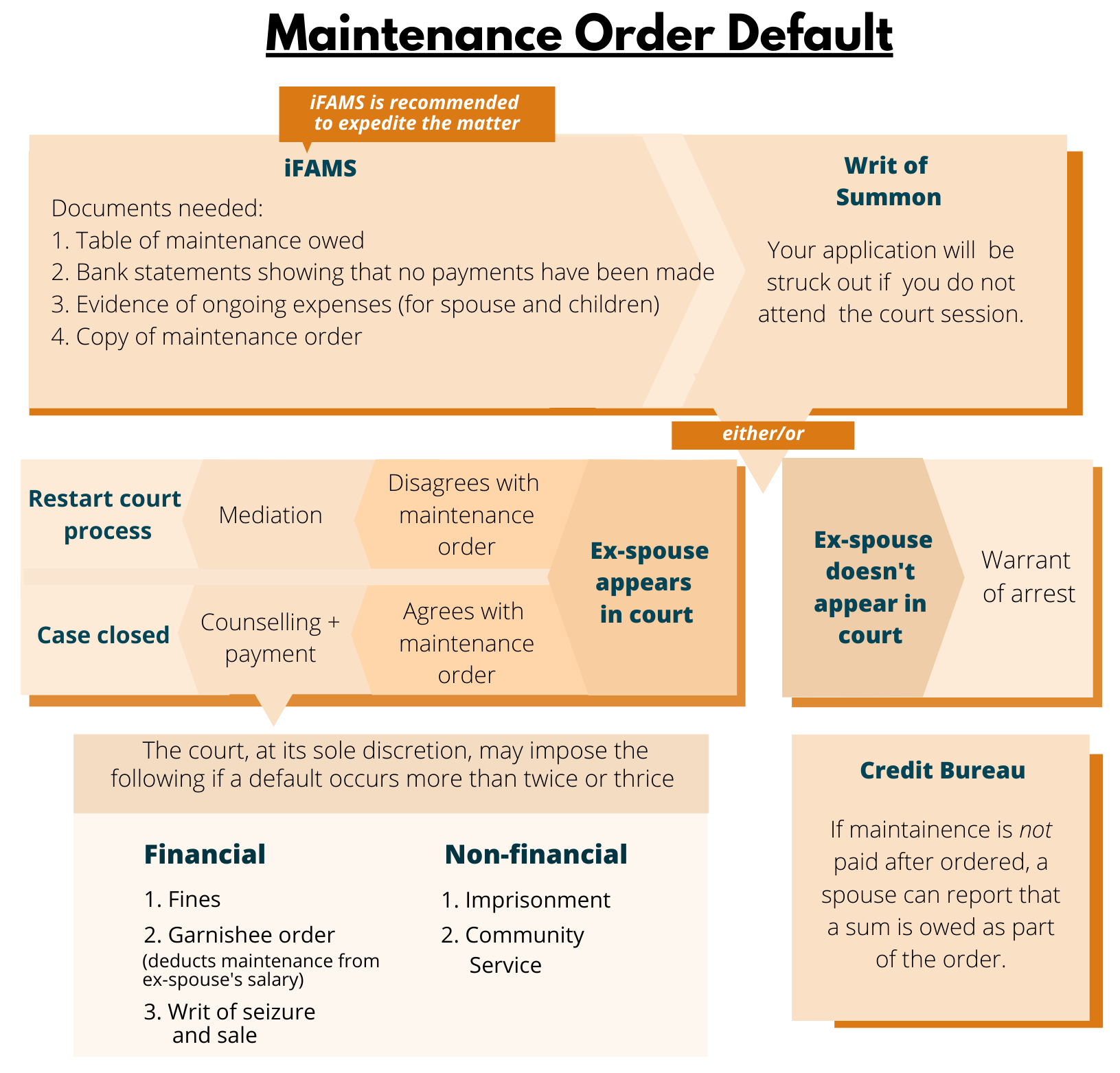
The ex-spouse may default on maintenance payments, citing reasons such as job loss, health issues and so on. The truth of these reasons will be determined by the Court, with the appropriate remedies should they turn out to be false. Consider filing an Enforcement of Maintenance Order under Family Justice Court and reporting to the Credit Bureau, especially if your ex-spouse is concerned about credit reputation. Refer to the diagramme for more information.

If the ex-spouse is determined not to comply with the maintenance order, you may need to attend numerous court hearings, which could be trying. However, know that there is support available for your emotional, legal and financial needs (see below).

2. How can you map your financial needs and resources?

It is essential to review whether your current financial resources are enough for you and your household. An immediate consideration would be to set aside a minimum of six months to a year of your monthly expenditure as emergency cash to cater for unexpected events, including a default on your maintenance.

Additionally, you may also need to ensure that you and your household insurance needs have been re-established. Your ex-spouse may cancel the entire household insurance and surrender all policies to claim the proceeds, to the detriment of you and your household. Protect your financial status with the appropriate beneficiaries to your estate by doing a comprehensive assessment.

Here are basic financial management principles, useful in any financial situation. These can be further explored with a financial consultant.

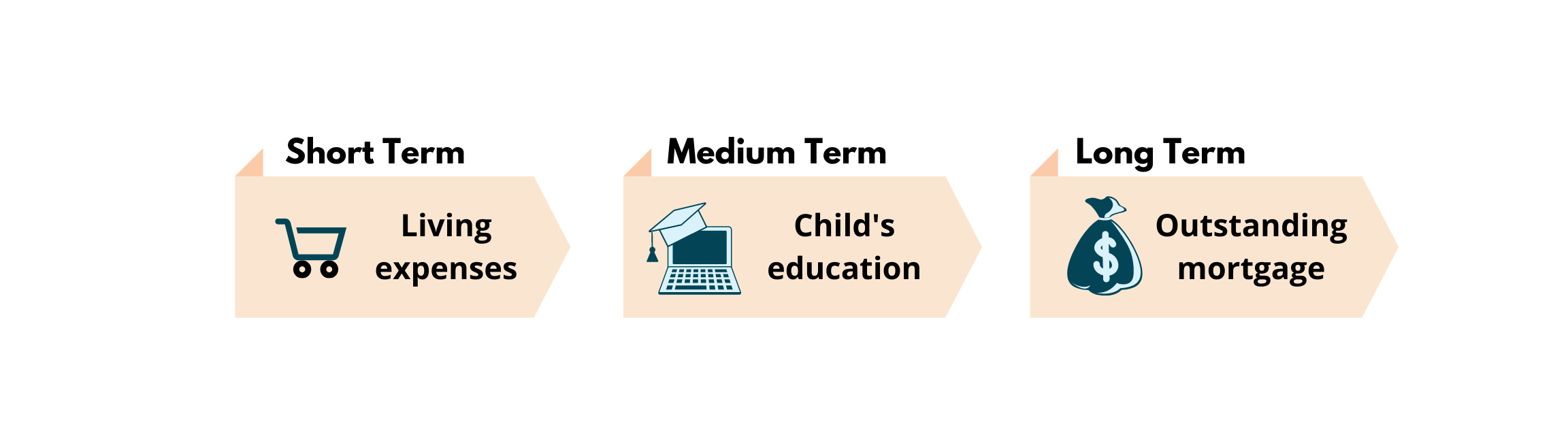
  • Principle 1: Identify short-, medium- and long-term financial objectives:

  • Principle 2: Prioritise all your financial objectives into two categories: needs and wants
  • Principle 3: Match your needs to your guaranteed income and wants to your non-guaranteed income
    • Examples of guaranteed income: CPF life, annuity, fixed deposits
    • Examples of non-guaranteed income: Property rental, investments, alimony
  • Principle 4: Seek out loans that you are able to repay
  • Principle 5: If there is a gap in your financial needs, seek assistance as soon as possible


3. What can you do to safeguard your health?

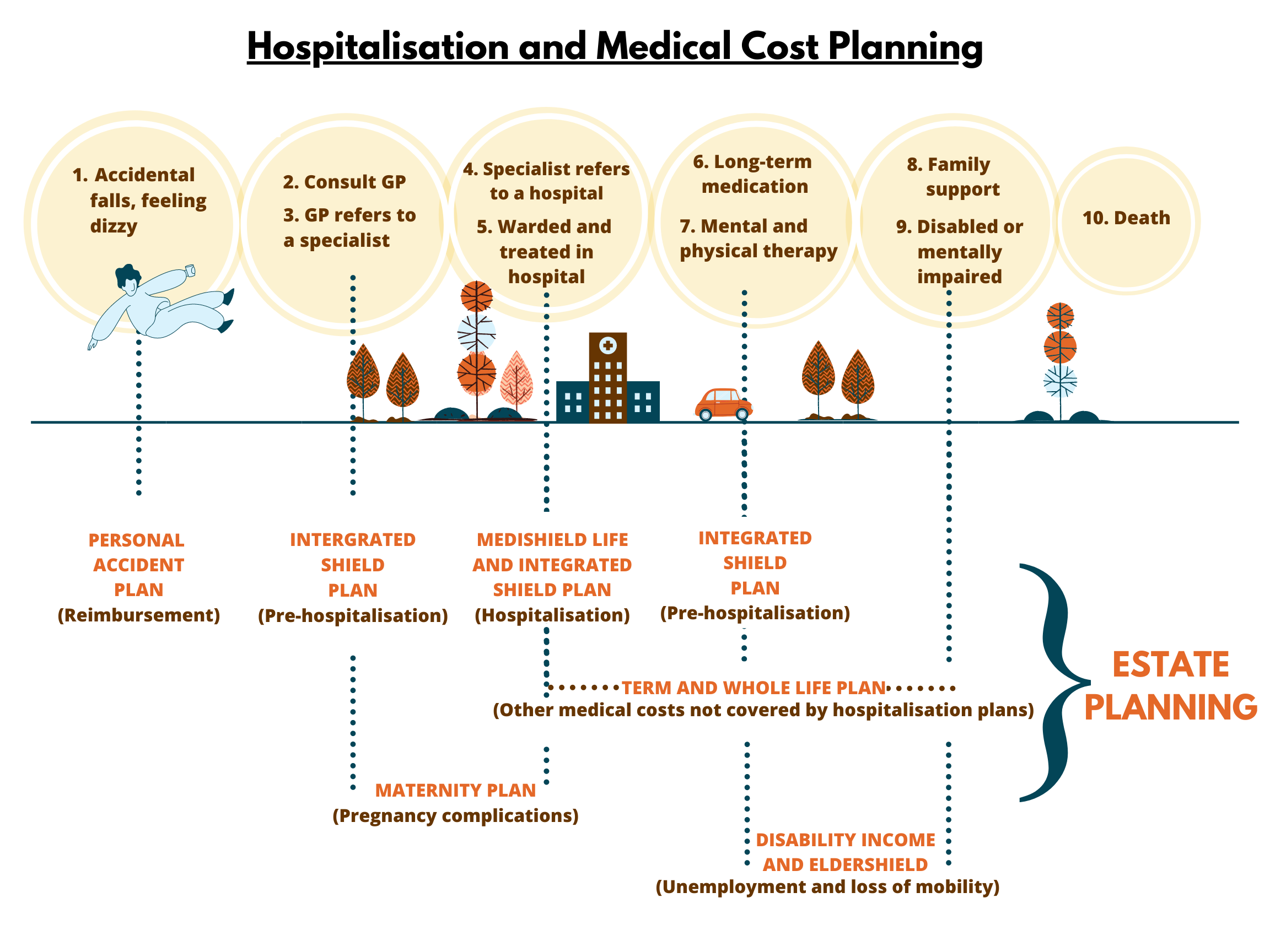
Medical planning includes planning for your physical and mental health. Below is an overview of what a medical plan should look like.

Apart from physical health, declining mental health is also a concern. Protect yourself with the Lasting Power of Attorney and appoint someone who will make the best decisions when you are mentally impaired—the time when you are most vulnerable and dependent on others. Refer to the information by the Office of Public Guardian below or seek professional advice.

4. How can you seek support for your changing financial needs?

Clients of AWARE have shared that the legal proceedings, the adjustment period, and lifestyle changes that accompany divorce do take a toll on their savings. Here are some avenues for financial support:

  • Speak to a social worker at a Family Service Centres near you to get information on programmes that offer financial aid
  • Apply for various types of assistance, such as ComCare financial assistance, job matching and family services at your nearest Social Service Office
  • Visit AWARE’s online resource for single parents for more information on government parenting support schemes, HDB policy and important legal issues. (Note: The site is specifically for unmarried single mothers, but some information is applicable for divorced single mothers.)

Counselling services are also available islandwide at counselling centres, all Family Service Centres and specialised social services, such as Divorce Specialist Support Centres. AWARE also provides individual counselling for women. To seek counselling support at AWARE, call 1800-777-5555.

By regulation, assisting in divorce financial matters is not within the scope of responsibility of a financial planner in Singapore. (This may be different in other countries.) However, you may reach out to a financial planner for general financial planning that arises out of a divorce—for example, documenting your family’s financial situation in general, making changes to your insurance plans, or selling your assets.


Bernard is a financial educator who strongly believes in the rights of everyone to access information on financial planning. Witnessing his mother’s financial and emotional vulnerability from her marital failure, spurred him to use his financial knowledge to support women considering divorce. He currently volunteers with AWARE’s CARE services to raise awareness about the need for financial planning for women contemplating or undergoing divorce.

27 August, 3 September and 10 September 2020: Birds & Bees, A Workshop for Parents About Sex Education

“This was valuable… it made me reflect on my own values regarding sex and what I may project onto my children.”

“It opens up our inhibitions and gives us real opportunities to put [our thoughts into] words.”

“Often boys are let off the hook, but I think they should be mindful and learn about boundaries, especially in this day and age when lines are blurred and there’s so much to access online.”

“Can they do this in school for our children?”

– Previous Birds & Bees workshop attendees

Most parents believe that it is important to talk to their children about sex, but many are uncertain how to do it. But what happens when you keep putting it off until the children are “older”? Where do your children get answers to questions they can’t ask you? (The internet is one such place, and young people say they are most likely to ask peers and romantic partners.)

Birds & Bees is an experiential workshop for parents, developed by parents, to explore what works for you when talking to your child about romantic relationships and sex. A variety of formats will be used, including opportunities for dialogue, discussion and reflection

Most parents want to be an “ask-able” parent: to be the approachable adult who is open to questions and who their child turns to for answers. Attend this workshop to explore how you can work on developing your own strategies to enhance the trust and bond with your child!

All parents would find the content useful and applicable. For this online workshop, we are giving priority to parents of children aged 10-15 so that the discussions can be more age-targeted.

Places are limited so do sign up quickly!

Date: 27 August, 3 September, 10 September (Participants are expected to attend all three sessions)

Time: 8.00pm – 9.30pm (1.5 hours)

Workshop Fee: $15 (in total, covering all three sessions)

Survey: After you sign up, you will be asked to complete a short pre-workshop survey about the age(s) and number of your children. This is very important so that parents with children of similar ages can be grouped together to that you will get the most out of the workshop.

Special instructions for online workshop: As small-group discussions will be a big part of the workshop, participants are expected to switch on their video as well as audio whenever possible, and to join in the discussions for maximum benefit.

Refunds and cancellations: Unfortunately we will not be offering refunds. You are expected to attend all three session of the online workshop. In exceptional circumstances, if you are unable to attend the subsequent sessions, you will be able to join the next set of workshops if you write in to publiceducation@aware.org.sg in advance giving your reasons.

**If you would like to join the workshop but cannot make it at this time, please fill in the indication of interest form.

Register here.

How to Navigate the Financial Realities of Divorce: Part Two (Mid-Divorce)

written by Bernard Foong and edited by Ashley Chua

Divorce takes up time, energy and money, and demands a lot of emotional resources. Regardless of whether or not you are prepared for it, the legal and financial reality of the process can hit hard for all parties. However, some basic knowledge of financial management and planning can empower you to know your rights and options during divorce. You could start planning to have funds put away – for expenses during divorce, and for financial needs after divorce.

Divorce looks different for every individual. Hence, you should seek more specific advice from experts familiar with your situation. Nonetheless, these financial tips should point you in the right direction.

This three-part article provides advice on three phases of divorce:

This is part two: the mid-divorce phase.

MID-DIVORCE PHASE

So you have received or filed the Writ of Divorce, and now you’re contemplating your next step. Here are some common financial considerations:

  1. How can you defend yourself against financial abuse by your spouse?
  2. What are your post-divorce financial considerations?
  3. How can you protect financial assets for yourself and for your children?
  4. Should you terminate jointly owned properties?
  5. Should you update the beneficiaries of your will and insurance policies?

Let’s answer these one by one.

1. How can you defend yourself against financial abuse by your spouse?

It is possible for a spouse to exert additional financial pressure to coerce you into an unfavourable divorce settlement. Some common tactics employed include:

  • Withdrawing money from a joint account
  • Maximising the credit card limit from your supplementary credit card
  • Refusing to support household expenses until ordered to do so
  • Refusing to cooperate in mediation, with the intent of increasing legal fees
  • Contesting the divorce or ancillary matters, with the intent of complicating or dragging out the divorce process

You have options to protect yourself from such actions. Provide evidence as and when these thing happen and, if you are represented, present it to your lawyer. Interlocutory applications – such as a maintenance order, and interim care and control for children – can be filed. The Court may consider such conduct by the spouse as prejudicing in its judgment.

2. What are your post-divorce financial considerations?

In the midst of divorce, you and your spouse may disagree on the division of matrimonial assets, maintenance for you and your children, as well as child custody, care and control. Either party may contest proposed arrangements for any of these items. Some lawyers may advise their clients to aim towards minimising the financial impact to them and their family.

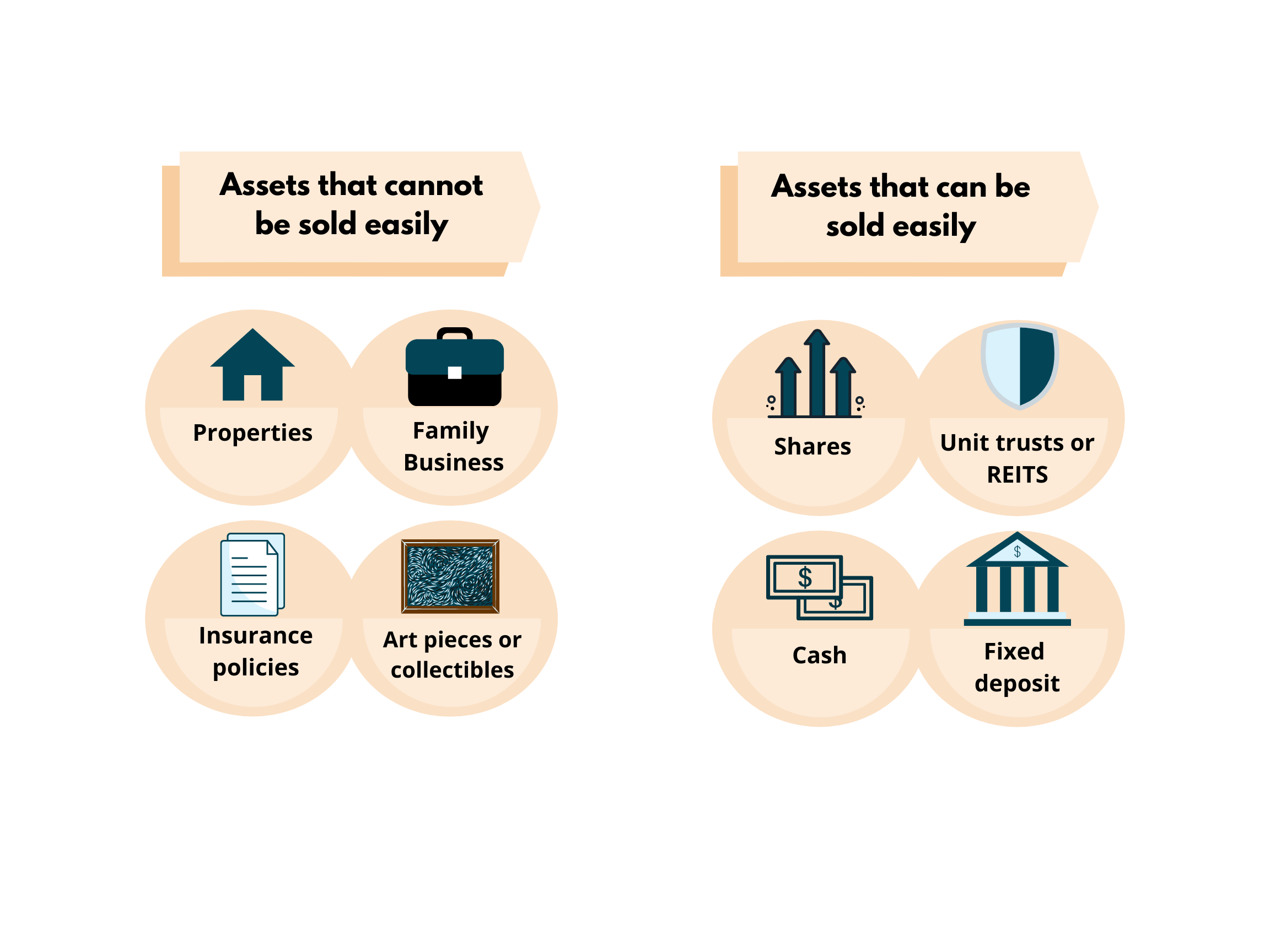
Not all assets are equal. Some assets, if sold within short notice, may result in heavy losses. Likewise, some assets may have huge potential to grow.


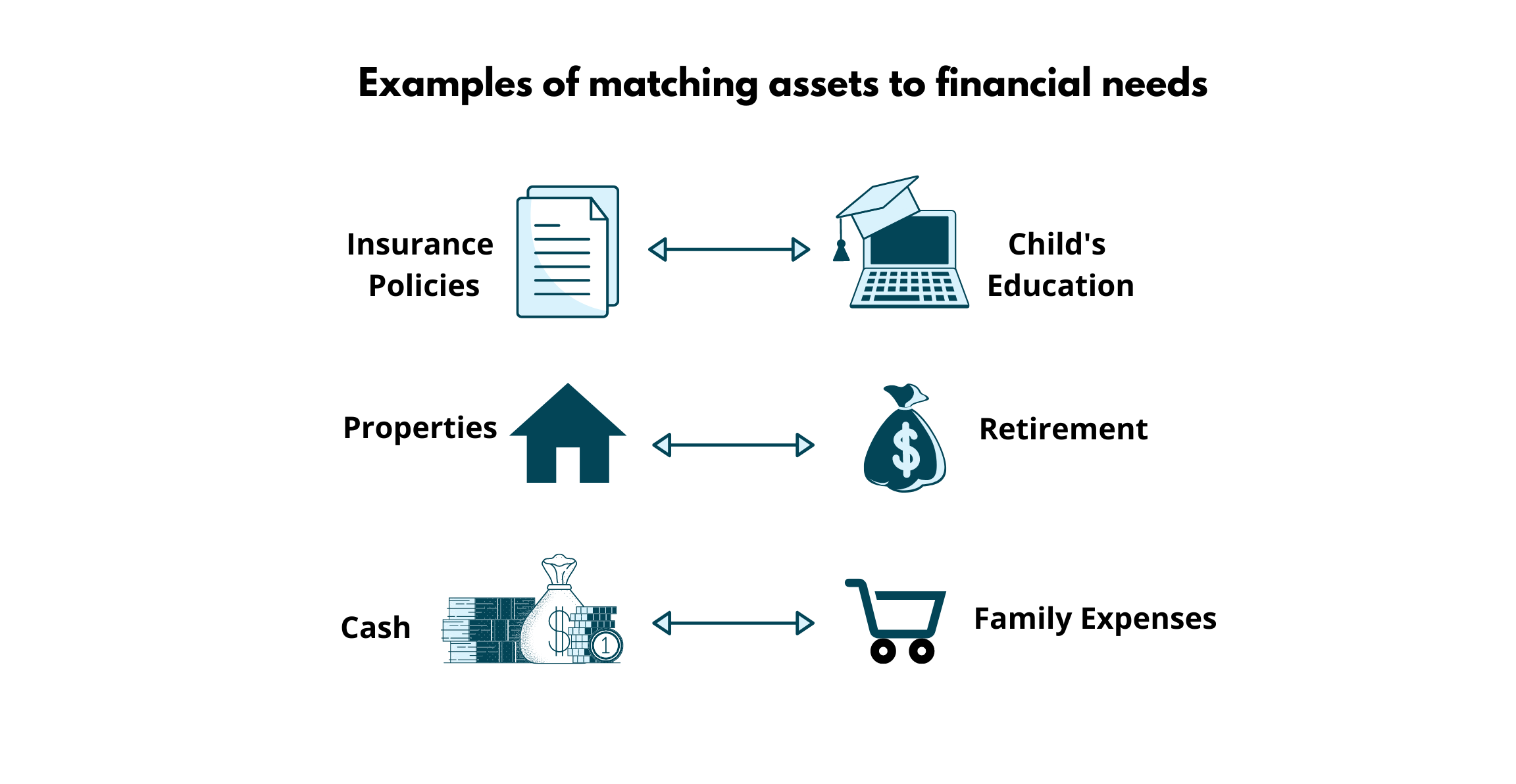
Based on your post-divorce financial needs, certain assets may be more useful to you and your family. Below are examples of matching a specific asset to a specific need. Once you know which asset is useful, you are in a better position to negotiate with your spouse.

3. How can you protect your financial assets for your children?

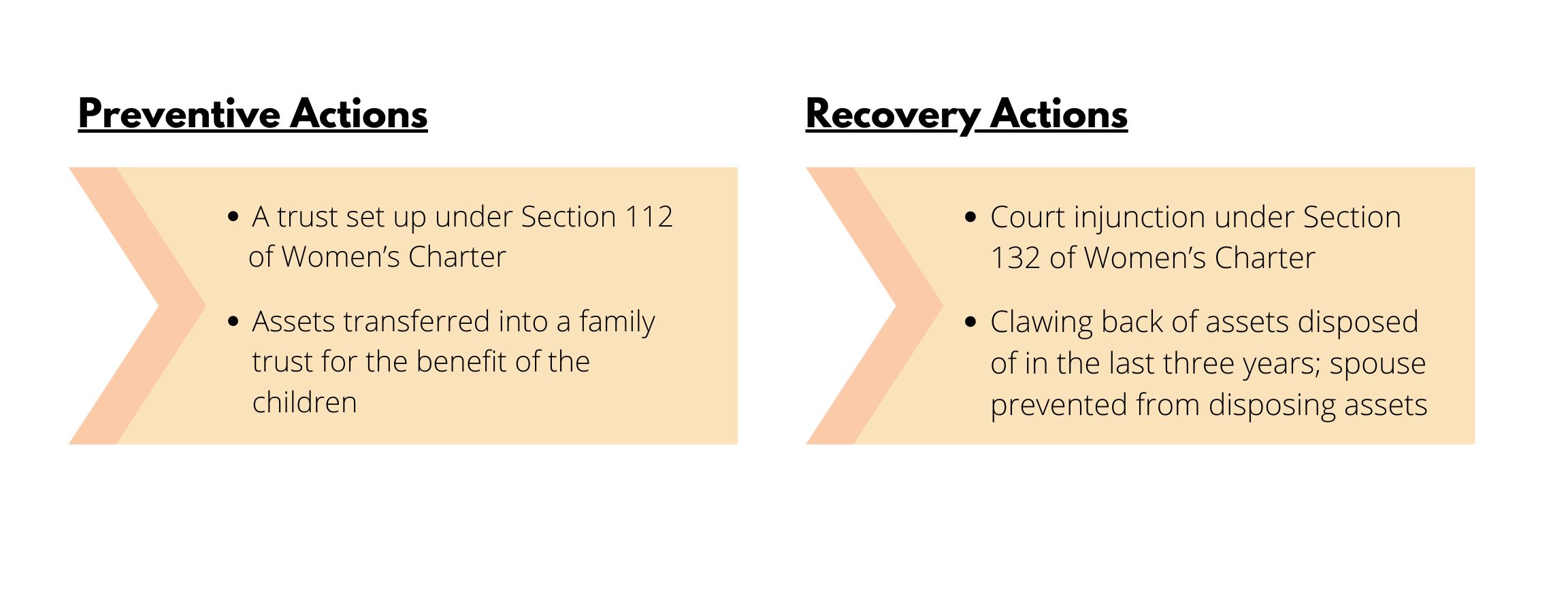
At any point of time, your spouse may dispose or transfer various assets, with the aim of reducing the division of matrimonial assets or alimony payable.

There are two possible approaches to safeguard your assets. If you are uncertain, it is advisable to speak to professionals in their specialised trade – legal and finance.

4. Should you terminate jointly owned properties?

Uncontested divorce procedures may take between three to six months, whereas a contested divorce may take up to more than six months, depending on the nature of dispute.

Should a sudden premature death happen, and the property is jointly owned, the living spouse will take sole ownership of the property. To prevent this, a conversion from a jointly owned property to a tenancy in common may be needed.


Converting a HDB flat Converting Private Property
Needs consent of the joint owners to convert the status of jointly owned property. Need HDB approval. Does not need consent of the joint owners. However, a statutory declaration, stating intentions, needs to be signed and duly served by a lawyer. 


Note that if there is a charge or outstanding mortgage on the jointly owned property, the conversion may need the consent of the bank. Due to the complexities of such conversion, it is advisable to speak to a lawyer.


5. Should you update the beneficiaries of your will and insurance policies?

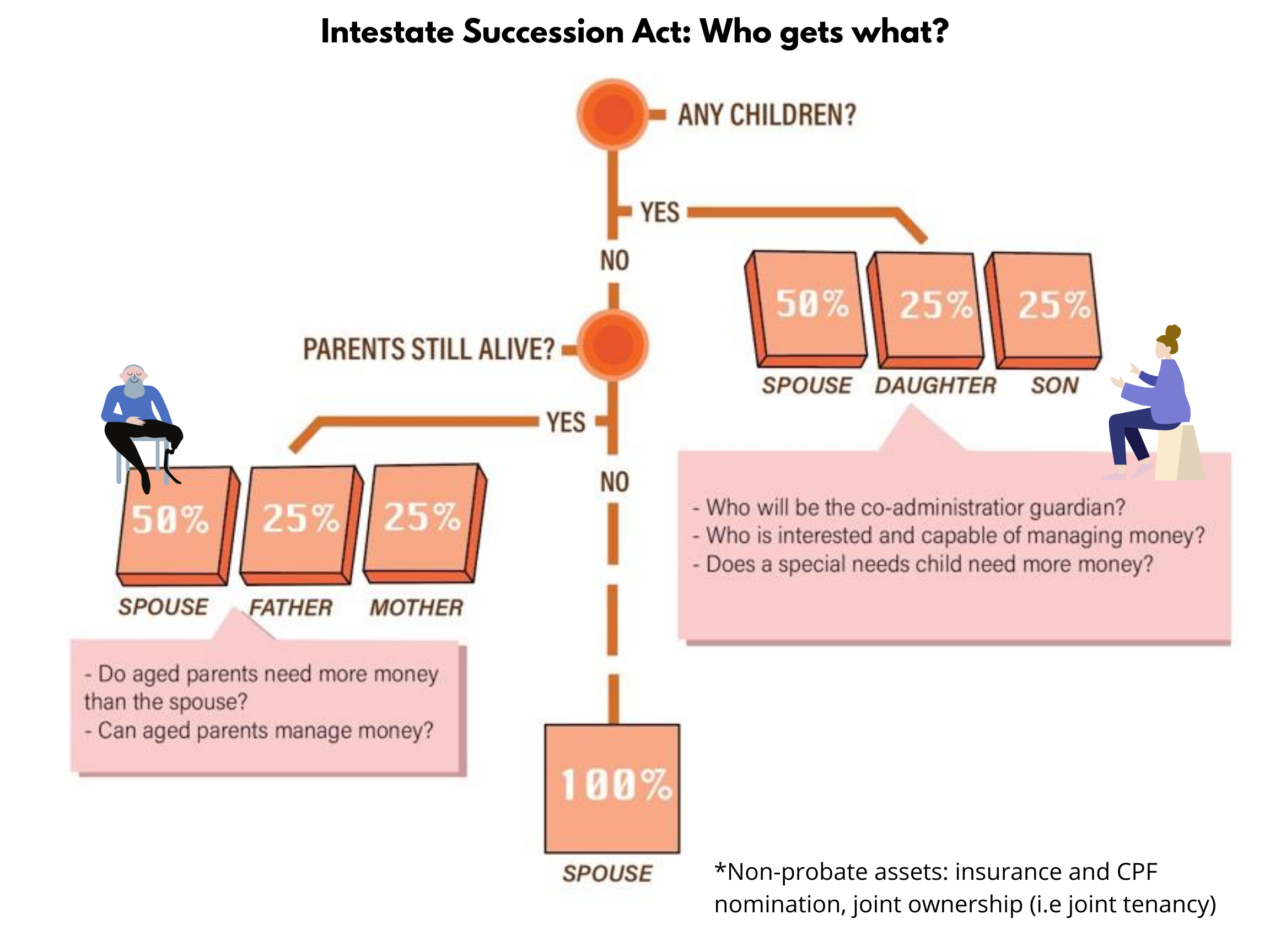
Without a will or nomination, your spouse could potentially be entitled to 50 percent of your assets under the Intestate Succession Act, as illustrated below. Having a will and nomination bypass this.

Wills and nominations are two parts of estate planning. To find out more about estate planning, you may reach out to a financial planner.

You can understand your rights and get guidance on these steps through:

  • Legal clinics islandwide provide free legal advice sessions ranging from 20-40 minutes. The AWARE legal clinic provides you with a one-time, free, 20-minute legal clinic session. Call 1800-777-5555 to get a referral. Otherwise, you can check your eligibility with other Singapore legal clinics at legalclinics.sg.
  • The Legal Aid Bureau provides pro bono legal aid to Singaporeans and PRs for a number of legal issues. Contact them to check your eligibility. Otherwise, foreigners can contact ACMI to check if they are able to provide legal aid.
  • Some private firms offer a short free or discounted first consultation.


Counselling services are also available islandwide at various counselling centres, Family Service Centres and specialised social services, such as Divorce Specialist Support Centres. AWARE also provides individual counselling for women. To seek counselling support at AWARE, call 1800-777-5555.

By regulation, assisting in divorce financial matters is not within the scope of responsibility of a financial planner in Singapore. (This may be different in other countries.) However, you may reach out to a financial planner for general financial planning that arises out of a divorce – for example, documenting your family’s financial situation in general, making changes to your insurance plans, or selling your assets.

Future-planning for yourself and your children

In the last installment, we will be talking about financial planning for your life post-divorce. Here are some questions we’ll consider:

  • How can you seek support for your changing financial needs?
  • How can you balance your children’s needs with your own retirement needs?
  • What can you do for your health needs as they increase with age?

Bernard is a financial educator who strongly believes in the rights of everyone to access information on financial planning. Witnessing his mother’s financial and emotional vulnerability from her marital failure, spurred him to use his financial knowledge to support women considering divorce. He currently volunteers with AWARE’s CARE services to raise awareness about the need for financial planning for women contemplating or undergoing divorce.