
Author: Media Intern

How to Navigate the Financial Realities of Divorce: Part One (Pre-Divorce)

written by Bernard Foong and edited by Ashley Chua

Divorce is often a daunting process. It takes up time, energy and money, and demands a lot of emotional resources.

Regardless of whether or not you are prepared for it, the legal and financial reality of the process can hit hard for all parties. However, some basic knowledge of financial management and planning can empower you to know your rights and options during divorce. You could start planning to have funds put away – for expenses during divorce, and for financial needs after divorce.

This three-part article provides advice on three phases of divorce:

In this article, we will cover the pre-divorce phase. We recognise that women are often in a disadvantaged position financially and socially during divorce procedures. Nevertheless, the below information would be helpful to anyone contemplating divorce. (Lastly, divorce looks different for every individual. While these financial tips should point you in the right direction, you should seek more specific advice from experts familiar with your situation.)

PRE-DIVORCE PHASE

This is the phase where divorce proceedings have yet to commence. Your relationship may have strained, and you suspect that divorce may be in the cards soon. Or you may be contemplating divorce and realising that financial constraints are a big factor in the decision.

It is a good practice to start off by:

  • Understanding the divorce process and its cost
  • Organising and documenting the family’s financial situation
  • Understanding your financial, emotional and practical needs
  • Consider a maintenance order
  • Seeking professional support for legal, financial and emotional matters
  • Planning for yourself and your children


1. Understanding the Divorce Process

Many women who have called AWARE’s Helpline and/or attended our legal clinics have shared that they feel lost in a maze of legal procedures once divorce proceedings commence. Tight timelines need to be met. There are numerous trial conferences to attend and documents to be submitted. Sometimes, confusion about these processes even leads to extraneous costs being incurred. For example, researching and comparing multiple lawyers and their costs can greatly help your planning.

Uncontested Divorce Typical Cost Contested Divorce Typical Cost
$1,500 – $3,000 $10,000 – $35,000
Typical Legal Hourly Rate
 Partner: $800/hr
Senior Associate: $500/hr
Junior Associate: $350/hr

*taken from singaporelegaladvice.com dated 21 October 2019

There are also other resources available online for divorce processes and costs. Check out these two:


2. Organising and Documenting Family Financial Situation

Gathering key evidence and documents before filing for a divorce is a good idea – not just so you can plan for your post-divorce circumstances. It’s also useful so that your lawyer and the Court can decide how to apportion matrimonial assets and debts, and whether to award maintenance for the wife and children.

Documents Gather this to show:
Spouse’s IRAS statement Spouse sources of income
Spouse’s Will, Property Deed, Bank Statement Spouse assets
Spouse’s Credit Card Statement Spouse debts
Groceries, Utilities, Internet, Mobile Bills Family maintenance
Vehicle Maintenance Receipts Family maintenance
Meals and Clothing Expenses Personal maintenance
Insurances and Savings Policies Personal and children maintenance
Tuition Bills, School Fees, Education Children maintenance

(Under the Women’s Charter, matrimonial assets are: assets acquired by one or both parties during the marriage, assets used by any spouse or their children for various purposes, or assets acquired before the marriage but substantially improved during the marriage. Gifts or inheritance [and things that have not been substantially improved during the marriage] are not considered matrimonial assets.)

Apart from the aforementioned documents, if you were not employed/gave up employment to contribute towards home and supporting your family, do consider your own employment opportunities post divorce. In post-divorce financial planning, employment can be an important stream of income for financial sustainability. Hence, at this stage, it could also be timely to revisit your educational and prior work experiences in anticipation of (re-)joining the workforce.


3. Understanding Your Financial, Emotional and Practical Needs

In divorce, individuals typically are put into a position where they need to juggle multiple financial, emotional and practical considerations. Often, the cost of litigation comes up against other current and future financial needs, one’s emotional health, the needs of children, and many other factors.

Here are some questions to consider at this stage:

  • Should I self-represent or seek out a lawyer? How much time would a divorce take up in my daily life if I were to self-represent? How much more costly would a lawyer be?
  • How might the divorce process affect my work hours and my childcare schedule?
  • How might having a lawyer support my emotional needs?
  • Would contesting the divorce be affordable?

To reiterate, there is no one-size-fits-all approach. You are the expert on your own situation. The goal when planning for divorce is simply to know what’s best for you with information, guidance and support.


4. Consider a Maintenance Order

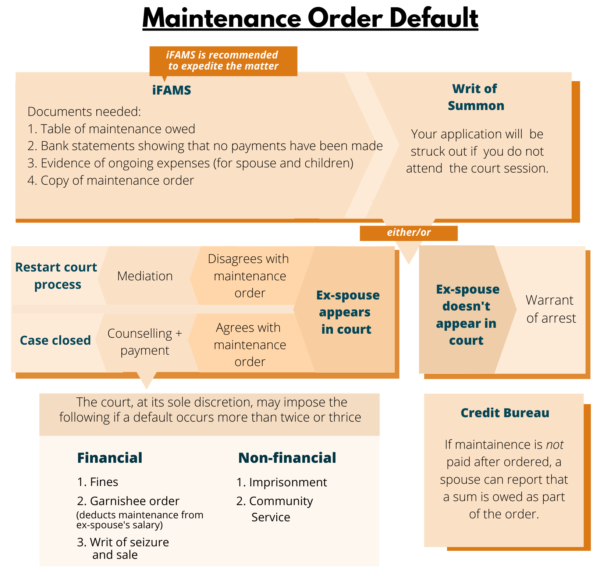
In anticipation of the expenses and changes in financial situation, you may consider applying for a maintenance order for yourself, and for your children.

It is crucial to be informed of the procedure so that you do not waste unnecessary time and resources trying to figure out the next course of action. Refer to the diagramme for more information.
 

5. Seek Professional Support

After doing some of your own research on divorce, understanding your family’s current and future financial, emotional and practical needs, as well as documenting your finances, you can also seek professional support.

If you are uncertain, and if you can, it is beneficial to speak to professionals in their specialised trade – legal, financial counselling, emotional counselling.

If you need less pricey alternatives to private legal counsel, here are some of them:

  • Legal clinics islandwide provide free legal advice sessions, ranging from 20-40 minutes. The AWARE legal clinics provide you with a one-time free 20-minute legal clinic session. Call 1800-777-5555 to get a referral. You can also check your eligibility with other Singapore legal clinics at legalclinics.sg
  • The Legal Aid Bureau provides pro bono legal aid to Singaporeans and PRs for a number of legal issues. Contact them to check your eligibility. Otherwise, foreigners can contact ACMI to check if they are able to provide legal aid.
  • Some private firms offer a short free or discounted first consultation.

Counselling services are also available islandwide at counselling centres, Family Service Centres and specialised social services, such as Divorce Specialist Support Centres. AWARE also provides individual counselling for women. To seek counselling support at AWARE, call 1800-777-5555 to get a referral.

By regulation, assisting in divorce financial matters is not within the scope of responsibility of a financial planner in Singapore (this may be different in other countries). However, you may reach out to a financial planner for general financial planning that arises out of a divorce – for example, documenting your family’s financial situation in general, making changes to your insurance plans or selling your assets.


6. Planning for Yourself and Your Children

In the next two installments, we will be talking about financial planning during divorce and for your life post-divorce. You’ll consider the following questions:

  • What new financial needs will my children and I have after divorce? How can I ask for financial support for these needs from my ex-spouse?
  • What new environment do I wish my children to grow up in? How can I make provisions for it? (Eg. living arrangements, childcare needs, etc.)
  • How can I protect my financial assets during and post-divorce?

Bernard is a financial educator who strongly believes in the rights of everyone to access information on financial planning. Witnessing his mother’s financial and emotional vulnerability from her marital failure, spurred him to use his financial knowledge to support women considering divorce. He currently volunteers with AWARE’s CARE services to raise awareness about the need for financial planning for women contemplating or undergoing divorce.


 

Andrew’s story: Living without his wife, caregiver and emotional support

Our “Your Stories” series are submissions shared with us via email or in one-on-one interviews, for the purposes of our research and campaigns. All names have been changed (unless the use of real names was explicitly permitted by the author), and we have sought permission to publish from the authors/interviewees themselves. The opinions expressed in these posts do not represent those of AWARE.

Andrew is a Singaporean man married to a Vietnamese woman, Thao. What he hoped would be a happily ever after (“so long as they shall live”) turned out to be years of turmoil, separation and unanswered questions.

Despite four attempts, Andrew’s appeals to the ICA to secure a Long Term Visit Pass (LTVP) for his wife have been fruitless. This has forced the couple into an emotionally and financially laborious arrangement: They can only be together nine months in a year, in three-month stretches at a time. Each time Thao has to return home to Vietnam, Andrew follows her, which is a drain on his finances due to the two-way airline costs, higher living expenses overseas, and lower monthly salary. (He has to take no-pay leave to go to Vietnam with his wife.)

He had also turned to his MPs (Members of Parliament) for help with appeals to ICA, but has still failed to secure an LTVP for his wife. Despite tremendous efforts to communicate with the ICA about his situation by requesting for interviews and asking how he could address the shortcomings of the applications, all he has received is silence. The uncertainty of the couple’s situation and their prolonged separation from each other has forced them to give up on their plans to conceive, halting their IVF sessions altogether.

Now 75 years old, Andrew is beset with health problems such as an intestinal blockage and eyesight issues arising from his cornea transplant. He is dependent on his wife for care and support. Due to COVID-19 border restrictions and the escalation of cases in both Singapore and Vietnam, his wife has been stuck in Ho Chi Minh for the past five months, leaving Andrew without his primary caregiver and source of emotional support.

The separation between husband and wife has led to increased emotional turmoil for Andrew, and deterioration of his health.

“If I die,” he says, “I would just like to see my wife one last time and tell her how much I love her.”

[Closed] Focus group participants needed: Foreign domestic workers providing eldercare

AWARE will hold an online group discussion on Zoom with foreign domestic workers (FDWs) who look after an elderly person in Singapore. This discussion will take place on Sunday, 6 September 2020, 11am – 1pm.

This discussion is part of our research to understand FDWs’ experiences of caring for the elderly in Singapore. We want to share our current findings with you and get your thoughts on them.

To participate, you must:

  • Currently be looking after an elderly person above 67 years old in Singapore
  • Have been hired between 2018 – 2020
  • Be able to speak comfortably in English
  • Have access to a Zoom account

The elderly person you look after must:

  • Need help with more than one Activity of Daily Living (such as washing, feeding, dressing, transferring, toileting or showering)

OR

  • need help due to a mental condition (dementia, Alzheimer’s, etc.).

All participants in this discussion will be given a $30 NTUC voucher as a token of appreciation.

Click here to apply

If you are interested, or know an FDW who might be, please fill up the form by 31 August 2020. Do feel free to email Kristen at researchintern@aware.org.sg if you have any questions.

Don’t separate transnational couples in Singapore during the pandemic

This letter was originally published in The Straits Times on 3 August 2020.

Immigration policies and travel restrictions brought about by the ongoing Covid-19 pandemic are putting transnational families under tremendous stress.

In the last month, the Association of Women for Action and Research has seen two cases of transnational couples, made up of a Singaporean citizen and a non-resident, who are at risk of being physically separated from each other.

In both cases, the non-resident spouse has failed to secure a long-term visit pass (LTVP), and the short-term pass (30 days, renewable up to three times) the spouse is on is expiring.

This leaves them scrambling for alternatives to guarantee their stay here. If their passes expire and they fail to get an extension – granted on a case-by-case basis by the Immigration and Checkpoints Authority (ICA) – these migrant spouses would be forced to leave Singapore.

However, travel restrictions and the limited number of flights now make it difficult for them to even return to their home country. Those with children risk being separated from them. What should these families be expected to do in such a situation?

The ICA typically does not reveal why an LTVP application has failed. Even in non-pandemic times, this caused great uncertainty for transnational families. Without an LTVP, migrant spouses also do not have the right to work.

In these exceptional times, we call for the authorities to be more compassionate to these families. All migrant spouses of Singaporean citizens should automatically be on the Long-Term Visit Pass-Plus. Those whose passes are expiring or due for renewal during this period of strict travel restrictions should receive an automatic extension.

Chong Ning Qian

Senior Executive of Research

AWARE

Employers have a role in tackling domestic violence

This commentary was originally published in Business Times on 23 July 2020.

As domestic violence cases surged at the beginning of Singapore’s circuit breaker, attention was duly paid to how family, friends and neighbours could provide support to those at risk of abuse.

However, there is an overlooked group of people who may be an invaluable source of support for victims of violence: employers and colleagues. Society tends to expect us to maintain a separation between our public and private lives. However – as the Covid-19 work-from-home boom has revealed – this divide is something of a fantasy. All the more so when it comes to domestic violence, which has a real and recognisable impact on the workplace.

What does domestic violence have to do with work?

Victims carry their trauma to work

Domestic violence can lead to serious consequences among workers: increased absenteeism and reduced performance. Perpetrators may be restraining their victims from leaving the house, whether physically or via threats. During the circuit breaker, when going to the office was not an option, Sheila had her work laptop destroyed, which made it impossible for her to work from home. She later called Aware’s Women’s Helpline to seek assistance.

Another woman, Tina, called the Helpline to say that, along with other forms of abuse and violence, her husband was intentionally trying to make it difficult for her to work by screaming at her when she was on work calls. Unfortunately, this is not an uncommon tactic to exert power and control over a victim. Besides the physical and psychological impacts of abuse, which can be long-term and crippling, a victim’s professional performance will naturally take a hit in this setting.

Unwanted visitors at the office

Sometimes, the office itself becomes a site of violence and abuse. Perpetrators often harass their victims at work, either in person or by message, e-mail, phone calls and more. Most perpetrators know where their victims work, and know their routines – knowledge that can unfortunately leave an employee vulnerable even after she ends an abusive relationship. A perpetrator may stalk his victim during her commute, or enter her workplace (or the surrounding premises) to harass her.

Research states that the risk of abuse is higher when a victim is entering or exiting the office, without her colleagues around her. Co-workers, clients and other bystanders may even become targets themselves. Many victims of domestic violence end up leaving their jobs. Some try to escape the violence and need time to figure out the next steps (eg. legal options, place of refuge, new bank accounts, etc); others are forced to quit by their abusers, in an effort to isolate and control them. Employers may also dismiss victims due to frequent absences at work and decreased productivity– further compounding their already agonising situations.

Work can be refuge or lifeline

Most companies do not have a formal workplace domestic violence prevention policy. This is largely due to specious, but unfortunately prevalent, ideas about domestic violence being a “family matter”, or best left to social services. Yet for many victims of domestic violence, workplaces are an essential refuge. Work not only provides them stability, it also reassures them that they are worthy of dignity and respect, even when their partners make them feel worthless.

The financial independence that continued employment provides can enable victims to escape abusive relationships – a prospect that would be hard to imagine if they were jobless and completely dependent on their abusers. Many victims also disclose their abuse to trusted colleagues, making these colleagues an invaluable bridge to provide information about helpful resources, such as protection specialist centres and shelters.

What can employers do?

Employers can play a crucial role in tackling domestic violence, during Covid-19 and beyond. They can keep in touch with those they believe to be at risk of domestic violence, or encourage other employees to do so. This could take the form of regular check-ins with them, whether over calls or texts (eg. if victims are concerned about being overheard by their abusers).

Employers can also clearly signpost support services, such as Aware’s Women’s Helpline, to their employees. This information is especially important to have at hand when employees disclose experiences of abuse and violence to colleagues. After all, many abusers cut victims off from their family and friends, leaving them with precious few chances to ask for help. Beyond the humanitarian impulse to help a colleague or employee in need, tackling domestic violence also makes business sense.

Of course, you do not need a price tag to convince you that domestic violence is abhorrent. But the numbers may surprise you all the same: According to the Centers for Disease Control and Prevention, the lifetime economic cost of domestic violence is estimated to be US$3.6 trillion across the US population. This toll manifests in reduced productivity, absenteeism, employee turnover, medical and other costs.

Aware’s corporate training arm, Catalyse Consulting, works with companies to equip employees with the skills to respond when colleagues disclose domestic abuse. A company we trained recently updated its HR policy to overtly acknowledge the potential workplace impact of domestic violence. It promised training for the workforce, and the ability to refer victims to resources. The policy also included measures such as paid leave, flexible work arrangements, emergency accommodation and financial assistance for those experiencing domestic violence. For them, these benefits could make for an essential safety net.

What can the government do?

Last year, the International Labour Organisation (ILO) adopted the first-ever treaty on violence and harassment at work, which emphasised that domestic violence affected employment and productivity at varying levels. The Convention recommended that “measures must be taken against domestic violence equally as in the case of violence at work”. However, the idea of employers being obligated to address domestic violence was one of the reasons why Singapore abstained from signing the treaty. The government argued that an official recognition of the effects of domestic violence at work, and attempts to mitigate its impact, would “expand workplace safety and health well beyond the workplace remit”.

In contrast to Singapore’s approach, fellow commonwealth countries Australia and New Zealand have already taken steps to recognise the workplace impact of domestic violence. In 2018, New Zealand passed legislation allowing those affected by domestic violence up to 10 days per year additional paid annual leave. The same year, Australia amended its Fair Work Act to introduce five days of unpaid leave for domestic violence victims. Last month, the United Kingdom’s government announced a review of workplace support for survivors of domestic abuse. It will look at how employers might pay wages into different accounts to safeguard cash for those living with a controlling partner, or otherwise make emergency cash available.

Domestic violence places a painful and preventable cost on workplaces. Government and employers alike should ensure that victims of domestic violence are not alone, either at home or at work.

Shailey Hingorani is the Head of Research and Advocacy in AWARE

25 July 2020: Consent – do you get it? Young Singaporeans’ perceptions of sexual consent

After months of social distancing, you and your partner finally meet up. You both want to have sex. After getting undressed, however, your partner expresses second thoughts about proceeding.

Do you:

A. Urge them to continue, since you’ve already started

B. Stop, even though you’d like to continue?

If you picked (A), you may not have obtained consent from your sex partner.

Consent can be more complex than we think. It’s hard to boil down to pithy epithets like “no means no”, or even “yes means yes”. Considering variables like a power differential, practices like “stealthing” or the sending of nudes, or mid-act changes of heart, a standard negotiation playbook doesn’t quite cut it.

In a new survey AWARE conducted with Ngee Ann Polytechnic, we asked 539 young adults, from 17 to 25, to share their perspectives on consent and their personal experiences with it. The results were encouraging: Many young people appear to have a strong general understanding of consent, and a desire to have more open conversations about it. Yet certain scenarios proved more difficult for our respondents to navigate.

At this event, we’ll roll up our sleeves and dive deep into the nebulous nature of consent, by talking through our survey findings (including various tricky hypothetical situations) with a panel of experts, then breaking off into small-group discussions. Together, we’ll work towards understanding a comprehensive definition of consent, put to rest some harmful myths and ensure that our decision-making in the bedroom is informed by empathy and respect. Join us on Saturday, 25 July, on Zoom from 2-3.30pm.

This event is pay-what-you-can. Suggested donation of $5 per head. All proceeds will go to AWARE’s Vulnerable Women’s Fund to help grow our services as much as possible during this period. Visit the campaign here.

Event Schedule

  1. Presentation of survey findings
  2. A panel discussion, moderated by AWARE’s Head of Advocacy and Research, Shailey Hingorani
  3. Facilitated small group discussions

Register here!


Our panellists

Carissa Cheow

Carissa is currently reading her Master’s in Public Policy at the Lee Kuan Yew School of Public Policy. A political theorist by training and community organiser by circumstantial necessity, she serves as the co-founding Co-President of Students for a Safer NUS, a community organization tackling sexual violence, and co-founding Advisor to transNUS, a ground-up collective of trans and nonbinary students, staff and alumni in her university. Her research interests range from the politics of de-alienation to interpersonal and intrapersonal politics. She is also currently working on her first collection of poems, titled you need a very small space to read these poems.

Lee Yi Ting

Yi Ting taught in JCs for five years, and was a Ministry of Education-trained sexuality education facilitator. She currently works in the areas of gender justice and sexual rights. She is a facilitator for AWARE’s Birds & Bees workshop series, which helps parents have important conversations with their children about sex in a non-judgmental way.

Priscilla Chia

Priscilla is a lawyer in private practice. Priscilla’s practice focuses on commercial, public interest and criminal litigation. Outside of her legal practice, Priscilla is actively involved in and invests her time in non-profit and public interest work.


29 July 2020: Sexual Assault First Responder Training (Online)

“Are you sure that happened? Why didn’t you fight back? You should have known better.” These are some common responses survivors of sexual assault have heard, which may further their feelings of doubt, guilt and shame.

First response that is sensitive to the survivor’s needs and choices is necessary in preventing re-victimisation. We may not always know the right words to say, but we can all agree that sexual assault should never happen to anyone.

One way to show zero tolerance for sexual assault is through our own words and actions. It is not always easy for survivors to tell someone about what happened. In fact, for some survivors, it can be especially daunting.

As an individual that they put their trust in, our response becomes pivotal in their journey of recovery. SACC’s First Responder Training helps familiarize participants with trauma reactions and symptoms to better contribute to a survivor’s well-being. In this workshop, SACC will share more on the following:

1. Definition of sexual assault and harassment

2. Recognising Singapore’s legal framework

3. Understanding consent

4. Understanding the impact of sexual assault and trauma on survivors

5. Role of a first responder

6. Providing support to survivors of sexual assault

7. Resources available for help

8. Key skills such as ensuring safety, active listening and empathy

Under AWARE’s #AimForZeroSG campaign, this popular workshop has been made affordable to all. While you are welcome to pay what you can, we suggest a sum of $10 per workshop attendee. Please note that all proceeds to towards SACC and that the donation made towards the workshop is non-refundable.

Persons of all genders and nationalities are more than welcome to attend.

We strongly request that all participants commit to the full duration of the 5.5-hour workshop (there are breaks!) to ensure that everyone will get the opportunity to engage in interactive discussions and learn useful skills. This includes keeping your video ON and utilizing the audio to participate.

This event has sold out. For early notice about future editions, fill out this form.

16 July, 23 July, 30 July 2020: Birds & Bees, A Workshop for Parents About Sex Education

Important: This workshop will be held online via Zoom. It will be a set of three sessions. Participants are required to attend all three sessions.

“This was valuable… it made me reflect on my own values regarding sex and what I may project onto my children.”

“It opens up our inhibitions and gives us real opportunities to put [our thoughts into] words.”

“Often boys are let off the hook, but I think they should be mindful and learn about boundaries, especially in this day and age when lines are blurred and there’s so much to access online.”

“Can they do this in school for our children?”

– Previous Birds & Bees workshop attendees

Most parents believe that it is important to talk to their children about sex, but many are uncertain how to do it. But what happens when you keep putting it off until the children are “older”? Where do your children get answers to questions they can’t ask you? (The internet is one such place, and young people say they are most likely to ask peers and romantic partners.)

Birds & Bees is an experiential workshop for parents, developed by parents, to explore what works for you when talking to your child about romantic relationships and sex. A variety of formats will be used, including opportunities for dialogue, discussion and reflection

Most parents want to be an “ask-able” parent: to be the approachable adult who is open to questions and who their child turns to for answers. Attend this workshop to explore how you can work on developing your own strategies to enhance the trust and bond with your child!

All parents would find the content useful and applicable. For this online workshop, we are giving priority to parents of children aged 10-15 so that the discussions can be more age-targeted.

Places are limited so do sign up quickly!

Date: Thursdays – 16 July, 23 July, 30 July (Participants are expected to attend all three sessions)

Time: 8.00-9.30pm (1.5 hours)

Workshop Fee: $15 (in total, covering all three sessions)

Survey: After you sign up, you will be asked to complete a short pre-workshop survey about the age(s) and number of your children. This is very important so that parents with children of similar ages can be grouped together to that you will get the most out of the workshop.

Special instructions for online workshop: As small-group discussions will be a big part of the workshop, participants are expected to switch on their video as well as audio whenever possible, and to join in the discussions for maximum benefit.

Refunds and cancellations: Unfortunately we will not be offering refunds. You are expected to attend all three session of the online workshop. In exceptional circumstances, if you are unable to attend the subsequent sessions, you will be able to join the next set of workshops if you write in to publiceducation@aware.org.sg in advance giving your reasons.

Register here.

Legislate right to request flexible work arrangements

This letter was originally published in The Straits Times on 27 June 2020

In our research on the conflict between caregiving and work, the Association of Women for Action and Research has repeatedly asserted the importance of flexible work arrangements (FWAs).

We agree with Dr Petty Pin Yu Chen that FWAs have the potential to close the gender pay gap, which starts to widen in the late 30s when women typically have children (Flexible work arrangements can help narrow gender pay gap, June 24).

The widespread adoption of FWAs can help close a related gap – the retirement savings gap.

Even women without children may experience a “caregiver penalty” when they start caring for an older person, usually in their mid-50s. Much like mothers, these women will either fully or partially withdraw from the labour force and face systemic disadvantages in pay, benefits and perceived commitment to work.

FWAs can be designed to minimise conflict between caregiving and work responsibilities. Yet, their mere availability is not enough.

The Government should legislate a right to request FWAs which employers can turn down only on the basis of business-related reasons defined in legislation.

This right should be extended to all employees, including those on part-time contracts. Extending FWAs to only some employees – for example, mothers – runs the risk of them being resented by their colleagues for having an additional benefit.

Research shows that supportive work policies will not achieve the desired results by themselves if organisations continue to use face time as a proxy for productivity, and lack sufficient trust in their employees to use FWAs responsibly.

A legislated right would also mean establishing formalised human resource processes to evaluate and grant FWAs.

Currently, the choice to stay in or out of the workforce often hinges on employees’ ability to balance work and caregiving responsibilities in a world where work and caregiving are fundamentally incompatible.

Astute legislation of FWAs will help to eliminate this unfair choice.

Shailey Hingorani

Head of Research and Advocacy

AWARE