Author: Media Intern

Don’t rush transfers of FDWs

This letter was originally published in The Straits Times on 23 May 2020.

The Ministry of Manpower’s (MOM) new rule easing transfer procedures for employers of foreign domestic workers (FDWs) fails to take into account the interests of the FDWs (Move towards letting domestic workers switch employers freely, by the Humanitarian Organisation for Migration Economics, May 21).

It also creates perverse incentives for employment agencies to transfer FDWs to new employers as fast as possible or risk incurring the costs of their repatriation.

After an employer has requested that an agency transfer his or her FDW, the agency has 14 days to find a new employer.

In the meantime, the agency is responsible for all of the FDW’s transition costs, including accommodation and medical insurance.

Any agency trying to maximise its profits would seek to minimise the time FDWs spend in its care by rushing the transfer, despite incompatibility.

It is in everyone’s interest for employment transfers to be expedited – but only if all parties are given adequate time to match FDWs’ skills, experience and interests to employers’ needs and expectations.

We recommend the Government consider expanding the two-week transfer window to between four weeks and six weeks, and ensuring two-way matching.

The longer window will create additional costs for agencies, which the Government should subsidise to best meet its objective: protecting both employers’ and FDWs’ interests despite the pandemic’s restrictions.

A. Preethi Devi

Project Executive

Association of Women for Action and Research

Position Filled: Malay-Speaking Helpline Executive, Women’s Care Centre (Part-Time)

We are no longer accepting applicants for this role.

AWARE’s CARE department is looking for a part-time Helpline Executive for our Women’s Helpline.

Position: Helpline Executive
Department: CARE – Women’s Care Centre (WCC)
Commitment: Four-hour shifts from 10am – 2pm, Monday – Friday. Six-month contract
Engagement fee: $15 per hour
Application deadline: 31 May 2020
Starting date: 1 June 2020

Job Description

  • Ensure timely and high quality of support and logs for all Women’s Helpline calls, chat service, and emails, and Sexual Assault Care Centre calls when necessary.
  • Ensure timely attendance to Women’s Helpline callback requests.
  • Support the WCC team in volunteer management, support, and engagement, including building relevant resources, providing daily emotional and practical support, and providing mentorship and support for trainings.
  • Improve current Helpline processes.
  • Provide daily operational support to the team.
  • Coordinate updates of resources and SOPs.
  • Any other tasks assigned in relation to supporting the helpline and the CARE team.

Requirements

  • Beneficial to have completed the four-month AWARE Helpliner Training.
  • Must be proficient in English and Malay.
  • Must be able to commit to 10am-2pm shifts, Monday to Friday.
  • 1 year of related experience required.
  • Relevant educational qualification such as social work, counselling, psychology or related field preferred.
  • Excellent interpersonal, empathy and communication skills (verbal and written)
  • Good knowledge of Microsoft Office (Excel, MS Word, PowerPoint)
  • Strong belief in gender equality and the values of AWARE

Read our privacy policy here.

Please note that due to the large number of applications, only shortlisted applicants will be contacted for an interview. If you have any questions about this position, please email careers@aware.org.sg.

Closed: Senior HR Executive

We are no longer accepting applicants for this role.

AWARE’s Secretariat department is looking for a Senior HR Executive responsible for coordinating and administering the full spectrum of HR programmes and activities.

Position: Senior HR Executive
Department: Secretariat
Commitment: Full-time, Monday-Friday
Salary range: $3,900-4,545
Term: Permanent

Job Description

1. Recruitment

  • Conduct, monitor and be involved in the recruitment activities for all employees.
  • Upload and screen applications on AWARE website and social media.
  • Handle interview schedules and participate in joint interviews for non-managerial positions to ensure job requirements and expectations are clearly understood and candidates are assessed against appropriate criteria.
  • Develop contacts and network that will aid in the recruitment such as recruiting agencies, colleges, alumni, etc.
  • Handle employment processes and documentation, including pre- and onboarding, contract signing and extension, reference and background checks and probation reviews/confirmation.
  • Handle documentation for engagement of consultants.
  • Handle exit interview and ensure all exit procedures are well-adhered to.

2. Internship Administration

  • Administer interns’ application and appointment.
  • Provide on-boarding and establish training programmes with the receiving department.
  • Handle completion of internship programme on a timely manner.

3. Compensation and Benefits Administration

  • Assist with the administration of AWARE’s wages, including payroll management, merit increments, promotion and variable bonuses.
  • Research pay trends to help establish pay practices and pay bands to recruit and retain employees.
  • Participate in data collection for salary survey.
  • Work and coordinate with Finance on monthly payroll by verifying payroll information, provide tax clearance, etc. for employees, interns and consultants.
  • Provide day-to-day benefits administration services such as leave administration.
  • Administer employee benefits insurance enrolment.

4. Performance Management

  • Support implementation of the performance management system that includes KPI-setting and quarterly performance discussions. Ensure quarterly performance discussions are recorded.

5. Policies and HR handbook

  • Explain and communicate HR policies, handbook practices to staff.
  • Provide support to advise managers about the process on progressive discipline.
  • Provide timely feedback to Executive Director on people related matters.

6. Employee Records

  • Maintain employee records in personal file and HR system accurately.

7. Operations

  • Oversee the maintenance of the AWARE centre, pertaining to facilities maintenance, office supplies and housekeeping.

8. Continuous Improvement

  • Reporting to the executive director and the HR board committee, be involved in working on projects that will further strengthen HR function in AWARE.

Requirements:

Qualifications and Experience

  • Bachelor’s degree or equivalent in HR, Business, or Organisation Development (or equivalent)
  • Mininum three years of HR experience, preferably a generalist

Competencies

  • Evidence of the practice of a high level of confidentiality
  • Knowledge of Singapore Employment Act (be apprised of the latest MOM Guide and Advisory)
  • Successful track record in people-programmes administration
  • Effective oral and written communication skills
  • Excellent interpersonal and organisational skills

Read our privacy policy here.

Please note that due to the large number of applications, only shortlisted applicants will be contacted for an interview. If you have any questions about this position, please email careers@aware.org.sg.

If mums are amazing, why do some workplaces discriminate against pregnant women?

This commentary was originally published in Channel NewsAsia on 15 May 2020.

SINGAPORE: For many women, the news you are expecting can be one of the most thrilling announcements you can make in your lifetime.

Yet for some working mothers-to-be, the occasion may not be such a pleasant one.

Retrenchment, forced dismissal and lack of reasonable accommodations: These are some of the injustices mums in Singapore say they face at work.

UNNECESSARY WORRIES

Pregnancy and new motherhood come with a host of difficulties for women, from medical complications that necessitate time away from the office to an inability to carry out physically laborious tasks. This may require colleagues to pick up the slack for their pregnant or nursing teammate.

Many mothers themselves worry this imposes unfair costs on others. We forget that in bearing children, mothers are performing important, socially productive work that also contributes to economic growth by producing workers and citizens.

Employers themselves could embrace working mothers as valuable employees to acknowledge and compensate the employees who provide coverage for colleagues while they are on maternity leave. But they do not, leaving mums to shoulder guilt and their co-workers to bear the workload by themselves

In fact, international labour standards have since 1919 accorded special status to expectant and nursing mums via maternity protection.

These protections include legislating paid maternity leave and sick leave, a daily reduction of hours of work to accommodate breastfeeding, allowing women to return to the same position after becoming mothers, and prohibiting employers to terminate a mother’s employment for a certain period following her return.

These ensure work does not pose a risk to the health of either mother or child, and that women’s reproductive roles do not compromise their employment and economic security.

In Singapore, some of these labour standards are enshrined in policy, even law. Yet they do not often bear out in practice.

TERMINATION AND INCONSIDERATE BEHAVIOUR

Seventy per cent of the 27 workplace discrimination cases seen by AWARE’s Workplace Harassment and Discrimination Advisory (WHDA) since its launch in September 2019 relate to pregnancy discrimination.

We have heard horror stories of employers who try to get their pregnant employees to leave the company, ostensibly in anticipation of them receiving maternity leave or becoming poor performers once they have a child.

These deep-seated prejudices are problematic where they reduce mothers to stereotypes to justify discrimination. Studies show that compared to other workers, mothers are viewed as less competent and committed to their work, regardless of actual performance.

WHDA has seen clients who have been told their job no longer exists while on maternity leave, or when they come back from leave.

Their productivity is suddenly questioned, even when up until a month before their pregnancy, they received pay raises and contract extensions.

Apart from redundancy, returning mothers also face grossly inconsiderate acts. Nalini* was still nursing when she returned to work and had to pump milk during office hours.

On more than a couple of occasions, the breast milk she had carefully stored in the office fridge had either been spilled or thrown away.

WORKING MUMS HAVE FEW EFFECTIVE REMEDIES

Singapore has made significant progress in protecting workers against discrimination at work, most recently via the Tripartite Guidelines on Wrongful Dismissals, which make any dismissals without a just cause – i.e. misconduct, poor performance or redundancy – wrongful. The Tripartite Guidelines also cover constructive dismissal, i.e. being forced to quit a job.

Four in 10 of the pregnancy-related wrongful dismissal clients we have seen took their cases to the Tripartite Alliance for Dispute Management, which has jurisdiction to mediate claims between employees and employers in accordance with these guidelines.

A successful mediation can result in reinstatement or compensation in lieu of maternity benefits or lost wages.

Reinstatement is an unattractive option. Employees hardly want to go back to an employer who has disrespected them and questioned their worth as a worker.

The compensation option, capped at three months of pay, does not take into account that a pregnant worker tends to be stranded without employment once wrongfully dismissed, something vulnerable groups of workers, including seniors and low-wage workers, say they experience too.

WHDA’s clients have tried to look for new jobs after being wrongfully dismissed, but rare is the employer who wants to hire a pregnant woman or a mum with a newborn, in our experience.

In calculating compensation, it would make more sense to take into account the number of months a pregnant employee is likely to be out of a job because of wrongful dismissal, which would probably exceed three months.

For discrimination cases that do not amount to dismissal, employees can file a complaint with the Tripartite Alliance for Fair and Progressive Employment Practices. The complaint triggers an investigation which involves speaking to the employer. First-time violators may only end up with a light slap on the wrist.

Some pregnant women are discouraged from taking this route. They are afraid their employers would retaliate against them, with knock-on effects for them when it comes to compensation, benefits or progression.

PREGNANCY DISCRIMINATION DURING COVID-19

COVID-19 has fundamentally changed how we work, largely for the better. Jobs we had been told could not be performed remotely are now being done from homes.

Unfortunately, pregnancy discrimination has persisted into this new world of greater accommodation and flexibility.

Soon after she told her boss she was pregnant, Noor Siti* was told her position had been made redundant due to COVID-19.

She thinks she was unfairly targeted because she had received a salary increase on the basis of good performance barely a month before. Yet two male employees at the same position as her, who did not perform well, were not let go.

When asked if she could be assigned duties that did not involve interactions with clients, Sheila*, another pregnant client of ours, was told she had to continue managing the front desk.

Her fears of contracting the coronavirus and compromising the health of her unborn child were dismissed, even though other countries, such as the UK, have classified pregnant women as a vulnerable demographic when it comes to contracting the coronavirus.

WHAT WOULD A HAPPIER MOTHER’S DAY LOOK LIKE

Many penalties mothers face at work may not be unique to them. We have all heard anecdotes of colleagues stealing from the shared office fridge, or being penalised for absenteeism.

However, what’s at stake for working mothers is equity, not equality.

Making paid leave policies more inclusive and available to all employees when it comes to caregiving and healthcare needs, which everybody surely will have at some point, would not only be equitable, but could also reduce resentment. Covering for each other in our hour of need would become part of a workplace culture.

We have all just celebrated Mother’s Day. Yet for mothers to have it easier working in Singapore, we still have some way to go.

This would take a whole-of-society approach. Fathers would need to pick up their share of household and caregiving responsibilities so that mothers can no longer be penalised at work for being caregivers.

Flexible work arrangements would be mainstream so we can balance work and caregiving responsibilities.

In policy terms, this would mean extending maternity protection to a set period of months even after maternity leave. It would mean protecting pregnant employees’ rights to continue working at the same position and rate of pay after taking sick or hospitalisation leave.

Unfairly dismissed mothers would be awarded fairer compensation. These would deter such cases in the first place.

Until these measures are put in place, any celebration of motherhood in the workplace will continue to ring hollow.

Shailey Hingorani is Head of Advocacy and Research at AWARE.

Waive rental fees for those living in public rental flats during pandemic

This letter was originally published in The Straits Times on 12 May 2020.

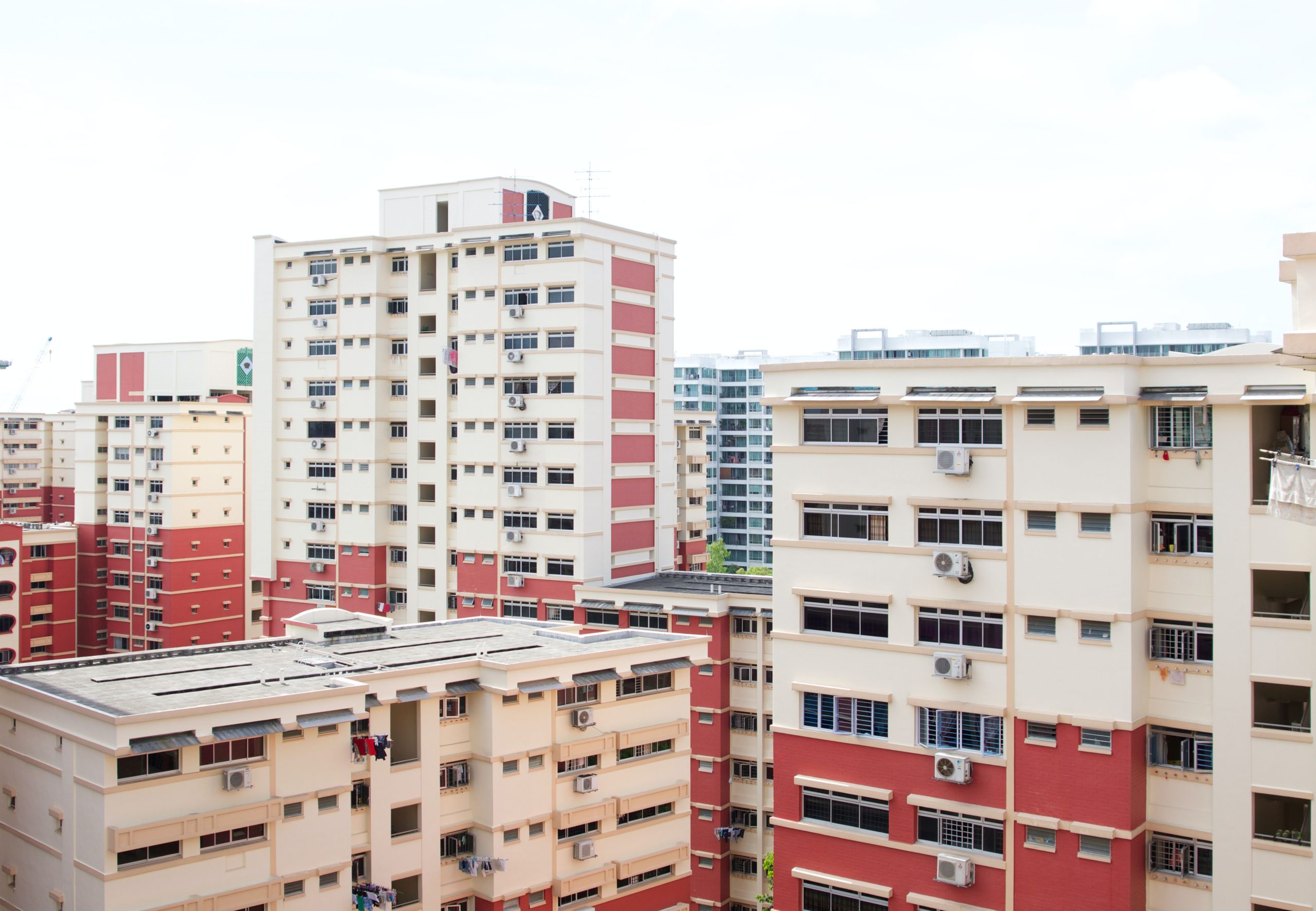
National Development Minister Lawrence Wong said last week that about 5,200 public rental households, or about 10 per cent of all such households, are in rent arrears (More social workers at family service centres, May 6).

He also said rent arrears alone would not result in termination of rental tenancies, which is a “last resort”.

Such assurances are welcome, particularly when it is ever more critical to have shelter against the coronavirus.

In the past few weeks, the research team at the Association of Women for Action and Research (Aware) has been interviewing low-income families about how the circuit breaker measures have affected their financial situation.

Many of these families live in public rental housing, and have experienced a loss in income because the jobs they were doing, such as house cleaning and waiting tables, have been negatively affected by safe distancing measures.

Some were anxious about how they would pay their bills, including rental fees, as well as for other daily necessities during this period.

The Housing Board should consider waiving rental fees for those living in public rental housing during the Covid-19 pandemic.

Before the pandemic, more than 5,000 households in Singapore were already struggling to pay rent.

As the economic fallout from the pandemic worsens, it is likely that more households will end up in the same situation.

While they are not under immediate threat of losing shelter, these households may be forced to compromise on other aspects of their lives, such as by cutting down on food expenses, in order to cope.

Being guaranteed a home allows people in crisis situations more choices for their well-being.

We hope that more support will be given to low-income households during this period to ensure that they have a roof over their heads.

Chong Ning Qian

Senior Executive, Research

Association of Women for Action and Research

AWARE launches chat service to better support survivors of abuse and violence

This post was originally published as a press release on 8 May 2020.

8 May 2020 – After receiving record-breaking numbers of calls since the outbreak of COVID-19, gender-equality organisation AWARE today launched a new online text chat service. This chat service is an extension of AWARE’s long-running Women’s Helpline and related services, and part of the organisation’s efforts to meet the ongoing surge in demand. 

As people are required to stay at home during Singapore’s circuit breaker, women in abusive relationships are more likely to experience violence at the hands of their spouses, partners and/or relatives, without the respite previously afforded by work, school or other daily activities. 

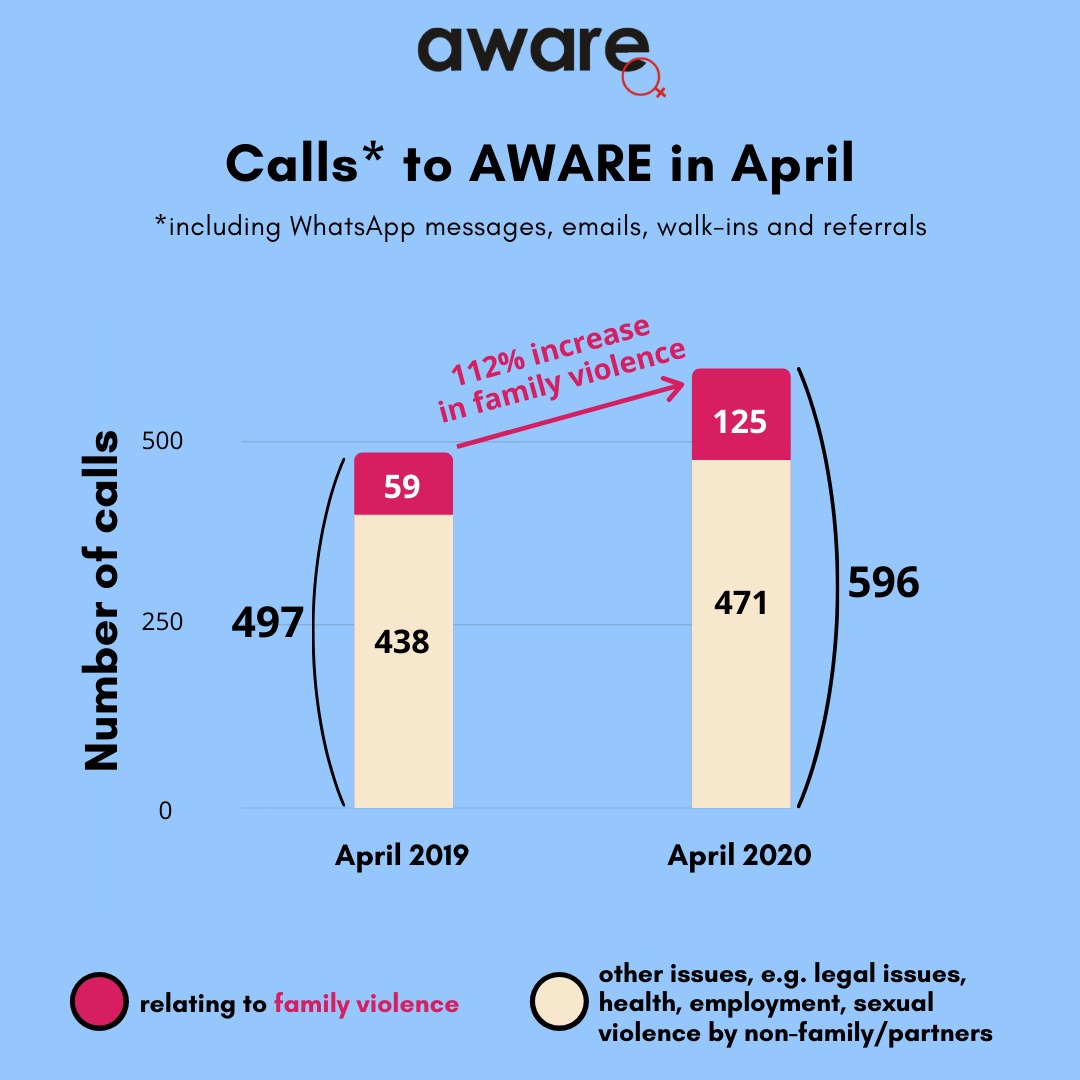
In March, AWARE’s Helpline received 619 calls* (including messages, emails, walk-ins and referrals), the most recorded in one month in the Helpline’s 29 year history. Meanwhile, April saw 596 calls and, with 43 calls on 14 April, the most calls ever received on a single day. Many callers have sought support for situations of family violence. In April, 125 calls pertained to family violence, a 112% increase over family violence calls received in April 2019 (59).

Women in distress can visit AWARE’s website (aware.org.sg/womens-care-centre/callback-chat) and schedule a 30-minute appointment to chat with a trained staff member or volunteer. Appointments can be made during Women’s Helpline hours (10am – 6pm, Mon – Fri, except public holidays). During the chat, AWARE representatives perform the same support functions as on the Helpline: They can provide emotional support and practical information, make referrals to AWARE counsellors and legal clinic, and advise on other helpful resources from crisis shelters to Family Service Centres, Protection Specialist Centres and Family Justice Court. 

With the chat, AWARE particularly hopes to reach survivors of abuse and violence whose circumstances prevent them from calling the Helpline at all. These individuals may not have sufficient privacy to make a phone call in the same space as their family members or housemates. Helpliners have already noted a number of callers hanging up mid-call when abusers enter the room.

“We recognise that being able to make a phone call is a freedom that many individuals are not afforded right now,” said Corinna Lim, AWARE Executive Director. “We hope therefore that our new chat can provide more focused and direct assistance to survivors of violence who do not feel safe speaking on a call.”

Other recent steps AWARE has taken to meet caller demand include growing staff strength and expanding its Women’s Helpline to three phone lines, up from two previously.

*This number has been updated. Please refer to this press release.

Annex

AWARE Helpline calls in April 2019 and 2020

Migrant Spouses Support Singaporean Families, But Struggle to Belong

This commentary was originally published in RICE Media on 6 May 2020.

It’s a common refrain these days that the coronavirus doesn’t discriminate. Yet social policies, even those meant to provide relief from the pandemic, do.

Even before the coronavirus outbreak, the migrant spouses of Singaporean citizens found themselves in a country that did not treat them on par with citizens. Then the pandemic arrived, and these inequalities were thrust into sharp relief.

Migrant spouses, who are mostly women, have featured prominently in the composition of our households for the past decade. One-third of all marriages in Singapore are between a Singaporean citizen and a migrant spouse. Experts estimate approximately 70% of these marriages are between a low-income Singaporean man and a migrant wife from Southeast Asia.

AWARE surveyed 36 low-income migrant spouses in April 2020, to assess how Covid-19 has affected them, what strategies they are using to cope with the effects, and what they think the future holds for them. Most of the individuals we spoke to are facing all the economic hardships and struggles of a low-income Singaporean household trying to survive the coronavirus pandemic, but with the added complication of being ineligible, due to their migrant status, for most of the government support announced recently.

This may not seem problematic to many—indeed, many states prioritise their resources first and foremost for citizens in need. It does, however, beg the question: How can we continue to expect migrant spouses to sustain the lives and relationships of families in Singapore, without including them in our social compact?

Who did we interview?

We recruited respondents mostly through partner organisations, such as Family Service Centres (FSCs). Among those we interviewed, four were men.

Singaporeans are required to sponsor applications for their spouses to one of these passes: Social Visit Pass, Long Term Visit Pass (LTVP), Long Term Visit Plus Pass (LTVP+), Employment Pass or Permanent Residency (PR).

Each pass comes with a set of associated privileges, such as the right to work and length of stay, with PR being the top pick. These different passes therefore create a gradation among migrant spouses. The criteria used to determine which migrant spouses are granted PR, rather than the more limited LTVP+ or LTVP, has been left opaque to avoid the risk of the system being taken advantage of.

All but one of the migrant spouses we interviewed were on either LTVP/LTVP+, which researchers say are typically granted to low-skilled and less educated migrant spouses. Sixty per cent of them stayed in HDB rental flats, and roughly the same number had up to two children. The household income of 80% of them was under $2,000.

The experiences captured through our interviews may not be generally applicable, but they do provide a peek into the uneven impact of the coronavirus pandemic on a vulnerable group.

Loss of jobs and unmet needs 

90% of our respondents have either lost their jobs entirely or have seen a drastic decrease in income since the onset of Covid-19. Like many low-wage workers, foreign spouses also worked in industries where jobs are contracted, such as retail, F&B, cleaning, etc.

Social distancing is a privilege that many migrant spouses can’t afford. Unlike those of us who can work from home and continue to receive a paycheck, 46% of the migrant spouses we spoke to were not drawing any income from work because their roles didn’t allow them to work from home. Technically they were still employed, but their households had to deal with the same level of economic shock as those who had lost jobs entirely. Other reasons they lost jobs and/or income include a lack of childcare, which would allow migrant spouses with young kids to work, and retrenchment, because the businesses they were working for were no longer economically viable.

These economic losses have meant that transnational families are forced to cut back on expenses on basic needs such as food. Hila*, a married migrant spouse with no children, is coping on instant noodles, with just one or two meals a day. Nurit*, a migrant spouse with two children (one Singaporean, the other a non-citizen) says she won’t be able to pay rent for her HDB rental despite continuing to work part-time. Covid-19 has decreased her income from work by $850 a month. Hila, on the other hand, had hers decreased by $300.

Of the respondents with children, three in four have at least one Singaporean child. Migrant parents—like many other parents—are having to explain to them that they cannot afford to pay for tuition, laptops for home-based learning, clothes and toys, and in one case, a birthday present. Job and income losses affect not only migrant spouses, but their citizen children too.

Support to retain employees excludes migrant spouses

Migrant spouses are well-aware that work is the key to meeting their basic needs. Most who have lost jobs because of Covid-19 are looking for new ones, although only one in this group is confident of being successful in this search. Others are less self-assured because they believe that either the future economy doesn’t hold enough jobs, or employers are likely to only be hiring locals.

Wage support for employers to retain and continue to pay employees only extends to local employees, i.e. Singaporeans and PR. In the absence of similar incentives aimed at migrant spouses, struggling employers may not be able to keep those on LTVP/LTVP+ or employment passes.

Wazirah*, a divorced migrant spouse on an employment pass, lost her job because of Covid-19, and with it the right to remain in Singapore. Unless she can find a new job quickly—which is unlikely, given the way employer support is structured—or a local sponsor (as she’s estranged from her ex-husband’s family), Wazirah will have to leave the country in a couple of weeks. She is working with her social worker to see if her 8-year-old daughter, for whom she is the primary caregiver, can be allowed to sponsor her LTVP application.

Government support should remember this group

Even if migrant spouses were to successfully find jobs in the not-so-distant future, they are still likely to require financial assistance in the short to medium term, so that they can pay rent and meet other basic needs.

The government has dug deep into its financial pockets to provide an unprecedented amount of financial assistance to those affected by the coronavirus pandemic. Unfortunately, this provides little solace to migrant spouses on LTVP/LTVP+, who are not eligible for most of the schemes announced. They can avail of a one-off solidarity payment of $300, but even that is available only to those on LTVP+, not LTVP.

The government does provide relief to those who do not fulfil the criteria on a case by case basis. Yet this leaves many migrant spouses in a state of limbo, not knowing whether or not they will have enough to make ends meet. Appeals may also take longer during this period, given that the number of people the government is providing support to has increased dramatically.

The government should consider relaxing the citizenship criteria for Covid-19-related financial assistance and make it available for all migrant spouses with a Singaporean in their household, without the need for an appeal. In the long-term, every migrant spouse should be granted an LTVP, with the automatic right to work, and a clearly defined path to PR and citizenship.

These will ensure that the labour and care we expect migrant spouses to perform in Singapore is acknowledged, and they are made to feel like they belong.


Shailey Hingorani

Head of Advocacy and Research at AWARE Singapore.

A Recap: Sharul Channa’s Am I Old? (Virtual Edition)

Written by Tanya Ragupathi.

“Can you see me or not?” Savitri “Savi” Channa asked. The 68-year-old hobbled into view, adjusting the angle of her laptop’s camera.

Of course, “Savi” was actually being played by the sprightly 33-year-old actress and comedian Sharul Channa. The character—a Singaporean retired teacher—had been carefully constructed by Sharul, based on AWARE’s 2019 research on female family caregivers.

Sharul moulded her portrayal of Savi into a 45-minute long comedic monologue titled Am I Old?, which played at the Drama Centre Black Box in March. With Singapore’s circuit breaker making live theatre impossible, however, AWARE and Sharul decided to put on three virtual sessions of Am I Old? in April. Conducted over the video platform Zoom, the sold-out shows were watched by more than 300 people in all. I attended the performance on Friday, 24 April.

Am I Old? sheds light on the experiences of family caregivers in Singapore, and the sometimes painful, sometimes poignant reality one faces when ageing. Sharul employs comedy to make these weighty issues all the more relatable. (This is not her first time working with AWARE—her 2019 piece, Crazy Poor Sita, which earned her a Best Actress nomination at The Straits Times LIFE! Theatre Awards, highlighted the plight of women living below the poverty line in Singapore.)

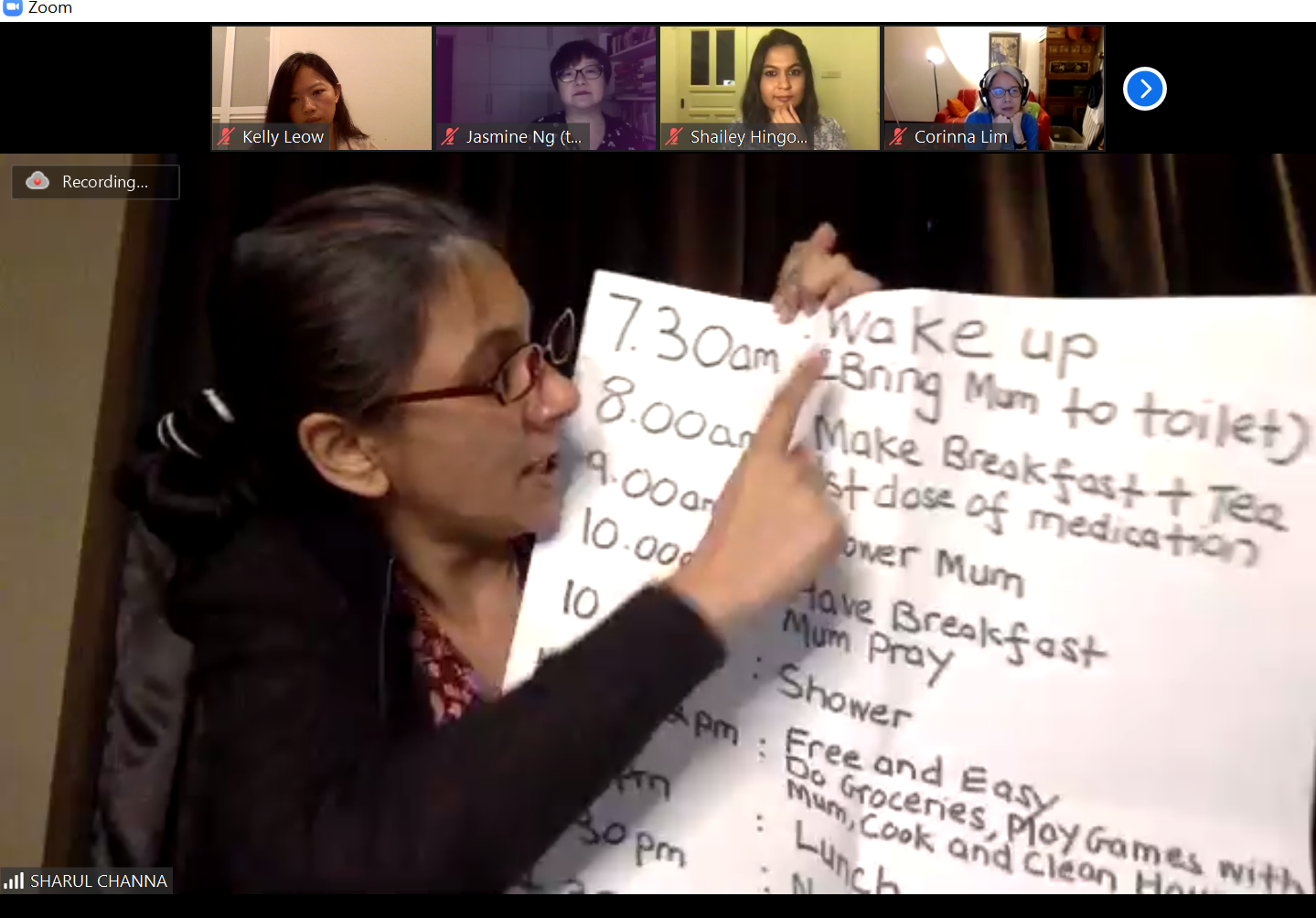
Savi (Sharul Channa) takes the audience through her daily caregiving routine

After she had been assured, by moderator Shailey Hingorani from AWARE, that the audience could indeed see her, Savi kicked off her show last Friday night by asking the audience to share their ages by typing into the Chat function in Zoom. As the answers came flooding into the chat, Savi seemed to reflect on the different stages of her own life.

Savi then recounted her journey into caregiving, from her father’s untimely death to her mother’s stroke. As her parents’ only unmarried daughter, Savi was thrust into the role of caregiver for her mother. On the other hand, her miserly brother belittled her efforts and grilled her about everything. (How she could possibly be pressed for cash and time with a domestic worker to help out?) Recalling her frustration at his lack of empathy, Savi exasperatedly asks the audience, “You think it’s very easy to be a caregiver, is it?”

Pulling out a handwritten timetable, Savi walked the audience through her daily routine, where every moment revolved around her mother’s needs. Despite the undoubtedly gruelling schedule, she said, she grew closer to her mother over the 10 years spent caring for her: “I understood her as a woman and she understood my pain.”

In a particularly emotional scene, Savi recounts a moment when her mother insisted that she make tea for her (long-dead) father as well. Sharul looked at the audience and asked, “Have you ever made tea for a dead person?” Savi’s mother passed on soon after.

Savi ended off by chuckling ironically about how her mother left her with a hereditary gift: a wheelchair.

Sharul (as herself) during the post-show panel discussion on caregiving and aging

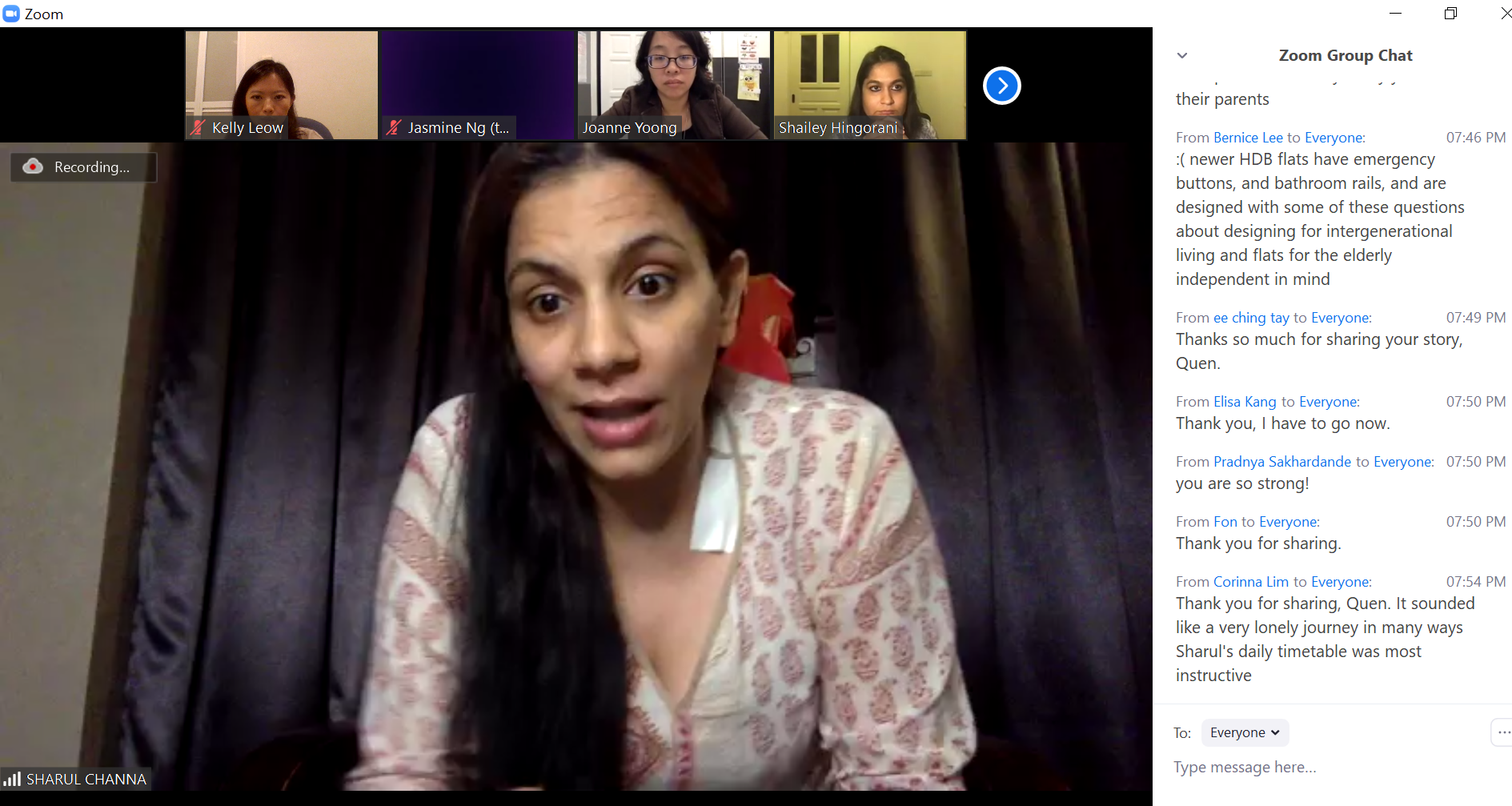
As the audience gave Sharul a rousing round of applause, the second half of Am I Old?, a post-show panel discussion, began. Panellists Dr Joanne Yoong, an applied economist, and Quen Wong, a freelance filmmaker and former family caregiver, joined Sharul and Shailey to discuss the practical and psychological impact of caregiving, and the support systems in place (or not) to help Singapore’s caregivers.

Joanne pointed out that while Singapore does provide “a lot of support on paper”, caregivers on the ground lack the know-how to navigate the existing schemes.

Quen echoed this, drawing from her own experience. Your first priority as a caregiver is the person you’re caring for, she noted, and you often have “little bandwidth left” to figure out the often confusing resources for which you might be eligible.

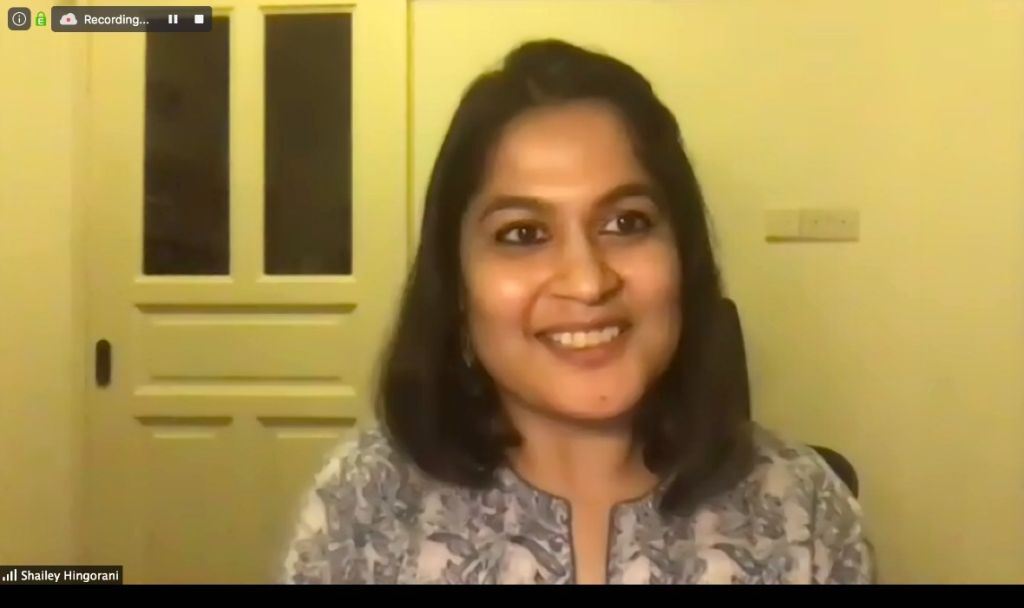
AWARE Head of Research and Advocacy Shailey Hingorani moderated the panel after Am I Old?

With a flurry of audience questions coming in over the chat, the panel discussion touched on the state’s responsibility to help caregivers (e.g. with stronger financial support) and how individuals can prepare themselves for the emotional and physical toll of caregiving.

To the latter question, Sharul highlighted the importance of having “difficult but necessary conversations” about retirement and ageing early on with loved ones. She urged people to “have conversations at the community-level”.

Comedies like Am I Old? are certainly one way to make such grim issues more accessible.

AWARE and Sharul Channa are putting on three more virtual performances of Am I Old? on 9, 10 and 15 May. Get tickets here.

9, 10 and 15 May 2020: Sharul Channa’s Am I Old? (Mother’s Day Special Virtual Edition)

Savitri, a 68-year-old, Singaporean retired school teacher, is looking for something exciting to do. So she tries stand-up comedy for the first time. Armed with nothing but her PAssion Card and her Pioneer Generation Package, Savitri is ready to hit you with her best punch lines about unrequited love, being a caregiver and, of course, coming to terms with age. After all, her rallying cry is “old woman, new jokes”!

Am I Old? is a comedic monologue written and performed by local comedy pioneer Sharul Channa. The innovative new show has earned rave reviews from audiences in both live and Zoom formats! Now, join us for a special Mother’s Day edition in May.

Choose one of three performance times:

Saturday, 9 May 2020, 8 – 9.30PM

Sunday, 10 May 2020, 3 – 4.30PM

Friday, 15 May 2020, 8 – 9.30PM

To make the show as accessible as possible to audiences during COVID-19, this special virtual edition of Am I Old? is pay what you can, with donations going to AWARE. (We suggest a $10 donation per audience member.)

Each performance will be followed by a panel discussion with a family caregiver, an elderly person and a representative from AWARE (whose 2019 eldercare report “Make Care Count” provided foundational research for this show).

How to watch:

1. Before your selected show, you will receive an email from AWARE/Eventbrite with instructions on how to register on Zoom. Do check your email on the day before the show, to ensure that you have received this link.

2. Once you register, you will be led to a Zoom link to join the meeting. (Alternatively, you will also receive an email titled “Am I Old? Confirmation” from Shailey Hingorani with this same link.) Click this link to enter the performance.

About Sharul Channa:

Over the past two years, Sharul Channa has proven her ability to use comedy to shed light on important, and sometimes neglected, social issues in Singapore. In 2017, she deconstructed misogyny at Indian weddings with Sharul Weds Sharul, performed to sold-out theatres at The Esplanade and at The Darwin Festival in Australia. In 2018, she cycled through multiple characters in Disco Sheela and Other Indian Superwomen, a show that left “listeners breathless with laughter, and in the next moment, unable to breathe because the truth hurts” (The Straits Times, LIFE!).

Most recently, in a performance that earned her a Best Actress nomination at The Straits Times LIFE! Theatre Awards, Channa highlighted the plight of women living below the poverty line in Singapore, in her landmark solo 2019 piece, Crazy Poor Sita.

Get tickets now!