Author: Media Intern

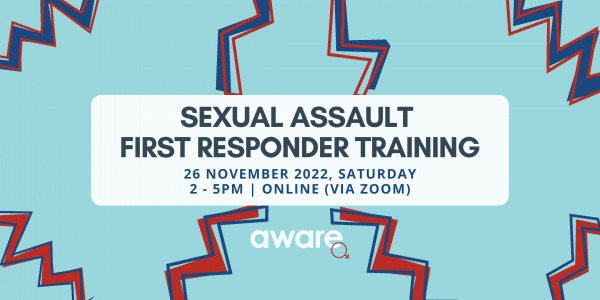
26 November 2022: Sexual Assault First Responder Training (Online Session)

“Are you sure that happened? Why didn’t you fight back? You should have known better.” These are some common responses survivors of sexual assault have heard, which may further their feelings of doubt, guilt and shame.

It is not always easy for survivors to tell someone about what happened; in fact, for some survivors, it can be especially daunting. So the way their loved ones respond becomes pivotal in their journey of recovery. First response that is sensitive to a survivor’s needs and choices is necessary in preventing re-victimisation.

This Sexual Assault First Responder Training helps familiarise participants with trauma reactions and symptoms to better contribute to a survivor’s well-being. In this workshop, we will share more on the following:

  • Definition of sexual assault and harassment
  • Recognising Singapore’s legal framework
  • Understanding consent
  • Understanding the impact of sexual assault and trauma on survivors
  • Role of a first responder
  • Providing support to survivors of sexual assault
  • Resources available for help
  • Key skills such as ensuring safety, active listening and empathy

We want this workshop to be accessible to everyone, and require your generous contribution to keep it running. While you are welcome to give any amount you wish, we suggest a minimum of $30 per person. No tax deduction will be provided. Note that Eventbrite requires a minimum contribution of $1. If you require a waiver of this minimum contribution, please email gec@aware.org.sg.

Note as well that we are unable to accommodate transfers and cancellations if participants are unable to attend after payment has been made.

Persons of all genders and nationalities are more than welcome to attend.

We strongly request that all participants commit to the full duration of the 3-hour workshop (there are breaks!) to ensure that everyone will get the opportunity to engage in interactive discussions and learn useful skills.

Date: Sunday, 26 November 2022

Time: 2PM – 5PM

Venue: Online (Via Zoom). Please note this workshop will be online only (Singapore time). Participants will be emailed the Zoom link shortly before the session date. As a commitment to this training we will be asking all participants to turn on their video throughout the session.

Entry Fee: This event is contribute-what-you-can. Suggested contribution of $30 per person.

Register here!

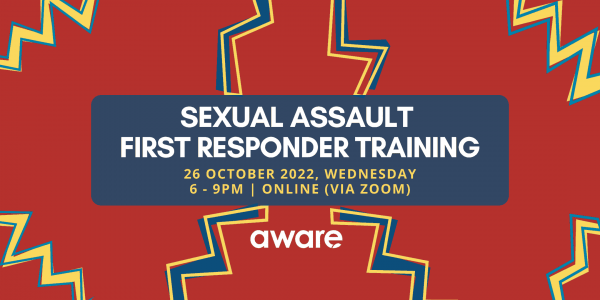
26 October 2022: Sexual Assault First Responder Training (Online Session)

“Are you sure that happened? Why didn’t you fight back? You should have known better.” These are some common responses survivors of sexual assault have heard, which may further their feelings of doubt, guilt and shame.

It is not always easy for survivors to tell someone about what happened; in fact, for some survivors, it can be especially daunting. So the way their loved ones respond becomes pivotal in their journey of recovery. First response that is sensitive to a survivor’s needs and choices is necessary in preventing re-victimisation.

This Sexual Assault First Responder Training helps familiarise participants with trauma reactions and symptoms to better contribute to a survivor’s well-being. In this workshop, we will share more on the following:

  • Definition of sexual assault and harassment
  • Recognising Singapore’s legal framework
  • Understanding consent
  • Understanding the impact of sexual assault and trauma on survivors
  • Role of a first responder
  • Providing support to survivors of sexual assault
  • Resources available for help
  • Key skills such as ensuring safety, active listening and empathy

We want this workshop to be accessible to everyone, and require your generous contribution to keep it running. While you are welcome to give any amount you wish, we suggest a minimum of $30 per person. No tax deduction will be provided. Note that Eventbrite requires a minimum contribution of $1. If you require a waiver of this minimum contribution, please email gec@aware.org.sg.

Note as well that we are unable to accommodate transfers and cancellations if participants are unable to attend after payment has been made.

Persons of all genders and nationalities are more than welcome to attend.

We strongly request that all participants commit to the full duration of the 3-hour workshop (there are breaks!) to ensure that everyone will get the opportunity to engage in interactive discussions and learn useful skills.

Date: Sunday, 26 October 2022

Time: 6PM – 9PM

Venue: Online (Via Zoom). Please note this workshop will be online only (Singapore time). Participants will be emailed the Zoom link shortly before the session date. As a commitment to this training we will be asking all participants to turn on their video throughout the session.

Entry Fee: This event is contribute-what-you-can. Suggested contribution of $30 per person.

Register here!


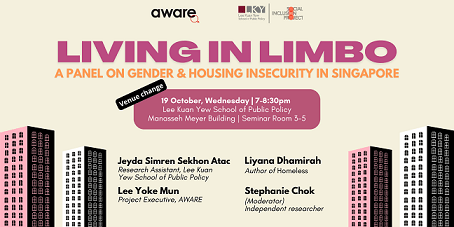
19 October 2022: Living in Limbo – Gender and housing insecurity in Singapore

IMPORTANT: The venue has changed to Lee Kuan Yew School of Public Policy, Manasseh Meyer Building, Seminar Room 3-5. Kindly also note that Project Executive Lee Yoke Mun will replace Corinna Lim in representing AWARE.

Housing is a basic need. So why is it that in Singapore—a nation widely recognised for its comprehensive public housing programme—many people still encounter housing barriers? Women, in particular, face greater challenges, whether accessing housing as single mothers or encountering difficulties when rough sleeping.

To commemorate the United Nations International Day for the Eradication of Poverty, this panel event will draw upon a growing body of local research about the gendered realities of housing insecurity in Singapore. This includes AWARE’s recently concluded evaluation of the Support, Housing and Enablement (S.H.E.) Project, a research-based service that provided stable and decent housing, alongside transformational support programmes, for 18 low-income single-mother families; AWARE’s earlier work on single mothers’ access to public housing; the nationwide street counts of homelessness done by the Social Inclusion Project (SIP, at the Lee Kuan Yew School of Public Policy); and the Minimum Income Standard studies on the costs of a basic standard of living in Singapore.

Our panel of speakers brings together the voices of advocacy and research as well as women who have experienced housing insecurity firsthand. They will discuss the difficulties single mothers face in securing stable housing; the unique challenges of homelessness for women; the implications of recent debates about living costs and the definition of family; and the policy changes that still need to happen. What might adequate housing for everyone—including those with the fewest means—look like? Join us as we attempt to find an answer.

Date: Wednesday, 19 October 2022

Time: 7pm – 8.30pm

Venue: Lee Kuan Yew School of Public Policy, Manasseh Meyer Building, Seminar Room 3-5 [changed from Seminar Room 2-1]

Fee: This event is contribute-what-you-can. Suggested contribution of $5 per head.

Register here!

Our panellists

Stephanie Chok (moderator)

Dr Stephanie Chok is an independent researcher who received her PhD from Murdoch University, Western Australia. Her PhD focused on the precariousness of low-paid temporary migrant workers in Singapore, and the thesis was runner-up in the 2015 Asian Studies Association of Australia President’s Prize for Best Thesis on Asia. For the last 10 years, she has volunteered and worked in non-governmental organisations and been involved in multiple research and advocacy projects, including authoring research reports on wage theft, forced labour, income inequality and food insecurity.

Jeyda Simren Sekhon Atac

Jeyda Simren Sekhon Atac is a Research Assistant in the Social Inclusion Project at the Lee Kuan Yew School of Public Policy. As part of her research focus, she co-authored the recent research report entitled “Seeking Shelter: Homeless during the COVID-19 Pandemic”. She completed her Masters in Comparative and International Education at the University of Oxford, where she was a Leading for Impact Fellow, after receiving her Bachelor of Arts in Politics and Sociology at the University of Cambridge. She also volunteers widely, both in Singapore and remotely, with initiatives working to create social impact internationally.

Liyana Dhamirah

Having gone through a period of homelessness, Liyana has emerged stronger through her struggles and even wrote the award-winning book Homeless: The Untold Story of a Mother’s Struggle in Crazy Rich Singapore. She is also a contributing writer for White: Behind Mental Health Stigma and the recipient of the “Woman of Resilience” award from AWARE in 2019. Liyana was invited to deliver her maiden speech on the TEDx Singapore stage. Work and life as a mother of four keeps her busy, but in between it all, Liyana actively advocates for lower-income and under-privileged families.

Lee Yoke Mun

Lee Yoke Mun is a Project Executive at AWARE. Her work at the women’s rights NGO focuses on advocating for low-income women and comprehensive sexuality education. She also coordinates some of AWARE’s community programmes, including its community Sexual Assault First Responder Trainings and Birds & Bees workshops for parents.

2 October 2022: What We Inherit x City Book Room

What does it mean to be an Indian woman in Singapore? Join us for a panel on navigating Indian identity and gender.

“What is an Indian person supposed to look like?”

For Indian women in Singapore, questions that cast doubt on their identities are all too common. Expressions of identity that go against stereotype are often met with confusion and uncertainty – for example, when the race on their IC isn’t “Indian”, or when they study Chinese in school instead of Tamil.

These complications of Indian womanhood, among others, are explored at length in What We Inherit: Growing Up Indian, AWARE’s anthology of personal essays and poems by Indian women. Since the book’s launch in July, these stories have inspired stimulating discussions on gender and race in Singapore. We want to keep the conversation going!

Join us at City Book Room on 2 October, 3pm, for a free panel discussion and Q&A with three authors from What We Inherit: ila, Saraniyah D/O Saravanan and Jeyda Simren Sekhon Ataç. They’ll unpack their personal essays about Indian womanhood. Look forward to revelations about identities that fall outside of CMIO markers, feelings of displacement and writing as catharsis.

We’ll have copies for sale of both What We Inherit and Growing Up Perempuan, AWARE’s previous collection of Malay and Muslim women’s stories, at the venue. Also for sale: the zine (Re)collections: Postcards from Afar (proceeds go towards AWARE’s Helpline fundraising campaign).

This is an in-person event. Because the space is small, we only have a limited number of places available, so be sure to sign up quickly!

Date: Sunday, 2 October 2022
Time: 3PM – 5PM
Venue: City Book Room – 387 Joo Chiat Road #03-02 Singapore, 427623
Entry Fee: Free

Register here!

1 in 2 experienced workplace discrimination in Singapore over the past five years, with race, age and gender discrimination most common

This post was originally published as a press release on 20 September 2022.

Around 1 in 2 workers in Singapore experienced workplace discrimination in the past five years, reveals a new survey by gender equality group AWARE in partnership with consumer research company Milieu Insight.

Singapore’s first comprehensive survey on workplace discrimination, it was conducted in August 2022, a year after Prime Minister Lee Hsien Loong announced that the nation would enact anti-discrimination legislation.

The survey polled 1,000 respondents—nationally representative by age, gender and race—on their experiences of (i) direct discrimination, (ii) indirect discrimination and (iii) discrimination-related harassment in the previous five years. To capture the first, respondents were asked if they had ever been treated less favourably than others at work because of their age, race, religion, gender, gender identity, sexual orientation, marital status, family responsibilities, disability or other characteristics. To capture the second, respondents were asked if any company policy or organisational practice had put them and others like them at a particular disadvantage compared with those who did not share the same characteristics. Finally, respondents were asked if they had experienced conduct that made them feel disrespected or that made their work environments intimidating, hostile, degrading, humiliating or offensive, based on aforementioned characteristics.

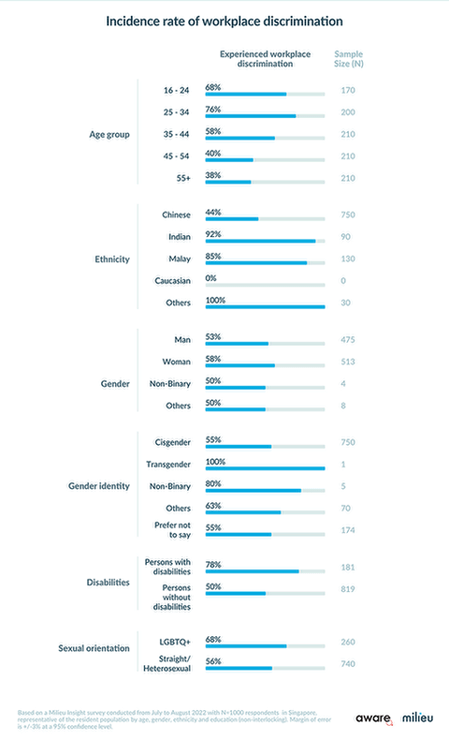
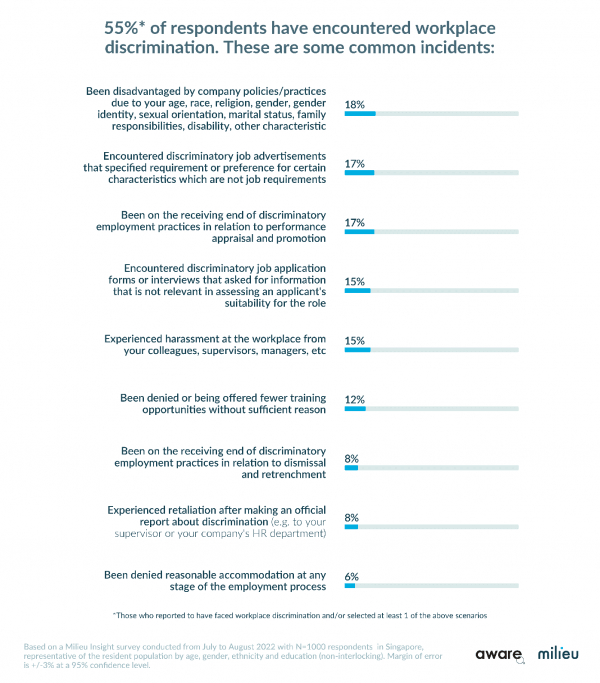
In total, 55% of respondents had experienced at least one form of discrimination. Certain groups proved more vulnerable to discrimination at work than others: Persons with disabilities experienced discrimination at a significantly higher rate (78%) than persons without disabilities (50%), as did LGBTQ persons (68%) compared to those who did not identify as LGBTQ (56%), and those of minority race (89%) compared to those of majority race (44%). Compared to 53% of men, 58% of women had experienced at least one type of discrimination. Overall, the three most common experiences of discrimination were:

  • Unfair company policies or practices, e.g. inaccessible office spaces, or prohibitions against flexible schedules that made it difficult for workers to manage family responsibilities (18% of all respondents experienced this)
  • Job advertisements that mandated or specified preference for certain characteristics that were not job requirements (17% of all respondents experienced this)
  • Discriminatory employment practices in relation to performance appraisal and promotion, e.g. receiving a poorer performance appraisal after disclosing pregnancy, disability or health conditions (17% of all respondents experienced this)

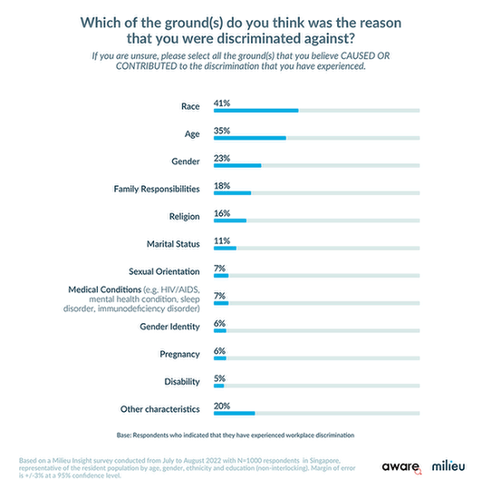
When asked the grounds upon which they faced discrimination, respondents chose race (41% of those who experienced discrimination), age (35%) and gender (23%) as the top three. Others included: family responsibilities (18%), religion (16%), marital status (11%), medical conditions (7%), sexual orientation (7%), gender identity (6%), pregnancy (6%) and disability (5%). (Respondents could select more than one.)

“Our goal with this survey was for the results to contribute to the drafting of Singapore’s upcoming anti-discrimination legislation—the government’s best opportunity to make far-reaching change in this arena,” said Corinna Lim, executive director of AWARE. “The findings highlight particular ‘pain points’ that deserve attention, such as indirect discrimination, which is frequently left out of conversations and policy decisions. Accordingly, we hope the legislation can employ an expansive definition of discrimination, one that captures the full range of experiences workers face at all points of the employment cycle.”

She noted that AWARE’s Workplace Harassment and Discrimination Advisory (WHDA) has seen a rise in discrimination cases since its inception in 2019. WHDA saw 59 discrimination cases in the first two quarters of 2022, up from 44 in the same period of 2021, and 26 in 2020.

“Furthermore, these results add to the body of evidence that people with marginalised identities are particularly vulnerable,” said Ms Lim, “which is useful, in light of recent national discourse about who requires protection. Anti-discrimination legislation must also include a comprehensive range of protected characteristics, including sexual orientation, gender identity and disability.”

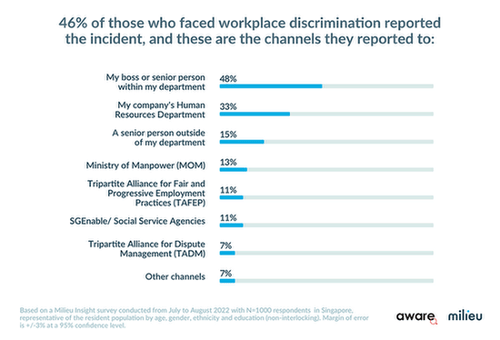
When it came to seeking recourse, 1 in 2 respondents (54%) who had experienced workplace discrimination did not report it to any channels (e.g. Human Resources, a boss or senior, Ministry of Manpower and so on). Those who did not report cited these top reasons: not believing that the discrimination was “severe” enough (36%); not trusting authorities to act on the report (30%) and not having enough evidence of discrimination (29%).

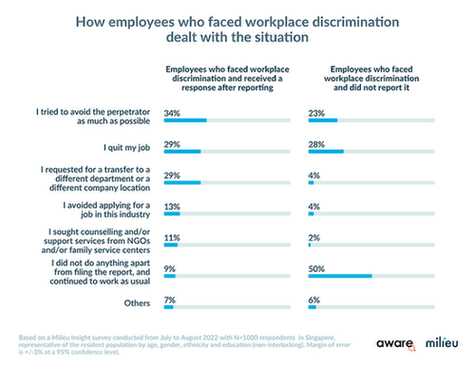
An almost identical proportion of those who reported discrimination (29%) and those who did not report (28%) ended up quitting their jobs. Other actions taken by those who reported included avoiding their perpetrator as much as possible (34%); requesting transfer to another department or location (29%) and refraining from applying for jobs in that industry (13%). Of those who did not report, besides quitting, 23% avoided their perpetrator while 4% requested transfer and another 4% refrained from applying to jobs in that industry.

“The adverse career impacts on even those who did report discrimination are a grim indictment of organisations’ ability to deal with this issue,” said Ms Lim. “It’s clear that companies cannot be relied upon to tackle discrimination on their own without further incentive and guidance. With the government’s leadership, we look forward to a new era of fairer workplaces in Singapore.”

Milieu Insight’s Chief Operating Officer, Stephen Tracy, said, “We conducted this study with AWARE as part of our Milieu for Good program, which seeks to support non-profits through research that helps build greater awareness and understanding of key social issues. The findings of this study highlight just how complex, and sometimes even invisible, issues of discrimination at the workplace can be. I hope managers and senior business leaders will take these results seriously and ensure they’re working to cultivate positive, open and equitable workplace environments.’’

Annex A: Full results for topline findings
Annex B: Case studies from AWARE’s Workplace Harassment and Discrimination Advisory (names have been changed)

Case A

After Elise* had returned from maternity leave, her supervisor yelled at her and disparaged her at a meeting, criticising her “attitude” when she was pregnant and implying that her taking maternity leave showed a lack of concern for her work. Her supervisor subsequently continued to verbally harass her on multiple occasions and explicitly stated that he had no remorse about doing so. Elise found that she was being left out of meetings. Eventually, she felt she had no choice but to resign from the company.

Case B

Maya* was the only employee of her ethnicity at her company. Her supervisor made derogatory comments about her accent, and she found that she was not given any work to do. After just three weeks, Maya’s employment was terminated. No reason was provided to her and there had been no issues with her performance. On her way out, she was told to “not touch any of our things”.

Case C

Pooja* was given a poor performance appraisal just before she reached the eligible age for re-employment. She had displayed stellar performance during her time at the company prior to this. There was no feedback or discussion regarding her performance. Shortly after, she was terminated.

23 August 2022: Feminism for All Workshop

What does it mean to call yourself a feminist? What are feminist ideologies and how can we apply them to our daily lives? What are the most expedient ways to fight for gender equality?

These questions might not always have neatly defined answers. After all, the ideas and the discourse around feminism can be complicated – especially when theory comes up against the complexities of reality.

Feminism For All is a workshop for anyone who wants a dedicated occasion to discuss, unpack and gain a better understanding of feminism. Whether you are curious to learn more about gender equality in the Singaporean context, or want to advance along your own feminist learning journey, this interactive workshop will provide an overview of the foundational principles behind the movement, outline how they inform AWARE’s work, and empower you to apply various feminist values to your daily life.

This hands-on, in-person masterclass led by AWARE staff and members will have interactive segments, including small discussion groups and presentations.

Date: Tuesday, 23 August 2022
Time: 7PM – 10PM
Venue: AWARE Centre (5 Dover Crescent, #01-22, S130005)
Entry Fee: $16.77 (with GST)

Workshop outline:

  • Introduction to key terms
  • Brief history of feminism
  • Overview of core feminist concepts
  • Feminism in Singapore
  • AWARE’s work
  • Q&A

Register here!

Grant low-income families greater access to non-subsidised pre-schools, early childhood education

This letter was originally published in The Straits Times on 29 July 2022.

We agree with Ms Lam Yin Yin that pre-school should be made mandatory and provided free for those who are unable to afford it (Consider mandatory pre-school, and make it free for vulnerable children, July 25).

The Association of Women for Action and Research (Aware) has spoken to many low-income mothers who report few vacancies and long waiting lists at the subsidised childcare centres located close to them. At the same time, private childcare centres are inaccessible to them due to the high fees.

This conundrum can prevent mothers from taking up full-time paid employment. In 2021, women formed 62.4 per cent of those outside the labour force, with 38.2 per cent citing housework or caregiving as the main reason for not working. This was in stark contrast to men outside the labour force, of whom only 3.7 per cent cited the same reasons for not working.

At least two low-income single mothers from Aware’s Support, Housing and Enablement (S.H.E.) Project experienced this problem. When they applied for their children to attend childcare centres near them, they were placed on year-long waiting lists. Without anyone else to care for their children, they had no choice but to delay seeking employment.

Making high-quality pre-school accessible would be crucial in increasing mothers’ labour force participation, as they would not have to worry about their children’s safety and well-being when at work.

Additionally, studies have shown that high-quality early childhood education can benefit children in their skill acquisition, improve quality of maternal care, and protect against the development of behavioural problems in children from disadvantaged backgrounds.

We are glad that the KidStart programme provides low-income families with support for child development, such as organising playgroup sessions and helping with pre-school enrolment, in selected neighbourhoods. We hope that the programme can be expanded to be available nationwide so that more families can access it.

We also echo Ms Lam’s call to make pre-school free for lower-income households. Access to high-quality childcare services should be a right of every child.

Meanwhile, to address the current shortage of childcare vacancies, we recommend allowing lower-income families to access non-subsidised childcare centres (including private childcare centres) for free until 2023, when an additional 10,000 new full-day pre-school places will be developed. This scheme could be limited to those who have tried but failed to enrol in subsidised childcare, and therefore would be forced to enrol their children into more expensive centres.

Lee Yoke Mun
Project Executive
AWARE

Questions remain about new Adoption of Children Act

This letter was originally published in The Straits Times on 28 July 2022.

Under the Adoption of Children Act 2022, which was passed in Parliament on May 9, couples seeking to adopt must be married under laws recognised by Singapore.

Later, the Ministry of Social and Family Development (MSF) clarified that single, divorced or widowed persons can apply to adopt alongside married couples, but that their applications would be assessed “on a case-by-case basis”.

The ministry reiterated that the Government “does not encourage planned and deliberate single parenthood as a lifestyle choice”.

The Association of Women for Action and Research has worked extensively with single parents over the years, conducting research into their challenges and providing services. Having observed these parents and their capacity to overcome obstacles, we cannot agree with the Government’s blanket disavowal of single parenthood, or the implication that being legally married somehow makes people better parents.

Here are some other questions we have about the new Act.

First, does the approach outlined by MSF truly put the welfare of children first?

Singapore acceded to the United Nations Convention on the Rights of the Child (UNCRC) in 1995. Article 21 of UNCRC states that parties must “ensure that the best interests of the child shall be the paramount consideration” in matters relating to adoption. Does the desire to prioritise parenthood within marriage inadvertently counter that principle, by denying or delaying some children’s access to viable homes?

Second, do the new restrictions constitute a policy change, a codification of existing practice or simply a clarification of policy that was in place under the old Act?

Third, given the additional discretion that single adoption applicants will face, can MSF shed more light on how its case-by-case decisions and suitability assessments will be made?

Though we understand the need for robust criteria for prospective adopters, we have also heard accounts of single mothers whose adoption processes took notably longer, and felt far more onerous, than those of their married counterparts.

It seems only right that these criteria be made publicly available, so that prospective parents can make informed decisions about family planning.

Shailey Hingorani

Head of Research and Advocacy

AWARE

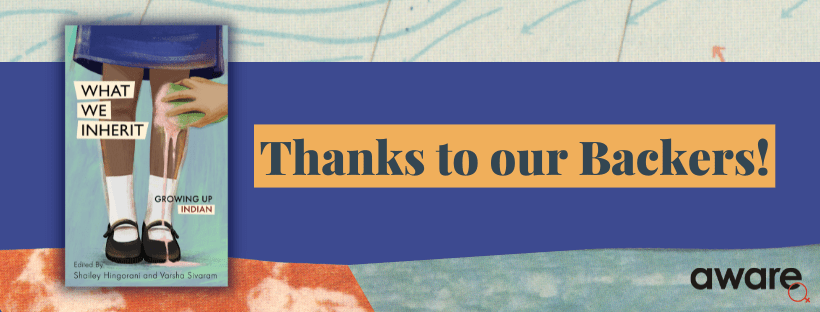
Thank you to our Growing Up Indian Kickstarter backers!

In November and December 2021, a total of 255 backers pledged $21,190 to our Kickstarter campaign for Growing Up Indian—under which initiative we have published our new anthology book, What We Inherit.

We are immensely grateful to all 255 backers for making this book a reality, but especially the Tier 3 and 4 backers, who pledged $100 and $200 respectively.

Tier 4

Alan John
Arjun Vadrevu
Caesar Sengupta
Chia Juat Ngoh
Chirag Agarwal
Corinna Lim
Cui
Eliza Quek
Eunice Tan
haresh.aswani
Jayne Nadarajoo
Joshua Wong
Khoo Hoon Eng
Lee Tse Liang
Lemony Snicket
Liz
Margaret Thomas
Nabilah Said
Navneet Hingorani
Ng Kok Hoe
Patrick Daniel
Paul Ng
Pranav Sethaputra
Prashant Somosundram
Razy Shah
Richa Hingorani
Sandeep Singh
Shyn Yee
Sonia Pereira
Sugidha Nithiananthan
Tharani
Thilarajah
Vaani
Wynthia Goh

Tier 3

Adrienne Michetti
Alli Arumugam
Cindy Ng
Conor McCoole
Hajar Ismail
Hui Min Teo
Jeremiah Pereira
Kelvin Ang
KY Low
M Tay
Mandakini Arora
Maria Velez
Pavani Nagarajah
Ranveer
Reuben George
Rosemarie Somaiah
Shamla Jeyarajah
Tarin Mithel
Thushara Pillai
Vernie Oliveiro
Xuan


We also want to say an extra-special thanks to the following supporters, who donated significant sums towards Growing Up Indian.

Special thanks to

Ajay and Paramita Bhattacharya
Christopher Chen and Vidula Verma
Fiona Kanagasingam
Shareen Khattar and Sat Pal Khattar
Coonoor Kripalani-Thadani
Arun Mahizhnan
Smitha Menon
Sunita Venkataraman
Sanjeev Namath
Nicholas Narayanan
Sriram Narayanan
Radhecka Roy
Harpreet Singh Nehal
Shivani Retnam and Jaikanth Shankar
Eugene Thuraisingam