Author: Media Intern

Glad that gig workers may be covered by Workplace Injury Compensation Act

This letter was originally published in The Straits Times on 9 July 2022.

The Association of Women for Action and Research is pleased to hear that the advisory committee on platform workers is adopting the principle that a delivery gig worker is not dissimilar from a worker who does delivery work as an employee, if they provide the same services to people (Work Injury Compensation Act may be applied to ’employee-like’ gig workers: Koh Poh Koon, July 5).

In Singapore, paid working relationships are divided into two broad categories: contract of service (an employer-employee relationship) and contract for service (a client-contractor relationship). Workers under contracts for service are not covered by employment-related legislation such as the Employment Act and the Workplace Injury Compensation Act (Wica).

While the Ministry of Manpower’s website lists a few factors for consideration (including who pays for employees’ wages, who provides work equipment and whose account the business is carried out on), there is currently no conclusive test to distinguish these two categories.

This is an issue for platform workers. As Senior Minister of State for Manpower Koh Poh Koon pointed out, these workers are currently categorised under contracts for service, but the nature of their work is closer to that of employees. They lack the professional autonomy of self-employed persons, and their contract terms and wage levels are subject to management controls exerted by the platforms and their algorithms.

Yet these platforms are not obliged to grant them statutory employment benefits and protections.

Many platform workers belong to low-income households. The absence of Central Provident Fund contributions, paid leave and medical benefits does little to alleviate their economic vulnerability.

Since January last year, five platform workers have been involved in fatal work-related traffic accidents. Another 62 sustained work injuries from 2018 to last year that resulted in permanent incapacity. Meanwhile, the insurance amounts paid by Grab, Deliveroo and other platforms fall short of the minimum compensation for employees’ permanent incapacity or accidental death under Wica.

Therefore, it is heartening that the Government is considering the committee’s recommendation to extend Wica’s coverage to include platform workers. This will enhance financial support for these workers if they are injured.

We hope the committee will also consider other measures to support platform workers, such as introducing a “dependent contractor” employment category to the existing framework. The committee should study the experiences of other countries in expanding the range of employment categories and extending statutory labour protections to workers accordingly.

Kimberly Wong
Research Executive
AWARE

28 September 2022: Sexual Assault First Responder Training (Online Session)

“Are you sure that happened? Why didn’t you fight back? You should have known better.” These are some common responses survivors of sexual assault have heard, which may further their feelings of doubt, guilt and shame.

It is not always easy for survivors to tell someone about what happened; in fact, for some survivors, it can be especially daunting. So the way their loved ones respond becomes pivotal in their journey of recovery. First response that is sensitive to a survivor’s needs and choices is necessary in preventing re-victimisation.

This Sexual Assault First Responder Training helps familiarise participants with trauma reactions and symptoms to better contribute to a survivor’s well-being. In this workshop, we will share more on the following:

  1. Definition of sexual assault and harassment
  2. Recognising Singapore’s legal framework
  3. Understanding consent
  4. Understanding the impact of sexual assault and trauma on survivors
  5. Role of a first responder
  6. Providing support to survivors of sexual assault
  7. Resources available for help
  8. Key skills such as ensuring safety, active listening and empathy

Date: Wednesday, 28 September 2022

Time: 4.00-7.00pm

Venue: Please note this workshop will be online only. Participants will be emailed the Zoom link shortly before the session date. As a commitment to this training we will be asking all participants to turn on their video throughout the session.

We want this workshop to be accessible to everyone, and require your generous contribution to keep it running. While you are welcome to give any amount you wish, we suggest a minimum of $30 per person. No tax deduction will be provided. Note that Eventbrite requires a minimum contribution of $1. If you require a waiver of this minimum contribution, please email gec@aware.org.sg.

Note as well that we are unable to accommodate transfers and cancellations if participants are unable to attend after payment has been made.

Persons of all genders and nationalities are more than welcome to attend.

We strongly request that all participants commit to the full duration of the 3-hour workshop (there are breaks!) to ensure that everyone will get the opportunity to engage in interactive discussions and learn useful skills. This includes keeping your video ON and utilising the audio to participate.

Register here!

27 July 2022: Sexual Assault First Responder Training (Online Session)

“Are you sure that happened? Why didn’t you fight back? You should have known better.” These are some common responses survivors of sexual assault have heard, which may further their feelings of doubt, guilt and shame.

It is not always easy for survivors to tell someone about what happened; in fact, for some survivors, it can be especially daunting. So the way their loved ones respond becomes pivotal in their journey of recovery. First response that is sensitive to a survivor’s needs and choices is necessary in preventing re-victimisation.

This Sexual Assault First Responder Training helps familiarise participants with trauma reactions and symptoms to better contribute to a survivor’s well-being. In this workshop, we will share more on the following:

  1. Definition of sexual assault and harassment
  2. Recognising Singapore’s legal framework
  3. Understanding consent
  4. Understanding the impact of sexual assault and trauma on survivors
  5. Role of a first responder
  6. Providing support to survivors of sexual assault
  7. Resources available for help
  8. Key skills such as ensuring safety, active listening and empathy

Date: Wednesday, 27 July 2022

Time: 4.00-7.00pm

Venue: Please note this workshop will be online only. Participants will be emailed the Zoom link shortly before the session date. As a commitment to this training we will be asking all participants to turn on their video throughout the session.

We want this workshop to be accessible to everyone, and require your generous contribution to keep it running. While you are welcome to give any amount you wish, we suggest a minimum of $30 per person. No tax deduction will be provided. Note that Eventbrite requires a minimum contribution of $1. If you require a waiver of this minimum contribution, please email gec@aware.org.sg.

Note as well that we are unable to accommodate transfers and cancellations if participants are unable to attend after payment has been made.

Persons of all genders and nationalities are more than welcome to attend.

We strongly request that all participants commit to the full duration of the 3-hour workshop (there are breaks!) to ensure that everyone will get the opportunity to engage in interactive discussions and learn useful skills. This includes keeping your video ON and utilising the audio to participate.

Register here!

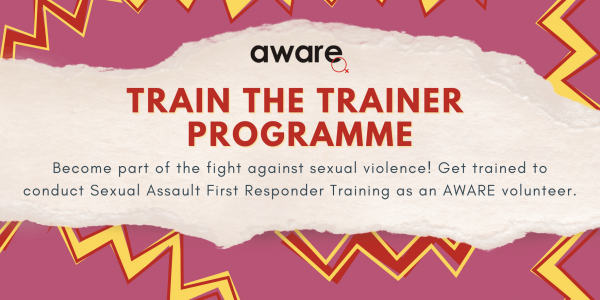
Train the Trainer: Become a Sexual Assault First Responder Trainer with AWARE

AWARE’s Sexual Assault First Responder Training (SAFRT) has equipped hundreds of participants with the skills to be effective and empathetic first responders to survivors. This impact would not have been possible without the dedication and support of our incredible cohort of SAFRT trainers.

Through AWARE’s Train The Trainer (TTT) programme, you, too, can become part of the fight against sexual violence. The TTT programme trains participants to conduct community SAFRT sessions, both on behalf of AWARE and elsewhere. Upon completing the programme, participants will receive a certificate.

All participants in this programme are required to conduct one SAFRT session with AWARE as practice. After completing this course, trainers have the option to continue volunteering with AWARE to conduct future SAFRT sessions (open to the public). They will receive an hourly honorarium for each such session.

Those who choose not to volunteer with AWARE may nonetheless conduct trainings in sensitive and empathetic sexual assault first response with other communities—be it in a school, religious setting or neighborhood group.

The TTT curriculum includes:

    • Walkthrough of SAFRT materials
    • Supplementary workshops, including a session on the laws and legal processes relating to sexual violence, and a session on empathy
    • Teachback exercise
    • Co-delivery of SAFRT with AWARE

An ideal candidate would fulfil the following criteria:

  • Minimum two (2) years of related experience working in community work, social work, counselling, legal work or related fields, preferably in the Singapore context
  • Access to a community that might benefit from SAFRT (e.g. university/religious/industry group). Interest and ability to conduct this training within their community a bonus
  • Educational qualifications in social work, counselling, psychology, law, human resource management, religious studies, or related fields preferred, with trauma management credentials a bonus (training will be provided as needed)
  • Excellent interpersonal, empathy, communication, and public speaking skills in English
  • Strong belief in gender equality and the values of AWARE
  • Interest in SAFRT
  • Ability to attend one or two training sessions per week across six weeks

Course fees

  • If you intend to volunteer as a trainer at AWARE’s SAFRT after this course, the course fee will be waived. You will be required to conduct a minimum of three sessions on AWARE’s behalf in 12 months.
  • If you do not intend to volunteer with AWARE (and for example plan to conduct SAFRT sessions with your own community instead), a $250 fee is required to cover the cost of the TTT programme. Note that this rate is subsidised with the expectation that you will impart your knowledge and skills to others as a trainer; as such, we strongly recommend that you conduct a minimum of three sessions in your own community within 12 months of completing TTT.
  • If cost is a barrier to you in participating in TTT, please email us at volunteermanager@aware.org.sg. We will consider further subsidy on a case-by-case basis.

Fill out the below form by 22 July, 2022.  Note that we will only be reaching out to shortlisted candidates. All interviews will be conducted over Zoom. 

Apply here.

Longer shelter stays ease pressure and reduce families’ stress

This letter was originally published in The Straits Times on 21 June 2022.

As a long-time social worker, I appreciated the Ministry of Social and Family Development’s letter, “No fixed cap on how long families can stay at shelters” (June 11).

Homeless families and those experiencing violence, as well as their social workers, would welcome the ministry’s assurance that the families’ stays at transitional and crisis shelters can be extended without a fixed cap.

Last year, Social and Family Development Minister Masagos Zulkifli shared that in 2020, a resident stayed in a crisis shelter for an average of four months.

Over the years in my career, I have known families who felt anxious about requesting extensions on their shelter stays, and overwhelmed with the fear of being homeless. Shelters may be inadvertently putting pressure on families by requiring them to apply for extensions to their stay every three or six months. Extensions are also not always granted.

The environment is such that many do feel an intense urgency to follow through on case goals, like securing employment or housing, and intervention plans proposed by the shelters.

However, setting a timeline does not work for everyone. Some families might need to prioritise other issues, like court cases, parenting challenges and applying for financial assistance. This mismatch in priorities can amplify the families’ existing distress.

Mr Masagos also shared that only 5 per cent of crisis shelter residents moved out to public rental housing and 2 per cent to transitional shelters in 2020. Others returned to their own homes or moved in with families and friends.

However, living with family or friends does not promise safety or stability. Some families have to move multiple times, going between their families and friends’ homes due to overcrowding, family tension and abuse.

Between 2018 and 2021, I served as the house mother for Aware’s Support, Housing and Empowerment Project, which provides free, long-term housing for 18 single-mother families.

The guaranteed stay of up to two years empowered our residents, letting them set their own goals, such as improving their well-being and strengthening their relationships with their children. They were able to enrol their children in schools and find work in the vicinity, knowing they would not likely need to move again soon.

By the end of their tenancy, 75 per cent of our families managed to secure public rental flats.

My experience working closely with the families drove home the importance of a guaranteed long-term stay and its positive impact on psychological security.

Staying in a shelter is an inherently stressful experience for any family. I hope that more efforts can be made to ease the stress for those who need to stay at shelters.

Elizabeth Quek
Project Manager

AWARE

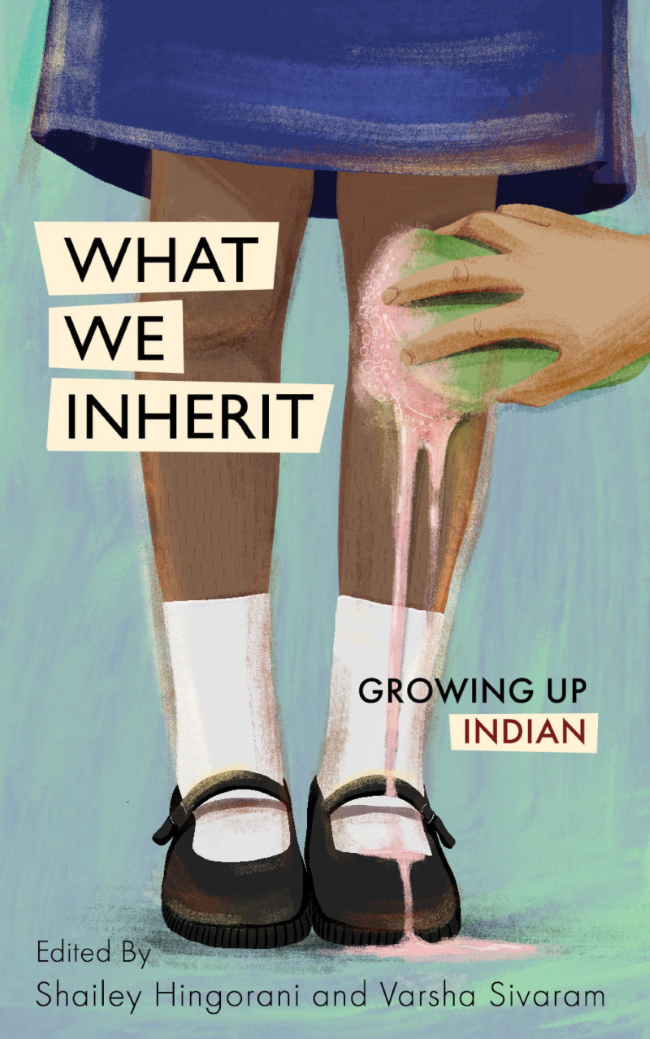
What We Inherit: Growing Up Indian available now!


Following a successful Kickstarter campaign in 2021, What We Inherit: Growing Up Indian is now on sale via distributor Ethos Books! This anthology of diverse Indian voices is available in both paperback and e-book version, online and in Singapore bookstores.

Buy now!


About What We Inherit: Growing Up Indian

A celebration of the slippages, strife and secret histories that make us—for better or worse—who we are.

A woman faces off against a xenophobic stranger across a supermarket turnstile.

A young girl mistakes her first period for strawberry yoghurt and endures an embarrassing puberty ceremony.

At the funeral of her cruel and prejudiced dadhi, a granddaughter reflects on the confusions of grief and the trauma passed through family lines.

A follow-up to the best-selling anthology Growing Up Perempuan (AWARE, 2018), What We Inherit tells the stories of Indian women (and a few men) in Singapore entirely in their own words. They question the expectations foisted upon them, discover new avenues into old traditions and carve out spaces for joy amid anger and sorrow. At a time when the bonds between us seem at constant risk of breaking, What We Inherit turns our attention towards community in all its complexities. It’s a reminder of how we honour, betray and ultimately bear witness to each other… and ourselves.

What We Inherit is published by AWARE and distributed by Ethos Books.

Featuring contributions by

    • Akshita Nanda
    • Balli Kaur Jaswal
    • Constance Singam
    • Kelly Kaur
    • Mandakini Arora
    • Matilda Gabrielpillai
    • Pooja Nansi
    • Prasanthi Ram
    • Ranjana Raghunathan
    • Sharul Channa

… and many more.

About the editors

Shailey Hingorani is AWARE’s Head of Advocacy, Research and Communications. She has spent the last 13 years working on human rights issues in the United States, South Asia and Southeast Asia.

Varsha Sivaram is a Senior Projects Executive in AWARE’s Advocacy, Research and Communications department. They are passionate about literature and advocacy.

About the cover art

Cover art by Prashanti Aswani.

When must an organisation report sexual offence case to police?

looking at phone

This letter was originally published in The Straits Times on 16 June 2022. 

The recent case in which a member of a Catholic order sexually abused two boys raises questions about what institutions and organisations should do when they receive a sexual assault complaint, whether from an employee, student or constituent.

We have seen many organisations struggle with the same question as the church, namely: Must organisations report a case of sexual violence to the police under Section 424 of the Criminal Procedure Code, even if the complainant does not want them to do so?

It was reported that the police issued a written advisory to a 64-year-old man to remind him of his reporting obligations under Section 424, unless there is a “reasonable” excuse (Police issue advisory to man for not reporting sex crime, May 7). The church then clarified that it had not made a police report because the survivors did not want to do so.

It is very rare for the police to issue such advisories. Practically speaking, most organisations who work with survivors of sexual violence (including Aware’s Sexual Assault Care Centre) do not report every single case to the police.

When, then, is an organisation required to make a report? Is it only in the case of minors? Does the severity of the crime and the number of alleged offences make a difference? What is the obligation when an adult survivor does not wish the organisation to make a police report?

While law enforcement has a duty to prevent and punish crime, this duty should not be the only consideration here.

Reporting sexual offences without survivors’ consent robs them of their agency in determining how their complaint is handled. It can thus exacerbate their feelings of powerlessness and helplessness.

Further, the prospect of an unwanted report can have the unintended effect of deterring survivors from seeking help in the first place, for fear that they may become involved in a police investigation against their wishes. It is already difficult for victims to seek help after sexual assault; concern about mandatory reporting places another barrier in their way.

In reviewing Section 424 of the Criminal Procedure Code, we urge the Government to adopt a nuanced approach that strikes a balance between law enforcement and minimising secondary traumatisation.

Safety, transparency, autonomy and collaborative processes in the aftermath of sexual assault go a long way towards supporting survivors’ recovery.

We therefore suggest that in cases where the survivor is unwilling to report to the police, mandatory reporting be narrowed to specific situations, such as cases involving minors where there has been an abuse of power, or where there is imminent danger and/or repeated offences.

Further, in such cases, where appropriate, survivors should be given a longer grace period before the authorities are informed. Meanwhile, a social worker could be brought in to support them until they feel ready to make the report.

Corinna Lim
Executive Director
AWARE

From the Vault: “It’s a man’s world” by Margaret Thomas

On 10 June 2022, the Singapore Press Club Awards honoured AWARE founding member and veteran journalist Margaret Thomas, inducting her into the Singapore Media Industry Hall of Fame as part of its inaugural batch.

To celebrate Margie’s latest accolade, here’s a throwback to February 1986, when she launched a column, “Working Woman”, in the (now defunct) magazine Singapore Business. This is the very first entry in that series, titled “It’s a man’s world”. At the time, AWARE was a fledgling volunteer organisation—it had been registered just three months prior, in November 1985, and would only be officially launched to the public a month later in March of 1986. Nevertheless, the SB editors knew of Margie’s feminist convictions and invited her to pen the monthly column.

Almost four decades later, Margie finds that the piece still resonates. The desire to galvanise women into putting language to their own experiences, and participating more actively in civil society, rings true—even though “that last point, about why women need to get into the thick of things—I would not phrase it quite that way today.” Gratifyingly, she notes that “more women and men these days are quite happy to call themselves feminists and activists”.


This article was first printed in the February 1986 issue of Singapore Business.
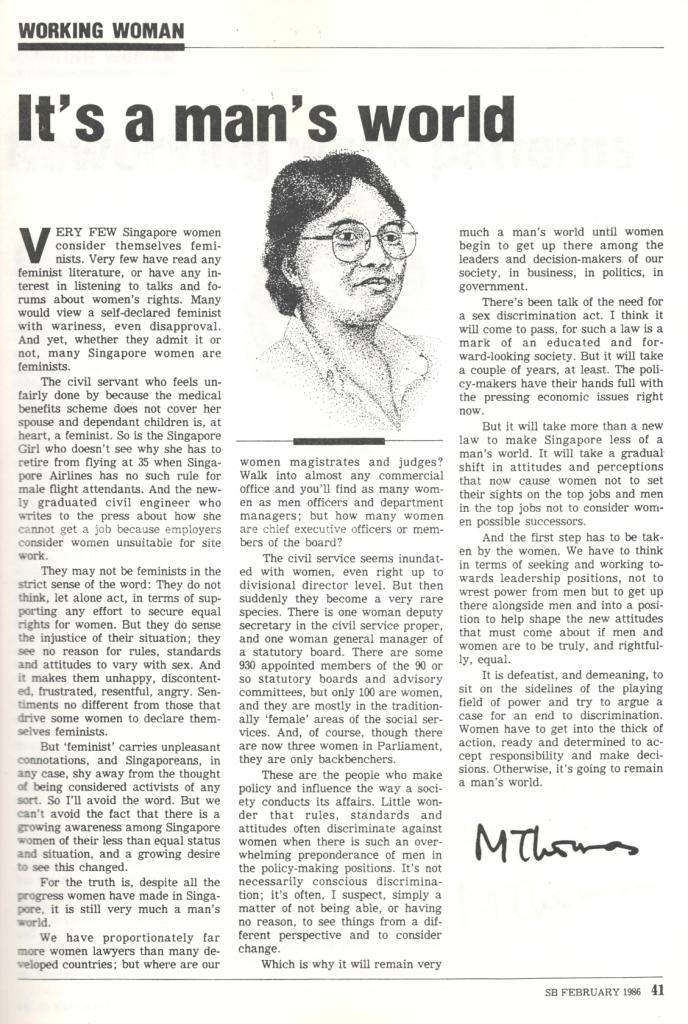
Very few Singapore women consider themselves feminists. Very few have read any feminist literature, or have any interest in listening to talks and forums about women’s rights. Many would view a self-declared feminist with wariness, even disapproval. And yet, whether they admit it or not, many Singapore women are feminists.

The civil servant who feels unfairly done by because the medical benefits scheme does not cover her spouse and dependent children is, at heart, a feminist. So is the Singapore Girl who doesn’t see why she has to retire from flying at 35 when Singapore Airlines has no such rule for male flight attendants. And the newly graduated civil engineer who writes to the press about how she cannot get a job because employers consider women unsuitable for site work.

They may not be feminists in the strict sense of the word: They do not think, let alone act, in terms of supporting any effort to secure equal rights for women, but they do sense the injustice of their situation; they see no reason for rules, standards and attitudes to vary with sex. And it makes them unhappy, discontented, frustrated, resentful, angry. Sentiments no different from those that drive some women to declare themselves feminists.

But ‘feminists’ carries unpleasant connotations, and Singaporeans, in any case, shy away from the thought of being considered activists of any sort. So I’ll avoid the word. But we can’t avoid the fact that there is a growing awareness among Singapore women of their less than equal status and situation, and a growing desire to see this changed.

For the truth is, despite all the progress women have made in Singapore, it is still very much a man’s world.

We have proportionately far more women lawyers than many developed countries; but where are our women magistrates and judges? Walk into almost any commercial office and you’ll find as many women as men officers and department managers; but how many women are chief executive offices or members of the board?

The civil service seems inundated with women, even right up to divisional director level. But then suddenly they become a very rare species. There is one woman deputy secretary in the civil service proper, and one woman general manager of a statutory board. There are some 930 appointed members of the 90 or so statutory boards and advisory committees, but only 100 are women, and they are mostly in the traditionally ‘female’ areas of the social services. And, of course, though there are now three women in Parliament, they are only backbenchers.

These are the people who make policy and influence the way a society conducts its affairs. Little wonder that rules, standards and attitudes often discriminate against women when there is such an overwhelming preponderance of men in the policy-making positions. It’s not necessarily conscious discrimination; it’s often, I suspect, simply a matter of not being able, or having no reason, to see things from a different perspective and to consider change.

Which is why it will remain very much a man’s world until women begin to get up there among the leaders and decision-makers of our society, in business, in politics, in government.
There’s been talk of the need for a sex discrimination act. I think it will come to pass, for such a law is a mark of an educated and forward-looking society. But it will take a couple of years, at least. The policy-makers have their hands full with the pressing economic issues right now.

But it will take more than a new law to make Singapore less of a man’s world. It will take a gradual shift in attitudes and perceptions that now cause women to not set their sights on the top jobs and men in the top jobs not to consider women possible successors.

And the first step has to be taken by women. We have to think in terms of seeking and working towards leadership positions, not to wrest power from men but to get up there alongside men and into a position to help shape the new attitudes that must come about if men and women are to be truly, and rightfully, equal.

It is defeatist, and demeaning, to sit on the sidelines of the playing field of power and try to argue a case for an end to discrimination. Women have to get into the thick of action, ready and determined to accept responsibility and make decisions. Otherwise, it’s going to remain a man’s world.

Margaret Thomas

28 July 2022: Queer Violence, Queer Silence — a panel on LGBTQ persons’ experiences of sexual assault

Sexual violence against LGBTQ persons has long been overlooked. This panel explores how to break the silence.

While the MeToo movement has empowered more survivors of sexual violence to speak out, an important segment of society has been left out of those conversations: the LGBTQ population. This despite research showing that LGBTQ people are as vulnerable to violence, if not more. Why have their experiences of sexual violence been pushed to the sidelines?

One major reason is obvious: The retention of Section 377A creates an environment of fear that discourages LGBTQ to seek help after sexual violence, or risk prosecution. Meanwhile, insufficiently comprehensive sexuality education and the absence of well-rounded representation in mainstream media further compound the problem.

Sexual violence is difficult enough for anyone to face, but LGBTQ persons have their own unique stigmas and challenges in the journey to justice and recovery. How do we bring their voices from the margins to the centre of our fight against sexual violence? Where can LGBTQ survivors go for support?

Join speakers from AWARE and Sayoni and a survivor of sexual violence on Thursday, 28 July 2022, for a panel discussion on sexual assault in the LGBTQ community.

Entry to this event is contribute-what-you-can. While you are welcome to give any amount you wish, we suggest $5 per person. No tax deduction will be provided. Note that Eventbrite requires a minimum contribution of $1. If you require a waiver of this minimum contribution, please email gec@aware.org.sg.

Date: 28 July 2022 [Postponed from 28 June 2022]

Time: 8 – 9.30pm

Register here.