Author: Media Intern

Don’t stop at street names, work on changing policies and social norms to improve gender equality

This letter was originally published in The Straits Times on September 25 2021. 

The recent announcement by Prime Minister Lee Hsien Loong that a garden at Dhoby Ghaut Green will be dedicated to the women of Singapore came amid news of more policy changes and programmes to support women (Concrete proposals to tackle women’s issues in the works, Sept 19).

Naming public spaces after women is a symbolic gesture of appreciation for women’s efforts. It increases public consciousness of women’s professional and cultural successes, which will inform and inspire future generations of girls and women.

I look forward to more public education that centres on women as an integral part of Singapore’s narrative, including women such as Dr Maggie Lim and Ms Constance Goh, who advanced women’s reproductive health, or Ms Checha Davies and Madam Che Zahara, who championed women’s rights.

This must continue far beyond the Year of Celebrating SG Women.

More needs to be done to materially improve gender equality and equity in Singapore.

There are three ways to make a more immediate and tangible difference: introducing and strengthening legislation, changing societal norms and getting men to be more involved in the pursuit of gender equality.

Legislation can help, for example, by improving the wages of low-skilled workers in sectors with a high concentration of women, such as in food and beverage, and retail; introducing a temporary gender quota on the composition of company boards (to be lifted after the equal gender representation has been achieved); eradicating maternity discrimination; and making the criminal justice system more sensitive to survivors of sexual assault.

More emotional and financial support can be given to caregivers, who tend to be primarily female.

More can be done on a societal level to eradicate misogyny and re-evaluate traditional gender roles, perhaps through comprehensive sexuality education incorporating lessons about gender roles and dynamics.

Male advocates should be part of the discussion and fight for gender equality.

As we honour and remember the prominent women in Singapore’s past, we should also turn our attention towards the women of today and tomorrow.

Khaing Su Wai, Communications Executive, AWARE

7, 14, 21 Oct 2021: Birds & Bees, A Workshop for Parents

Most parents believe that it is important to talk to their children about sex, but many are unsure how to do it. Or, when to start having these conversations and about what. Where do children get answers to the questions they can’t ask their parents? The internet is one source, and young people themselves say they are most likely to ask peers and romantic partners. Wouldn’t you rather they turn towards you? The “ask-able” parent who is open to questions, ready to make an effort to listen without judgement and engage in a dialogue?

Who should attend:

Parents with children of all ages will benefit, although parents with tweens and teens are more likely to find the case studies and discussions in groups immediately relevant.

Date: Consecutive Thursdays – 7, 14 & 21 October 2021 (Participants are expected to attend all three sessions)

Time: 8:00-9:30pm

Workshop Fee: $20 (in total)

Survey: After you sign up, you will be asked to complete a short pre-workshop survey about the age(s) and number of your children. This is very important so that parents with children of similar ages can be grouped together to that you will get the most out of the workshop.

Special instructions for online workshop: As small-group discussions are a big part of the workshop, participants are expected to switch on their video as well as audio whenever possible, and to join in the discussions for maximum benefit.

Refunds and cancellations: Unfortunately we will not be offering refunds. In exceptional circumstances, if you are unable to attend the subsequent sessions, you will be able to join the next set of workshops if you write in to publiceducation@aware.org.sg in advance giving your reasons.

What the workshop will cover:

1. Communicating with your children

  • The importance of active listening
  • Tips on having constructive conversations

2. Consent

  • What is consent
  • The gold standard for consent
  • Consent in real life

3. Being an “ask-able” parent

  • Exploring own attitudes and value systems
  • Broaching awkward topics

4. Relationships

  • Signs of healthy and unhealthy relationships
  • Sexual Assault
  • Navigating the online world

Attend this workshop to explore how you can work on developing your own strategies to enhance the trust and bond with your child! Places are limited, so do sign up quickly!

**If you would like to join the workshop but cannot make it at this time, please fill in the indication of interest form.

Register here!

Take into account employees’ perspective when drafting law on workplace discrimination

This letter was originally posted in The Straits Times on September 17 2021.

While the newly announced anti-discrimination legislation is a significant and much-needed step for Singapore, recent comments in Parliament indicate a continued lack of understanding about what it takes to truly tackle discrimination at work.

Senior Minister of State for Manpower Koh Poh Koon on Tuesday said about two-thirds of reported cases of workplace discrimination are not substantiated. The minister seemed to infer from this that a large number of discrimination reports are baseless, noting that most of them stemmed from misunderstandings.

However, it is unclear that this is indeed the case. Workplace discrimination is often very difficult to substantiate.

While the Tripartite Alliance for Fair and Progressive Employment Practices (Tafep) provides a useful framework to understand what workplace discrimination can look like, it requires claims to be substantiated by evidence that employees often do not have.

Discrimination often takes place in private conversations, and employees may not be able to document these to support their cases.

That does not mean that discrimination is not occurring, but simply that it cannot be easily proved.

Legislation should ensure that subtle forms of discrimination do not go unaddressed, and that employees have adequate protection against all kinds of discrimination.

Dr Koh also placed an emphasis on mediation as the first step to resolve cases of workplace discrimination.

Mediation can be useful for communication between employers and employees, but it may not be appropriate in all cases.

For many victims of discrimination, having to face their employers in such a setting is potentially traumatising. This does not make for a level playing field.

To make the mediation processes fairer and safer for all parties, employees could, for instance, opt to have a trained social worker present, who could help communicate on their behalf in emotionally distressing moments.

Lastly, Dr Koh mentioned that about one in seven reported discrimination cases involves discrimination on the basis of gender. However, discrimination based on gender identity (or sexual orientation) is not currently covered by the tripartite guidelines. This suggests that the cases seen by Tafep so far may not be representative of the full range of such discrimination occurring in Singapore.

About eight in 10 of the discrimination cases seen by the Association of Women for Action and Research’s Workplace Harassment and Discrimination Advisory last year involved maternity, family care, or gender/ gender identity discrimination.

We urge that discrimination against any minority groups be enshrined in the upcoming legislation.

Dr Koh said an “even-handed approach” will help both employers and employees. We wholeheartedly agree. Therefore, we hope that the tripartite partners and the Government will seriously consider the perspective of employees when drafting this crucial legislation.

Margaret Thomas, President, AWARE

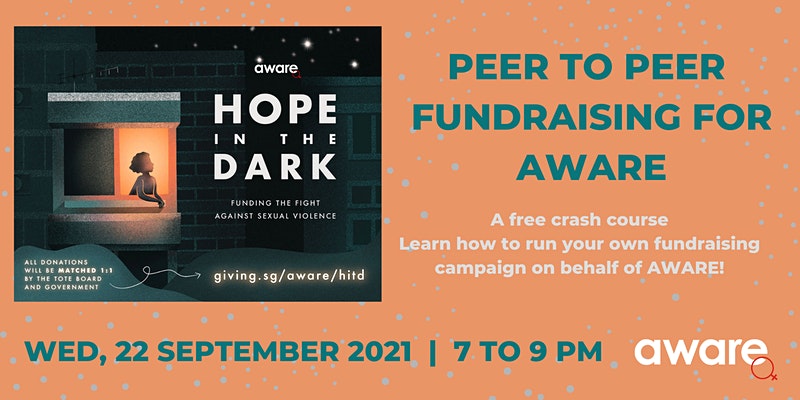
22 September 2021: Peer-to-Peer Fundraising Workshop for AWARE

This workshop hopes to gather supporters who are thinking of creating peer-to-peer fundraising campaigns on behalf of AWARE. Our fundraising team will break down, in simple easy steps, the best way to go about this, and provide you with the tools and all the digital assets you need to fundraise amongst your friends, family and social networks.

Once you have organised your very first peer-to-peer fundraiser, you will gain the experience and confidence to create other campaigns into the future and support a host of other worthy causes.

Why AWARE Needs Your Help

Our newly launched fundraising campaign – Hope in the Dark – aims to raise $350,000 to fund the fight against sexual violence. Donations to this campaign will go towards sustaining Singapore’s only dedicated Sexual Assault Care Centre and towards community engagement programmes such as our Birds & Bees parents’ sex education programme and Sexual Assault First Responder Training. Donations will also fund our research into under-examined areas such as tech-facilitated sexual abuse.

Help us spread the word and raise greater awareness on the issues surrounding sexual violence through your peer-to-peer campaigns.

Session Overview

  • Overview of Hope in the Dark fundraising campaign
  • Quick tips and strategies for this campaign and any others you may run in the future
  • Fundraising toolkit for Hope in the Dark to help you promote your campaign
  • Idea generation and on-the-spot advice to help you execute your campaign right after this kick-off session

AWARE has benefitted from many incredible peer-to-peer fundraising campaigns in the past, from bake sales to online craft fairs and more. It’s thanks to passionate supporters like you that we are able to get our message of gender equality heard. We look forward to assisting you with many more creative initiatives!

Register Here

Don’t let pornography become your child’s default sex educator

This op-ed was originally published in The Straits Times on September 3 2021.

Some of us treat sex and sexuality as shameful and taboo. Others are extremely comfortable talking about their sexuality. How do we come to have these beliefs and attitudes? What determines our relative openness and comfort with conversations about sexuality?

It’s hard to pinpoint any one determining factor, but experts believe that our attitudes towards sex are shaped at an early age by parents, peer groups, teachers, media and social media… and pornography. Yes, pornography.

As anyone who has spent time with teenagers, or been a teenager, can attest, most teens are naturally curious about sexuality. They may seek out (or accidentally stumble across) pornography to satisfy that curiosity. But what happens when adolescents watch porn without the tools to make sense of what they are seeing?

And is banning access to pornography the best way to protect children from its harmful effects? The Children’s Commissioner for England, Dame Rachel de Souza, earlier this week urged pornographic websites and social media companies to do more to stop children’s access to explicit materials. But while her recommendations, which centre on strengthening age verifications for such platforms, would surely help, many believe that such regulations can only go so far in enabling children to resist porn’s pernicious influence.

In Singapore, nine in 10 boys between the ages of 13 and 15 years have watched or read sexually explicit materials, according to a 2016 survey by Touch Cyber Wellness. Some surveyed children were exposed to pornography even before they started primary school.

While the proliferation of free streaming porn sites has made explicit content easier than ever to accidentally stumble upon, the survey showed that 54 per cent of boys intentionally sought it out.

Negative effects

Unlike more balanced and measured introductions to human sexuality, exposure to pornography (accidental or not) provides adolescents a distorted view of sex. Studies show that most mass-market pornography conveys the beliefs that sex is divorced from intimacy, for example, and that women are always ready for sex.

A longitudinal study among American adolescents also found that increased use of pornography predicted more sexist attitudes two years later.

Pornography also shapes models of behaviour and introduces new sexual expectations. It has been linked to sexually violent behaviour later in life: In another US study, people who watched violent pornography were more than six times as likely to engage in sexually aggressive behaviour.

A 2019 study found that 13 per cent of sexually active girls aged 14 to 17 have been choked by their partners; experts believe this to be linked to increased exposure in boys to violent porn, which normalises certain dangerous behaviours as “expected”. For young women, the pornography use of their male partners can also feed into their own body shame, and make them susceptible to coercion in sexual acts.

Regulating pornography

Parents at a virtual dialogue hosted this year by the Ministry of Education expressed concern about the easy accessibility of pornography online and suggested that more can be done to regulate such content.

The Infocomm Media Development Authority (IMDA) maintains a symbolic ban on a list of 100 websites, most of which are pornographic in nature.

The ban is considered “symbolic” as it is intended to communicate the Government’s disapproval of pornography and to prevent young children from accidentally accessing these sites, not to comprehensively ban all pornographic websites available in Singapore. Of course, the proliferation of virtual private networks (VPN) has meant that any such ban, symbolic or not, is easy to sidestep.

Meanwhile, age verification measures are often beset with technical and regulatory challenges. Chief among them is the near impossibility of reliably verifying the age of the user. A Guardian report showed that fake profiles could circumvent these blocks within minutes.

Many parents we meet through Birds & Bees – an Association of Women for Action and Research (Aware) programme designed to help parents initiate and sustain conversations with their children about sex, consent and respect – have told us about the range of filters and parental controls they use to completely block their children’s access to pornography.

Yet there are two hitches to this approach: First, according to a UK study, more 16- and 17-year-olds had seen pornography on social media platforms than on pornographic websites. These often escape parental controls because parents do not expect their children to find pornography on these platforms.

Second, parents often deploy these measures without any conversations with their children, or attempts to provide them with context. It’s natural to want to protect children from the deleterious effects of pornography by ensuring their access to pornography is regulated. However, is it realistic for us to rely on artificial barriers to porn as our main strategy? Even the most obsessively vigilant parents are hard pressed to monitor every single piece of media that their child consumes throughout childhood and adolescence.

More importantly, taking such a top-down approach to parenting does not make for the healthiest or most trusting relationships.

Instead, a number of sex educators and public health experts are recommending a new educational tool to push back on the negative effects of pornography exposure: porn literacy.

What is porn literacy?

Essentially, porn literacy aims to equip adolescents with critical thinking skills, so that when they do see pornography, they know how to unpack it. Instead of burying children’s heads in the sand, it teaches them to understand porn for what it is: profit-driven content that is potentially misogynistic at best, downright violent and exploitative at worst.

A study analysing one of the most comprehensive porn literacy programmes (titled The Truth About Pornography: A Pornography-Literacy Curriculum For High School Students Designed To Reduce Sexual And Dating Violence) found that students were less likely to see pornography as lucrative, realistic or a good way to learn about sex after taking the class. They also had a better understanding of the legality of underage individuals sending nude selfies.

Ideally, porn literacy in schools should be supplemented with parents talking to their children about pornography. These conversations can mitigate the harms of porn: A study found that pornography was associated with an increased probability of condomless sex only when parents engaged in little to no sexual health communication with their children.

Parents may be concerned that talking to adolescents about pornography will encourage their children to seek it out, but there’s no evidence to support this fear. On the other hand, a stand-alone conversation about pornography may not be of much help either – parents need to build on a foundation of regular, age-appropriate conversations about bodies, healthy boundaries and relationships.

A 2020 survey by Blackbox and Aware of 564 parents found that only half of the respondents were comfortable talking to their children about sexuality education. Thirty-five per cent of parents who were uncomfortable said they lacked the appropriate tools to begin conversations about sex and sexuality.

Unfortunately, unless parents can secure these tools (for example, via programmes like Birds & Bees) and schools can introduce porn literacy as part of their sex education curriculum, sexually explicit content produced for profit and entertainment will have “the Talk” with their children instead.

Shailey Hingorani, Head of Research and Advocacy, AWARE

Better support migrant domestic workers providing care

Caregiving for someone with dementia is a huge undertaking, particularly when one is not adequately equipped to do so. M.E’s challenges in caring for the author’s mother are definitely not unique (Putting mum in a nursing home will be the last resort, Aug 16).

Many families in Singapore hire migrant domestic workers (MDWs) to help care for their elderly relatives. However, a joint study by AWARE and HOME in 2020 found that not all MDWs hired for caregiving receive relevant training beforehand. Existing training programmes are also not standardised.

Without proper training, MDWs are ill-equipped to manage the high care needs of care recipients with dementia. They also have to adapt to their care recipients’ evolving care needs and increasing dependency as the latter’s condition deteriorates. For those who lack the skill to manage the physical and mental strain of caregiving, this is extremely challenging.

At the same time, many MDWs refrain from voicing their concerns for fear of jeopardising their employment. Ultimately, MDWs’ fatigue and inability to cope can compromise their provision of care.

More needs to be done to better prepare and support MDWs in taking on caregiving responsibilities.

Establishing an accreditation system to certify MDWs’ skills can ensure greater standardisation of caregiving training. A standardised care matrix should be used to assess the skill levels of MDWs intending to take on caregiving jobs.

Dementia-specific caregiving training should be made mandatory for MDWs prior to deployment. This would improve the matching process between employers and MDWs by aligning the latter’s skills and the care recipients’ needs. Also, employers intending to hire an MDW for caregiving should be required to declare if the care recipients have dementia and/or behavioural issues.

Our research also found that respite care services are under-utilised, primarily due their high cost. This translates into over-dependance on MDWs to provide round-the-clock care, leaving them overworked and often unable to take rest days. Our eldercare infrastructure should include a national respite care programme to guarantee access to MDW caregivers, and all who need it. Care services should be publicly provided to keep costs affordable.

In 2018, around 82,000 persons above 60 were suffering from dementia in Singapore. This figure is projected to reach 152,000 by 2030. We need to develop more sustainable long-term care plans that do not overly rely on MDWs, and are supportive of all caregivers.

Jaya Anil Kumar, Research and Advocacy Manager at the Humanitarian Organization for Migration Economics (HOME)

Kimberly Wong, Research Executive, AWARE

We harp on false sexual assault accusations despite evidence to the contrary

This op-ed was originally published in Channel NewsAsia on August 19 2021. 

SINGAPORE: The spectre of false sexual abuse accusations looms large in cultural narratives about sexual violence, with public anxiety about the ease and frequency of false reporting remaining high.

Although the evidence on false allegations has repeatedly failed to support that fear, many continue to rue that #MeToo’s political dictum of “believe women” has gone too far.

Case in point: When a Singapore anaesthetist was acquitted of molesting a 32-year-old woman, after she admitted at trial that she was lying, commentators took to banging the drum, claiming that false allegations are widespread and that all sexual assault complaints – or gender equality movements, even – should be treated with scepticism.

“Women can be vile creatures too,” a Twitter user tweeted at AWARE after news of the above case broke. “That is why I have never supported women’s rights.”

A comment on Facebook reads: “Singapore is a country whereby women have much higher status than men and can always play victim to garner sympathy.”

A LOT OF US THINK MANY SEXUAL HARASSMENTS CLAIMS ARE FALSE

In an Ipsos survey of 1,019 Singaporeans and PRs in 2019, four in 10 agreed with the statement that false accusations of sexual harassment are becoming more common in Singapore. Forty-one per cent of all Singaporeans agreed or strongly agreed that false accusations of sexual harassment are a bigger problem in our society than unreported acts of sexual harassment.

Lest you write this off this as the conservative beliefs of an older population, the survey found that this perspective is more prevalent among younger and middle-aged Singaporeans, aged 18 to 49 years.

On the other hand, under-reporting of sexual abuse remains pervasive. Seven out of 10 clients of AWARE’s Sexual Assault Care Centre (SACC) do not file an official report.

Studies in the US have found that anywhere between 6 per cent and 38 per cent of men admit to sexually coercive behaviour. Yet it is rare to see proportionate uproar about the number of perpetrators who get away with sexual abuse.

Of course, “believe women” has never meant “believe all women categorically, no questions asked”. But the knee-jerk dismissal with which women’s stories have historically met needs to be put to bed.

So what should we make of the burgeoning conviction surrounding false accusations? How do we answer those who would cite this recent case as evidence of a more widespread conspiracy?

FALSE ACCUSATIONS ARE EXCEEDINGLY RARE

Research for the United Kingdom’s Home Office in 2005 – believed to be the most comprehensive study of its kind to date – suggests only 4 per cent of cases of sexual violence reported to the UK police are found or suspected to be false. (Of the 216 assault complaints classified as false, only six led to arrest, and only two led to actual charges.)

Studies in Europe and in the US put these rates at between 2 per cent and 6 per cent.

In Singapore, according to the Ministry of Home Affairs, of the 250 reported cases of serious sexual crimes (rape and sexual assault by penetration) a year from 2014 to 2018, police charged or warned the complainants for making false reports in only 10 cases – comparable to the rate in the UK.

It’s important to note that, although the two are frequently lumped together, these cases shouldn’t be confused with cases that don’t result in prosecution because of lack of evidence. In fact, experts suggest that the number of false reports may themselves be inflated because of the way crimes are sometimes classified around the world.

In the UK, for example, police sometimes record cases as “no crime” or “unfounded” because of insufficient corroborating evidence. As many types of sexual harassment – flashing, verbal harassment for example – occur without leaving any definitive evidence, one would expect this investigative outcome to be fairly common.

Yet this does not square with the deliberate, targeted deception that false accusers supposedly practise, as popular imagination would have it.

Although this doesn’t appear to be a problem with the crime data in Singapore, the conflation of cases of false accusations and cases without sufficient evidence continues to hold sway in public opinion. This confusion may be one of the reasons why false accusations are perceived by the public as much higher than they actually are.

FALSE ACCUSATIONS DON’T JUST HAPPEN IN CASES OF SEXUAL ASSAULT

There’s no evidence that the rate of false accusations of rape is higher than that of other crimes. However, false sexual abuse accusations receive disproportionately higher levels of attention than other types of false accusations.

Take, for example, false accusations involving theft. How many of us remember the 72-year-old man who, just a month ago, was investigated for a false report claiming he had been robbed by two unknown men? Or the 48-year-old man charged with providing false information to the police when he claimed that one of his workers had stolen S$2,800 in cash from a co-worker?

In those cases, irrational generalisations don’t run wild – we would be laughed at if we extrapolated from these that significant numbers of men who report theft are lying about it or doing it for attention.

But when it comes to sexual violence, a crime that is heavily gendered, with victim-survivors being overwhelmingly female, the lingering stain of misogyny is hard to scrub away. Tropes about lying, untrustworthy women have long been deployed to discredit those who would challenge the status quo.

Accordingly, stereotypes about false accusers condition us to imagine them as women. In reality, though, men can and do make false reports too. In 2019, a 34-year-old man provided false information to an investigation officer, saying that his 50-year-old Singaporean boyfriend had force-fed him a pill and raped him at their home while he was unconscious. Yet we tend to harp on cases of women making false accusations.

THE HARM OF THE FALSE REPORTING MYTH

Such an imagined prevalence of false accusations has real-world effects. For one, it impedes justice.

There are a variety of reasons why women choose not to officially report a rape or sexual assault, but the fear of not being believed is often a prominent reason.

In an AWARE-Ipsos survey on workplace sexual harassment published in January, 20 per cent did not report their sexual harassment because they feared no one would believe them – a fear fuelled by social media comments harping on about false accusations.

Second, incorrect and unreliable assumptions about false complaints could create biases and sway how rape allegations are managed if we are not careful.

Research has investigated the chasm between the high rates at which police officers believe false allegations to be made, and the actual low rates of false allegations. A 2005 study found that police officers in the UK believed half of cases to be false, a sharp contrast from the more accurate rate of 4 per cent (as per the Home Office study).

LEGAL FRAMEWORKS PROTECT AGAINST FALSE ACCUSATIONS

Making an accusation of sexual abuse is often onerous and traumatising for survivors with plenty of hard evidence on hand.

Considering this, it’s mind-boggling why anyone would entertain the idea that many women are expending significant effort, time and money, and subjecting themselves to cross-examination, investigations that can last well over a year, and public backlash, for some sort of ill-defined personal gain.

The fact is that the criminal justice system in Singapore is well-positioned to weed out false reports, no matter how few they may be. The police take a serious view of the waste of public investigative resources.

For giving false information to a public servant, one can be jailed for up to a year and fined up to S$5,000.

In addition to criminal consequences for complainants, there are also potential civil consequences. The person falsely accused can sue the complainant for defamation on the basis that their reputation was damaged by their false allegations.

False accusations of sexual abuse do happen, and when they do, real harm is done to the accused. Nobody should be put through the trauma of defending themselves against an act they did not commit.

But looking at the facts, we have to keep our imaginations in check and not succumb to bogeyman narratives that allow abusers to escape accountability for their actions.

Dr Yeo Sow Nam, the anaesthetist acquitted earlier this week, himself spoke to the need to treat all reports of sexual assault with sensitivity and rigour.

Referring to “the good, necessary and difficult work of ensuring access to justice for real victims of sex crimes, many of whom already hesitate to accuse their attackers publicly”, the doctor hoped that his verdict would not “discourage real victims of sex crimes from coming forward, or set back the moral agenda in their favour”.

The vast majority of sexual abuse accusations can and should be taken seriously. That remains the foundational premise with which we should handle such cases.

Shailey Hingorani, Head of Research and Advocacy, AWARE

9 September 2021: Get to Know AWARE Night

Join us at our popular Get to Know AWARE Night, happening again this September.

Explore the HERstory of AWARE and learn what we do to support women and improve women’s rights in Singapore.

Come and meet other AWARE members and supporters of gender equality, participate in discussions with us and experience the spirit that has kept AWARE’s flame burning strong for the last 35 years.

Date: Thursday, 9 September 2021

Time: 7.00pm to 9.30pm

EVENT WILL BE CONDUCTED ON ZOOM. PLEASE REGISTER TO RECEIVE ZOOM LINK.

Register here!

Give parents paid miscarriage leave to heal

This was originally published in The Straits Times on August 11 2021. 

The Association of Women for Action and Research (Aware) welcomes the changes to the Child Development Co-Savings Act, especially the recognition of stillbirths through the extension of birth-linked leave and benefits to parents of stillborn children.

This will grant parents who lose a child after the 22nd week of pregnancy more time to heal physically and emotionally.

A study published last year found that 16 per cent of women who had a miscarriage suffered long-term post-traumatic stress, and 17 per cent experienced long-term anxiety.

Such negative health effects are likely prolonged by going back to work too quickly after the miscarriage, even for fathers.

Furthermore, the distress faced by parents is often amplified by misconceptions around miscarriages, such as that miscarriage represents some sort of parenting failure, or that it is a personal matter with no bearing on one’s professional life.

Aware’s Workplace Harassment and Discrimination Advisory has seen clients who face this issue.

One client was given two weeks of hospitalisation leave after her miscarriage, but she cut it a week short after receiving pressure to return to work.

Despite her doing so, her manager gave her the cold shoulder when she returned.

This escalated to exclusion from work meetings after she took leave for her follow-up medical appointments.

To help parents come to terms with their loss, New Zealand recently introduced three days of paid miscarriage leave for those who miscarry before their 20th week of pregnancy.

Taiwan and South Korea also offer five days of leave if mothers miscarry early on in their pregnancy, while mothers in Indonesia are entitled to 11/2 months of miscarriage leave.

Given that one in six pregnancies ends in miscarriage, we hope that the Singapore Government can follow suit and offer support to these couples by introducing five days of paid miscarriage leave.

It will also ensure that they would not have to sacrifice their sick or annual leave, or feel compelled to resume work sooner during a difficult period.

Lee Yoke Mun, Projects Executive, AWARE