Author: Media Intern

2, 9, 16 September 2021: Birds & Bees, a workshop for parents about sex education

“What should I do if I catch my child watching porn?”

“How do I start talking to my child about romantic relationships?”

“How can I talk to my child about sex without making it sound like a lecture?

“How can I let my child know that I’m on his/her side and care about what he/she feels?

Most parents believe that it is important to talk to their children about sex, but many are unsure how to do it. Or, when to start having these conversations and about what. Where do children get answers to the questions they can’t ask their parents? The internet is one source, and young people themselves say they are most likely to ask peers and romantic partners. Wouldn’t you rather they turn towards you? The “ask-able” parent who is open to questions, ready to make an effort to listen without judgement and engage in a dialogue?

Who should attend: Parents with children of all ages will benefit, although parents with tweens and teens are more likely to find the case studies and discussions in groups immediately relevant.

Date: Consecutive Thursdays – 2, 9 and 16 Sep 2021 (Participants are expected to attend all three sessions)

Time: 8:00-9:30pm

Workshop Fee: $20 (in total)

Survey: After you sign up, you will be asked to complete a short pre-workshop survey about the age(s) and number of your children. This is very important so that parents with children of similar ages can be grouped together to that you will get the most out of the workshop.

Special instructions for online workshop: As small-group discussions are a big part of the workshop, participants are expected to switch on their video as well as audio whenever possible, and to join in the discussions for maximum benefit.

Refunds and cancellations: Unfortunately we will not be offering refunds. In exceptional circumstances, if you are unable to attend the subsequent sessions, you will be able to join the next set of workshops if you write in to publiceducation@aware.org.sg in advance giving your reasons.


**If you would like to join the workshop but cannot make it at this time, please fill in the indication of interest form.

Register here!

21, 28 August 2021: Birds & Bees, a workshop for parents about sex education

“What should I do if I catch my child watching porn?”

“How do I start talking to my child about romantic relationships?”

“How can I talk to my child about sex without making it sound like a lecture?

“How can I let my child know that I’m on his/her side and care about what he/she feels?

Most parents believe that it is important to talk to their children about sex, but many are unsure how to do it. Or, when to start having these conversations and about what. Where do children get answers to the questions they can’t ask their parents? The internet is one source, and young people themselves say they are most likely to ask peers and romantic partners. Wouldn’t you rather they turn towards you? The “ask-able” parent who is open to questions, ready to make an effort to listen without judgement and engage in a dialogue?

Attend this workshop to explore how you can work on developing your own strategies to enhance the trust and bond with your child! Places are limited, so do sign up quickly!

Date: Saturday – 21 & 28 August 2021 (Participants are expected to attend BOTH sessions )

Time: 3:30 – 5:30pm (2 hours)

Workshop Fee: $15 (in total)

Survey: After you sign up, you will be asked to complete a short pre-workshop survey about the age(s) and number of your children. This is very important so that parents with children of similar ages can be grouped together to that you will get the most out of the workshop.

Special instructions for online workshop: As small-group discussions are a big part of the workshop, participants are expected to switch on their video as well as audio whenever possible, and to join in the discussions for maximum benefit.

Refunds and cancellations: Unfortunately we will not be offering refunds. In exceptional circumstances, if you are unable to attend the subsequent sessions, you will be able to join the next set of workshops if you write in to publiceducation@aware.org.sg in advance giving your reasons.

**If you would like to join the workshop but cannot make it at this time, please fill in the indication of interest form.


This event has been postponed. Apologies for the inconvenience.

20 August 2021: Sexual Assault First Responder Training (Online Session)

Understand trauma reactions and learn tangible skills to support sexual violence survivors at this workshop by AWARE.

“Are you sure that happened? Why didn’t you fight back? You should have known better.” These are some common responses survivors of sexual assault have heard, which may further their feelings of doubt, guilt and shame.

It is not always easy for survivors to tell someone about what happened; in fact, for some survivors, it can be especially daunting. So the way their loved ones respond becomes pivotal in their journey of recovery. First response that is sensitive to a survivor’s needs and choices is necessary in preventing re-victimisation.

This Sexual Assault First Responder Training helps familiarise participants with trauma reactions and symptoms to better contribute to a survivor’s well-being. In this workshop, we will share more on the following:

  1. Definition of sexual assault and harassment
  2. Recognising Singapore’s legal framework
  3. Understanding consent
  4. Understanding the impact of sexual assault and trauma on survivors
  5. Role of a first responder
  6. Providing support to survivors of sexual assault
  7. Resources available for help
  8. Key skills such as ensuring safety, active listening and empathy

Date: Friday – 20 August

Time: 5:30-8:30pm

Venue: Please note this workshop will be online only. Participants will be emailed the Zoom link shortly before the session date. As a commitment to this training we will be asking all participants to turn on their video throughout the session.

This popular workshop has been made affordable to all. While you are welcome to pay what you can, we suggest a sum of $30 per workshop attendee. The donations made are non-refundable and no tax exempt receipts are provided.

Persons of all genders and nationalities are more than welcome to attend.

We strongly request that all participants commit to the full duration of the 3-hour workshop (there are breaks!) to ensure that everyone will get the opportunity to engage in interactive discussions and learn useful skills. This includes keeping your video ON and utilising the audio to participate.

Register here

Make divorce more amicable

This op-ed was originally published in The Straits Times on 22 July 2021. 

It is 2021, and 50 years since the passing of the Women’s Charter in Singapore. So why are we still debating the value and necessity of divorce?

A recent proposal by the Ministry of Social and Family Development (MSF) has been particularly contentious in certain circles. The proposal centres on the introduction of a new “amicable divorce” option, to make the process of divorce more accessible for willing parties.

Under the current system, the only legal ground for divorce is the irretrievable breakdown of marriage. This may be proven in four ways: either via one of three “fault-based” facts – adultery, desertion and unreasonable behaviour – or the couple’s separation for at least four years (three years if both parties have consented to the divorce).

Amicable, or “no-fault”, divorce would do away with the need for the fact of separation. It thus removes the need for divorcing parties to cite a fault and thereby enter into what many find to be an adversarial relationship during the proceedings.

The possible introduction of this option has been welcomed by many, and condemned by others who question if it is a step in the right direction. Is marriage no longer sacrosanct? Won’t children suffer, having divorced parents and two different homes? What will a more accessible divorce option mean for divorce rates?

These questions are worth answering. But so is this perhaps more fundamental question: Why is divorce still stigmatised? Why are we still treating it like the source of harm, instead of the consequence of it?

After all, for couples who have tried to resolve their issues and failed, or for those stuck in abusive or unhappy marriages, divorce is not necessarily a bad thing – it can indeed be the healthiest option available.

‘Undermines the sanctity of marriage’

For those who view marriage in the traditional sense, as a lifelong commitment, rising divorce rates are a concern.

Earlier this year, an MSF report revealed that more couples are getting divorced, and at an earlier stage. For instance, nearly 16 per cent of those who got married in 2006 split up before their 10th wedding anniversary, which is double the rate (8.7 per cent) for those who wedded in 1987.

Having an amicable divorce option is thought to aggravate this by making divorce “easier”. As this thinking goes, couples may file for divorce without even trying to work through their differences.

This argument, however, has little basis in the reality of divorce. It is always a difficult decision to make, especially when there are children involved. Even divorces that are mutually agreed upon by both parties exact an emotional and financial toll on all involved.

An amicable divorce model allows those who already wish to divorce to do so in a less acrimonious manner. Safeguards will remain in place to ensure that couples have considered their separation seriously: Parties will still be subject to relevant legal processes, and be made to undergo pre-divorce counselling or mandatory parenting programmes if they have minor children. MSF also plans to maintain a time bar, where couples can file for divorce only after a specified time, currently three years of marriage.

If all of those measures don’t convey the seriousness with which marriage and divorce are taken in Singapore, what does?

‘Divorce harms children’

Divorce can be a confusing, trying time for divorcing parties and their children. Along with the separation comes a lot of changes, including moving homes and spending less time with each parent or child.

Some have also argued that children of divorced couples will fare worse than their peers in their education and careers, as well as their mental well-being.

Of course, children should ideally grow up with both parents caring for them lovingly and harmoniously in the same household. But what of those who cannot attain that ideal? Try as we may to avoid it, conflict happens – sometimes irreconcilably.

And continued exposure to high-conflict environments poses a greater risk to children’s well-being. Studies dating back to the 1990s in the United States have documented significantly fewer behavioural problems in children of high-conflict parents who divorce, compared to those whose parents stay in the marriage.

Even more salient for no-fault divorce: Children who witnessed their parents peacefully resolve their marital issues were shown to exhibit less distress than their high-conflict counterparts. Some of the single mothers Aware has spoken with have seen this change take root in their children.

“There used to be a lot of fights at home, but after divorcing my husband, my children and I are a lot happier now. They’re doing well at school too,” said Irene (not her real name), a mother of three.

Another said her son’s behaviour has improved after getting out of their former, hostile environment – he used to be “stingy”, but has since become better at sharing his toys with others.

Furthermore, less adversarial dispute resolution methods were proven to benefit parents and children economically.

‘Divorce rates will spike’

This trend has indeed been observed in other countries that introduced no-fault divorce in their jurisdictions.

After the enactment of no-fault divorce in 2006, Scotland experienced a sharp increase in the number of divorces from 10,875 in 2005 to 13,012 in 2006.

Similarly, Australia’s divorce rate rose in the 1960s and 1970s, peaking at 4.6 divorces per 1,000 residents in 1976, the year after no-fault divorce came into force, before dropping below three per 1,000 residents in subsequent decades.

However, the spike is often followed by a downward trend, typically over a longer period of time.

In Scotland, the number of divorces dropped right after it surged in 2006 and further reduced over time – there were 6,766 divorces in 2017.

Australia also observed a gradual decrease in its divorce rates, recording 1.9 divorces per 1,000 residents in 2016, its lowest rate since 1976.

This could likewise happen here if amicable divorce is made available, and we should not be quick to interpret the initial increase in a negative light.

The spike may indicate that many couples were resigning themselves to staying married on paper because the no-fault option wasn’t available. And, with greater access to education and economic empowerment, some of these women were likely able to leave abusive or unsatisfying marriages.

‘Divorce disadvantages women’

Divorce does place a financial burden on many women, due to a variety of factors, including the gender wage gap and the uneven caregiving burden that women are expected to carry.

In an analysis of divorces between Singapore citizens from 2011 to 2015, 73 per cent had orders for care and control in favour of the mother. This translates into additional costs for mothers, who now shoulder the bulk of expenses for both themselves and their children, while earning a lower income than their male counterparts.

Yet research in other countries has shown that divorces that occur within fault rules are actually more expensive than those that don’t. The legal costs incurred in fault-based divorces tend to be higher due to protracted proceedings and the need for legal representation. This suggests that amicable divorce would actually reduce the costs for women.

At the same time, policies such as enhanced enforcement of maintenance orders will need to be developed in tandem to address these issues.

Building fulfilling family lives

Divorce is but a remedy available to couples whose marriages do not work out. It is a tool deployed by those searching for a way to solve a problem – not the problem itself.

Couples should, by all means, preserve marriages that are capable of being preserved. For them, more effort should go into support options like counselling and other services, as was already proposed in MSF’s recent consultation alongside the amicable divorce model. Those services would go a long way in equipping couples with conflict resolution skills, and enable a smoother transition for families should they still opt for divorce.

One last thing we should consider: With the median age at first marriage increasing over the years in Singapore, the median age of divorce has also risen.

For men, it is 43.4 years, and for women it is 39.3 years. Making the divorce process longer would not bode well for the nation’s already low birth rate: It would take longer for people to be able to move on to another partner and start a family with them.

If we truly wish to encourage citizens to have more fulfilling family lives, therefore, we need to allow couples to divorce more quickly under the amicable divorce option, rather than prolonging unhappy unions during their childbearing years.

Corinna Lim, Executive Director, AWARE

Difficult for workers to substantiate wrongful dismissal claims

This letter was originally published in The Straits Times on July 15 2021. 

Recent figures published by the Ministry of Manpower and Tripartite Alliance for Dispute Management (TADM) show more employment-related appeals (More locals sought help on salary disputes, wrongful dismissals, July 10).

This indicates a commendable effort to help employees recover owed salaries and compensation in cases of wrongful dismissal.

But the particularly low number of wrongful dismissal claims leads to the question: Are there factors that keep employees from seeking help when unfairly terminated?

To start with, we should consider the difficulties in substantiating wrongful dismissal claims.

The Tripartite Guidelines on Wrongful Dismissal provide useful scenarios of what a wrongful dismissal looks like. To prove that the termination was made based on the specified “wrongful” provisions, the employee has to corroborate the claim with evidence.

However, many wrongful dismissal situations are subtle and difficult to document.

This is seen often in maternity discrimination, for example. Though it’s not, in theory, illegal to dismiss someone who has just returned to work after maternity leave, such a dismissal would be wrongful if the employer’s attitudes and behaviours conveyed a discriminatory attitude towards women with family care responsibilities.

The Association of Women for Action and Research’s Workplace Harassment and Discrimination Advisory has seen multiple cases involving employees who have either been asked to resign once they return from maternity leave, or are dismissed because of contractual termination.

Subtle discriminatory remarks about caregiving responsibilities were made in phone conversations or video meetings.

That these were not in writing, which would provide a paper trail, did not help the employees’ cases.

This lack of hard evidence discourages many employees from approaching TADM.

Another commonly cited reason for not approaching TADM: The damaging effects of workplace harassment (bullying and sexual harassment) on workers, which often cause them to resign, are not mentioned in the guidelines on wrongful dismissal, and employees don’t know how TADM will perceive their grievances.

Finally, the tripartite partners should take into consideration how many workers are simply unaware of TADM’s existence as a recourse option for wrongful dismissal.

The tripartite partners should, therefore, consider taking measures to address these points, and avoid wrongfully dismissed employees from slipping through the cracks.

Mamta Melwani, Senior Executive, Workplace Harassment and Discrimination Advisory, AWARE

For victims of stalking, a new court may relieve some of the bitter agony

This op-ed was originally published in Channel NewsAsia on 2 July 2021.

Five years ago, in June 2016, a man was jailed for 12 months for stalking and harassing his former lover.

It was a historic case – the first conviction of a stalker under the Protection from Harassment Act, or POHA.

Until POHA came into force in November 2014, there was almost nothing people who were being stalked could do about it. Unless there was physical violence, the police could do little beyond issuing a warning.

Stalking and other forms of harassment were simply not criminal offences. To try to get a harasser to stop, you had to file a civil suit to get an injunction.

FOUR YEARS OF HARASSMENT

The closest there was to a law under which stalkers could be taken to task was the Miscellaneous Offences Act. In 2011, a woman was convicted under this law for having harassed former journalist Joanne Lee for four years.

Over those four years, Joanne’s mental health deteriorated to the point where she dared not answer her office phone. She was in a constant state of anxiety, suffered panic attacks and became withdrawn.

Joanne had to file three police reports and produce hundreds of letters and emails, hours of voice messages, and countless gifts she had received from the woman, before the Attorney General’s Chambers (AGC) decided there was enough evidence to prosecute.

The stalker, who was found to have schizophrenia, pleaded guilty and was fined S$4,000.

If POHA had been in existence then, Joanne could have been spared some of the distress she suffered.

She could have applied for a protection order against her stalker. If the stalker persisted with harassment, the police could have stepped in and the AGC could have prosecuted her. And if found guilty, the stalker could have faced not just a fine but also a jail sentence.

POHA criminalised harassment, stalking and other anti-social behaviour, in recognition of the many ways in which such behaviour manifests, and the seriousness of its impact.

And starting this month, a specialised Protection from Harassment Court and streamlined processes, including online filing of claims, will make it easier for victims of stalking and other forms of harassment to get Protection Orders, and for cases to be heard more quickly.

REDRESS FOR VAST NUMBERS OF VICTIMS

POHA was passed too late for Joanne, but it has brought relief and redress for a good number of victims of harassment since it became law.

In May 2019, when the Law Ministry made some amendments to the Act, it was revealed there had been more than 1,700 prosecutions under POHA.

Details of these prosecutions are not known, but undoubtedly some would have been for stalking. Police say they handled an average of about 50 stalking cases a year between 2016 and 2020.

But these are likely to be just a fraction of the actual incidence.

In the UK, it is thought that one in five women and one in 10 men experience stalking during their adult life, according to Paladin, a stalking advocacy service. In the US, the 2015 National Intimate Partner and Sexual Violence Survey says that one in six women and one in 17 men have experienced stalking in their lifetimes.

To some — especially those who believe physical violence to be more serious than psychological violence — stalking might seem to be relatively mild or harmless behaviour.

This notion is likely exacerbated by irresponsible narrative tropes too often found in popular culture, which laud a prospective lover for his “persistence” even after he is rejected by the object of his affection.

Yet for those who have experienced stalking, which these days includes cyber-stalking, the effect can be devastating and life-changing: Constant anxiety, fear, anger, terror, panic attacks, depression, self-doubt, insecurity, loss of self-esteem. These affect both mental and physical health, which in turn affects their work and social lives.

After all, stalking, like all forms of sexual violence, is ultimately about asserting power and control over another person – in regularly reminding them that their privacy is being eroded and their life is not entirely their own.

With today’s multitudinous points of access into someone’s life – not just at their homes or workplaces, but on their social media and other digital accounts – perpetrators have so many more ways to do just that.

A CASE OF PROLONGED AND VICIOUS STALKING

In the 2016 case of the first stalker to be jailed under POHA, the teenage victim had suicidal thoughts during the three years she was harassed by a former boyfriend.

After their brief sexual relationship, he insisted on accompanying her to school and back. When she tried to avoid him by blocking him on her phone, he posted nude pictures of her on her school’s social media platforms and distributed flyers with these pictures in her neighbourhood.

In sending the stalker to jail, District Judge Lim Keng Yeow said the man’s acts and threats were prolonged and unrelenting, and acute and vicious.

They were, the judge said, “aimed at keeping the victim trapped under his power so as to do his bidding and calculated to cause as much embarrassment and inflict as much humiliation as possible”.

VICTIMS OTHERWISE SUFFER IN SILENCE

Psychologists say there are several types of stalkers, including those driven by lust, the love-scorned (usually an acquaintance), and those who stalk celebrities.

Most commonly, however, stalkers are current or former intimate partners. And, as with other forms of sexual violence, victims of stalking may not seek help because they do not fully understand what is happening to them or realise that it is illegal.

They may not know where they can go for help. They may blame themselves for “having landed themselves in such a situation”, or they may think no one will believe them.

For one woman who called AWARE’s Sexual Assault Care Centre, her anguish was compounded by the fact that her stalker was a man with whom she had had an extramarital affair. Despite the affair ending, her ex-lover stalked and harassed her persistently, repeatedly demanding that she come away with him.

In Singapore, the legal framework is in place, with what constitutes stalking and harassment clearly defined. And it has just been made simpler and easier for people who are being harassed to seek redress.

As Law and Home Affairs Minister K Shanmugam recently said, people need to know that they do not have to suffer in silence because there is a system to protect them.

OUTREACH AND EDUCATION

What is now needed is outreach and education so people know they have recourse to help (for example, the National Care Hotline) if someone is causing them distress and pain.

But in the longer term, we have to educate our children about such matters. We need comprehensive sexuality education in our schools to prepare young people for the relationships they will have in life, both good and bad.

They need, for instance, to understand the psychology and power dynamics behind stalking behaviours. They need to know why acts such as these are wrong, and what to do if it happens to them – or if they find themselves drawn to such behaviour.

While there are, of course, female stalkers and male victims of stalking, the statistics show that like so many facets of sexual violence, stalking is linked to a gendered power imbalance. So ultimately, as Minister Shanmugam declared in September 2020, we can only hope to reduce the incidence of sexual violence if there is gender equality.

“Every boy and girl must grow up imbibing the value of gender equality,” he said. “They need to be taught from a very early age that boys and girls are to be treated equally, and very importantly, with respect. It has to be a deep mindset change.”

Let’s hope this does not take a generation or two. Much will depend on whether we as a society can come together and commit to this vision of gender equality.

A good start will be made if the Government’s White Paper that is due later this year paints a bold and inspiring picture of what can be, with a clear pathway of the practical steps that will be taken to get us to the goal of a gender-equal Singapore.

Margaret Thomas, President, AWARE

12, 19 June 2021: Birds & Bees, a workshop for parents about sex education

“How do I start talking to my child about romantic relationships?”

“How can I talk to my child about sex without making it sound like a lecture?

“How can I let my child know that I’m on his/her side and care about what he/she feels?

Most parents believe that it is important to talk to their children about sex, but many are uncertain how to do it. But what happens when you keep putting it off until the children are “older”? Where do your children get answers to questions they can’t ask you? (The internet is one such place, and young people say they are most likely to ask peers and romantic partners.)

Birds & Bees is an experiential workshop for parents, developed by parents, to explore what works for you when talking to your child about romantic relationships and sex. A variety of formats will be used, including opportunities for dialogue, discussion and reflection

Most parents believe that it is important to talk to their children about sex, but many are unsure how to do it. Or, when to start having these conversations and about what. Where do children get answers to the questions they can’t ask their parents? The internet is one source, and young people themselves say they are most likely to ask peers and romantic partners. Wouldn’t you rather they turn towards you? The “ask-able” parent who is open to questions, ready to make an effort to listen without judgement and engage in a dialogue?

Parents with children of all ages will benefit, although parents with tweens and teens are more likely to find the case studies and discussions in groups immediately relevant.

Places are limited, so do sign up quickly!

Date: 12 and 19 June 2021 (Saturday—participants are expected to attend BOTH sessions)

Time: 3:30-5.30pm (2 hours)

Workshop Fee: $15 (in total)

Survey: After you sign up, you will be asked to complete a short pre-workshop survey about the age(s) and number of your children. This is very important so that parents with children of similar ages can be grouped together to that you will get the most out of the workshop.

Special instructions for online workshop: As small-group discussions are a big part of the workshop, participants are expected to switch on their video as well as audio whenever possible, and to join in the discussions for maximum benefit.

Refunds and cancellations: Unfortunately we will not be offering refunds. In exceptional circumstances, if you are unable to attend the subsequent sessions, you will be able to join the next set of workshops if you write in to publiceducation@aware.org.sg in advance giving your reasons.

**If you would like to join the workshop but cannot make it at this time, please fill in the indication of interest form.

Register here.

A Recap: AWARE’s 36th Annual General Meeting

Written by Mithalina Taib, AWARE intern

On Saturday, 24 April 2021, 77 members attended AWARE’s 36th Annual General Meeting over Zoom. They then stayed on for AWARE’s first-ever Virtual Town Hall, to hear about the plans for 2021 and share suggestions for the organisation’s work. 

Margaret Thomas, AWARE President

In her opening remarks, AWARE President Margaret (Margie) Thomas noted that 2020 was a landmark year for many reasons. While the COVID-19 pandemic affected the organisation in many ways, 2020 actually turned out to be AWARE’s most successful year ever in terms of fundraising.

Another landmark announcement that took place in 2020 (while AWARE celebrated its 35th birthday) was Law and Home Affairs Minister Shanmugam’s declaration that gender equality should be embraced as a fundamental value in Singapore. AWARE has therefore been eagerly awaiting the announced White Paper on gender equality that the government will produce later this year. In the meantime, AWARE’s Advocacy and Research team is working hard on its own set of recommendations on gender equality, which we will submit before the White Paper’s release.

Various staff members at the AGM spoke about their departments’ key achievements during 2020, the full details of which are in the Annual Report 2020.

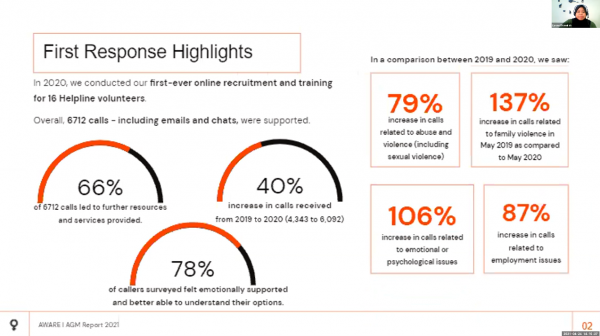
Liyana Dhamirah, Senior Programme Executive at the Women’s Care Centre (WCC), reported an increase in both calls and clients as the pandemic progressed in 2020 – a result of the global economic slowdown, rising unemployment and social isolation that took place.

WCC supported more than 4,900 women via their first response and direct service channels. The department also conducted its first-ever online recruitment and training, for 16 new Helpline volunteers. 

The Women’s Helpline managed to cope with a whopping 40% increase in calls, with 78% of callers reporting that they felt emotionally supported and better able to understand their options. Most notably, 2020 was the first year that WCC partnered with a Syariah law firm to provide improved access to Syariah legal support for women in need. 

Ashley Chua, Assistant Manager at the Sexual Assault Care Centre, said that 2020 saw SACC’s caseload topping 1,000 cases for the first time ever. Though the pandemic greatly limited their resources and capacity, the SACC team was ultimately able to handle this increase. The department was also proud of its continued collaboration with the Law Society and successful online training of more than 300+ defense lawyers.

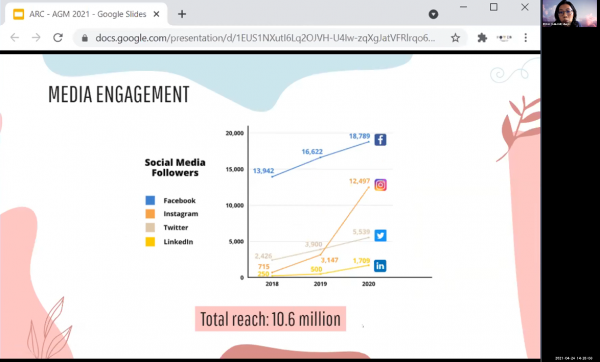
Ashley reported that the department’s two-year campaign, Aim For Zero (AFZ), had concluded at the close of 2020. During its run, AFZ posts had a total social media reach of nearly 2 million.

A key element of AFZ was the Sexual Assault First Responder Training (SAFRT,) which went online in 2020 and trained 400 participants. As it has a waitlist of some 200, SAFRT will continue to take place in 2021.

Filzah Sumartono, Projects Manager of AWARE’s Advocacy, Research and Communications department, pointed to the significant advocacy and research successes made by the team in eldercare, migrant spouses, domestic workers and sex education. 

Two major reports were published, one about migrant wives and the other migrant domestic workers providing eldercare (the first local study on this issue). Throughout the circuit breaker period, the department also conducted a series of surveys involving women from marginalised communities (in partnership with HOME and Singapore Alliance for Women in Ageing) to study how the pandemic affected these communities. In 2021, ARC decided to restructure its work around the national Gender Equality Review, recognising that it is a significant opportunity for AWARE to influence the national agenda on women’s rights.

Caroline Callow, Senior OD Facilitator at Catalyse, said the team had designed and delivered 59 online workshops in a single year. They successfully reached around 4,000 employees, via online workshops or new workplace policies they helped to develop. 

In 2020, three new workshops were introduced, including “Workplace Response to Family Domestic Violence”, which made its debut as a response to the spike in family domestic violence cases during COVID-19.  

Renee Tan, Head of Development and Partnerships

Renee Tan, Head of Development and Partnerships, reported on behalf of the Secretariat department that AWARE raised $2.9 million in 2020, the largest amount in its history. The team is heartened by the increase in individual donations as a result of its most successful online fundraising campaign, the Vulnerable Women’s Fund. The AWAREHouse Party, our first virtual event with pre-recorded and live elements, also raised over $500,000.  

At the Virtual Town Hall that followed the AGM, issues raised by members included how AWARE can continue its support for marginalised communities, such as single parents, transgender women and non-binary people.

Wrapping up the Virtual AGM and Town Hall, Margie expressed her special thanks to the staff of AWARE, noting that as a founder member, it was amazing to see how far AWARE has come in 35 years. She assured members that AWARE will continue to work towards an inclusive and equal society for years to come.

25 May 2021: Navigating the civil divorce process in Singapore

The decision to divorce is not an easy one. Often, it can be difficult to maintain a clear direction throughout the proceedings while managing your own emotions.

This webinar will cover some practical solutions and resources that women can use to navigate the legal proceedings with more ease.

Our speaker, Lim Shu Yi, will discuss making use of certain materials, including the forms, checklists and brochures available on the Family Justice Courts’ website, to help guide expectations before and during divorce proceedings. She will also explain how the Family Justice Courts and the family justice community can engender a shift in mindsets so that the resolution of family disputes need not be adversarial in nature – through a renewed vision of family justice, informed by principles of therapeutic justice.

You should attend if you are:

  • A Singaporean/PR/migrant spouse contemplating or undergoing civil divorce
  • A social service professional
  • Interested in learning about the divorce process and supporting your own family and friends


Date: Tuesday, 25 May 2021

Time: 8-9pm

Venue: Online (Zoom)

Register here!

Speaker: Lim Shu Yi 

Lim Shu Yi is a lawyer at Parwani law LLC. She was admitted as an Advocate and Solicitor of the Supreme Court of Singapore in 2019 after reading law at the University of Bristol. She trained and worked in a variety of firms in Singapore prior to being called to the Singapore Bar. Her experience in the legal industry has thus far included, but is not limited to, commercial real estate law, commercial and corporate law, due diligence, compliance, landlord-tenancy work, criminal defence litigation, general civil litigation, insolvency law, family law and mediation. Shu Yi is presently a member of the Association of Criminal Lawyers of Singapore.