
Author: Media Intern

Stop asking why she took the nude, start asking why he shared it

This op-ed was originally published in Channel NewsAsia on 5 May 2021.

SINGAPORE: It took unusual presence of mind from a National University of Singapore student for a new rash of Telegram chat groups circulating obscene images of women to come to public attention last month.

These groups were eerily similar to SG Nasi Lemak, which made headlines in 2019 for similar criminal activities, despite its shockingly high membership count (around 44,000 in one group alone), and the subsequent arrests of some admins.

Although most of us expressed disgust over the new groups, we ultimately moved on with our lives, like we have countless times before. These happen so often we are becoming inured to them.

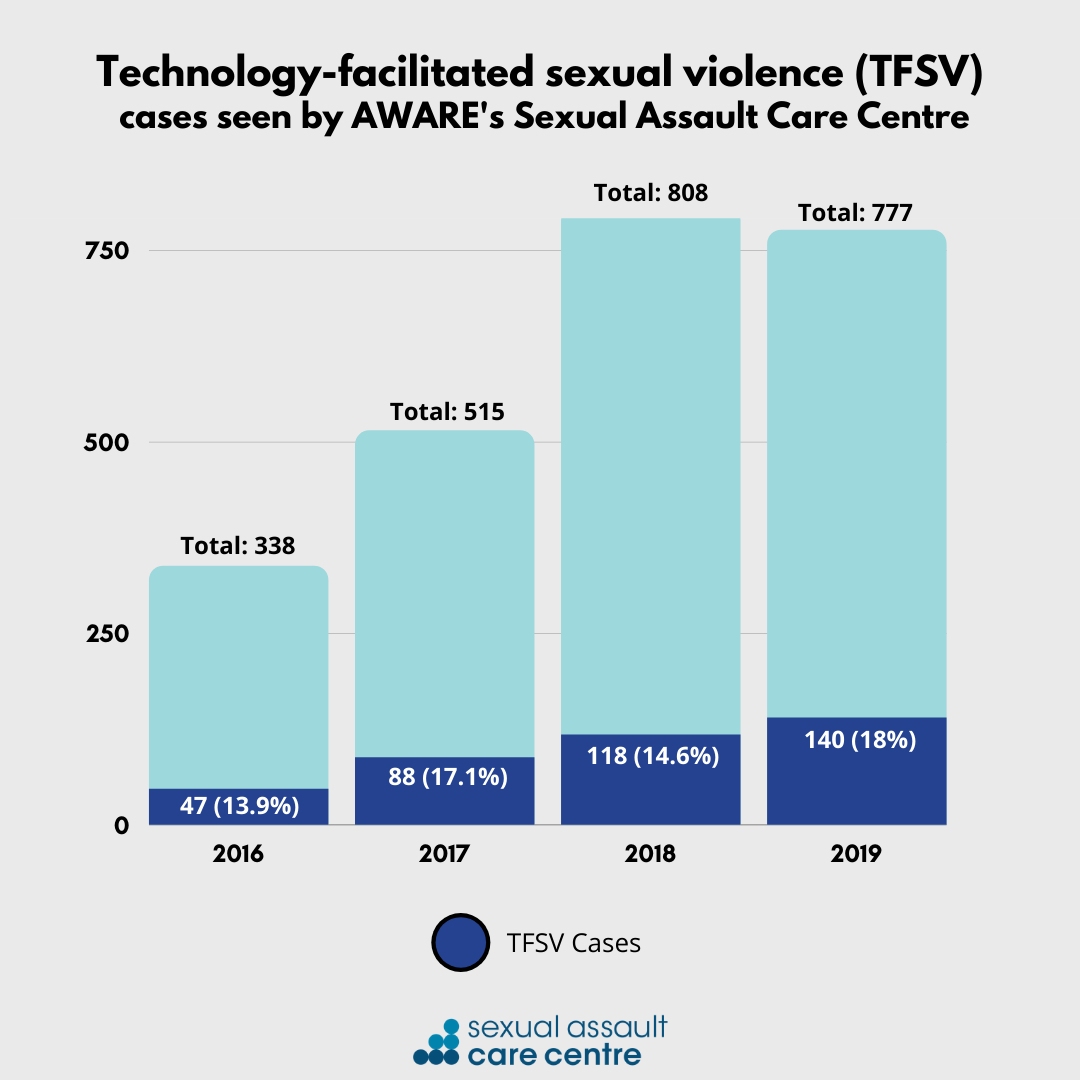
After all, in the year 2020 alone, AWARE’s Sexual Assault Care Centre saw 140 cases of technology-facilitated sexual violence, or TFSV.

Unfortunately, victims of TFSV do not always have the option to move on. In addition to experiencing levels of trauma comparable with survivors of physical assault, isolation from loved ones and potential professional repercussions, victims of TFSV also face the constant, inescapable threat of being violated repeatedly – whenever their photos or videos are shared non-consensually with new recipients.

When their images end up online, women are often blamed for having participated in their creation. Instead of asking “why would someone do that to her?” we tend to instead direct our ire at the person in the photograph, asking “why did you take that photo?”

We zero in on an individual woman and condemn her, without paying heed to the context in which the photo was taken or the content of the photo itself.

WHAT TYPE OF PICTURES GO ONLINE

Over the course of an eight-year relationship, Sara* exchanged intimate photos with her boyfriend.

But when she wanted to end things, he threatened to release those photos and videos if she went through with the break up. Scared and tired of the emotional abuse she was facing, she sought help from our centre.

Sara’s case falls into a first category of photos that are non-consensually circulated online. These are photos and videos co-created by couples in the context of a romantic, often sexual relationship.

The voluntary sharing of intimate photos can be an expression of love and intimacy. They form a part of the cultural phenomenon of “sexting”, an increasingly common part of adult romantic relationships.

But they transform into TFSV when they are shared non-consensually, either via hacking, or when the initial recipients or co-creators disseminate them without the victim’s knowledge and consent.

A second category of photos are taken by someone known to the victim, but their creation and dissemination are non-consensual.

We often see such visuals emerge in the context of domestic violence, with their production and distribution means of control.

A client of ours, Ayesha* shared that her ex-boyfriend forced her to take nude photos and videos and sent these explicit materials to her family members after she filed a police report against him for harassment.

The third category are photos obtained through voyeurism – including upskirting, and photos taken while a woman is sleeping or in the shower. These might be non-consensually created and distributed, or used for private “consumption”

Finally, we have innocent images taken from women and girls’ own social media accounts and shared on chat groups without their consent. While accounts might be set to public or private, the photos are subject to a torrent of sexualised comments and framing after being shared on illicit groups.

Often these users are tweens who post everyday photos of themselves and their friends on Instagram – enjoying a meal, goofing around in the park and in many non-sexual everyday activities. Sometimes the photos are digitally altered to exaggerate certain body parts.

In these Telegram chats, personal details of the victim, such as their name, address and links to social media profiles, are shared alongside visuals, turning non-consensual online circulation into offline abuse, including stalking, sexual harassment and assault.

The effects can be wide-reaching. Half of 1,244 victims who had reached out to the US Cyber Civil Rights Initiatives had seen their full names and social media profiles published alongside their images. Over 20 per cent reported that their email addresses and phone numbers were published along with their images.

ASSIGN BLAME ON THOSE RESPONSIBLE

It should be plain to see that perpetrators are culpable for TFSV, not victims. Taking a photograph of yourself, or posing for a photograph, does not hurt anyone. Sharing those photographs without consent does.

So it does not help to focus on what women did that resulted in these Telegram chats, or chastise them for innocuous behaviour.

Focusing on a woman’s behaviour (for example, the fact that she took an intimate photo) is at the very heart of victim-blaming.

We have seen a similar pattern of comments online regarding cases of sexual assault that fixate on the women’s decisions (for example, we question if they drank alcohol and what they wore) and their reactions in the aftermath of violence, which cleverly diminishes the responsibility of the perpetrator and transfers it to victims.

Survivors who face victim-blaming are less likely to make police reports and seek further support in their recovery journeys. But women should not be held responsible for the behaviour of their boyfriends, husbands, exes, voyeurs, stalkers, underwear thieves or bosses who send unsolicited pictures of genitalia.

Until we clearly identify the point at which violence occurs, and assign blame where it belongs, we won’t see any real progress. Photos and videos of women will continue to circulate without their consent, and without accountability on the part of perpetrators.

Teaching consent from a young age should not be a matter of choice. It should be made non-negotiable. For older children, the Council of Europe recommends that parents use real-life examples to explain the risks, dangers, and legal issues surrounding sexting.

If children find themselves exposed, they should have the tools to discuss how to report the offensive materials with a trusted adult and find affirming emotional support.

WHAT MORE CAN BE DONE 

Recent amendments updated Singapore’s Penal Code to be relevant to the “smartphone age” by criminalising voyeurism, non-consensual creation and distribution of intimate images, and cyber sexual exposure (i.e. vulgar images). However, despite this enormous progress, it’s clear we haven’t begun to solve the problem.

Clients of AWARE’s Sexual Assault Care Centre share with us the countless hours they spend tracking down images, filing takedown requests with individual social media platforms, changing phone numbers, deleting social media accounts – all to protect themselves from further harm and achieve a modicum of relief after their privacy and autonomy is violated.

Huge amounts of labour goes into those efforts. Yet we know that once a photo or video is out there on the internet, there’s no telling where it may end up. And the longer photos and videos stay online, the harder they become to remove.

We hope the new Protection from Harassment Act courts will be sensitive to these nuances, and allow the filing of cases and issuance of takedown requests to be processed within 48 to 72 hours.

We can model our system after other effective ones. Australia’s Office of eSafety Commissioner responds to complaints of image-based abuse within 48 hours of official reports being filed with them.

Social media platforms have a very important role to play here too. They must proactively implement steps to deter non-consensual photos or videos from being shared in the first place.

They should be required to share information across platforms so that a non-consensual image’s digital footprint can be used to prevent it from being uploaded on a platform after it has been taken down by another, instead of requiring victims to file complaints with each individual social media platform.

Social media platforms need to devote more human resources to tackling such cases and provide a clear time frame within which victims can expect assistance.

There’s much to be done before the horrible practice of TFSV can be put to bed. But just attacking women for sharing nudes is not one of them.

Shailey Hingorani, Head of research and advocacy, AWARE
Starting 1 July 2021: Revision of AWARE’s counselling fee structure

With effect from 1 July 2021, the fee structure for the Women’s Care Centre (WCC) and Sexual Assault Care Centre (SACC) counselling services will be changed.

These changes apply to all new and existing clients. If you are an existing client, you will be given a grace period. Please discuss this with your counsellor.

Fee changes as of 1 July 2021

  • The minimum fee has been increased from $20 per session to $35 per session. This means that if you are not working, or your monthly salary is below $3,000, you’ll pay a flat fee of $35 per session.
  • If your monthly salary is $3,000 and above, the percentage sliding scale applies. The scale will increase from 1% of monthly salary to 2% of monthly salary; i.e. you’ll pay 2% of your monthly salary per session. For example, if you earn $4,000 per month, your charge will be $80 per session.
  • There will no longer be a cap on the maximum fee amount per session.

For the last 10 years, we have done our best to keep AWARE’s counseling fee structure as low as possible, despite the increasing demand for services and operating costs. We have looked closely at the current market rates with other social services and analysed the impact this fee increase will have on our clients. This level of increase will mean that our services remain affordable, but also ensure that we can sustainably provide quality counselling that holds true to AWARE’s mission: non-judgmental, gender-focused support to women.

We understand that one’s financial status should not be a barrier for seeking help. Therefore, should you have any financial difficulties with the above fees, you may request a fee waiver. Please email wccadmin@aware.org.sg for more information.


Choice between motherhood and career shouldn’t have to be so hard

This letter was originally published in The Straits Times on 22 April 2021.

Journalist Malavika Menon’s column, “Hard choice between career and motherhood” (April 18), resonated with me as a new mother who values her career as a social worker.

My daughter is only five months old, and various obstacles have already cropped up for me.

One obstacle I have faced is the unequal amount of parental leave my partner and I have received.

My partner used all our shared parental leave, giving him a total of 30 days, while I had three months.

He had to return to work during my maternity leave, which meant I had to carry my baby more, going against my physiotherapist’s advice to not lift heavy things three months after the caesarean delivery.

Another issue concerns the question of working from home or returning to the office.

Both my partner and I have been lucky enough to work from home during the pandemic.

I experience a condition in which I feel a burst of negative emotions right before breastfeeding, and having my partner’s presence at home is very helpful for me to cope.

And though my partner sometimes finds working from home challenging, the flexibility and reduced travel time have given him more time with our child and equal involvement in her care.

However, the gradual return to working in the office has made us anxious about how our parenting situation might have to evolve.

We are having more frequent arguments about caregiving.

We have even discussed the possibility of one of us quitting our job if we cannot work from home.

My last set of worries centres on infant care. We have decided to register our daughter for half-day infant care so that I can return fully to my job.

However, affordable infant care is hard to get – our current best option is a centre 3km away, and we are still on the wait list.

I believe there are ways these challenges can be mitigated for all working mothers in Singapore.

For one thing, paternity leave should be longer.

Both parents should have three months dedicated to their newborn and post-partum recovery.

Second, we should legislate the right for all employees to request flexible work arrangements, so that parents can more easily manage their care and work responsibilities.

Lastly, affordable infant care should be made more accessible.

Ideally, priority can be given to single parents (who have greater need).

The choice between career and motherhood should really not be this hard.

Elizabeth Quek, Programme Manager, Support, Housing and Enablement (S.H.E.) Project, AWARE 

Why S’pore companies fail in getting more women on board

This op-ed was originally published in The Straits Times on April 15 2021. 

A recent survey by the Singapore Chinese Chamber of Commerce and Industry had a significant and alarming finding: two in five female respondents have experienced gender discrimination in the workplace compared with one in 10 men.

Although social media responses to the news largely consisted of denials (“Women love to complain”), knee-jerk reinforcements of gender norms (“Women are better housewives so they shouldn’t work anyway”) and general “whataboutery”, that statistic should raise concerns in anyone interested in equality and the health of Singapore’s economy.

Though sexist keyboard warriors would have you believe otherwise, gender discrimination is real. It manifests itself in many ways, such as in lower wages for women than men, unequal representation in management positions and as members of corporate boards, and unequal workplace norms.

On Sunday, the Council for Board Diversity revealed that although Singapore’s statutory boards, companies and Institutions of a Public Character did appoint more women to their boards last year, the increase still fell short of the council’s short-term target – 20 per cent female board membership by the end of that year. Indeed, last year, women made up only 17.6 per cent of the boards of the largest 100 primary-listed companies on the Singapore Exchange (SGX) – a measly 1 percentage point increase from the previous year.

In 2019, Singapore tied with Italy for countries with the highest proportion of female chief executives, but that figure was an embarrassingly low 15 per cent. Since senior leadership roles are a springboard for women to join company boards, we cannot consider the lack of gender parity on boards in isolation from women’s limited ascendancy to top management positions.

Women’s lack of equal representation in leadership is especially disappointing in Singapore, where they are as educated as men. The gender gap in university graduate cohorts has significantly narrowed, with women making up half of the resident population aged 25 years and above with university qualifications. Women enter the labour force in similar numbers, too: Participation rates of men and women aged 25 to 29 in 2019 were nearly identical, at 90.1 per cent and 90 per cent, respectively.

Let’s examine the ways we have allowed gender discrimination to persist.

Why so few women at the top?

In 1986, The Wall Street Journal’s Carol Hymowitz and Timothy Schellhardt introduced a metaphor – the glass ceiling – to explain the pronounced lack of women in top management and leadership positions. “Even those few women who rose steadily through the ranks,” they wrote, “eventually crashed into an invisible barrier.”

However, a glass ceiling suggests a singular barrier that women will inevitably hit when they try to ascend to influential leadership roles. But the image flattens out the complex and varied challenges women face throughout their careers – not only when they try to make the leap to senior management or leadership positions.

Women and men tend to be clustered in different occupations. Employers often perceive certain jobs as more suitable for one sex than the other. Women are thus frequently found in occupations that are seen as an extension of their so-called “natural” reproductive, nurturing roles. Indeed, according to the Ministry of Manpower’s 2020 paper on the gender gap, the distribution of full-time resident employees aged 25 to 54 shows that women have largely remained in “traditionally female occupations”: nursing, teaching, administration and so on.

Management functions tend to be gender-segregated too. According to an International Labour Organisation (ILO) report on overcoming gender segregation in management occupations and business in Asia and the Pacific, women are usually clustered in areas such as human resources, financial administration, corporate social responsibility and public relations.

As a result, women find it difficult to gather the kind of diverse and broad experiences that are often preconditions for top management positions and, subsequently, for boards.

There’s also research to show that women’s careers typically halt at the middle management level. Consider findings of a 2015 ILO report which found that, although women make up half of middle management globally, only 5 per cent of the CEO positions of publicly listed Organisation for Economic Cooperation and Development companies belong to women.

Their careers are being stalled because of unrealistic demands on their time: ILO estimates that women in the Asia-Pacific spend 4.1 times more time on unpaid care and household chores than men.

How could those responsibilities not hold women back from management roles requiring long hours on weeknights and weekends?

Why are board positions not diverse enough?

First, board recruitment often relies on personal networks. Eighty-nine per cent of the 780 SGX-listed companies surveyed by the Ministry of Social and Family Development in 2014 reportedly utilised personal networks for board recruitment, with 42 per cent using this as their sole recruitment tool. For many reasons, women often do not have access to male networks.

Second, group member demographics play an influential role in how new members are selected. People who are similar to one another feel more comfortable and satisfied working together. So what a 2018 BoardAgender report suggests is hardly surprising: Current composition frequently dictates future composition of boards.

Third, we continue to implicitly associate leadership with men and masculinity. Many employers still associate the qualities required to be a good manager, such as assertiveness, independence and a willingness to take risks, with inherent maleness. A 2016 survey by recruitment firm Randstad found that 76 per cent of Singapore employees prefer a male boss.

Finally, boards are not renewed frequently enough. In 2016, the average directorship tenure in Singapore (9.4 years for male directors and 7.4 years for female directors) was significantly longer than that in the region (3.1 to 8.7 years and 2.4 to 5.8 years for men and women, respectively). These figures suggest that boards in Singapore are relatively entrenched. As a result, aspiring female directors have fewer opportunities to be appointed.

Benefits of a gender-diverse organisation

There’s plenty of research to suggest that an increase in female board representation and company leadership improves decision-making. Benefits include the availability of more diverse perspectives, more ethical governance behaviour and increased access to resources and expertise. Gender diversity is positively associated with the company’s business performance.

Despite this, gender equality in leadership and board positions is unlikely to happen on its own.

Deloitte’s Women in the Boardroom report catalogues the diverse approaches countries have taken to ensure greater board diversity: Some countries have relied on gender quotas, whereas others – such as Australia, New Zealand and Britain – have promoted gender diversity through target setting and corporate governance recommendations. Singapore’s approach is more closely aligned with the latter. Yet, as the Council for Board Diversity’s update shows, our measures are falling short of even modest expectations.

To really improve in this area, we need to take a more ambitious and expansive tack.

We have to focus our efforts at earlier points in women’s career trajectories. We need to build workplaces that recognise the roles that employees play outside of work, and support them in dispensing those responsibilities.

Employers can do this, for example, by providing flexible work arrangements and paid caregiving leave, and by giving women more opportunities to manage high-value assignments, which research suggests is a good predictor of success later in their careers.

The success of Singapore women means the success of Singapore businesses. So more effort should go into creating the sort of environment that allows women to thrive across their entire careers.

Shailey Hingorani,  Head of Research and Advocacy, AWARE


Normalise flexi-work arrangements to alleviate burden on working caregivers

This letter was originally published in The Straits Times on April 15 2021.

Eldercare has rightly been discussed as a matter of national concern.

Research by the Association of Women for Action and Research (Aware) in 2019 found that many women experience a change in work situation because of caregiving. These women suffered on average a 63 per cent loss in income, or an average annual loss of $56,877.

Aware and other advocates have long highlighted the role that flexible work arrangements (FWAs) can play in alleviating the burden on working caregivers. So it’s time Singapore took bigger strides forward to normalise FWAs, for the sake of all who perform care.

So far, through the Work-Life Grant, the Government has adopted an incentive-based approach to get employers in Singapore to offer formal FWAs.

The Tripartite Alliance for Fair and Progressive Employment Practices has also released resources for companies to support the implementation of FWAs.

This is a start. But a survey commissioned by technology firm Polycom suggests that FWA take-up rates in Singapore remain low. And the Manpower Ministry’s 2018 Comprehensive Labour Force Survey found that one in four female residents outside of the labour force had cited familial obligations and caregiving as the reason for exiting the workforce.

It seems, therefore, that leaving employers to develop their own FWAs does not go far enough to help working caregivers balance job and family responsibilities.

The problem is that the mere existence of FWA guidelines does not translate into effective utilisation.

Inflexible and unsupportive organisational cultures persist, creating environments where asking for FWAs is taboo.

Employees fear that their performance assessments will suffer if they reduce face time with their managers.

Polycom found that out of seven in 10 employees whose companies offered FWA out of the office, only half were able to take advantage of them.

We need to eradicate archaic beliefs around productivity and commitment to work. Long hours in the office (or in our virtual offices) do not directly correlate with higher rates of productivity and efficiency. So workers with caregiving responsibilities should not be embarrassed or afraid to ask for FWAs, or be penalised for doing so.

The Government should consider adopting legislation that makes requesting FWAs a right for all employees (including those working part-time).

Such a law would necessitate a formalised human resources process that is supportive of all employees.

FWA legislation should also include the fact that requests should be denied only for serious business-related reasons.

During the Year of Celebrating SG Women, this would be a fantastic way to mitigate the burden on workers who are forced to make a choice between staying gainfully employed and caring for their loved ones.

Mamta Melwani

Senior Executive of Workplace Harassment and Discrimination Advisory, AWARE

Singapore’s streets are comparatively safe, but women still face sexual danger

This commentary was originally posted on CNA on 1 April 2021.

SINGAPORE: On Mar 3, 33-year-old marketing executive Sarah Everard went missing in London while walking home from a friend’s house at around 9pm.

About a week later, a London police officer was charged with her murder. Hours after his appearance in court on Mar 13, the Metropolitan Police clashed with civilians who gathered to mourn Everard’s death and protest the lack of security women feel when out alone.

Due to coronavirus restrictions, the Met Police said any vigil “would be unlawful and unsafe”. Video footage revealed scuffles and police officers forcing women to the ground, while witnesses report police dragging several women away.

Sarah Everard’s case has triggered debate worldwide about women’s safety in public spaces and how those in charge fail, or even betray, the people they are meant to protect.

The streets of Singapore may be much safer for women than the streets of London. After all, Singapore is consistently ranked as one of the world’s safest cities.

But the relative safety of Singapore’s public spaces belies the constant threat of sexual assault and harassment in other spaces. A recent spate of cases show how women and girls are vulnerable in private-hire vehicles, classrooms, hotel rooms and their own homes.

Earlier this month, on Mar 8, we celebrated International Women’s Day. Yet on that day, two men were sentenced to jail and caning for sexual crimes.

One man sexually abused his four-year-old daughter multiple times over the course of a few months, while the other, pretending to be a Grab driver, offered a woman a lift home then molested her in the back of his van.

Since Mar 8, there have been at least a dozen other reports in the media of court cases of sexual offences – rape, molest, upskirt video filming and stealing women’s underwear.

We couldn’t wait to put the illicit SG Nasi Lemak Telegram chats behind us. And yet on Tuesday (Mar 30), the police are investigating new chat groups sharing obscene visuals of women including commuters on the MRT or girls in school uniforms, many without the subjects’ consent.

TOO MANY CASES GO UNREPORTED

These were just the cases that were reported. But far too many continue to go unreported.

In the US, as many as three in four sexual assaults may go unreported. The World Health Organisation says in Latin America, only around 5 per cent of cases of adult sexual violence are reported to the police.

In Singapore, while more women are these days ready to report incidences of sexual assault, many still hold back, for a variety of reasons.

They may feel they do not have strong enough evidence for a police report, or if the perpetrator is someone they know, such as a family member, they may be reluctant to get that person into trouble. Others may not want to have to relive the trauma, or they feel no-one is going to believe them.

At AWARE’s Sexual Assault Care Centre, only three in 10 clients decide to file police reports.

THE NEED FOR EDUCATION

Concern about the seemingly growing incidence of sexual assault and harassment led Law and Home Affairs Minister K Shanmugam to announce the raising of maximum penalties for certain sexual offences, including molest and carrying out sexual activity in the presence of a minor.

He also declared last September that it is vitally important for boys and girls to be taught at a young age that they should respect each other. Gender equality must become a fundamental value in Singapore if we are to have any hope of reducing the number of these cases, he said.

Mr Shanmugam is absolutely right. We need major shifts in mindsets, norms and patterns of behaviour, and for this to happen the messaging and the teaching needs to start when kids are very young.

But will the policymakers be able to do what’s necessary?

A critical part of this teaching will have to be about sex and sexuality. Kids need to learn how to handle relationships, they need to understand the concept of consent and why it is so important.

And they need to learn about sex and sexuality and the various forms of sexual desire, including the fetishes that drive some people to steal underwear, film people in the shower and so on.

These lessons have, of course, to be age-appropriate, but at some point our young will need knowledge and understanding of the full spectrum of human sexuality. Those who find themselves drawn to behaviour that may get them into legal and other trouble need to know they should seek professional help.

SQUEAMISH ABOUT SEX ED

Many are still squeamish about having frank conversations around sex and sexuality. A 2020 survey conducted by AWARE and independent research agency Blackbox found that only half of 564 surveyed parents felt comfortable talking with their children about sex, with a quarter worrying the discussion would encourage their children to have sex.

These parents might prefer that their children’s education on sexuality start and end at abstinence until marriage.

However, a 2009 UNESCO review of sexuality education programmes around the world found that programmes that emphasised condom and contraceptive use alongside abstinence were more effective than abstinence-only programmes at three important goals: Delaying students’ initiation of sexual intercourse, decreasing the frequency of sexual intercourse and decreasing the number of sexual partners.

And the United Nations Population Fund’s 2015 Evaluation of Comprehensive Sexuality Education Programmes notes that young people who undergo comprehensive sexuality education “adopt more egalitarian attitudes about gender roles” and are “less likely to be in relationships characterised by violence”.

Sexuality education in our schools is guided by the Education Ministry’s curriculum, which it describes as “holistic and secular”. It is taught, MOE says, “in the context of mainstream national values, according to students’ development needs”.

How these values are interpreted, however, is to some extent down to schools and teachers in classes conducting them. The recent case involving a transgender student whose charges were refuted by MOE shows there are tensions which cannot be easily resolved.

But finding a way to address changing norms and behaviours is an important part of the discussion we will need to have.

TRAINING BYSTANDERS

What is also needed is education about the role of bystanders. We all need to understand what is right and what is wrong, and what we can and should do when we witness or hear about instances of wrong behaviour.

If we see a couple fighting, and the man appears to be hurting the woman, should we intervene? If a man appears to be pressing himself against a schoolgirl in a crowded bus or train, should we do something?

And if a colleague or friend or family member looks troubled and hesitantly begins to tell you about an incident of sexual assault, will you be able to respond with the empathy and support they need? Many people will not know what to say or do.

This is where public education programmes like AWARE’s Sexual Assault First Responder Training will help. The AWARE workshop, which is open to all members of the public and schools, explains what is sexual assault and harassment; what is consent; how sexual assault affects survivors, and how we can provide support.

Finally, what is perhaps most needed as we try to reduce the incidence of all forms of sexual assault is for men to stand up and speak out about the bad behaviour of other men.

Take a stand against boorish behaviour, the locker-room talk and sexist jokes that pitch men as the sexual conquerors and women as the submissive vessels for men’s pleasure.

The times have changed. Men need to catch up.

Margaret Thomas, President of AWARE

A Recap: Violence in a Click, a panel discussion on technology-facilitated sexual violence

Written by Danesha Shah

On 6 March 2021, AWARE hosted a virtual panel, Violence in a Click—how do we close the tab on tech-facilitated sexual violence?, with the support of the High Commission of Canada.

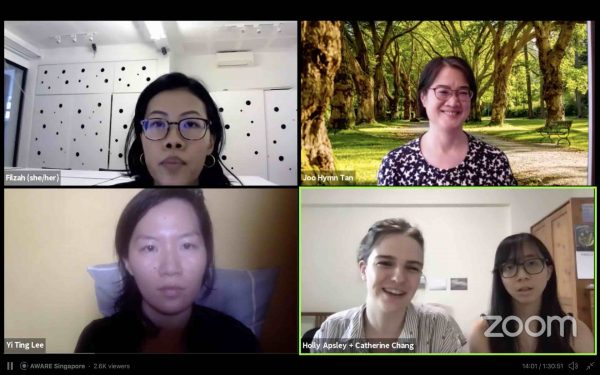
The panel included the two teams working with AWARE under the “Taking Ctrl, Finding Alt” grant: Catherine Chang and Holly Apsley, who are currently developing a website for people experiencing online abuse in Singapore; and Lee Yi Ting, who is conducting research on image-based sexual abuse. They were joined by Tan Joo Hymn, facilitator of AWARE’s sexuality education programme for parents, Birds & Bees. The event was moderated by AWARE Projects Manager Filzah Sumartono, and was livestreamed on Twitter.

TFSV, or technology-facilitated sexual violence, is a type of sexual violence enabled by digital communications technology, such as social media and messaging platforms, digital cameras and dating and ride-hailing apps. These behaviours range from unwanted, explicit sexual messages and calls, to the creation, obtainment and distribution of sexual images without consent.

Based on interviews with survivors of TFSV, Holly explained that an important first step in their seeking help after an incident is recognising their experiences as sexual violence in the first place—as many think of violence as manifesting only as physical assault. She noted that this is why first responder training is important, as common victim-blaming reactions only serve to reinforce harmful myths about TFSV that prevent survivors from accessing support.

Similarly, Catherine said that many victims of online sexual grooming erroneously blame their own natural curiosity about sex, instead of perpetrators’ predatory behaviours, as the reason for their abuse.

When it comes to legal recourse after an experience of TFSV, Holly said that the prospect could be fairly complex. Although victims may be aware of some of the options that exist—such as pursuing a Protection Order under Singapore’s Protection from Harassment Act (POHA)—they anticipate that the process would be expensive and emotionally taxing.

Yi Ting added that seeking help from the authorities might also expose victims to retraumatisation and discomfort, for example when official personnel themselves examine the victims’ images.

Holly and Catherine explained that survivors can issue a Digital Millennium Copyright Act (DMCA) takedown order to websites hosted in the United States that contain their non-consensual images. However, it can be difficult for survivors to issue DMCA takedown orders, as images may be uploaded to and shared between an unlimited number of websites around the world every day. Although survivors can hire third-party takedown services, one of the team’s research respondents had said that these services charged her USD$199 for every website they contacted on her behalf. This process was obviously financially unsustainable (in addition to being retraumatising). Additionally, as the DMCA is a U.S. copyright law, it is only legally binding for websites hosted in the U.S., which limits the effectiveness of this option.

Other than financial constraints, some survivors may be unable to successfully remove or limit the spread of their images due to loopholes within platforms’ policies. For instance, one respondent had been unable to take down a link to an explicit picture of herself on Twitter, as the tweet itself did not contain the image. She found it difficult to dispute decisions made by the platform.

The panellists also discussed online pornography platforms as key players in the landscape of TFSV, both because they host many non-consensual videos, and because even consensually produced porn can impart harmful values in the absence of further conversation and education. Joo Hymn noted that because youth are being exposed to porn at increasingly younger ages, it’s imperative for parents and educators to teach that porn is produced for specific purposes, and often portrays unrealistic and non-consensual scenarios.

Holly added that these conversations must make clear the ethical differences between watching consensually produced pornography and viewing or sharing images produced or uploaded sans consent.

Joo Hymn stressed the importance of providing comprehensive sexuality education in schools as a means of tackling TFSV. She lamented that understanding of consent is so lacking, people often do not even think about asking for consent in everyday situations—e.g. when individuals take pictures of others and upload them onto social media without asking.

During the Q&A segment, the panellists addressed several questions that attendees posed via the chat.

One attendee asked about common myths surrounding TFSV. Yi Ting reiterated that many do not see it as a “legitimate” or “serious” form of sexual violence, while Holly highlighted that TFSV is often seen as a “women’s issue” although people of all genders experience it. Catherine pointed out that some oft-overlooked parts of survivors’ experiences include social isolation and practical changes to their daily life: Some survivors she had interviewed had changed their habits, for example paying for Grab rides instead of taking public transportation.

The panellists agreed with an attendee that a dedicated TFSV helpline would be helpful for survivors, pointing out that dealing with TFSV without external support is labour-intensive for survivors and emotionally taxing. Yi Ting added that an NGO that worked directly on TFSV, e.g. by organising support groups for survivors or facilitating digital security training, would be welcome.

Holly spoke about the importance of having workplaces that are understanding and supportive of employees who experience TFSV. For instance, workplaces can support an individual who is being targeted with harassment or stalking through a simple action like removing their email address from a company website, or allowing them to use a generic email ID that does not include their name.

Yi Ting stated that all companies, including social media companies, search engines and porn sites, need to be more responsible for ensuring that non-consensual images are not hosted.

As new cases of voyeurism and other forms of TFSV are increasingly reported in the media, Singaporeans are becoming more interested in curbing such acts of violence. Having conversations like this is critical in raising awareness and sustaining pressure on local stakeholders to urgently address TFSV.

View the slides from Violence in a Click here.

AWARE’s participation in the 38th Universal Periodic Review Pre-session

Together with 10 other civil society organisations, AWARE submitted a joint report to the Human Rights Council in October 2020. The report covered a wide range of human rights issues in Singapore. In the area of women’s rights, issues raised included the persistence of the gender wage gap; violence against women; discrimination against Muslim women and migrant women. 

We then made an oral presentation at the 38th Universal Periodic Review (UPR) Pre-session held on 25 March 2021. The Pre-session offers civil society groups a platform to directly advocate to state delegations ahead of the UPR session; state delegations can ask civil society representatives clarifying questions. 

Singapore’s Pre-session opened with a statement by Mr Umej Bhatia, Singapore’s Permanent Representative to the United Nations Office in Geneva. The statement laid out Singapore’s general approach to human rights, with an emphasis on creating “careful balance” between respect for “individual rights” and “social harmony” because of Singapore’s “unique” circumstances.  

AWARE’s statement focused on two issues: first, the under-reporting of sexual violence, and second, the vulnerability of migrant women to family violence. To address the former, we called on the government of Singapore to establish specialised courts to deal with sexual violence cases, and commit resources to support efforts in eradicating rape myths. To better protect migrant spouses, we recommended that they be granted the right to seek another sponsor or be able to self-sponsor their right to reside in Singapore, in the case of spousal abuse.

Representatives from Community Action Network, Disabled People’s Association, Oogachaga, TWC2 and Amnesty International also delivered a statement focusing on their respective areas of concern. 

Singapore’s UPR is scheduled for 12 May 2021, during the 38th session of the UPR Working Group. We hope that the recommendations raised at this Pre-session, as well as in other civil society submissions, will be reflected in the final list of recommendations made to the Government. 

24 April 2021: Notice of AWARE’s 36th Annual General Meeting (Virtual)

Our 36th AWARE Annual General Meeting (AGM) will be held on Saturday, 24 April 2021. It will be virtual (via Zoom), because of the continuing restrictions on large gatherings. 

We will start at 2pm and plan to wrap up the formal meeting by 3.30pm. We hope you will then stay for a virtual Town Hall, from 3.30pm to 4.30pm. 

We will soon be starting work on AWARE’s strategic plan for the next five years, and we want to hear your thoughts about the path ahead. 

So let’s have a chat about these matters after we’ve completed the formal AGM on 24 April. 

Details of the virtual AGM

The Notice for the 36th AGM can be found here and will be sent to members on 26 March 2021. The AGM is a members-only event. If any AWARE member has not received an email with the Notice of the AGM, they should contact membership@aware.org.sg.

Pursuant to the COVID-19 (Temporary Measures) (Alternative Arrangements for Meetings for Registered Societies) Order 2020, the AGM will be held as follows: 

a) Members may only attend the AGM by observing and listening to the proceedings via Zoom. Please register for the virtual AGM at tinyurl.com/awareagm2021registration by 2pm, 22 April.

b) Members will not be able to submit questions live at the AGM. Instead, all questions must be submitted in advance by email or post or via the registration page by 18 April.

c) Members may only vote BEFORE the AGM by submitting the Proxy Form online or by email or post by 2pm, 22 April. There will be no live voting during the AGM.

Please note that you may vote, using the Proxy Form, even if you are not able to attend the Virtual AGM. You may also choose to attend the Virtual AGM and not vote.

As it is not a Board election year, most of the matters for consideration at the AGM will be routine, but you will have to vote on one non-standard item, which is a resolution to pass some changes to the Constitution of AWARE. 

REMINDER: The AGM is open to AWARE members only, namely: current members, renewed members whose past membership lapsed not earlier than 24 April 2019, and new members who joined us as a member before 13 March 2021

If your membership has expired not more than 2 years before the General Meeting, or is close to expiry, it is time to renew it to ensure that you can attend the AGM. To check or renew your membership, login to our Membership Portal with your login name and password. 

You may contact membership@aware.org.sg if you have any questions.