Author: Comms Executive

24 Feb, 3 & 10 Mar 2022: Birds & Bees, A Workshop For Parents

Most parents believe that it is important to talk to their children about sex, but many are unsure how to do it. Or, when to start having these conversations and about what. Where do children get answers to the questions they can’t ask their parents? The internet is one source, and young people themselves say they are most likely to ask peers and romantic partners. Wouldn’t you rather they turn towards you? The “ask-able” parent who is open to questions, ready to make an effort to listen without judgement and engage in a dialogue?

Who should attend:

Parents with children of all ages will benefit, although parents with tweens and teens are more likely to find the case studies and discussions in groups immediately relevant.

Date: Consecutive Thursdays – 24 Feb, 3 & 10 Mar 2022 (Participants are expected to attend all three sessions)

Time: 8PM – 930pm

Workshop Fee: $20 (in total)

Survey: After you sign up, you will be asked to complete a short pre-workshop survey about the age(s) and number of your children. This is very important so that parents with children of similar ages can be grouped together to that you will get the most out of the workshop.

Special instructions for online workshop: As small-group discussions are a big part of the workshop, participants are expected to switch on their video as well as audio whenever possible, and to join in the discussions for maximum benefit.

Refunds and cancellations: Unfortunately we will not be offering refunds. In exceptional circumstances, if you are unable to attend the subsequent sessions, you will be able to join the next set of workshops if you write in to publiceducation@aware.org.sg in advance giving your reasons.

What the workshop will cover:

1. Communicating with your children

  • The importance of active listening
  • Tips on having constructive conversations

2. Consent

  • What is consent
  • The gold standard for consent
  • Consent in real life

3. Being an “ask-able” parent

  • Exploring own attitudes and value systems
  • Broaching awkward topics

4. Relationships

  • Signs of healthy and unhealthy relationships
  • Sexual Assault
  • Navigating the online world

Attend this workshop to explore how you can work on developing your own strategies to enhance the trust and bond with your child! Places are limited, so do sign up quickly!

**If you would like to join the workshop but cannot make it at this time, please fill in the indication of interest form.

Register here!

Anti-discrimination legislation should be comprehensive

This letter was originally published in The Straits Times on November 19 2021. 

Since the announcement in August that anti-discrimination legislation will be enacted, both the public and parliamentarians have raised relevant questions about what the legislation entails and its implications (What’s needed in new laws to ensure fair play at the workplace?, Nov 13).

However, there are some concerns regarding the new laws that suggest an incomplete understanding of the reality of workplace discrimination.

To ensure that the anti-discrimination legislation is comprehensive, all vulnerable groups must be protected.

Currently, the Tripartite Guidelines on Fair Employment Practices that will be enshrined into law protect employees from discrimination on the basis of age, race, gender, religion, marital status and family responsibilities, and disability.

Absent is any mention of discrimination based on gender identity and sexual orientation.

Workplace harassment should also be categorised as a form of discrimination under the new law.

Discrimination can be expressed through harassment, such as in instances where employers or co-workers create a hostile, intimidating or threatening work environment through words or actions.

Marginalised groups, including LGBTQ (lesbian, gay, bisexual, transgender or queer) people, are more vulnerable to harassment due to deep-seated discriminatory stereotypes.

The upcoming legislation should also be accompanied by relevant examples to provide clarity on different forms of discrimination. Indirect forms of discrimination tend to escape attention. Indirect discrimination results from policies that apply to everybody at the workplace, but disproportionately affect a marginalised group.

Another obstacle that should be addressed is that of under-reporting. A national survey by market researcher Ipsos and the Association of Women for Action and Research this year showed that only three in 10 victims of workplace sexual harassment filed official reports. As Straits Times senior political correspondent Tham Yuen-C points out, there is a fear of retaliation or damage to one’s reputation that can hold victims back from reporting.

To reduce the barriers faced during the reporting process, the new legislation should offer victims and witnesses better protection from retaliatory action by perpetrators and employers.

Legislation alone cannot eradicate discrimination. However, at the minimum, it will set out clear standards for businesses, and offer employees far-reaching legal protection and recourse. Other policies, including mandatory anti-discrimination training, have to be developed in tandem to bolster workers’ safety, well-being and productivity.

Apoorva Shukla,
Executive, Workplace Harassment and Discrimination Advisory 

A Recap: Fair Enough? Towards an anti-discrimination law for Singapore (online panel)

Written by Erynn Lau, Junior Executive, Catalyse

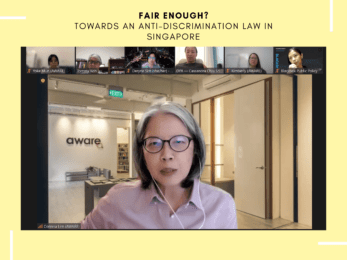
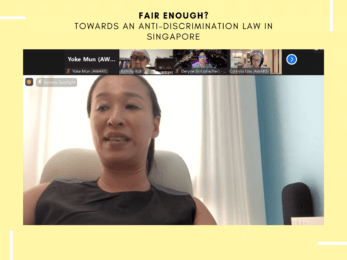
On the last Thursday of October, 150 listeners came together over Zoom for the virtual panel Fair Enough? Towards an anti-discrimination law for Singapore.

Our speakers that afternoon hailed from across Singapore’s civil society: AWARE Executive Director Corinna Lim; Cassandra Chiu from Disabled People’s Association (DPA), and Deryne Sim of Pink Dot. Also present were David Black, founder and CEO of Blackbox Research, and Adelene Ong, Blackbox’s Public Policy Research Director, who presented findings from a new Blackbox survey on workplace discrimination in Singapore.

Tying everything together as the moderator was Professor Tommy Koh, Ambassador-at-Large at the Ministry of Foreign Affairs, Rector of the Tembusu College at NUS and Special Adviser to the Institute of Policy Studies.

The event was catalysed by Prime Minister Lee Hsien Loong’s announcement, during this year’s National Day Rally, of new legislation to target workplace discrimination, which would enshrine into law existing guidelines from Tripartite Alliance for Fair and Progressive Employment Practices (TAFEP). Taking this—in the words of Professor Koh—”historic opportunity to help our government formulate new anti-discrimination legislation”, the panellists set out their shared commitment to combat workplace discrimination of all forms.

From data-driven insights to our speakers’ emotive personal accounts, here are our key takeaways from the event:

1) The reality: What does discrimination look like?

According to Blackbox’s survey of 1,000 people aged 15 and above in Singapore, 19% and 15% of the respondents said that they have personally experienced sexism and sexual harassment in the workplace respectively. Additionally, 8% reported that they faced homophobia and 7% felt that they were subjected to transphobia, while 6% said that they were discriminated against on the basis of their disabilities.

Following these statistics, the panellists talked about their own lived experiences with workplace discrimination, as well as how discrimination affects the communities they serve, in these four areas: hiring, retention, career growth and mediation.

Within hiring, Cassandra described the inner battle faced by applicants with disabilities in deciding whether to disclose their disabilities to interviewers, and risk not receiving a call back.

As for lesbian, gay, bisexual, transgender, queer and other sexual and gender minority (LGBTQ+) applicants, Deryne shared data from a 2018 Asia Pacific Transgender Network report that found that cisgender applicants received 81.5% more positive responses for job applications than transgender applicants, even though they have similar qualifications and experience.

All panellists agreed that fair employment practices should be extended to this stage of employment, such that hiring practices centre solely on the skills pertinent to the job. If that was the case, Cassandra said, Singapore would be able to raise the employment rate of persons with disabilities, which currently stands at a disappointingly low figure of 28%.

Corinna brought up maternity discrimination as one of the more common forms of gender-based discrimination seen in Singapore. Out of the 67 discrimination cases seen by AWARE’s Workplace Harassment and Discrimination Advisory (WHDA) in 2020, a full 48 pertained to maternity discrimination. Corinna described the different ways that maternity discrimination manifests: from being told not to get pregnant “early in the job”, to receiving poor performance reviews after pregnancy despite having a good track record prior.

2) Community-based support: What protects complainants from retaliation?

As the discussion progressed, panellists gave an overview of options for discrimination victims.

Asked about the efficacy of community-based support services and processes for those seeking recourse, Corinna observed that the experience of AWARE’s WHDA has brought to light the limitations of existing channels for recourse.

Blackbox’s survey found as well that awareness surrounding available community-based support services is lagging: Respondents seemed largely unfamiliar with a wide range of services that could assist them with workplace discrimination. For example, 54% of respondents indicated that they were unfamiliar with the types of support offered by TAFEP for workplace discrimination cases.

As such, those desperate for justice may turn to social media, a high-risk move that may easily backfire on them. 

To make the recourse process safe for all parties, panellists agreed, all official channels for reporting discrimination should be trauma-informed, as well as LGBTQ+- and gender-informed.

3) Wishlists: Ensuring better protections by law

Speakers reflected that while some cases of workplace discrimination blow up in the news, many more cases of discrimination go unreported, especially without adequate reporting or processing mechanisms. Higher proportions of discrimination are also observed in minority communities. For instance, the Blackbox survey findings show that ethnic Indians (54%) and Malays (50%) were twice as likely as Chinese (21%) to report having personally experienced race-based discrimination in the workplace.

Corinna explained why harassment should be covered in law as a form of discrimination. This translates to companies being held accountable when a report of workplace misconduct has been made. As a baseline, firms should be held liable if no reasonable steps were taken to process a report of workplace wrongdoing.

On top of this, panellists were in agreement over the inclusion of specific diversity categories. Firstly, disability and mental health must be protected, noted Cassandra. Declarations of mental health status in the hiring process should be removed, unless directly relevant to the position advertised. 

Secondly, as both Deryne and Corinna pointed out, legislation should include mention of gender identity and sexual orientation in order to protect sexual and gender minorities. While the Prime Minister did mention gender as a protected category in his NDR speech, no mentions of gender identity or sexual orientation were made, a fact that concerned our panellists.
4) Calls to action

This new legislation is only the start. Firms and institutions play their own role in providing inclusivity training for employees on managing unconscious bias. As Corinna said, the work of AWARE’s corporate advisory arm, Catalyse, shows that this scales up education dramatically and has a great positive impact.

Pamela Chng, the founder of Bettr Barista, a home-grown specialty coffee company with inclusive employment practices, was invited to speak for a few minutes about her experience as an employer seeking to stamp out discrimination. Firms and institutions, said Pamela, should focus on implementing structural changes to shape the organisational perspective. For example, businesses can include anti-discrimination policies in their Employee Handbook and during the on-boarding of all staff, and detail in their handbook how policies also apply to recruitment. Medical benefits should aim to include mental health and counselling. 

At the individual level, we can also play a part in combatting discrimination. Some recommendations from Cassandra included educating yourself to be a better ally who can call out discrimination when it occurs.

In their concluding remarks, panellists urged the government to consider the specific needs of marginalised Singaporeans at this crucial and opportune moment.

“Discrimination is about all of us, so we all hold responsibility,” said Corinna. It will take the combined effort of each member of society to eradicate it.

Deryne reminded participants of the importance of LGBTQ+ inclusion in legislation, to counter the discrimination which stems from the continued retention ofSection 377A. 

Meanwhile, Cassandra encouraged everyone to “be kinder, stand in other people’s shoes, and have empathy, [so] Singapore can be a more inclusive place”.

“The law is not enough,” Professor Koh reiterated to end off. “Beyond this, we must work to change culture and mindset. In these two respects, there is a lot of work for us to do!”

Limited service for AWARE’s CARE and WHDA services: Dec 2021-Jan 2022

Our Women’s Care Centre, Sexual Assault Care Centre and Workplace Harassment and Discrimination Advisory will provide limited service over December 2021 and January 2022, to allow us to make some operational changes that will strengthen our capabilities into the new year. All our operations will fully resume from 10 January 2022 onwards.

We seek your kind understanding and patience during this period.

For emergencies, please call 999 for the police. You can also call 1800 221 4444 for the Samaritans of Singapore (SOS) if you have thoughts of hurting yourself, including thoughts of suicide.

 
Sexual Assault Care Centre (SACC)
Limited service period 13th December 2021 – 7th January 2022
What is open?

SACC Helpline (6779 0282) will operate between 10am and 3pm from Mondays to Fridays. If you are unable to reach us, please leave a voicemail.

If your sexual assault occurred within the last 72 hours, we will endeavour to provide appointments through the SACC helpline for case management, befriending, legal consultation and counselling service. (You may also refer to this page for suggested actions.)

If your sexual assault did not occur within the last 72 hours, you can call our SACC helpline for interim support and referrals to other organisations. However, appointments for SACC case management, befriending, legal consultation and counselling will only be available in January 2022. Please reach out to us again to book an appointment from 4 January 2022.

For existing clients, please reach out to your case coordinator/case manager for further information about availability of appointments.


What is closed? WhatsApp, email and walk-in services will not be operational during this period.

SACC case management, befriending, legal consultation and counselling are not available for cases where the assault occurred more than 72 hours prior.

Full closure for holidays AWARE is closed from 24 December 2021 to 2 January 2022.
When will all services resume? Our operations will fully resume 10 January 2022 onwards.


Women’s Care Centre (WCC)
Limited service period 13th December 2021 – 7th January 2022
What is open? The Women’s Helpline (1800 777 5555) will operate 10am-3pm, Mondays to Fridays from December 13 to December 23. If you are unable to reach us, please leave a voicemail.
What is closed? The online chat, call-back service, counselling and legal clinic services will not be operational during the limited service period. The Women’s Helpline will be closed from 24 December 2021 to 2 January 2022.
Full closure for holidays AWARE is closed from 24 December 2021 to 2 January 2022.
When will all services resume? The Women’s Helpline will resume operations on 3 January 2022. The remaining services will fully resume from 10 January 2022 onwards.


Workplace Harassment and Advisory (WHDA)
Limited service period 15th December 2021 – 2nd January 2022
What is open? WHDA Helpline (6777 0318) will operate 10am-3pm on 15 December 2021. If you are unable to reach us, please email whda@aware.org.sg and we will get back to you from the week starting 3 January 2022.
What is closed? WHDA Helpline and befriending services will not be available from 16 December 2021 to 2 January 2022.
Full closure for holidays AWARE is closed from 24 December 2021 to 2 January 2022.
When will all services resume? Our operations will fully resume 3 January 2022 onwards.

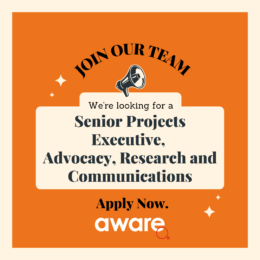
Position Filled: Senior Projects Executive, Advocacy, Research and Communications

Job Listing

We are no longer accepting applicants for this role.

AWARE’s Advocacy, Research and Communications department is looking for a Senior Projects Executive who will work to strategically provide evidence for AWARE’s core advocacy messages to the public, the media and our diverse community of members, donors and clients. For 2022, you will help coordinate AWARE’s upcoming Growing Up Indian project, and a research project on domestic violence.

As part of our small team, you will work to strategically provide evidence for AWARE’s core advocacy messages to the public, the media and our diverse community of members, donors and clients. For 2022, you will help coordinate AWARE’s upcoming Growing Up Indian project, and a research project on domestic violence.

This is an exciting opportunity for an early career professional who is savvy, creative and well-versed in feminism and social justice topics.

Position: Senior Projects Executive, Advocacy, Research and Communications (ARC)
Department: ARC
Salary range: SGD$3,750 – 3,900
Term: Full-time, 1-year employment contract (renewable)
Starting date: January 2022

Job Description

Project Coordination 

  • Timely coordination of AWARE’s Growing Up Indian (GUI) project, including assistance with budgeting, funding applications, coordination of honorariums
  • Liaising with contributors, volunteers, communications and fundraising staff, designers, printers, and other partners
  • Co-writing the introduction to the GUI anthology, editing and proofreading submissions
  • Organising public engagement events to publicise the launch of GUI, community workshops on oral histories, intercultural understanding, and effective writing

Advocacy and Research

  • Project coordination of AWARE’s primary research projects (including assistance with budgeting, funding applications, recruitment and training of personnel, coordination of payments etc.)
  • Research support for AWARE’s primary research projects, including conducting literature review, assistance with drafting interview and focus group discussion interview guides, conducting interviews and focus group discussions, data analysis, and writing of research reports)
  • Drafting occasional forum letters on primary research topics (e.g forum letters) on AWARE’s core advocacy areas
  • Developing and executing AWARE’s public advocacy campaigns to accompany the publication of new research
  • Helping the ARC department to conceptualise, organise and promote events (both online and, in the long term, offline)
  • Other miscellaneous administrative tasks

Preferred Candidate Profile

  • Singapore Citizen/Permanent Resident with at least two years of related work experience in project coordination, conducting primary and secondary research
  • A diploma/degree in political science, sociology, gender studies, media and communications, or any other related field is strongly preferred
  • Top-notch communication skills (perfect written and spoken English)
  • Confident public speaking and presentation skills
  • A keen editorial sense, with an eye for clean, sharp and impactful copy
  • Competency to maintain positive and effective working relationships with a broad range of stakeholders
  • Prior experience organising events
  • Ability to work independently to manage projects
  • Strong belief in gender equality and the values of AWARE

You must read and acknowledge our Privacy Statement here.

Please note that due to the large number of applications, only shortlisted applicants will be contacted for an interview. If you have any questions about this position, please email careers@aware.org.sg.

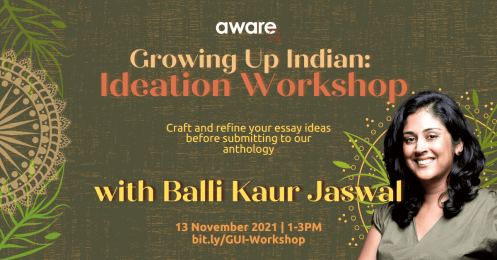
Growing Up Indian: Ideation Workshop With Balli Kaur Jaswal

If you’re currently mulling over an idea for a personal essay to submit to our Growing Up Indian anthology, and would like some guidance, here’s a fantastic opportunity! Attend a free ideation workshop over Zoom, conducted by acclaimed local novelist Balli Kaur Jaswal. Receive guidance from Balli and constructive feedback from other participants in order to strengthen the angle, themes and structure of your essay. 

So that each participant receives personalised attention, this workshop is limited to 15 participants. We will select participants based on their pitch ideas (submit up to three pitches) and notify all applicants about their acceptance one week before the workshop. Each pitch should be about at least one aspect of your lived experiences as an Indian woman in Singapore.

Please note that this workshop is designed to shape ideas and not already written pieces. 

Applications are now closed.

The online workshop is free of charge and will take place on Saturday, 13 November from 1pm to 3pm. For consideration to be included in AWARE’s Growing Up Indian anthology, writers must submit their complete stories to the anthology by Tuesday, 14 December. 


Themes

Learn more about Growing Up Indian on our call for entries page. We’re on the lookout for stories that bring out the themes below:

  • Straddling two or three different worlds, e.g. “mainstream” Singapore, being Indian, being a minority Indian in Singapore 
  • Experiences with language, e.g. studying your mother tongue after school or on weekends
  • Supernatural stories or superstitions you’ve grown up with
  • “Taboo” topics such as sexual health, desire and sexual attraction, religious practices and beliefs
  • Cultural rituals, celebrations and festivals that held special meaning for you as a child 
  • Food, cuisine and recipe related tales
  • Didactic mythological stories or folklore linked to sexuality, mental health, marriage or divorce
  • Unique family histories, traditions, e.g. the multi-generational history of activism
  • Belonging, e.g. feeling of connectedness to an idea, a country, a culture or an identity 
  • Otherness, e.g. ways in which you might have been marked as different
  • Pop culture, e.g. music, film, celebrities, advertisements, fashion, trends or memes
  • Travel, e.g. familial impacts of migration, holidays in your country of origin or sending/receiving packages

Other details

  1. Your pitch and final submission should be in English.
  2. Essays should be between 1,000-2,000 words long.
  3. You do not need to have written or been published formally in order to send in your pitch.
  4. Pitches should be original content: stories that have been previously published will not be considered for the workshop. 
  5. Writers who have already submitted a story for consideration can submit another pitch. 
  6. This anthology will prioritise female voices. However, if you are not female and would like to contribute writing on themes of gender or masculinity, you can still submit your pitch.
  7. AWARE reserves the right to shortlist and select both the selected workshop applicants and the final stories that will be featured in the anthology. 
  8. All submissions selected for the anthology may be edited and our edits will be final. We will get in touch with you if this is the case.

12 November 2021: Sexual Assault First Responder Training (Online Session)

Understand trauma reactions and learn tangible skills to support sexual violence survivors at this workshop by AWARE.

“Are you sure that happened? Why didn’t you fight back? You should have known better.” These are some common responses survivors of sexual assault have heard, which may further their feelings of doubt, guilt and shame.

It is not always easy for survivors to tell someone about what happened; in fact, for some survivors, it can be especially daunting. So the way their loved ones respond becomes pivotal in their journey of recovery. First response that is sensitive to a survivor’s needs and choices is necessary in preventing re-victimisation.

This Sexual Assault First Responder Training helps familiarise participants with trauma reactions and symptoms to better contribute to a survivor’s well-being. In this workshop, we will share more on the following:

  1. Definition of sexual assault and harassment
  2. Recognising Singapore’s legal framework
  3. Understanding consent
  4. Understanding the impact of sexual assault and trauma on survivors
  5. Role of a first responder
  6. Providing support to survivors of sexual assault
  7. Resources available for help
  8. Key skills such as ensuring safety, active listening and empathy

Date: Friday, 12 November 2021

Time: 5.30-8.30pm

Venue: Please note this workshop will be online only. Participants will be emailed the Zoom link shortly before the session date. As a commitment to this training we will be asking all participants to turn on their video throughout the session.

This popular workshop has been made affordable to all. While you are welcome to pay what you can, we suggest a sum of $30 per workshop attendee. The donations made are non-refundable and no tax-exempt receipts are provided.

Persons of all genders and nationalities are more than welcome to attend.

We strongly request that all participants commit to the full duration of the 3-hour workshop (there are breaks!) to ensure that everyone will get the opportunity to engage in interactive discussions and learn useful skills. This includes keeping your video ON and utilising the audio to participate.

Register here

1 October 2021: Sexual Assault First Responder Training (Online Session)

Understand trauma reactions and learn tangible skills to support sexual violence survivors at this workshop by AWARE.

“Are you sure that happened? Why didn’t you fight back? You should have known better.” These are some common responses survivors of sexual assault have heard, which may further their feelings of doubt, guilt and shame.

It is not always easy for survivors to tell someone about what happened; in fact, for some survivors, it can be especially daunting. So the way their loved ones respond becomes pivotal in their journey of recovery. First response that is sensitive to a survivor’s needs and choices is necessary in preventing re-victimisation.

This Sexual Assault First Responder Training helps familiarise participants with trauma reactions and symptoms to better contribute to a survivor’s well-being. In this workshop, we will share more on the following:

  1. Definition of sexual assault and harassment
  2. Recognising Singapore’s legal framework
  3. Understanding consent
  4. Understanding the impact of sexual assault and trauma on survivors
  5. Role of a first responder
  6. Providing support to survivors of sexual assault
  7. Resources available for help
  8. Key skills such as ensuring safety, active listening and empathy

Date: Friday, 1 October 2021

Time: 5.30-8.30pm

Venue: Please note this workshop will be online only. Participants will be emailed the Zoom link shortly before the session date. As a commitment to this training we will be asking all participants to turn on their video throughout the session.

This popular workshop has been made affordable to all. While you are welcome to pay what you can, we suggest a sum of $30 per workshop attendee. The donations made are non-refundable and no tax-exempt receipts are provided.

Persons of all genders and nationalities are more than welcome to attend.

We strongly request that all participants commit to the full duration of the 3-hour workshop (there are breaks!) to ensure that everyone will get the opportunity to engage in interactive discussions and learn useful skills. This includes keeping your video ON and utilising the audio to participate.

Register here

10 September 2021: Sexual Assault First Responder Training (Online Session)

Understand trauma reactions and learn tangible skills to support sexual violence survivors at this workshop by AWARE.

“Are you sure that happened? Why didn’t you fight back? You should have known better.” These are some common responses survivors of sexual assault have heard, which may further their feelings of doubt, guilt and shame.

It is not always easy for survivors to tell someone about what happened; in fact, for some survivors, it can be especially daunting. So the way their loved ones respond becomes pivotal in their journey of recovery. First response that is sensitive to a survivor’s needs and choices is necessary in preventing re-victimisation.

This Sexual Assault First Responder Training helps familiarise participants with trauma reactions and symptoms to better contribute to a survivor’s well-being. In this workshop, we will share more on the following:

  1. Definition of sexual assault and harassment
  2. Recognising Singapore’s legal framework
  3. Understanding consent
  4. Understanding the impact of sexual assault and trauma on survivors
  5. Role of a first responder
  6. Providing support to survivors of sexual assault
  7. Resources available for help
  8. Key skills such as ensuring safety, active listening and empathy

Date: Friday, 10 September 2021

Time: 6-9pm

Venue: Please note this workshop will be online only. Participants will be emailed the Zoom link shortly before the session date. As a commitment to this training we will be asking all participants to turn on their video throughout the session.

This popular workshop has been made affordable to all. While you are welcome to pay what you can, we suggest a sum of $30 per workshop attendee. The donations made are non-refundable and no tax-exempt receipts are provided.

Persons of all genders and nationalities are more than welcome to attend.

We strongly request that all participants commit to the full duration of the 3-hour workshop (there are breaks!) to ensure that everyone will get the opportunity to engage in interactive discussions and learn useful skills. This includes keeping your video ON and utilising the audio to participate.

Register here