Author: Comms Executive

Sexual Assault Care Centre Closed 12-16 September, Reopening 19 Sept 2022

SACC will be closed from 12 to 16 Sept 2022

Our Sexual Assault Care Centre will be closed from Monday to Friday, 12 to 16 September 2022. This will allow us to review our work and ensure staff well-being so that the centre can continue to provide quality services to individuals reaching out for support. Our operations will fully resume from Monday, 19 September 2022 onwards.

During this period, no SACC services will be available. Kindly note that SACC will not be able to respond to emails or messages sent during this period.

If you are a new client and wish to access our services when the centre reopens, please resend your email/messages to us on 19 September 2022.

We seek your kind understanding and patience during this period.

You may also contact the National Anti-Violence Helpline at 1800 777 0000 for support. They operate 24/7 and will be able to provide support for any violence you are facing. For emergencies, please call 999 for the police. You can also call 1767 for the Samaritans of Singapore (SOS) if you have thoughts of hurting yourself, including thoughts of suicide.

Time to develop framework on gig workers’ rights and benefits

Photo of young delivery woman with thermal insulated bag for food walking up concrete steps

This letter was originally published in The Straits Times on 11 May 2022. 

We echo Mr Lee Teck Chuan’s call for the institutionalisation of a framework to safeguard the interests of gig workers (Give gig economy workers here due recognition, May 5). He accurately highlighted these workers’ vulnerability due to their current lack of employment protections and benefits.

It is encouraging that the Government has strengthened its efforts to support gig workers in recent years.

However, the root of their vulnerability remains unresolved: that is, the lack of labour protections and benefits for this group of workers, such as paid leave and medical benefits.

Since all gig workers are considered independent contractors under existing laws, the statutory employment benefits and protections stipulated by the Employment Act do not extend to them.

The work of self-employed workers is freelance in nature, but they do not have full autonomy over it. This is instead often determined by the platform they work for.

To address this, the Association of Women for Action and Research reiterates our recommendation to develop a new framework for gig workers currently not covered under the Employment Act. This framework should clearly distinguish between independent workers (like entrepreneurs who enter business relationships) and dependent workers (not employees, but still economically dependent on the company they work for). It should also stipulate their rights and benefits to minimise their precariousness.

This has already been implemented in other countries such as Britain, where working individuals are categorised as one of the following: self-employed, workers and employees. An example under the “worker” category would be Uber drivers, who are legally entitled to benefits and protection, including a statutory minimum level of paid holiday and limits on weekly work hours.

In Australia, such workers are also legally recognised as their own category within the labour force, with clearly defined rights and obligations.

As the number of gig workers in Singapore grows, we can look to these countries to establish a similar framework and better protect such workers.

Kimberly Wong
Research Executive
AWARE

3 ways to measure Singapore’s progress to a truly gender-equal society

This letter was originally published in TODAY on 26 April 2022. 

The vision outlined in the Government’s White Paper on Singapore Women’s Development last month is commendable.

Measures such as the upcoming anti-discrimination legislation and increased financial support for caregivers have been pushed for by various advocates, including Aware.

However, a question that has been relatively under-discussed is how we will track this progress towards gender equality. It’s one thing to talk about end goals for Singapore, but what targets are we setting to ensure that we’re on the right path?

Here are a few concrete suggestions.

One: We need to pay attention to our labour force participation rates (LFPRs)

As the White Paper points out, the onus of caregiving continues to fall on women. This contributes to the gap in LFPRs between the genders.

In 2021, data from the Ministry of Manpower (MOM) showed that the LFPR for males aged 15 and above stood at 77.2 per cent ー13 percentage points above the female LFPR of 64.2 per cent. If women participated at the same rates as men, we’d add a whopping 225,000 people to our workforce.

A reduction in LFPR disparity should follow the implementation of measures set forth in the White Paper to better protect women in the workplace, improve caregiver support and shift mindsets. Ideally, we should aim to reduce this gap to less than five percentage points in 10 years’ time.

Two: The gender wage gapーparticularly, the unadjusted figureーshould be monitored more closely.

There is some disagreement over whether the unadjusted or adjusted gender pay gap is more useful as an indicator of inequality.

MOM said in 2020 that the adjusted number (4.3 per cent) is a “better measure of whether men and women are paid equally for doing similar work”.

Yet that does not paint the full picture of gender inequality when it comes to work and pay. The unadjusted pay gap (14.4 per cent) reflects the fact that women are doing different (and generally lower-paying) work from men. Most of the time, this is not by choice: Low-wage jobs tend to afford women more flexibility, which they require to juggle care.

We should therefore examine the unadjusted wage gap every year to guide our plans moving forward, rather than focusing on the measure of similar work.

As the action plans are being rolled out, targets need to be established for reducing the unadjusted gender wage gap at regular intervals, with the goal of getting it below 10 per cent at the end of the next decade.

Three: We should consider a means of identification for family caregivers, to which caregiver support and benefits can be tied.

Such a “caregiver passport” would further centralise and streamline Singapore’s efforts to support caregivers by simplifying the process of seeking support (such as the Home Caregiving Grant), thus reducing the stress that they currently face navigating various schemes and resources.

Those with the passport should also be able to enjoy other benefits that grant them added support and financial relief. This will allow us to track the utilisation of the relevant schemes and identify gaps in our system where needs are not met and where we can improve.

In our workplaces, we aim to set Smart goals, that is goals that are specific, measurable, attainable, relevant and time-based.

We should do the same for Singapore, and in that way turn our vision of a truly gender-equal society into a reality.

Lee Yoke Mun
Research Executive
AWARE


18 May 2022: Feminism For All Workshop

What does it mean to call yourself a feminist? What are feminist ideologies and how can we apply them to our daily lives? What are the most expedient ways to fight for gender equality?

These questions might not always have neatly defined answers. After all, the ideas and the discourse around feminism can be complicated—especially when theory comes up against the complexities of reality.

Feminism For All is a workshop for anyone who wants a dedicated occasion to discuss, unpack and gain a better understanding of feminism. Whether you are curious to learn more about gender equality in the Singaporean context, or want to advance along your own feminist learning journey, this interactive workshop will provide an overview of the foundational principles behind the movement, outline how they inform AWARE’s work, and empower you to apply various feminist values to your daily life.

This hands-on, in-person masterclass led by AWARE staff and members will have interactive segments, including small discussion groups and presentations.

Date: Wednesday, 21 April 2022

Time: 7PM – 9.30PM

Workshop outline:

  • Introduction to key terms
  • Brief history of feminism
  • Overview of core feminist concepts
  • Feminism in Singapore
  • AWARE’s work
  • Q&A


Safety Measures

This is an in-person workshop! You will need to meet at least ONE of the following criteria to be allowed into AWARE’s premises:

1. Completed two doses of approved vaccination, including the 14 days window after the second dose.
2. Recovered from Covid-19
3. Medically ineligible for Covid-19 vaccines
4. Children aged 12 years or below (i.e. born in or after 2010)

The use of the TraceTogether App/HealthHub App for safe check in and to present proof of vaccination is mandatory.

Register here!

Image-based sexual abuse featured in 1 in 2 cases of technology-facilitated sexual violence seen by AWARE in 2021

This post was originally published as a press release on 20 April 2022.

* Correction notice, 6 Dec 2022: When our analysis was performed in early 2022, our system had not captured the full range of TFSV cases seen by SACC. This error affected our 2019, 2020 and 2021 TFSV data. We have since amended all three posts accordingly. We sincerely apologise for the errors.

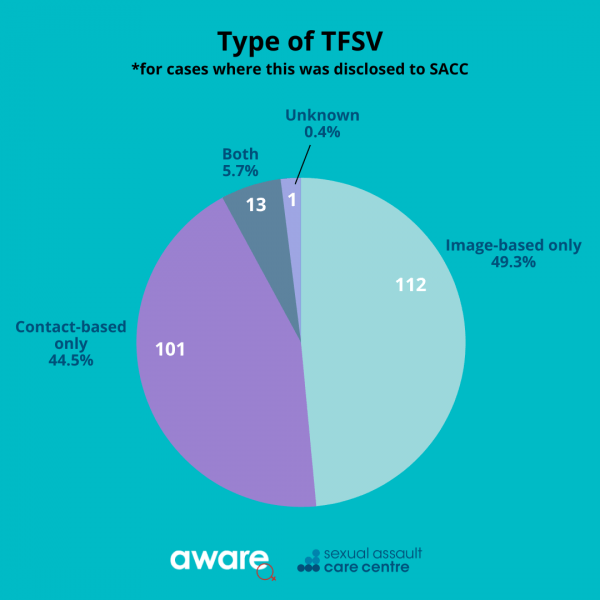
Half of the cases of technology-facilitated sexual violence seen by AWARE’s Sexual Assault Care Centre (SACC) in 2021 involved image-based sexual abuse (IBSA).

The gender-equality group today released its annual analysis of technology-facilitated sexual violence (TFSV) cases.

TFSV is unwanted sexual behaviour carried out via digital technology, such as digital cameras, social media, messaging platforms and dating and ride-hailing apps. IBSA, meanwhile, is an umbrella term for various behaviours involving sexual, nude or intimate images or videos of another person. AWARE identifies five types of IBSA: the non-consensual creation or obtainment of sexual images (including sexual voyeurism); the non-consensual distribution of sexual images (including so-called “revenge porn”); the forced viewing of sexual images (including dick pics); sextortion; and others.

In total, AWARE’s SACC saw 227 new cases of TFSV in 2021—an increase from 2020 (in which SACC saw 191 new TFSV cases). TFSV cases made up more than 1 in 4 (27%) cases at SACC in 2021. SACC saw an overall decrease in new cases last year (856 new cases), after an all-time high in 2020 (967 new cases) led the centre to modify its service model to more efficiently manage cases via triaging and referral.

“The pace at which sexual violence evolves and adapts to new technologies, platforms and social contexts makes it hard for researchers and support service-providers alike to keep up,” said Shailey Hingorani, AWARE’s Head of Research and Advocacy. “Who would have guessed, even a decade ago, that image-based sexual abuse would be both so diversified and so ubiquitous? We have a long and confounding journey ahead of us, fighting this.”

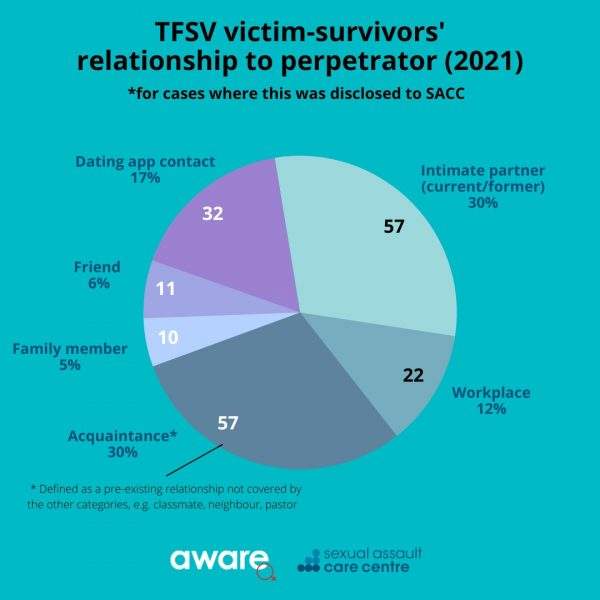
Of the 227 TFSV cases in 2021, the perpetrator was someone known to the survivor in 189 cases (the remaining 38 comprising cases involving strangers or cases in which perpetrator identity was not disclosed to SACC). The highest reported categories of perpetrators in 2021 were intimate partners, current or former (57 cases, or 30% of cases where perpetrator identity was disclosed); as well as acquaintances* (57 cases, or 30%), followed by dating app contacts (32 cases, or 17%). Other categories of perpetrator included family members, friends and contacts from the workplace.

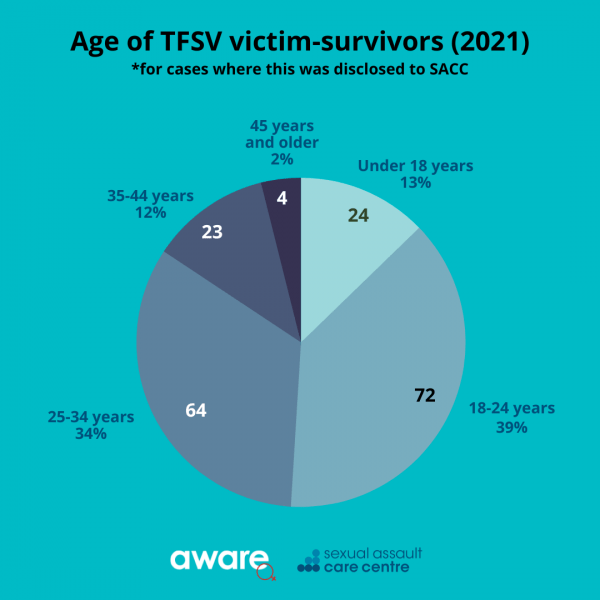
Where the age of the victim-survivor was disclosed to SACC, the highest number of cases fell into the 18-24 years age group in 2021 (39%), followed by the 25-34 years group (34%), under-18 years (13%) and 35-44 years (12%). A small percentage of victims were above 45.

Almost a quarter of cases in 2021 took place via messaging platforms such as Telegram and WhatsApp, an increase in percentage from previous years. Other online spaces where TFSV took place include social media, video streaming sites, porn sites and online forums.

“We are not surprised that perpetrators find messaging to be an attractive medium for TFSV, given that the end-to-end encryption made possible on messaging platforms prevents law enforcement, and the platforms themselves, from viewing the content of messages,” noted Ms Hingorani. “Advocates have been sounding the alarm recently about how direct messages, or DMs, facilitate online abuse. The Center for Countering Digital Hate, for example, released its ‘Hidden Hate’ report on Instagram DMs in early April.”

Few TFSV clients known to SACC sought assistance from the platforms, i.e. by making reports and requesting the removal of images or the suspension of offending accounts. Reasons for the low reporting rate are unclear, though this is in line with observations in previous years.

On a positive note, Ms Hingorani cited recent initiatives to address TFSV, such as the Alliance for Action on tackling online harms, which recently released a survey on the issue, as well as the victim support centre for online harms that will be set up by Singapore Her Empowerment (SHE), a new organisation announced earlier this month. 

“We have been glad to see a rise in efforts to address technology-facilitated sexual violence in Singapore,” she added. “We are particularly impressed by the leadership shown by the government to introduce new codes of practice requiring platforms to put in place systems to ensure a safer online environment. Although many big technology companies have community standards to moderate content on their sites, these new codes of practice will hopefully streamline their obligations such that a minimum level of safety is assured on all platforms. Ideally, the new codes of practice will apply to a broad range of companies, not just big tech companies—as has been the regulatory approach in some other jurisdictions.”

* “Acquaintance” is defined as a pre-existing relationship not covered by the other categories. Examples from 2021 include classmate, neighbour, pastor, landlord and social media follower.


Infographics
 

See previous information on TFSV at SACC here


Annex I: Definitions

Technology-facilitated sexual violence is unwanted sexual behaviour carried out via digital technology, such as digital cameras, social media and messaging platforms, and dating and ride-hailing apps. While all TFSV cases involve an aspect of technology, the abuse sometimes occurs in offline spaces too, and can take the form of physical or verbal sexual harassment, rape, sexual assault, stalking, public humiliation or intimidation. TFSV behaviours range from explicit sexual messages and calls, and coercive sex-based communications, to image-based sexual abuse.

Image-based sexual abuse is an umbrella term for various behaviours involving sexual, nude or intimate images or videos of another person. AWARE identifies five types:

  1. The non-consensual creation or obtainment of sexual images: including sexual voyeurism acts such as upskirting, hacking into a victim’s device to retrieve such images, and/or the creation of such images via deepfake technology
  2. The non-consensual distribution of sexual images: sometimes known colloquially as “revenge porn”, whereby images shared willingly by a partner or ex-partner are then disseminated to others without the subject’s consent
  3. The non-consensual viewing of sexual images: whereby a victim is made to view sexual content, such as pornography or dick pics, unwillingly, e.g. over message or email
  4. Sextortion: whereby sexual images of a victim, obtained with or without consent, are used as leverage to threaten or blackmail that victim, in order to solicit further images and/or sexual practices, money, goods or favours
  5. Others: including the capturing of publicly available, non-sexual images which are then non-consensually distributed in a sexualised context, e.g. with sexual comments and/or on a platform known for sexual content, such as the “SG Nasi Lemak” genre of Telegram group


Annex II: Selected Technology-Facilitated Sexual Violence Cases from 2021

Case A: The client found a hidden camera installed in the area where she worked. She discovered that it contained upskirt videos of herself and another colleague. She expressed concern about reporting this to her company or the police, as she felt uncomfortable about the prospect of other people viewing the videos, and worried about potential professional retaliation (e.g. if the company’s reputation came under fire).

Case B: The client met the perpetrator through an online dating app and agreed to get on a video call with him. During the call, the client suspected that the perpetrator might be impersonating someone as he looked different from photos on the dating app. Though the client was reluctant, the perpetrator insisted that the client undress on the video call, which the client eventually agreed to do. Upon hanging up, however, the perpetrator revealed that he had recorded the video call without the client’s knowledge or consent. He then blackmailed the client by threatening to share the video link on social media if the client did not immediately transfer a sum of money. The client managed to get the video taken down by reporting to the platform hosting it.

Case C: The client found out that her intimate videos, along with her name, had been leaked on multiple websites. She suspected that the perpetrator was her ex-partner, with whom she had consensually shared the videos during their relationship. Although one website took down the videos after she filed a police report, she was unable to remove them from other, international websites. The inclusion of her identity alongside the videos led to the client receiving an influx of follower requests from strangers over social media, which caused her distress. The police were ultimately not able to determine who uploaded the videos.

Case D: During an event hosted on Zoom, the client received sexually explicit chat messages from two participants via the private messaging function. Although she immediately informed the event organiser about the messages, no action was taken against the perpetrators. The client had to leave the event early to avoid further harassment. 

Case E: The client found out that a family member of her ex-partner was impersonating her on social media. This family member had obtained the intimate photos and videos that she had shared with her ex-partner during their relationship. The perpetrator had disseminated these on a fake social media account as well as on WhatsApp. He also inititated sexual conversations with other men online in the guise of the client, and gave these men the client’s phone number. As a result, the client received many harassing calls and messages from strangers. She has filed a police report against the perpetrator.

Position Filled: Administrative Executive, Sexual Assault Care Centre

We are no longer accepting applicants for this role.

AWARE’s Sexual Assault Care Centre (SACC) department is looking for an Administrative Executive. SACC is gearing up to assist more survivors of sexual violence over the next three years. As such, we are looking for additional administrative support to ensure that operations run smoothly.

Position: Administrative Executive, Sexual Assault Care Centre
Salary range: SGD$2,700 – 3,000
Term: Two-year contract (renewable)
Starting date: April 2022
Work Schedule:
Full-time/Employment Contract

Job Description:

  • Provide administrative and operational support to the CARE department, including Women’s Care Centre (WCC) and Sexual Assault Care Centre
  • Provide effective daily administrative and operational support for such that there is seamless delivery of SACC and WCC services
  • Support data management through regular documentation and filing of confidential notes, maintenance of internal knowledge base, etc.
  • Maintain various systems within CARE, such as IP phones, data management software, scheduling software, etc., through vendor management, troubleshooting and addressing other staff needs pertaining to these systems.
  • Innovate and work with CARE staff to make administrative and operational processes more efficient
  • Support various CARE projects as required

Requirements:

  • Minimum 1 year’s experience as an office administrator, office assistant or in a relevant role
  • Experience in client administration in social service industry is advantageous
  • Strong knowledge of Microsoft Office and G Suite
  • Able to use initiative and judgement to solve problems independently
  • Strong belief in gender equality and the values of AWARE
  • Able to meet deadlines in a high-paced environment while balancing workload and competing priorities
  • Able to main strict confidentiality of sensitive information
  • Excellent interpersonal, empathy and communication skills in English (verbal and written). Spoken or written fluency in a second language (Chinese, Malay, Tamil) is advantageous.
  • Strong organisational skills

You must read and acknowledge our Privacy Statement here.

Please note that due to the large number of applications, only shortlisted applicants will be contacted for an interview. If you have any questions about this position, please email careers@aware.org.sg.

19 Mar 2022: BREAK FREE! – celebrate International Women’s Month with AWARE

Break Free: AWARE celebrates IWD 2022

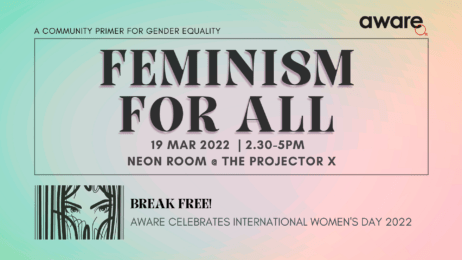
Break Free! with AWARE at The Projector X! On 19 March, join us for a one-day-only mini-IWD festival of three special events. First up, get a crash course in feminist history and theory at our Feminism For All workshop. Then, flex your gender-equality knowledge at Trivia Night in teams of four or five. Finally, watch a charity screening of the intimate, life-affirming Singapore film Some Women, followed by a conversation with filmmaker Quen Wong and her documentary subjects.

Tickets are limited.

Buy now!

Jump to:

Feminism For All Workshop

Feminism For All Workshop: AWARE Celebrates IWD 2022

What does it mean to call yourself a feminist? What are feminist ideologies and how can we apply them to our daily lives? What are the most expedient ways to fight for gender equality? These questions might not always have neatly defined answers. After all, the ideas and discourse around feminism is often complicated – especially when theory comes up against the complexities of reality.

Feminism For All is a workshop for anyone who wants a dedicated occasion to discuss, unpack and gain a better understanding of feminism. Whether you are curious to learn more about gender equality in the Singaporean context, or want to advance along your own feminist learning journey, this interactive workshop will provide an overview of the foundational principles behind the movement, outline how they inform AWARE’s work, and empower you to apply various feminist values to your daily life. This hands-on masterclass led by AWARE members will have interactive segments, including small discussion groups and presentations.

Trivia Game Night

Former AWARE President Constance Singam gave a legendary speech at the AWARE Extraordinary General Meeting on 2 May 2009, with the refrain “_____ ____ ___?”*

If you found yourself filling the above blanks with ease, you’re a shoo-in for our feminist Trivia Game Night! Join us for a night of exhilarating and educational fun, with categories covering the history of gender equality in Singapore, pioneering women from around the world, seminal pieces of feminist arts and culture, and more!

Dig deep into the recesses of your brain, pump up the adrenaline and gather in teams of between four to five people to tackle furious quiz rounds. There’s much at stake: You’ll have a chance to win prizes for each of the rounds, as well as emerge overall champions for the night.

There are limited slots available for teams, so if you dawdle, you lose!

*P.S. Answer is “Where were you?”

Some Women Charity Screening + Q&A

Please note this film is rated R21 – Suitable for adults aged 21 and above. Identification checks will be conducted at the discretion of the organiser.

Employing a mix of contemporary footage and archive material, local transgender film maker Quen Wong and theatre director Glen Goei’s Some Women shines light on the intergenerational experiences of transgender individuals in Singapore, as well as the queer history of Singapore’s Bugis district- once the safe space for the local transgender community.

This heartfelt and intimate documentary is, however, not exclusively about the experiences and struggles of trans individuals – it is a deeply intimate reflection about the human experience. It is about transcending labels, accepting diversity, and having the courage to rise above the stigma to reclaim one’s identity.

AWARE is delighted to host a special charity screening of Singaporean documentary Some Women, directed by Quen Wong and Glen Goei. After the film, stick around for a conversation with Wong herself, as well as Lune Loh and Kristin, both of whom appear in the film. Don’t miss this chance to hear first-hand about the trials, tribulations and triumphs involved in getting a film like this made in Singapore!

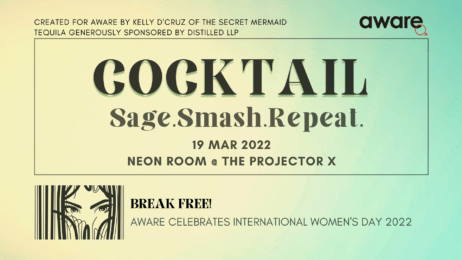
Event Cocktail

For Break Free, we’ve partnered with bartender Kelly D’Cruz of The Secret Mermaid to bring you

Sage.Smash.Repeat.

Codigo Blanco Tequila, Melati Aperitif, Sage, Fresh Lime and Pineapple + Sour Plum Caviar Pearls

Earthy flavours of 100% agave-based Codigo Blanco are blended with the healing elements of 26 botanicals from non-alco aperitif beverage Melati. Sage cleanses your spirit and fresh lime adds a citrus kick! The drink is garnished with pineapple and sour plum caviar pearls to burst through with flavour and smash every bias!

We have limited quantities of Sage.Smash.Repeat. up for grabs so please pre-purchase your cocktails online to avoid disappointment.

More ways to help low-income mothers take up work opportunities

This letter was originally published to The Straits Times on 11 February 2022. 

We appreciate Mr Abhishek Bajaj’s letter, “More can be done to help underprivileged women” (Feb 7), about the need for a “systematic approach to address the factors inhibiting mothers from taking up work opportunities”. We would like to add to his suggestions.

First, we urge businesses to accept a wider stakeholder view of their responsibility to society, and invest in well-paying jobs that pay decent wages.

Last year’s Minimum Income Standards report on households in Singapore found that a single parent with one young child requires $3,218 per month to lead a decent life. But many households’ incomes fall far short of this figure.

We hope that more businesses can index their jobs to the incomes households require for a decent life.

Second, flexi-work and freelance work can be a useful way to minimise work-care conflict if employers let mothers organise their time.

Casual work’s unpredictable nature makes childcare and eldercare difficult to organise, especially when a mother’s work hours fall outside regular childcare centre hours, or when she lacks notice to plan alternative caregiving arrangements around shifts.

Lastly, more attention to home-based businesses is certainly desirable, but people must go beyond ordering the occasional cake from a mum-owned business.

Our national policy discourse on self-employed persons needs to take these business owners more squarely into account.

Last year, the Ministry of Manpower initiated public consultation on proposed measures to strengthen protections for platform workers who provide transport and delivery services.

Similar consultation should be organised to focus on the unique struggles of home-based businesses.

We know, for example, that some home-based business owners may not receive Workfare Income Supplement top-ups because they don’t know they need to be registered with the Inland Revenue Authority of Singapore to be eligible.

The consultation should address this and other challenges these people face.

Elizabeth Quek, Project Manager, AWARE

Tackle prejudice while increasing live-out options for maids

This letter was originally published to The Straits Times on 26 January 2022. 

The Association of Women for Action and Research (Aware) echoes the Humanitarian Organisation for Migration Economics’ call for a review of the live-in rule for migrant domestic workers (Employers may find it hard to look after well-being, safety of maids if they live out: MOM, Jan 15).

In the article, speakers in favour of keeping the requirement that migrant domestic workers (MDWs) live at their employers’ homes cited concerns that, if offered a live-out option, MDWs would come to work “distracted” or get “involved in other illegal activities”.

These comments appear predicated on the idea that MDWs cannot make sound decisions about their own lives and perform their jobs like other workers.

They perpetuate the belief that MDWs are second-class workers who do not deserve to be treated equally.

Many MDWs that Aware has spoken to for our research have said the current live-in rule may compromise their well-being.

The isolation that most MDWs experience while living in their employers’ homes creates higher risk of overwork and abuse. With limited labour protection and no clearly stipulated work hours in their contracts, MDWs often work long periods without adequate rest.

In some cases, MDWs may be abused by employers or their family members. Living in the same household, they may not be able to seek help or contact helplines safely.

Ultimately, we have to dismantle prevailing prejudiced and condescending attitudes. Regardless of living arrangements, such mindsets will continue to result in MDWs’ mistreatment.

As live-in arrangements will likely remain necessary for some – for example, those requiring round-the-clock care – efforts to educate employers about treating MDWs with dignity need to be strengthened.

Additionally, we recommend increasing live-out options for MDWs. Such arrangements allow work hours to be more clearly defined.

The Household Services Scheme engages female migrant workers, who live in company-provided accommodation, to provide part-time household services. Its permanent implementation last year indicates that a live-out model is feasible and that domestic work can indeed be regulated.

We hope that the scheme can be scaled up while ensuring that MDWs receive decent housing and wages.

Lee Yoke Mun, Projects Executive, AWARE