
Author: Comms Executive

AWARE saw 34% increase in cases of technology-facilitated sexual violence in 2020; announces launch of Solid Ground website

This post was originally published as a press release on 14 July 2021.

* Correction notice, July 2023: When our analysis was performed, our system did not capture the full range of TFSV cases seen by SACC in 2020. We have since amended this post accordingly. We sincerely apologise for the error.

Gender-equality group AWARE’s Sexual Assault Care Centre (SACC) saw 205 cases of technology-facilitated sexual violence (TFSV) in 2020. This represents a 34% increase over 2019 cases (153), and the highest number yet since tracking began in 2016.

AWARE announced these latest statistics alongside the launch of a new website, Solid Ground, that provides practical information and guidance for TFSV victims in Singapore.

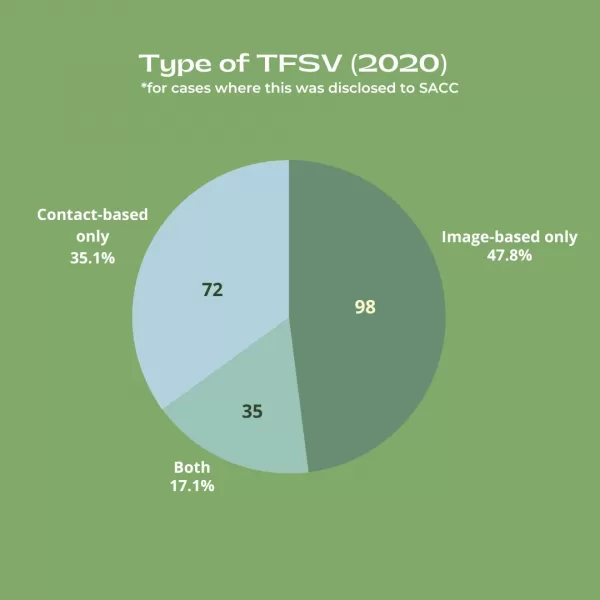
Technology-facilitated sexual violence is unwanted sexual behaviour carried out via digital technology, such as digital cameras, social media and messaging platforms, and dating and ride-hailing apps. These behaviours range from explicit sexual messages and calls, and coercive sex-based communications, to image-based sexual abuse, which is the non-consensual creation, obtainment and/or distribution of sexual images or videos of another person. Image-based sexual abuse includes sexual voyeurism, so-called “revenge porn” and threats to do the above. While all TFSV cases involve an aspect of technology, the abuse sometimes occurs in offline spaces too, and can take the form of physical or verbal sexual harassment, rape, sexual assault, stalking, public humiliation or intimidation.

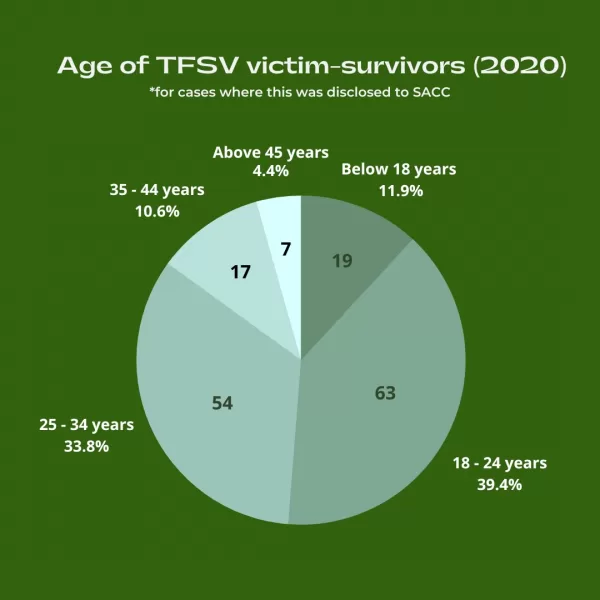
The victim-survivors seen by SACC in 2020 ranged in age, with the youngest being a tween and the oldest being 59. The highest number of cases fell into the 18-24 years age group in 2020 (63 cases, or 39% of cases where the age was disclosed): a significant jump from 2017-2019, when this category made up less than 30% of TFSV cases. The group with the next most cases in 2020 was 25-34 years (54 cases, or 34%).

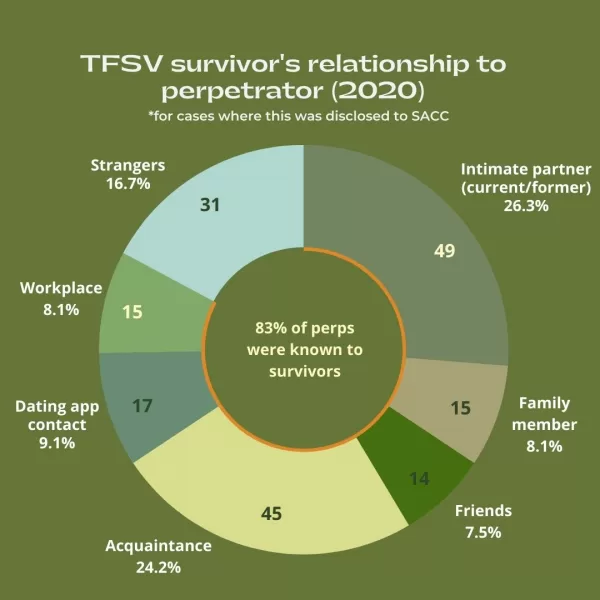
The perpetrator was known to the survivor in the majority of 2020 cases (where this was disclosed to SACC). Such perpetrators are typically far more common than strangers when it comes to sexual violence, perhaps all the more so during 2020 with COVID-19 circuit breaker measures reducing encounters with strangers. The highest reported category of perpetrators in 2020 was intimate partners, current or former (49 cases, or 26% of cases where a relationship was disclosed), followed by acquaintances* (45 cases, or 24%), which recorded a significant increase from 2019, then strangers (17 cases, or 8%). Other perpetrator types included family members, friends and persons from the workplace (though the last category saw a decrease in 2020, again possibly due to work-from-home measures).

“As our clients have attested time and again, the emotional, mental and physical impact of TFSV is on par with that of offline abuse,” said AWARE President Margaret Thomas. “It can include anxiety, depression, anger, guilt and suicidal thoughts. What’s more, there are often practical and financial effects: reputational damage, being forced to deactivate social media accounts, paying for a service to issue take-down requests to platforms, and so on.”

SACC clients experienced TFSV on a wide range of platforms, with some of the most common being messaging apps Telegram and WhatsApp, and social media platform Instagram. Ultimately, though, only 14 cases known to SACC sought assistance from the platforms, i.e. by making reports, seeking help with removal of non-consensual material and/or suspension of offending accounts. In most of these cases, however, survivors were not satisfied with the response from the platforms.

“We’ve seen an explosion in the means with which to perpetrate tech-facilitated sexual violence, but nowhere near a commensurate increase in the mechanisms to counteract it,” said Ms Thomas. “Users seem to have little confidence that platforms have their well-being at heart. We were cheered by the recent commitment made by Facebook, Google, TikTok and Twitter, in conjunction with the World Wide Web Foundation, to improve how they handle gender-based violence online. We hope to soon see this promise bearing fruit.”

In early 2020, AWARE held a contest called “Taking Ctrl, Finding Alt” to crowdsource initiatives against image-based sexual abuse in Singapore. One of the winning teams (Catherine Chang and Holly Apsley, both 24 and researchers at the Lee Kuan Yew Centre for Innovative Cities, Singapore University of Technology and Design) this month launched the website Solid Ground, which was developed in consultation with AWARE.

“Experiences of online harassment or abuse can be very isolating,” said Ms Chang. “Survivors need to privately and quickly find information to make sense of what happened and what they can do. When we couldn’t find a site containing this information in Singapore, we decided to create one.”

Solid Ground guides users through steps they can take if they experience any of nine common types of online harassment, such as being repeatedly contacted, being stalked online or having one’s personal information or images shared. Actions suggested include adjusting privacy settings, collecting evidence and applying for a protection order. The site also lists support resources in Singapore or online, and will be kept up to date to reflect changes to social media platforms’ policies over time.

“Many TFSV survivors are overwhelmed with gathering evidence, making reports, keeping themselves safe, managing their emotions and so on,” noted Ms Apsley. “We hope Solid Ground can be a place where survivors can catch their breath, find their footing and orientate themselves before taking their next steps.”

“Solid Ground is a port of call in the storm that is tech-facilitated sexual violence,” said Ms Thomas. “We’re confident that survivors will find it to be a comprehensive, thoughtful, action-oriented resource, one that meets a genuine need in Singapore.”

Solid Ground was funded by AWARE and the National Youth Council’s Young Changemakers Grant. At 8pm on Friday, 16 July 2021, Chang, Apsley and AWARE will hold a Twitter Spaces conversation to discuss Solid Ground and topics relating to TFSV.

Visit Solid Ground at solidground.sg. Join the Twitter Spaces event at @awarenews.

*“Acquaintance” is defined as a pre-existing relationship not covered by the other categories. Examples from 2020 include pastor, neighbour, classmate, doctor, coach and landlord.

Infographics
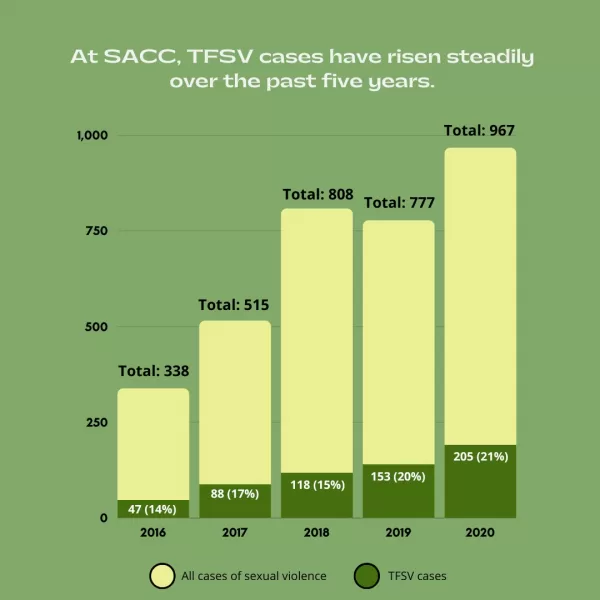


See previous information on TFSV at SACC here.

Annex

Technology-Facilitated Sexual Violence: Selected SACC Cases from 2020

Case A: The client discovered a public Telegram channel containing photos of herself and her own Telegram contact details. She had not consented to the photos being shared in public, nor had she known of the channel’s existence. She believes that the channel’s creator shared the link with a group with many members. As a result, she has been receiving unsolicited obscene messages and pictures of male genitals from strangers on Telegram. The client made a police report (outcome pending). She has also repeatedly asked Telegram to shut down the channel, but Telegram has been unresponsive. She feels very helpless.

Case B: The client found out that someone had been impersonating her on Facebook for years. The perpetrator actively posts details about the client’s life, pictures of her, as well as nude photos supposedly of her (though they are not of her). The perpetrator also uses this account to send messages to men, who then contact the client via her own real account.

Case C: After breaking up with her boyfriend, the client (and her friends) experienced sexual harassment from him over the course of multiple years. At one point, he created multiple social media accounts to stalk her. At another point, photos that she had posted on Facebook were uploaded to a Telegram group. There was even an instance of physical assault, which she reported to the police. The client decided to go on unpaid leave in order to stay home and away from the perpetrator.

Case D: The client got to know a man through an online dating app. However, after some investigation, she discovered that he had been using a fake name and lying to her about many aspects of his identity and life, including the fact that he had a girlfriend. He showed her nude photographs of other women, which led her to believe he was also sharing her own nude photographs with other individuals. She felt disappointed that their relationship had begun on false pretenses.

16 July 2021: Launch of Solid Ground (Twitter Spaces)

Join us this Friday for a conversation with Catherine Chang, Holly Apsley and AWARE on Twitter Spaces to discuss the new website Solid Ground and topics relating to technology-facilitated sexual violence (TFSV).

Solid Ground guides users through various steps they can take if they experience any of nine common types of online harassment, such as being repeatedly contacted, being stalked online or having one’s personal information or intimate images shared. Actions suggested include adjusting privacy settings, collecting evidence and applying for a protection order. The site also lists relevant support resources in Singapore or online.

Solid Ground was funded by AWARE and the National Youth Council’s Young Changemakers Grant. Visit the website at solidground.sg.

Date: Friday, 16 July 2021

Time: 8-9PM

Venue: Twitter Spaces

Set reminder here!

Commentary: Contrary to what we expect, women in senior roles face more workplace sexual harassment

This letter was originally published in ChannelNews Asia on 2 March 2021. 

SINGAPORE: Experts have long maintained that workplace sexual harassment is rooted in power imbalances.

The stereotypical perpetrator holds a powerful leadership position – for example, as a CEO or the head of a studio.

The stereotypical target is a colleague in a junior position – a secretary, say, or an aspiring actor.

You might thus reasonably expect that workers lower down on the totem pole – who have less professional stature and are more easily replaced, hence more vulnerable – would experience more harassment than those in powerful positions.

However, the truth is not quite so simple.

The first nationally representative survey of 1,000 respondents on workplace sexual harassment in Singapore, recently completed by AWARE and Ipsos, has revealed that female managers experience workplace sexual harassment at higher rates than female non-managers – while in managerial positions.

A closer look at different types of sexual harassment revealed discrepancies in prevalence between female managers’ and non-managers’ experiences.

For example, 10 per cent of non-managers had received promises of enhanced career prospects in return for sexual favours and threats to their career prospects if they didn’t return unwanted sexual advances.

On the other hand, managers reported experiencing both these forms of harassment at double the rate of non-managers at 21 per cent.

International research has provided similar evidence that women in supervisory roles seem to experience greater levels of harassment.

A 2012 US-based study by the universities of Minnesota and Maine analysed longitudinal survey data of 522 respondents, as well as qualitative interviews with 33 men and women.

One manager who experienced workplace harassment told those researchers she felt she had to “put up with [it]” to keep her job and maintain working relationships with colleagues.

Our survey found that many female managers didn’t report their harassment because they just wanted to forget about the incident. Almost one in five felt that reporting the incident would backfire on them – impacting their professional career or damaging their reputation.

HARASSMENT AS A POWER EQUALISER

One possible reason why this happens is female managers are perceived as threats in their typically male-dominated workplaces.

A woman wielding organisational authority subverts traditional notions of masculinity and is an obstacle to male bonding at work.

Sexual harassment becomes an instrument of equalising power to “put women in their place.”

According to Heather McLaughlin, the author of the 2012 study mentioned above, harassment is a way of undermining a powerful woman’s credibility: “Instead of your boss, she’s just a woman on a power trip.”

Examples of such harassment include inappropriate, sexual remarks about women’s bodies by male peers and subordinates.

When interviewed for AWARE’s upcoming study on the career and financial effects of workplace sexual harassment, a 45-year-old manager in the predominantly male IT industry revealed that she was frequently verbally and physically sexually harassed by a subordinate, whose actions included forcibly kissing her on the cheek and lips.

Even though the manager had more than 20 years of work experience and had managed this man for four years, her attempts at pushing him away did not deter him at all.

This antipathy towards women in power may also be why female managers more frequently have to deal with harassment involving the attribution of their professional success to their sexuality.

The underlying premise is that a woman’s success is a result of providing sexual favours, an idea that not only diminishes the hard work of many female leaders, but also besmirches their reputations and undermines their authority.

University of Illinois psychologist Louise F Fitzgerald, refers to this as “gender harassment” or “sexist hostility”: A subset of sexual harassment aimed at conveying insulting, hostile and degrading attitudes about people of a particular gender.

ALONE, WITHOUT SAFETY IN NUMBERS

Another reason for the paradox of power may be that the presence of women starts to thin out at higher leadership levels.

According to executive recruitment firm Robert Walters, women hold only 21 per cent of senior management roles in corporations in Singapore, which is similar to regional and international levels.

Being only one in every five organisational leaders makes easy targets of the few women at the top. A lone female departmental head in a sea of men is bound to be highly visible, whether or not she wants that attention.

The most prevalent types of workplace sexual harassment revealed by the AWARE-Ipsos survey were crude, distressing sexual remarks, and inappropriate texts, emails, or other digital communications.

Due to the popular misconception that non-physical acts of harassment are “not as serious” as assault, these types of sexual harassment are often dismissed as “harmless jokes” or “office banter” – inherent to company culture.

This attitude blames victims for making a mountain out of a molehill, and assumes they should adapt to the culture around them, not vice versa.

In the case of women in power, this kind of culture pressures them to get along with the other (male) managers for the sake of the organisation, and to let certain types of sexual harassment slide.

Time and again, we see women in male-dominated industries, force themselves to accept and even adopt masculine cultural norms.

By acting like “one of the boys”, they inadvertently end up exacerbating the problem by contributing to the normalisation of a toxic workplace culture.

KNOWLEDGE OF WHAT CONSTITUTES HARASSMENT

Perhaps the survey findings reveal some good news too: Perhaps female managers report higher rates – 49 per cent as compared to 26 per cent of non-managers – of workplace sexual harassment in part because they are more knowledgeable about it.

The lack of knowledge is a very real barrier to combatting sexual harassment.

When asked if they had been sexually harassed in the past five years, one in five respondents of the AWARE-Ipsos survey only realised what they had experienced was problematic after sexual harassment scenarios involving verbal comments, explicit texts and memes were described to them.

But when various harassment scenarios were described – including verbal comments and explicit texts or memes – two in five indicated having experienced those behaviours.

This speaks to a gulf in understanding of harassment across our workforce.

Workplace training sessions tend to be directed at managers, enabling them to respond sensitively to situations of harassment.

Consequently, managers are more aware of what constitutes harassment.

It makes sense, therefore, that managers would more readily identify themselves as having experienced it compared to non-managers who may not be similarly trained.

LEVERAGING SYSTEMIC POWER TO PROTECT EMPLOYEES

It seems that for working women, power – like physical attractiveness – is yet another double bind. Women are penalised in some ways for having too little power, and penalised in others for having too much of it.

As far we know, most workplaces, even those with robust anti-harassment trainings, do not take into account the risks that female managers face when it comes to sexual harassment.

Acknowledging that power does not necessarily protect is only the first step. What next?

Recognising that the issue is organisational and systemic in nature, not an individual problem, we should introduce national legislation specifically against workplace harassment in Singapore.

Such a legislation would go beyond the scope of existing criminal laws, which focus on obvious crimes such as molest, outrage of modesty or involuntary use of force, and the Protection from Harassment Act (POHA).

It would signal societal intolerance for workplace sexual harassment while also providing vital recourse to its victims.

This law should provide a definition and examples of workplace sexual harassment, ensure protection for all workers, and enforce employer liability for workplace sexual harassment.

Although strong anti-harassment policies by individual employers will also do the job, due to the urgency of this problem, we cannot wait for companies to get to this on their own time.

A national legal framework would jump-start the process.

Even a law cannot achieve everything. Employers still need to better equip themselves to deal with the problem.

Every organisation should create a well-defined sexual harassment policy that includes examples of prohibited behaviour, as well as a comprehensive reporting and grievance procedure.

By taking these steps, we can work towards mitigating sexual harassment, irrespective of gender, industry, or position of power.

Shailey Hingorani, Head of Research and Advocacy, AWARE

Position Filled: SACC Helpline Executive (Part-Time), Sexual Assault Care Centre

We are no longer accepting applicants for this role.

AWARE’s Sexual Assault Care Centre (SACC) is looking for part-time Helpline Executives to serve as a first responder for sexual assault survivors, and to support staff and case managers in various projects.

Position: Helpline Executive
Commitment: Part-time (4 hours/day, Mon to Fri), 1 year contract
Starting date: April 2021
Salary: S$15/hour
Citizenship: Singapore citizen/PR*

*We note the government announcement that starting from 1 May 2021, those who are not Singaporean Citizens or PR will have to obtain a work pass to work in Singapore. Accordingly, please note that with effect from 12 March 2021, we will only be accepting applications from Singaporeans and PRs. If you have submitted an application before 12 March 2021, and you require a Letter of Consent (LOC) to work, we will proceed with your application as per usual. 

Job Description

  • Ensuring high-quality and timely response to people reaching out to SACC through calls, WhatsApp, emails, walk-ins, referrals and other platforms
  • Scheduling clients with case managers, counsellors, etc. via phone, emails and/or face-to-face
  • Documenting and filing confidential notes, intake forms etc
  • Identifying and improving current processes, and coordinating updates of SOPs
  • Supporting staff and volunteers on various projects and ad-hoc programmes as required
  • Providing administrative and operational support to SACC

Requirements

  • At least 1 year of work experience in a related field
  • Relevant educational qualifications such as social work, counselling, psychology or related field preferred
  • Must be proficient in English (verbal and written). Fluency in a second (Mandarin, Malay, or Tamil) is a bonus
  • Training on trauma is a bonus
  • Beneficial to have completed the four-month AWARE Helpliner Training
  • In addition to passion and commitment to AWARE’s mission and vision, we look for candidates who demonstrate the following:
    • Excellent interpersonal, empathy and communication skills in English (verbal and written)
    • Good analytical skills and commitment to confidentiality
    • Superb organisational and time management skills
    • Ability to use initiative and judgment to solve problems independently
    • Experience or interest in supporting or empowering individuals
    • Strong belief in gender equality and the values of AWARE
    • Computer-savvy, proficient in Google Workspace and MS Office (Word and Excel)

Read our privacy policy here.

Please note that due to the large number of applications, only shortlisted applicants will be contacted for an interview. If you have any questions about this position, please email careers@aware.org.sg.

A Recap: Are Our Workplaces Safe Spaces? A panel on workplace sexual harassment

written by Antara Dasgupta and Daneel Jannae Shih

On 10 February 2021, AWARE and Catalyse hosted the virtual event “Are Our Workplaces Safe Spaces?”, with the support of Otis Elevator Company and The Asia Foundation, and more than 90 people attending over Zoom.

The event commenced with opening remarks from AWARE Treasurer Aarathi Arumugam, followed by Karine Scelles, Otis’s Asia-Pacific Executive HR director. In her short address, Karine emphasised Otis’s commitment to diversity, equity and inclusion at the workplace, which goes hand in hand with adopting a “zero-tolerance policy” for bullying or harassment of all kinds, and encouraging employees to speak up about such situations.

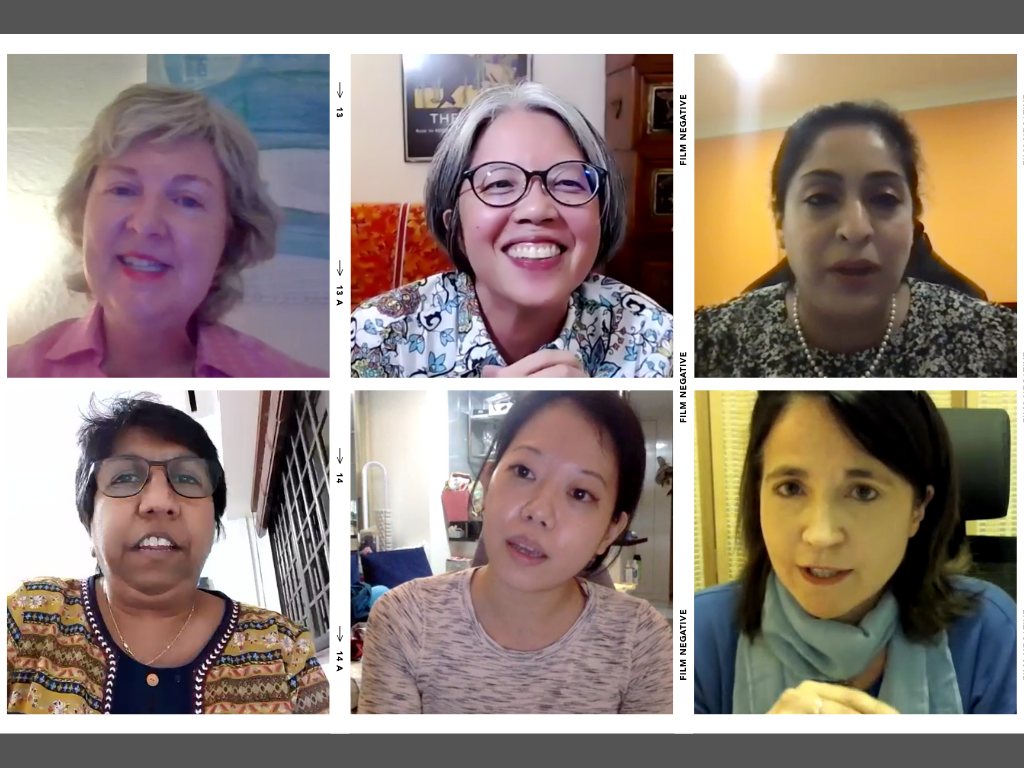
Then, the main event began. Leading the discussion was moderator Jane Sloane of The Asia Foundation. Her conversation partners were Chen Xuan (a.k.a. Georgia), a survivor of workplace sexual harassment during her career as a management consultant and organisational developer; Amarjit Kaur, a partner at Withers KhattarWong LLP; K Thanaletchimi (Thana), Vice President of the Central Committee at National Trade Union Congress (NTUC); and AWARE Executive Director Corinna Lim.

Understanding the Singaporean Landscape

Corinna started off by outlining the recent nationally representative survey on workplace sexual harassment in Singapore, conducted by AWARE and Ipsos. She noted that among the 1,000 individuals surveyed, only 1 in 5 initially stated that they had experienced sexual harassment at work per the definition employed in the Tripartite Advisory, but when specific behaviours, such as unwarranted obscene images and sexualised comments, were included, 2 in 5 indicated that they had experienced them.

These were eye-opening findings, said Corinna, marking “the first time that we’ve had a feel of just how prevalent workplace sexual harassment is in Singapore… there is a major gap in the understanding of what constitutes sexual harassment.”

Corinna and Thana then described how the high prevalence of sexual harassment, coupled with low reporting (as the survey had also found), perpetuated a dangerous cycle. Survivors chose not to report their harassment due to a plethora of reasons: fear of retribution, structural issues and the notion that their experiences were “not serious enough”.

Lawyer Amarjit Kaur added that Singapore has no specific workplace harassment law, and while there is a Protection from Harassment Act, along with the Workplace Safety and Health Act, “there is a need for more targeted legislation that holds organisations accountable.”

Georgia then shared, in detail that was difficult to hear, her own experiences with workplace sexual harassment at multiple multinational corporations. Her stories vividly drove home the mental anguish faced by survivors: “After the third incidence of workplace sexual harassment, I remember feeling, ‘Why me? What am I doing wrong, is it just me, am I overreacting?’ Speaking up is exhausting, tiring and draining… but we need to speak up.”

She also brought up the dissonance between official workplace policies and practical implementation at her MNCs: “There’s this gray area that exists between what America has written and what actually gets implemented on the ground in Singapore… you find yourself slipping through those cracks.”

What are Organisations Doing about Workplace Sexual Harassment?

NTUC, Thana said, has been encouraging unionised companies to establish and enter a collective agreement where the employer, by law, must guarantee the establishment of a safe working environment, including proper protocols and procedures addressing workplace harassment. However, there is still a long way to go. Out of 930 collective agreements, only 20 have since included this specific clause in their agreements.

“We are pushing for more unions to establish this as a legally binding clause in a collective agreement,” Thana said. “We are also pushing for employers to have [stronger] policies and escalating procedures.” When asked about non-union workers, she replied that NTUC provides the same level of support to non-union workers; they are encouraged to report through the NTUC hotline, as well as TAFEP channels.

One other resource for workers, of course, is AWARE’s Workplace Harassment and Discrimination Advisory, which has been running since late 2019, providing guidance and support on individual rights and next steps. “We will walk them through all of the options, both legal options as well as HR, practical options,” said Corinna. “We are very survivor-centric: What is it that they want to achieve? What would make them feel better, more empowered, OK about the situation?”

For corporations who require help tackling harassment, Corinna mentioned Catalyse’s work training HR teams and managers to be empathetic first responders.

Amarjit recounted her recent experience representing a survivor of workplace sexual harassment, who eventually received a 34-month salary settlement. Corinna commended her for achieving that “landmark settlement”, which Amarjit agreed was “quite phenomenal, given that we struggle to get one to three months on a good day… [this was] successful insofar as one can be successful in these circumstances.” However, Amarjit also noted the unique set of circumstances surrounding that particular case (which had included wrongful dismissal as well), and added that contrary to popular belief, compensation is not an easy fix: “Even after all of that, my client came to me and she said, ‘OK, so now what? How do I deal with a mental anguish that still plagues me?'” Instead, Amarjit stressed, we have to remember that “prevention is key”.

Legislative and Social Norms Need to Evolve

So how can individuals can be agents of change in preventing workplace sexual harassment?

Georgia spoke about her belief that reporting incidents can help to prevent future victims falling prey to perpetrators. She then gave advice, based on her own experiences, on how employees can best pressure management to take more active steps against workplace harassment: “There are certain decision makers whose voices really count. Get close to them and figure out how to get them listening… in times where nothing’s happened yet, I do my best to jump through the hoops and I perform, because when I finally do speak up, I know people are going to listen.”

During a short interval, Jane invited Ritika Dutt, founder of Canada-based tech company Botler AI, to speak from the “floor”. Ritika explained how Botler was using artificial intelligence to tackle sexual harassment cases in Canada: “The AI asks the user a series of trauma-informed and adaptive questions to really better understand and extract details on the situation that they have faced… to detect if there had been any specific violations based on the applicable law.” After the relevant laws are identified and explained to the survivor, Botler then refers them to services and legal support providers. Ritika pointed out that such technology, being free, can help survivors “regardless of their income, or immigration status, or any of the other kind of traditional barriers that you may have to accessing certain services”.

After addressing a few questions from the audience, Jane asked the panellists for final statements.

Corinna said, “You can’t do this alone. If you’re going through an experience where you have been disrespected, or you have been harassed—whether it’s the union or a friend in the workplace, WHDA of AWARE, it’s really important to get some support, practical advice, legal advice.”

Amarjit urged higher-level staff to do more: “If you hold a position of power in your organisation, please push them to put in place the policies the training, because that’s an essential starting point.”

With confidence, women can “create a movement”, said Thana.

Finally, Georgia ended with: “This is a marathon. It’s not a sprint. We’re all in it for the long haul.”

Creating a one-stop information page for migrant spouses

We welcome the clarifications made by the Immigration and Checkpoints Authority (ICA) about how it handles transnational divorce cases. These clarifications should bring about much-needed reassurance to migrant spouses in Singapore.

In our experience supporting migrant spouses through AWARE’s Women’s Helpline and legal clinic, we have observed a lot of confusion and anxiety on the ground regarding their right to remain in the country when their sponsors threaten to cancel their long-term visit passes (LTVP) or when they are going through divorce.

However, the information provided by ICA in its letter— e.g. that LTVP cannot be unilaterally cancelled by sponsors and that ICA typically facilitates the renewal of LTVP until the end of their divorce proceedings if they have Singaporean children and a local sponsor—is not easily found (if at all) on the relevant government websites.

We recommend that relevant government agencies work together to publish a one-stop information page for migrant spouses and transnational couples, covering such areas as: their legal rights; the types of passes or visas they can apply for; the qualifying criteria, conditions, benefits and rights that come with each type of pass or visa; immigration status and divorce (for example, what happens to an LTVP/+ upon divorce); where they can seek help, their right to work and apply for a pre-approved letter of consent, etc. The website should come in different languages that match the needs of migrant spouses.

The Marriage Preparation Programmes (MPP) supported by the Ministry of Social and Family Development should also cover such information, if they do not already do so. Currently, MPP is mandatory for some transnational couples to attend as a condition of the migrant spouse’s LTVP application. Those who are not required to attend should nonetheless also be made aware of their rights. 

Chong Ning Qian, Senior Research Executive

Closure of AWARE’s CARE and WHDA services: Chinese New Year (12 February) 2021

Please note that our Women’s Helpline (including call-back and chat services), Sexual Assault Care Centre (SACC) and Workplace Harassment and Discrimination Advisory (WHDA) will be operating with limited resources over the Chinese New Year 2021 holiday.

On the eve of Chinese New Year (11 February 2021), the SACC Helpline and chat/WhatsApp services will operate from 10 a.m. – 3 p.m. All other services will be operating as per normal.

On Friday, 12 February, all our services will be fully closed. Operations will resume on Monday, 15 February 2021.

For emergencies, please call 999 for the police. You can also call 1800 221 4444 for the Samaritans of Singapore (SOS) if you have thoughts of hurting yourself, including thoughts of suicide. If the assault happened in the last 72 hours, please read more here. You can still reach SACC via email (sacc@aware.org.sg), but there may be a delayed response.

We apologise for any inconvenience caused.

Sexual harassment: How workplaces can be made safer

This op-ed was originally published in The Straits Times on 26 January 2021. 

A growing number of people are speaking out publicly about sexual harassment in the workplace. But many individuals continue to be deterred.

A recent survey by gender equality group Association of Women for Action and Research (Aware) and market research company Ipsos found that seven in 10 workers in Singapore who experienced sexual harassment in the past five years did not report their harassment to the official authorities.

Furthermore, given the prevalence of sexual harassment in Singapore, as this survey shows – two in five have experienced it in the past five years – more needs to be done to address this issue.

Commonplace thinking on reporting sexual harassment suggests the decision to report is influenced by individual attributes, such as the gender and age of the victim, or situational determinants, such as the severity of the harassment.

But by focusing on the individual, are we overlooking other important factors – those at an organisational level?

The Aware-Ipsos survey found that many victims did not report their experiences of sexual harassment because they thought reporting would impact their professional career, or because they believed that official channels would not take sufficient action after they made a report. Some of them feared reputation damage; others feared retaliation from the harasser and/or company.

Unfortunately, although it has been more than three years since the #MeToo movement was sparked by sexual assault allegations against Hollywood mogul Harvey Weinstein, these organisational determinants have not received much public attention.

As a result, we have not been able to isolate concrete actions to make our organisations safer and more conducive environments for the tackling of sexual harassment.

Organisational factors

Based on our experience with individuals who reached out to Aware’s Workplace Harassment and Discrimination Advisory for advice, insights gleaned via Aware’s training arm Catalyse, and extensive research, we believe there are three organisation-level determinants that predict reporting behaviours.

First, when deciding whether or not to report sexual harassment, individuals perform their own evaluation of the trustworthiness of their organisations. To do so, they focus both on whether the organisation takes sexual harassment complaints seriously, and whether it appropriately sanctions harassers after a finding of harassment is established.

In our experience, trustworthiness and reporting are positively correlated, that is, the higher the trustworthiness, the more the reporting.

It is widely acknowledged that organisations, when dealing with sexual harassment complaints, often have to contend with a conflict of interest – between empowering the victim and protecting against litigation.

Therefore, it is important for individuals to know whether the organisation’s anti-harassment policies are procedurally fair, and if they are adhered to in practice, rather than being used to achieve favourable outcomes for the organisation.

The following usually make for fair procedure: documented policies and processes with timelines; appointment of impartial investigators and decision-makers; sensitivity in the personal treatment of victims and the accused throughout the process; available protection from retaliation; and perceived fairness of outcomes.

The second determinant of reporting is less tangible but equally important: the organisational culture on sexual harassment, which includes norms around sexist behaviour, so-called sexual banter, bullying and/or adherence to gender stereotypes. These norms are drawn from policies and procedures, as well as the informal actions of organisational leadership.

Organisations frequently treat reports of sexual harassment as standalone interpersonal problems removed from the wider organisational culture.

However, in making reporting decisions, individuals do not just think about the harassment itself, but factor in what they know about the organisation’s culture – whether it perpetuates or normalises harassment.

The organisation’s culture tells individuals not only how they can expect to be treated by the management and human resource department when they report, but also whether they are likely to receive support from co-workers.

Both these things are crucial: Imagine continuing to work in an office where your complaints of harassment are not taken seriously, surrounded by disbelieving or antagonistic colleagues.

Everyday interactions with colleagues are a crucial part of many jobs. It is not just that colleagues depend on each other to get work done – positive relationships with co-workers can help foster a sense of belonging and promote overall employee well-being.

However, when the group identity of co-workers is forged within a culture that normalises harassment, an individual might not be motivated to report out of fear of falling out of favour with the team. Making a report in this context – especially if the harasser is a co-worker – may be interpreted as a threat to group cohesion. This could result in retaliation from colleagues in the form of withholding of information, outright ostracism or anything in between.

The final determinant of reporting is related to the organisational set-up – the gender composition of the organisation, and organisational hierarchy.

Research has generally found “job gender context”, that is, the proportion of men to women in the workplace, to be associated with increased harassment when the number of male employees significantly outnumber female employees.

Why would that be the case?

Some researchers speculate that workplaces with a skewed gender ratio tend to be associated with hyper-masculine work cultures that are aggressive and competitive, ones that objectify workers and reduce women to sexual objects regardless of their organisational rank.

Another related reason could simply be that women find themselves more isolated in male-dominated organisations and therefore more vulnerable to harassment.

All organisations are hierarchical to some extent. However, studies have generally found that the more hierarchical the organisation, the more likely it is that those in power have a reduced tendency to pay attention to how other people see, think and feel.

That is antithetical to a respectful workplace, and the perfect breeding ground for harassment.

What can organisations do?

In combating sexual harassment, many organisations are content to take a passive approach: They do not bother with sexual harassment unless they have to.

Yet organisations have an economic – not just moral – imperative to prevent and manage workplace harassment. Civil and respectful workplaces are more productive and tend to have lower employee turnover, not to mention better brand reputations.

So what can organisations do? Before deciding on any course of action, we suggest that organisations carry out an anonymous climate survey on sexual harassment and collect data on how the organisational culture, policies and procedures are perceived by employees.

If the data reveals that employees think the organisation is not doing enough, or is biased in favour of harassers, or that the culture is insulting and inconsiderate, we recommend that the organisation take measures to incorporate civility and respect as core organisational values. These tenets could be embedded into performance reviews to indicate the organisation’s commitment.

To address reporting concerns related to co-worker retaliation, organisations could hire a third party to receive complaints, advise employees on their options and give employees an opportunity to raise concerns privately.

The organisation’s anti-harassment policy must specifically address retaliation and assure reporting victims, through practice, that they (and all other parties involved) will be protected when they come forward.

We also recommend that organisations minimise the power imbalance between leaders and subordinates, and make workplaces less hierarchical.

This would involve equipping leaders, through regular training, with more empathetic ways to guide their staff, including helping them articulate power less in terms of authority and more in terms of values and responsibilities.

Speaking up about sexual harassment is difficult in any scenario, but all the more so in the high-stakes world of the workplace. If we can build better systems, ones absent of the various hurdles typically faced by victims, we can start to change that.

Shailey Hingorani, Head of Research and Advocacy, AWARE

AWARE-Ipsos survey reveals high prevalence of workplace sexual harassment in Singapore, low rates of reporting over past five years

This post was originally published as a press release on 14 January 2021

Two in five workers in Singapore have been sexually harassed at the workplace in the past five years. This is the sobering key finding from a survey by market research company Ipsos in collaboration with gender-equality organisation AWARE—the first-ever nationally representative survey on workplace sexual harassment in Singapore.

The survey was conducted in November 2020. Respondents comprised 1,000 Singapore citizens and Permanent Residents who had been engaged in paid work (full-time, part-time, self-employed and freelance) in the previous five years. 

Importantly, when respondents were asked “Have you been sexually harassed in the workplace within the last five years?”, only 1 in 5 responded in the affirmative. However, when specific harassment situations were described to them, 2 in 5 reported that they had indeed experienced such behaviours—indicating a major gap in understanding of what constitutes sexual harassment.

The harassment situations illustrated in the survey included:

  • Pictures, jokes, texts or gestures of a sexual or sexist nature (approximately 1 in 5 reported experiencing this; approximately 1 in 10 experienced this behaviour on seven separate occasions in the past five years)
  • Alarming or offensive remarks or questions about their appearances, bodies or sexual activities (approximately 1 in 5 reported experiencing this; approximately 1 in 10 experienced this behaviour on eight separate occasions in the past five years)
  • Crude and distressing remarks, jokes or gestures of a sexual or sexist nature (approximately 1 in 5 reported experiencing this; approximately 1 in 10 experienced this behaviour on five separate occasions in the past five years) 
  • Unwanted physical contact, attempts to initiate romantic or sexual relationships, implications that career prospects were tied to sexual favours, and more. 

Harassment was most often perpetrated by the victim’s peer or senior in the office. Disappointingly, the survey found that few (only 3 in 10) survivors of workplace sexual harassment made official reports about their experiences. Those who did not often cited a desire to forget about the incidents, a belief that what they experienced was not severe enough, or a perceived lack of evidence. In 2 in 5 cases where reports were made, the harasser was reassigned or dismissed; however, in another 1 in 5 of such cases, the harasser faced no consequences despite evidence of harassment. 

“We have known for years that workplace sexual harassment is a problem in Singapore, as many clients at AWARE’s Sexual Assault Care Centre have experienced it,” said Ms Shailey Hingorani, Head of Research and Advocacy at AWARE. “However, up until now we have not had national data available on its prevalence. This survey changes that. It affirms that workplace sexual harassment is a pervasive and urgent problem; it also affirms that we cannot rely on official cases as our only measure of prevalence, due to frequent under-reporting. Lastly, it underscores the importance of identifying sexual harassment with clear illustrations—seeing that generalised definitions may be inadvertently perpetuating misconceptions.”

In making sense of these findings, AWARE pointed to a few inadequacies in Singapore’s current policy approach to tackling workplace sexual harassment. For one, the Protection from Harassment Act does not inform employers of the protective and preventive measures with which they must comply; neither does it educate employees about their employment rights. Furthermore, the Tripartite Advisory on Managing Workplace Harassment does not explicitly place a legal obligation on employers to prevent workplace harassment.

AWARE therefore recommends that the Government introduce national legislation against workplace harassment, as well as regular anti-harassment trainings across industries and the universal adoption of grievance handling policies. 

Ms Hingorani noted, “We recognise that Singapore is, in some regards, ahead of many countries in addressing the scourge of sexual violence. However, when it comes to workplace sexual harassment in particular, we appear to lag behind countries that have specific legislations on the matter. Giving employers an explicit statutory obligation to prevent and address sexual harassment, and educating workers on the remedies available to them against their employers, would provide a firm foundation from which to eradicate this very insidious and damaging behaviour.” 

Ms Melanie Ng, Director of Public Affairs at Ipsos in Singapore, said, “This research identifies a worrying prevalence of sexual harassment in the Singapore workplace today, and that it is the case for both women and men. While more education around the subject needs to happen, employers need to ensure that the reporting channels in their workplaces are accessible, safe and effective for employees to get the help that they need.”

Read AWARE and Ipsos’s Work and Gender report here.


About AWARE

AWARE is Singapore’s leading women’s rights and gender-equality advocacy group. It works to identify and eliminate gender-based barriers through research, advocacy, education, training and support services. AWARE embraces diversity, respects the individual and the choices she makes in life, and supports her when needed. AWARE’s corporate consultancy and training arm, Catalyse, trains employees and employers in preventing and managing workplace harassment. aware.org.sg

About Ipsos

Ipsos is the world’s third largest market research company, present in 90 markets and employing more than 18,000 people. Its passionately curious research professionals, analysts and scientists have built unique multi-specialist capabilities that provide true understanding and powerful insights into the actions, opinions and motivations of citizens, consumers, patients, customers or employees. Ipsos serves more than 5,000 clients across the world with 75 business solutions. Founded in France in 1975, Ipsos has been listed on the Euronext Paris since 1 July, 1999. ipsos.com.sg

Annex – Case studies from AWARE’s Workplace Harassment and Discrimination Advisory (*not their real names)

  • Maria* was groped at a company social gathering, with several colleagues bearing witness to the act. The perpetrator claims that he does not recall the incident. A police report was filed and an internal investigation was launched. Some months later, Maria was informed that the company would only take definitive action if the perpetrator was found guilty by the authorities. The harasser continued to make her feel uncomfortable at work. Eventually, Maria decided to quit as a result of the unsafe work environment.
  • While on an overseas work trip, Nadia* was sexually harassed by a colleague, who repeatedly asked her to come to his room, telling her that he was lonely. Nadia filed a report with her manager, but the manager decided not to take any action because the perpetrator was scheduled to depart the company anyway.
  • Jonathan* was sexually harassed by his male supervisor. The supervisor made comments about Jonathan’s private parts and repeatedly required him to stay late in the office. Although Jonathan reported the incidents internally, his case was dismissed because HR found it hard to believe that a man could be subject to sexual harassment.
  • Priya* was encouraged by her boss to go out for late-night drinks with clients, and instructed to wear “sexy” clothing both in the office and when she was out with clients. She was also told to get physically close to clients. When a client hit on Priya and invited her to his hotel room, she reported it internally. However, the company did not take any actions.